Red Rock Roundup Over

The incident concluded on May 11 with the following results:

  • 115 horses captured, 98 shipped, 11 released, 7 to be released and 2 dead
  • 70 burros captured, 69 shipped, none released and 1 dead
  • 1 mule captured and 1 shipped

The capture goals were 112 horses and 70 burros.

The removal goals were 92 horses and 70 burros.

Data quality was poor.  More horses were processed than captured.

The figures for burros and the mule balance.

Seven mares received an initial dose of GonaCon Equine on May 8.

They will receive another dose in 30 days according to the final daily report, constituting unlawful use of the pesticide.

RELATED: Red Rock Roundup Announced.

UPDATE: The numbers in the news release don’t balance either.

Horses returned to HMA = 115 captured – 100 removed = 15

Horses identified for return = 11 stallions + 7 mares = 18

Red Rock HMA to Become Next GonaCon Crime Scene?

A 2017 labeling amendment changed the interval between doses from 30 days to 90 days, as noted previously.

The bureaucrats ignore the update.

Seven mares were treated on May 8 but were not released, suggesting they will receive a second dose.

Giving it before August 6 will constitute unlawful use of the pesticide.

Nothing will happen of course, because liberals control the bureaucracy and only conservatives are not above the law.

RELATED: Red Rock Roundup, Day 11.

UPDATE: The gather page says they’ll receive a second dose in 30 days, making the HMA a GonaCon crime scene.

Red Rock Roundup, Day 11

The incident started on April 29.  Results through May 9:

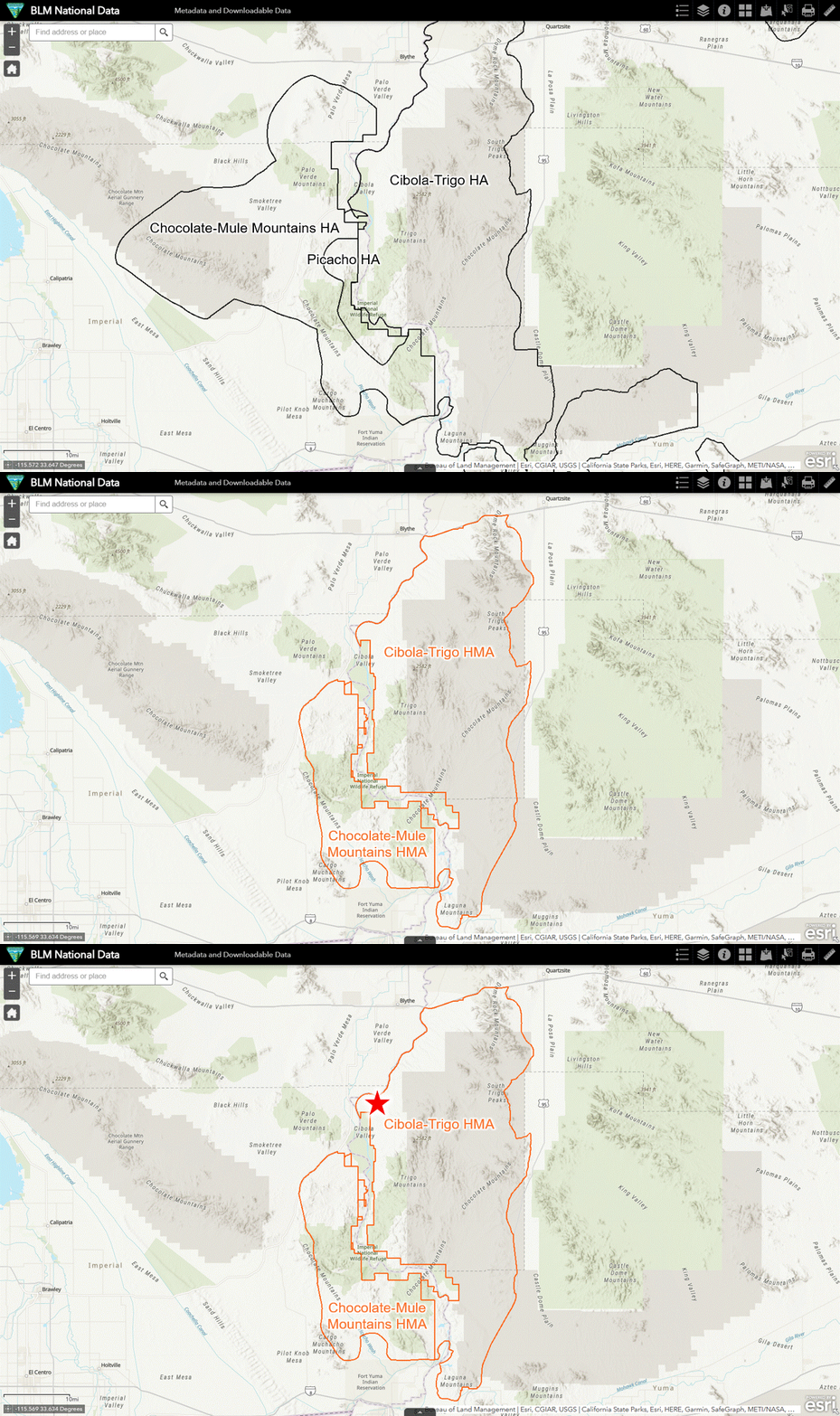
  • Scope: Red Rock HMA
  • Target: Horses and burros
  • Type: Planned
  • Method: Bait
  • Goals: Gather 112 horses and remove 92, gather 70 burros and remove 70
  • Captured: 113 horses, no change from Day 9, and 68 burros, up from 55 on Day 9
  • Shipped: 98 horses, no change from Day 9, and 54 burros, no change from Day 9
  • Released: 11 horses, no change from Day 9
  • Deaths: 2 horses, no change from Day 9, and 1 burro, no change from Day 9
  • Average daily take: 10.3 horses, 6.2 burros
  • Unaccounted-for animals: 2 horses, 13 burros

The figures above are based on the daily reports.

Horses

The capture target has been reached.

The death rate is 1.8%.

The capture total includes 48 stallions, 46 mares and 19 foals.  The sidebar at the gather page says 50 stallions.

Youngsters represented 16.8% of the animals gathered.

Of the adults, 51.1% were male and 48.9% were female.

Body condition scores were not given.

Burros

The death rate is 1.5%.

The capture total includes 24 jacks, 37 jennies and 7 foals.

Youngsters represented 10.3% of the animals gathered.

Of the adults, 39.3% were male and 60.7% were female.

General

The location of the trap site is not known.

The HMA is not subject to permitted grazing.

Seven mares were treated with GonaCon Equine on Day 10.  Given that they were not immediately released, a second dose is probably in the works.

There are no such plans for the burros.

RELATED: Red Rock Roundup, Day 9.

Red Rock HMA with Allotments 04-23-24

Bordo Atravesado Roundup, Day 9

The incident started on May 1.  Results through May 9:

  • Scope: Bordo Atravesado HMA
  • Target: Horses
  • Type: Planned
  • Method: Bait
  • AML: 60
  • Estimated population: 276
  • Goals: Gather 235, remove 225
  • Captured: 103, up from 43 on Day 7
  • Shipped: None
  • Released: None
  • Deaths: None
  • Average daily take: 11.4
  • Unaccounted-for animals: 103

The figures above are based on the daily reports.

The capture total includes 51 stallions, 40 mares and 12 foals.

Youngsters represented 11.7% of the animals gathered.

Of the adults, 56.0% were male and 44.0% were female.

Body condition scores were not given.

The location of the trap site is not known.

The disposition of captured animals was not stated.

The HMA is subject to permitted grazing.  Resources liberated to date:

  • Forage: 1,236 AUMs per year
  • Water: 1,030 gallons per day

Ten mares will be treated with GonaCon Equine, a fertility control pesticide, and be returned to the range according to the latest schedule.

RELATED: Bordo Atravesado Roundup, Day 7.

Bordo Atravesado HMA with Allotments 11-17-23

Ostracized Mare Boosts Currituck Herd by One

Maybe she was pushed out because she wouldn’t bear fruit.  The story doesn’t say.

Maybe it wasn’t her fault.  The story doesn’t say.

Maybe she regained fertility and was accepted into another band.  The story doesn’t say.

We don’t know her age but this is her first foal and the fourth born to the herd in 2024.

RELATED: Currituck Outer Banks to Become Like Assateague Island?

Red Rock Roundup, Day 9

The incident started on April 29.  Results through May 7:

  • Scope: Red Rock HMA
  • Target: Horses and burros
  • Type: Planned
  • Method: Bait
  • Goals: Gather 112 horses and remove 92, gather 70 burros and remove 70
  • Captured: 113 horses, up from 109 on Day 7, and 55 burros, up from 45 on Day 7
  • Shipped: 98 horses, up from 82 on Day 7, 54 burros, up from 39 on Day 7
  • Released: 11 horses, up from 1 on Day 7
  • Deaths: 2 horses, no change from Day 7, and 1 burro, no change from Day 7
  • Average daily take: 12.6 horses, 6.1 burros
  • Unaccounted-for animals: 2 horses, zero burros

The figures above are based on the daily reports.

Horses

The capture target has been reached.

The death rate is 1.8%.

The capture total includes 48 stallions, 46 mares and 19 foals.  The sidebar at the gather page says 50 stallions.

Youngsters represented 16.8% of the animals gathered.

Of the adults, 51.1% were male and 48.9% were female.

Body condition scores were not given.

Burros

The death rate is 1.8%.

The capture total includes 22 jacks, 30 jennies and 3 foals.

Youngsters represented 5.5% of the animals gathered.

Of the adults, 42.3% were male and 57.7% were female.

General

The location of the trap site is not known.

The HMA is not subject to permitted grazing.

Up to ten mares will be treated with GonaCon Equine, a fertility control pesticide, and be returned to the range with up to ten stallions.

There are no such plans for the burros.

RELATED: Red Rock Roundup, Day 7.

Red Rock HMA with Allotments 04-23-24

BLM Issues CX for Cibola-Trigo Burro Removal

A new project has been created in ePlanning and two files were copied to the documents folder.

There were no opportunities for public comment.

A map in the CX puts the target zone on the west side of the HMA.

The latest schedule does not show a roundup in FY24.

The Decision Memorandum on the last page of the CX indicates a capture goal of 250.

Removal would alleviate damage to private property and risks to public safety.

RELATED: BLM Approves Another Nuisance Removal Near Cibola-Trigo HMA.

Cibola-Trigo Burro Removal 05-08-24

Bordo Atravesado Roundup, Day 7

The incident started on May 1.  Results through May 7:

  • Scope: Bordo Atravesado HMA
  • Target: Horses
  • Type: Planned
  • Method: Bait
  • AML: 60
  • Estimated population: 276
  • Goals: Gather 235, remove 225
  • Captured: 43, up from 9 on Day 1
  • Shipped: None
  • Released: None
  • Deaths: None
  • Average daily take: 6.1
  • Unaccounted-for animals: 43

The figures above are based on the daily reports.

The capture total includes 28 stallions, 10 mares and 5 foals.

Youngsters represented 11.6% of the animals gathered.

Of the adults, 73.7% were male and 26.3% were female.

Body condition scores were not given.

The location of the trap site is not known.

The HMA is subject to permitted grazing.  Resources liberated to date:

  • Forage: 516 AUMs per year
  • Water: 430 gallons per day

Ten mares will be treated with GonaCon Equine, a fertility control pesticide, and be returned to the range according to the latest schedule.

RELATED: Bordo Atravesado Roundup in Progress.

Bordo Atravesado HMA with Allotments 11-17-23

Currituck Wild Horse Advisory Board Meeting Scrubbed

The May 16 meeting, which was to be held at the off-range farm in Grandy according to the minutes of the February 15 meeting, has been cancelled.

No explanation was given in the notice.

In other news, the herd of slightly over 100 has produced three foals this year as noted in a story dated May 7 by WAVY News.

The PZP darting program has been suspended since 2022 but the number of viable mares and the size of the breeding population are not known.

Previously, birth rates and breeding patterns were determined by the advocates, not the horses.

RELATED: Currituck Outer Banks to Become Like Assateague Island?

Red Rock Roundup, Day 7

The incident started on April 29.  Results through May 5:

  • Scope: Red Rock HMA
  • Target: Horses and burros
  • Type: Planned
  • Method: Bait
  • Goals: Gather 112 horses and remove 92, gather 70 burros and remove 70
  • Captured: 109 horses, up from 97 on Day 5, and 45 burros, up from 40 on Day 5
  • Shipped: 82 horses, no change from Day 5, 39 burros, up from zero on Day 5
  • Released: None
  • Deaths: 2 horses, no change from Day 5, and 1 burro, no change from Day 5
  • Average daily take: 15.6 horses, 6.4 burros
  • Unaccounted-for animals: 25 horses, 5 burros

The figures above are based on the daily reports.

Horses

The death rate is 1.8%.

The capture total includes 46 stallions, 45 mares and 18 foals.

Youngsters represented 16.5% of the animals gathered.

Of the adults, 50.5% were male and 49.5% were female.

Body condition scores were not given.

Burros

The death rate is 2.2%.

The capture total includes 19 jacks, 23 jennies and three foals.

Youngsters represented 6.7% of the animals gathered.

Of the adults, 45.2% were male and 54.8% were female.

General

The location of the trap site was not given.

The HMA is not subject to permitted grazing.

Up to ten mares will be treated with GonaCon Equine, a fertility control pesticide, and be returned to the range with up to ten stallions.

There are no such plans for the burros.

RELATED: Red Rock Roundup, Day 5.

Red Rock HMA with Allotments 04-23-24

Advocate Responds to Poor Body Condition of Currituck Stallion

He does not need any help and there are no plans to intervene, according to a report dated May 7 by OBX Today.

He’s around 30 years old and deserves the chance to die as naturally as he lived, without ever having human hands on him.

However, if the management team and veterinarian determine that he has reached the end of his life and needs to be humanely euthanized, they will step in immediately.

RELATED: Currituck Herd Expands by One.

Nobody Wants to Watch Animals Die?

That’s according to Tracy “You need to manage the numbers to fit what’s available for the horses” Wilson of the Campaign Against America’s Wild Horses in a story dated May 6 by KTVN News about fences and water for the Virginia Range mustangs.

The video shows a foal tangled in the wires.

This is nonsense.

She oversees the PZP darting program that has put many of the mares at risk of sterility.

That’s how nonmotorized removal works: You snuff out new life and pray for the older horses to die, especially when you’re trying to convince the bureaucrats and ranchers that it’s a viable alternative to motorized removal.

RELATED: Virginia Range Darting Update for April 2024.

Pesticide Pushers 07-17-23

Red Rock Roundup, Day 5

The incident started on April 29.  Results through May 3:

  • Scope: Red Rock HMA
  • Target: Horses and burros
  • Type: Planned
  • Method: Bait
  • Goals: Gather 112 horses and remove 92, gather 70 burros and remove 70
  • Captured: 97 horses, up from 84 on Day 3, and 40 burros, up from zero on Day 3
  • Shipped: 82 horses, up from 69 on Day 3
  • Released: None
  • Deaths: 2 horses, 1 burro
  • Average daily take: 19.4 horses, 40 burros
  • Unaccounted-for animals: 13 horses, 39 burros

The figures above are based on the daily reports.

Trapping shifted from horses to burros on Day 5.

Horses

Two stallions were dispatched on Day 3, bringing the death rate to 2.1%.

The capture total includes 44 stallions, 38 mares and 15 foals.

Youngsters represented 15.5% of the animals gathered.

Of the adults, 53.7% were male and 46.3% were female.

Body condition scores were not given.

Burros

A jack was found dead in an open trap on Day 5, putting the death rate at 2.5%.

The capture total includes 18 jacks, 21 jennies and one foal.

Youngsters represented 2.5% of the animals gathered.

Of the adults, 46.2% were male and 53.8% were female.

General

The location of the trap site was given.

The HMA is not subject to permitted grazing.

Up to ten mares will be treated with GonaCon Equine, a fertility control pesticide, and be returned to the range with up to ten stallions.

There are no such plans for the burros.

RELATED: Red Rock Roundup, Day 3.

Red Rock HMA with Allotments 04-23-24

SHOCKER: Advocates Don’t Know What to Do

Let’s see, the WHB Act no longer affords the protections sought by Velma, roughly half of their land is managed principally for livestock and the other half is managed primarily for livestock, and you don’t know what to do?

An organizer of the Save Our Wild Horses conference told KRNV News in a story dated May 2 “We don’t know if [the horses] should be rounded up at all, but we also don’t know can we improve the range conditions and leave the horses on the range where it doesn’t cost the taxpayers any money?  Right now, we’re doing these expensive roundups, putting horses in holding where we’re keeping them.”

A schoolboy could figure this out but we’re not dealing with schoolboys.

If forage demand exceeds forage supply, you have a problem.

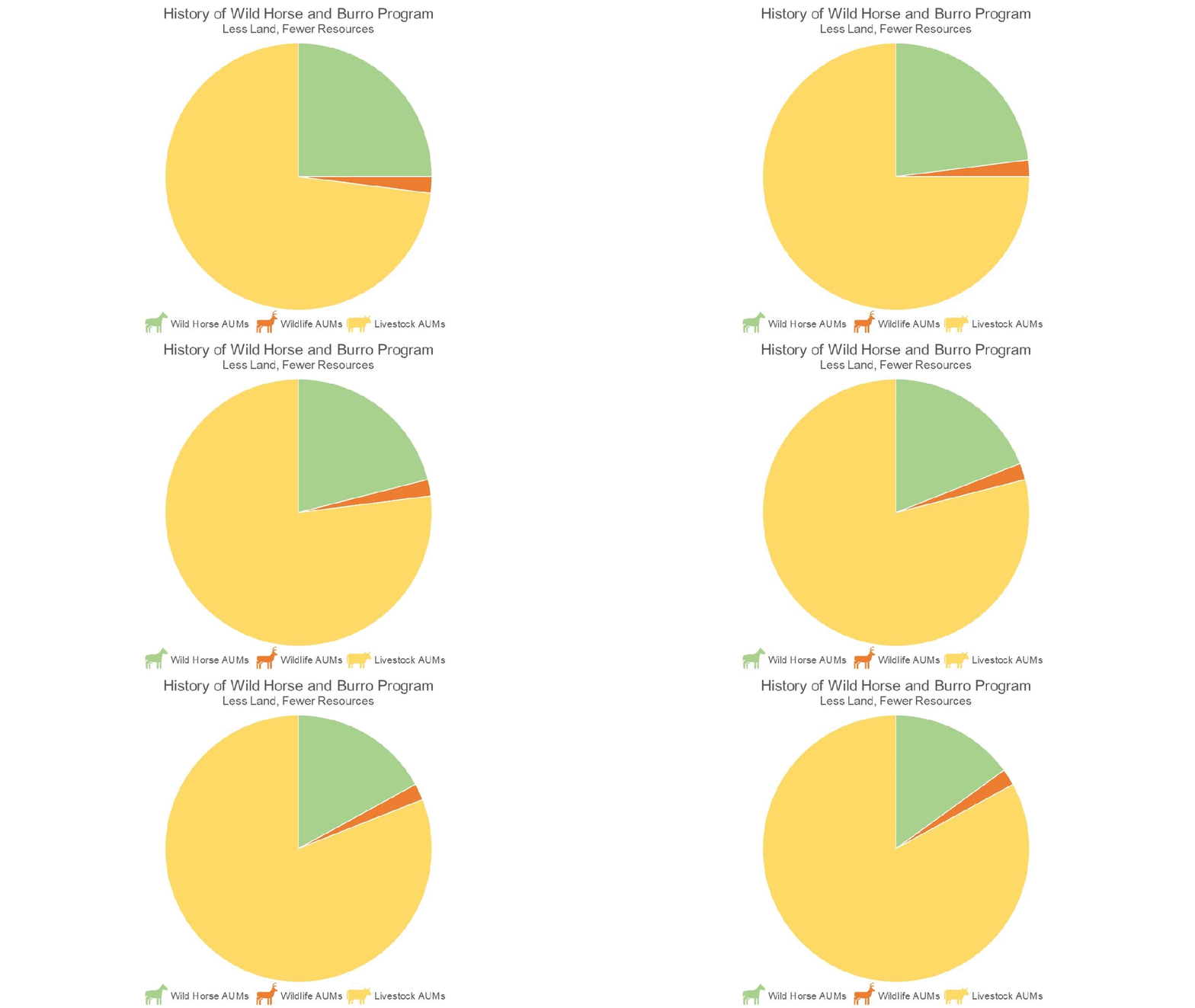
Once you understand that AMLs correspond to a small portion of the total authorized forage, and that most of the resource has been assigned to privately owned livestock, you’ll realize that public lands in the western U.S. can support many more horses than the bureaucrats and ranchers admit and that overpopulation is a myth.

RELATED: The Allotments Tell the Story: They’re Lying, All of Them.

History of Wild Horse and Burro Program 12-01-22

RTF Seeks PZP Darter, Launching Pest Control Business?

The signatory to the “Path Forward,” a 2019 plan for ranching superiority in the lawful homes of wild horses, has placed an undated job ad in High Country News for a wild horse population field coordinator and technician.

The successful candidate will report to Celeste Carlisle, RTF science advisor, chair of the Wild Horse and Burro Advisory Board and co-leader of the FREES Population Management Working Group.

In this role, you will work with RTF staff to identify wild equine herds in several herd management areas to determine tractability and appropriateness for current and future range projects.

You should be familiar with 4WD travel, firearms, hiking, camping, map reading, fixing flat tires and bringing survival gear into field, such as extra food and water, layers, batteries, flashlights, blankets or sleeping bags and first aid supplies.

In short, you’ll help RTF leadership transform the organization into a government contractor specializing in nonmotorized removal, just like the Campaign Against America’s Wild Horses.

Join the race to the bottom today!

RELATED: RTF: Surgical Sterilization Bad, Chemical Sterilization Good.

Working Together for a Horse-Free Future 12-21-22

Foal-Free Friday, Starting New Families Edition

A young bachelor stallion spends his days trying to steal mares from the family bands as discussed in the April edition of Horse Tales.  Go to “Wild Horse Tales” at the bottom of page 7.

It’s risky business and injuries do occur, but that’s how nature operates.

Speed, strength and shrewdness are passed on.  Weakness is not.

If he succeeds, he faces a more formidable challenge: The advocates.

They don’t like families.  They don’t like procreation.  They don’t like Velma, principal use and the 92nd Congress.

They like ranchers.  They like pesticides.  They like thriving ecological balances in the lawful homes of wild horses.

They rank among the lowest and sleaziest of the nonprofits.

They are phonies, leaders of the blind, irrelevant.

RELATED: Foal-Free Friday, Selecting for Weakness Edition.

Thriving Ecological Balance-3