The incident started on May 31. No activity has been reported since June 28.
An email inquiry sent on July 29 has not been answered.
RELATED: Piute Mountain Roundup, Day 27.
UPDATE: A BLM public affairs specialist said today the operation continues.

Western Horse Watchers Association
Exposing the Hypocrisy, Lies and Incompetence of the Wild Horse Advocates
On the range
The incident started on May 31. No activity has been reported since June 28.
An email inquiry sent on July 29 has not been answered.
RELATED: Piute Mountain Roundup, Day 27.
UPDATE: A BLM public affairs specialist said today the operation continues.
Demolition is almost complete. The reservoirs are gone and the river has returned to its original channel, exposing 2,200 acres of formerly submerged lands.
A last step in the process is to replant the basins with seeds, shrubs and trees, according to a story by the San Fransisco Chronicle, which has attracted the horses.
The herd has received national attention in recent years as the Wild Horse Fire Brigade.
Their sponsor says they’re benefiting the landscape, not hurting it.
Others disagree, claiming they don’t benefit the region.
The county has an open range policy, meaning the owners of the property must install fencing to keep the animals out.
It’s not clear if that was in the original project scope and if it will force the herd to find a new source of water.
They may not run the Democrat Party but it certainly has its share of them.
Same for the wild horse world.
Can you think of a better demographic from which to recruit and train PZP darters?
Leading the way is the Campaign Against America’s Wild Horses and its army of nitwits.
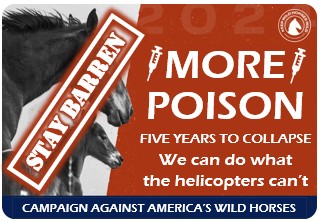
Allegations of abuse at the Blue Wing Complex may encourage more cat ladies to come out of the closet and become foot soldiers for CAAWH.
They’re a miserable lot, working alongside the legacy contractors to help the bureaucrats achieve their goal of ranching superiority in the lawful homes of wild horses.
RELATED: Foal-Free Friday, Plausible Deniability Edition.

The incident concluded today with 1.305 horses captured, 1,268 shipped, three released and 34 dead.
There were no unaccounted-for animals.
The capture and removal goals were 1,373 and 1,333, respectively.
The death rate was 2.6%.
The average daily take was 52.2.
Body condition scores were not given.
The capture total included 536 stallions, 544 mares and 225 foals.
Youngsters represented 17.2% of the animals captured, consistent with a herd growth rate of 12% per year.
Of the adults, 49.6% were male and 50.4% were female, well within the limits of variation from a random process centered at 50% males / 50% females.
Video of the abuse of a captured horse gave the advocates an opportunity to sell mass sterilization as a practical alternative to helicopter trapping.
The number of horses removed depends on the number returned.
The June 3 schedule indicates that 40 mares will be treated with a fertility control pesticide and be returned to the Complex, leaving open the possibility of another GonaCon crime scene.
As for the burros, 360 were captured, 353 were shipped, none were released and eight died.
More animals were processed than caught, putting the unaccounted-for total at -1.
The capture and removal goals were identical at 356 each.
The death rate was 2.2%.
The average daily take was 14.4.
The capture total included 186 jacks, 152 jennies, and 22 foals.
Youngsters represented 6.1% of the animals captured.
Of the adults, 55% were male and 45% were female.
There were no plans to treat any of the burros with pesticides and return them to the range.
The Complex is subject to permitted grazing. The roundup liberated 17,784 AUMs per year, giving new hope to the Blue Wing permittees.
RELATED: Blue Wing Roundup Announced.
UPDATE: The BLM news release was issued on August 7.
The incident started on July 8. Results through July 30:
The figures above are based on the daily reports.
Horses
Three stallions and two mares were dispatched on Day 22 for conditions that made them unadoptable, not unable to survive in the wild, bringing the death rate to 2.5%.
The capture total includes 516 stallions, 526 mares and 219 foals.
Youngsters represented 17.4% of the animals gathered, consistent with a herd growth rate of 12% per year.
Of the adults, 49.5% were male and 50.5% were female, results that could be produced by a random process centered at 50% males / 50% females.
Body condition scores were not given.
Burros
The capture goal has been reached.
More burros were processed than caught, throwing the numbers out of balance.
Captured – Shipped – Released – Dead = 360 – 353 – 0 – 8 = -1
The death rate is 2.2%.
The capture total includes 186 jacks, 152 jennies and 22 foals.
Youngsters represented 6.1% of the animals gathered.
Of the adults, 55% were male and 45% were female.
General
The location of the trap site is not known. Five HMAs are involved.
The Complex is subject to permitted grazing. Resources liberated to date:
The June 3 schedule indicates that 40 mares will be treated with a fertility control pesticide but this is not acknowledged at the gather page.
There are no such plans for the burros.
The roundup supports three tenets of rangeland management.
RELATED: Blue Wing Roundup, Day 21.

Report by WAVY News.
If they’re an endangered breed, why was Puckett trying to get rid of them with PZP, an ovary-killing pesticide?
We still don’t know size of the breeding population and how many mares can still bear fruit.
That’s the story they need to develop.
RELATED: Currituck Stallion Hit by Vehicle, Euthanized by Advocates.
The incident started on July 8. Results through July 28:
The figures above are based on the daily reports.
Horses
A mare was put down on Day 20 for club feet. The death rate is 2.2%.
The capture total includes 479 stallions, 487 mares and 207 foals.
Youngsters represented 17.6% of the animals gathered, consistent with a herd growth rate of 12% per year.
Of the adults, 49.6% were male and 50.4% were female, results that could be produced by a random process centered at 50% males / 50% females.
Body condition scores were not given.
Burros
The capture goal has been reached.
More burros were processed than caught, throwing the numbers out of balance.
Captured – Shipped – Released – Dead = 360 – 353 – 0 – 8 = -1
The death rate is 2.2%.
The capture total includes 186 jacks, 152 jennies and 22 foals.
Youngsters represented 6.1% of the animals gathered.
Of the adults, 55% were male and 45% were female.
General
The location of the trap site is not known. Five HMAs are involved.
The Complex is subject to permitted grazing. Resources liberated to date:
The June 3 schedule indicates that 40 mares will be treated with a fertility control pesticide but this is not acknowledged at the gather page.
There are no such plans for the burros.
The roundup supports three tenets of rangeland management.
RELATED: Blue Wing Roundup, Day 19.
The allotment, on the west side of Spring Creek Basin HMA, offers 2,508 active AUMs on 34,232 public acres, according to the Allotment Master Report.
The forage assigned to horses is zero.
How many wild horses could live there?
Using the principle of forage interchangeability, the True AML would be 2,508 ÷ 12 = 209, the number of horses the land could support if it was managed principally for them as specified in the original statute.
The stocking rate would be 209 ÷ 34,232 × 1,000 = 6.1 wild horses per thousand public acres.
Why is this important?
The bureaucrats and ranchers claim that public lands in the western U.S. can only support one wild horse per thousand acres (27,000 animals on 27 million acres).
The advocates support the narrative with their darting programs.
If the allotment was an HMA, the AML would be 34 and 175 horses would be consigned to off-range holding because of permitted grazing.
BLM allotments in Colorado carry livestock equivalent to 49,546 wild horses on 7,448,367 public acres, or 6.7 wild horses per thousand public acres.
Wild horses can be placed on public lands not identified for their use by acquiring the base property associated therewith and converting the grazing preference to horses, as American Prairie did for bison in Montagna.
RELATED: The Allotments Tell the Story: They’re Lying, All of Them.

On the eastern edge of the Kisatchie National Forest with C Plus Hikes.
The incident started on July 8. Results through July 26:
The figures above are based on the daily reports.
Horses
A stallion was released (or escaped) on Day 19.
A mare died of a broken neck on Day 19 and a stallion was dispatched for blindness in one eye, bringing the death rate to 2.3%.
The capture total includes 447 stallions, 460 mares and 199 foals.
Youngsters represented 18% of the animals gathered, consistent with a herd growth rate of 13% per year.
Of the adults, 49.3% were male and 50.7% were female, results that could be produced by a random process centered at 50% males / 50% females.
Body condition scores were not given.
Burros
The capture goal has been reached.
More burros were processed than caught, throwing the numbers out of balance.
Captured – Shipped – Released – Dead = 360 – 353 – 0 – 8 = -1
The death rate is 2.2%.
The capture total includes 186 jacks, 152 jennies and 22 foals.
Youngsters represented 6.1% of the animals gathered.
Of the adults, 55% were male and 45% were female.
General
The location of the trap site is not known. Five HMAs are involved.
The Complex is subject to permitted grazing. Resources liberated to date:
The June 3 schedule indicates that 40 mares will be treated with a fertility control pesticide but this is not acknowledged at the gather page.
There are no such plans for the burros.
The roundup supports three tenets of rangeland management.
RELATED: Blue Wing Roundup, Day 17.
The roundup took 57 stallions and 99 mares off the range, for a total of 156.
Yesterday your host suggested it would be very hard to reproduce those results by tossing coins.
The conclusion arises from a statistical calculation where p-bar = .5 and n = 156.

The observed proportions of males and females fall outside these limits. That is, they don’t look like they came from a random process centered at 50% males / 50% females.
That statement could be tested by tossing a coin 156 times with many replications.
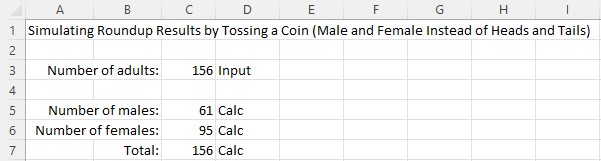
Another option is to simulate the tosses in an Excel spreadsheet using the built-in random number generator, counting the number of males and females in each replicate.
Enter 156 into cell C3. Then press F9 repeatedly to see the distribution of results.
Can you come up with 57 or less males and 99 or more females?
It may be possible but it won’t happen very frequently.
Your host was able to achieve 61 and 95.
The North Lander roundup took 1,005 stallions and 1,101 mares off the range for a total of 2,106.
Western Horse Watchers was able to achieve those results exactly, meaning they look like they came from a random process centered at 50% males / 50% females.
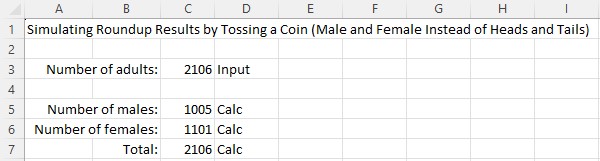
The spreadsheet limit is 5,000 adults.
You can also try this for the Blue Wing roundup, which has taken 447 stallions and 460 mares off the range as of July 26.
RELATED: Reproducing the Swasey Gather Results.
A July 25 update of the original news release says park officials opted for a direct negotiated bid through GSA and the animal has now been transferred to its new owner.
The new management plan provides guidance for the Grand Junction Field Office to bring the size of the herd to within the appropriate management level of 90-150 wild horses and then regulate that population according to today’s news release.
The Decision Record authorizes the Proposed Action (Alternative B), discussed in Section 2.1.3 of the Final EA.
The DR and EA were copied to the project folder in ePlanning with other supporting documents.
The HMA was dropped from the FY24 roundup schedule in early June.
A preliminary schedule for FY25 has not been released.
RELATED: Colorado Lawmakers Upset with BLM’s Plan for Little Book Cliffs.
The incident concluded yesterday with 189 horses captured, 188 shipped, none released and one dead.
There were no unaccounted-for animals.
The capture and removal goals were 166 and 154, respectively.
The death rate was 0.5%.
The average daily take was 31.5.
The capture total included 57 stallions, 99 mares and 33 foals.
Youngsters represented 17.5% of the animals gathered, consistent with a herd growth rate of 12% per year.
Of the adults, 36.5% were male and 63.5% were female, results that don’t correspond to a simple random process centered at 50% males / 50% females.
The Swasey sex ratio may be skewed in favor of females, a common problem in herds treated with PZP, but the HMA does not appear in the first part of the June 3 roundup schedule for nonmotorized removal.
The HMA is subject to permitted grazing. The roundup liberated 2,268 AUMs per year, giving new hope to the poor ranchers.
The number of horses removed depends on the number returned.
The schedule indicates that up to 10 mares will be treated with GonaCon Equine and be returned to the range with up to 10 stallions.
A news release, if published, may clarify this.
The advocates are positioning themselves to avoid any responsibility for the destruction of the Salt River and Virginia Range herds, claiming they can apply as many doses of PZP as they want with no long-term effect on fertility.
They’ll go through the motions, applying more and more of the pesticide, although it’s really not necessary because the mares are sterile.
At that point the trend lines will go south even if the darting programs are shut off, just like the Maryland side of Assateague Island.
“We didn’t know, we thought it was harmless.”
They’re lying, of course.
The bureaucrats knew as well, that’s why they signed the agreements.
RELATED: Foal-Free Friday, Grounding the Helicopters Edition.
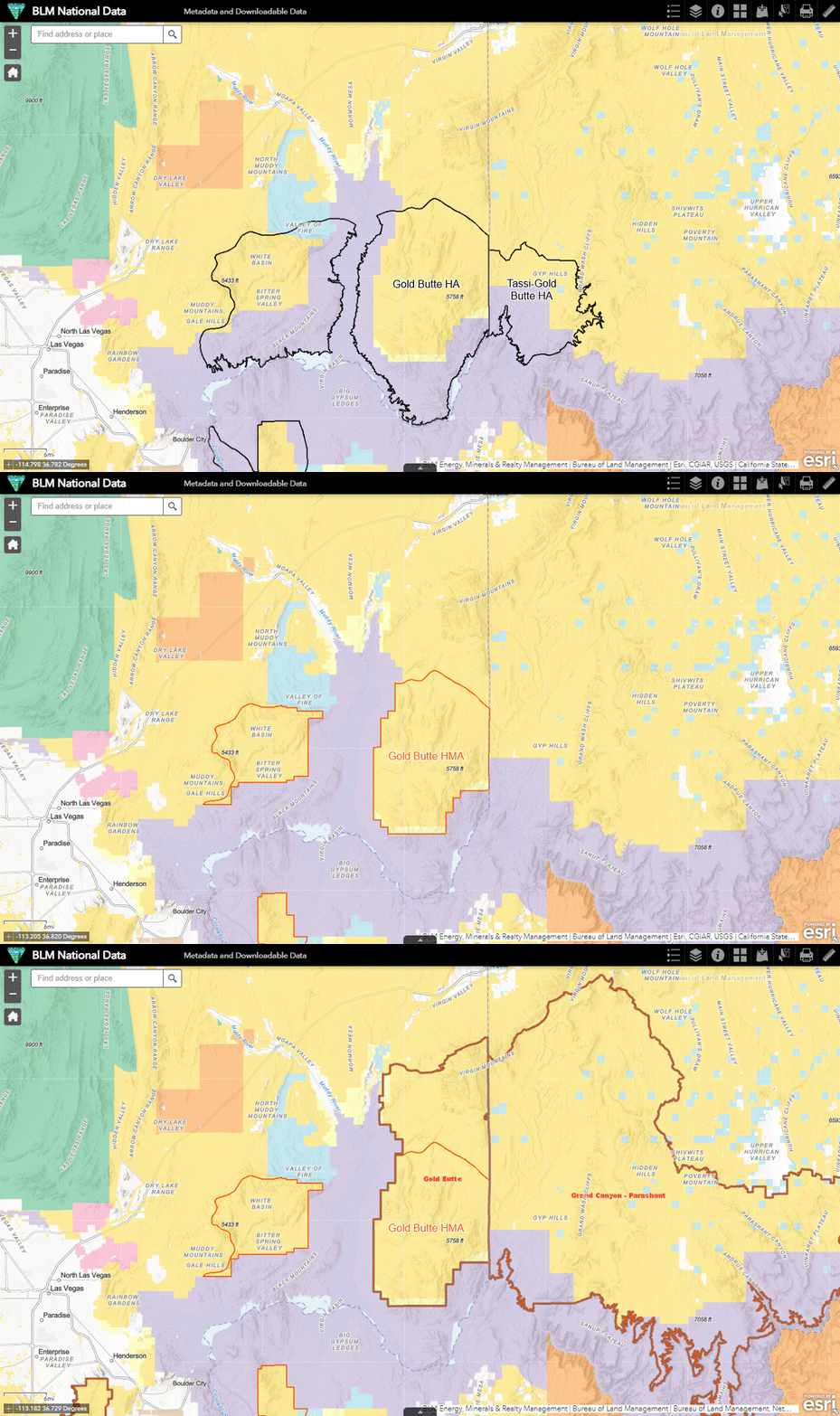
The project description says the BLM and NPS propose to gather and remove wild burros from within and outside the Tassi-Gold Butte HMA, which was zeroed out in 1998.
The National Data Viewer shows a Gold Butte HMA and Tassi-Gold Butte HA.
The HMA lies within the Gold Butte National Monument and the HA lies within the Grand Canyon Parashant National Monument.
No documents were copied to the project folder.
The incident started on July 20. Results through July 24:
The figures above are based on the daily reports.
The capture total includes 50 stallions, 79 mares and 28 foals.
Youngsters represented 17.8% of the animals gathered.
Of the adults, 38.8% were male and 61.2% were female.
Body condition scores were not given.
The location of the trap site is not known.
The HMA is subject to permitted grazing. Resources liberated to date:
The June 3 schedule indicates that 10 mares will be treated with GonaCon Equine and be returned to the range but this is not discussed at the gather page.
The roundup supports three tenets of rangeland management.
RELATED: Swasey Roundup, Day 3.

The incident started on July 8. Results through July 24:
The figures above are based on the daily reports.
Horses
The death rate is 2.2%.
The capture total includes 428 stallions, 439 mares and 194 foals.
Youngsters represented 18.3% of the animals gathered, consistent with a herd growth rate of 13% per year.
Of the adults, 49.4% were male and 50.6% were female, results that could be produced by a simple random process centered at 50% males / 50% females.
Body condition scores were not given.
Burros
The capture goal has been reached.
More burros were processed than caught, throwing the numbers out of balance.
Captured – Shipped – Released – Dead = 360 – 353 – 0 – 8 = -1
The death rate is 2.2%.
The capture total includes 186 jacks, 152 jennies and 22 foals.
Youngsters represented 6.1% of the animals gathered.
Of the adults, 55% were male and 45% were female.
General
The location of the trap site is not known. Five HMAs are involved.
The Complex is subject to permitted grazing. Resources liberated to date:
The June 3 schedule indicates that 40 mares will be treated with a fertility control pesticide but this is not acknowledged at the gather page.
There are no such plans for the burros.
The roundup supports three tenets of rangeland management.
RELATED: Blue Wing Roundup, Day 15.
The incident concluded on July 23 with 2,577 horses captured, 2,560 shipped, none released and 16 dead.
There was one unaccounted-for animal.
2,577 – 2,560 – 0 – 16 = 1
The capture and removal goals were 2,766 and 2,716, respectively.
The death rate was 0.6%.
The average daily take was 112.
The capture total included 1,005 stallions, 1,101 mares and 471 foals.
Youngsters represented 18.3% of the horses gathered, consistent with a herd growth rate of 13% per year.
Of the adults, 47.7% were male and 52.3% were female, results that could be produced by a simple random process centered at 50% males / 50% females.
The Complex is subject to permitted grazing. The roundup liberated 30,924 AUMs per year, restoring the ranchers’ birthright.
The number of horses removed will depend on the number returned.
The June 3 schedule indicates that up to 20 mares will be treated with a fertility control pesticide of unspecified type and be returned to the range with up to 20 stallions.
The gather page will be updated when that process is complete.
RELATED: North Lander Roundup Pending.
UPDATE: The BLM news release confirms the use of pesticides but does not indicate the type, leaving open the possibility of another GonaCon crime scene.
The Salt River Wild Horse Darting Group and the Campaign Against America’s Wild Horses filed suit yesterday in U.S. District Court against the Johnson County Livestock Exchange, Rail Lazy H Contracting and Consulting, the United States Forest Service and United States Department of Agriculture according to a summary of the case at Justia.
A copy of the complaint was not attached.
They may be seeking a temporary restraining order to stop the removal of wild horses from the forest near Alpine, AZ.
RELATED: Advocates to ASNF: Let Us Fix Your Wild Horse Problem.
 Western Horse Watchers Association