If Wild Horses Had Principal Use of Easter

The tiny allotment, consisting of several parcels north of McAllister, MT, offers 137 active AUMs on 1.012 public acres according to the allotment master report.

It’s in the Custodial category, condition unknown.

The management plan assigns zero AUMs to wild horses.

How many could live there?

The forage assigned to livestock is equivalent to 11 wild horses, or 10.9 per thousand public acres.

Why is this important?

Your faithful public servants claim that rangelands in the western U.S. can only support one wild horse per thousand acres (25,500 animals on 25.6 million acres).

The advocates bolster the narrative with their darting programs.

The allotment is too small and too fragmented to be an HMA (or refuge), but if it was, the AML would be 1 and 10 wild horses would be consigned to off-range holding because of permitted grazing.

BLM allotments in Montana support livestock equivalent to 112,120 wild horses on 7,991,479 public acres, or 14.0 wild horses per thousand public acres.

Wild horses can be placed on public lands not identified for their use by acquiring base properties associated with grazing allotments and flipping the preference to horses.

RELATED: The Allotments Tell the Story: They’re Lying, All of Them.

Lahontan Number Magic

Do you think the 511 horses identified for removal were born in the HMA?

Do you think they lived happily therein until recently?

The EA says on page 11 (of the pdf) that the population has grown exponentially during the past nine years from 78 in the spring of 2016 to 510 in the spring of 2024.

Wouldn’t that be eight years?

The same page indicates the annual growth rate is approximately 10 percent.

These two statements are incompatible.

If the growth rate is correct, a herd of 78 would expand to 167 in eight years.

If the herd sizes are correct, the growth rate would be about 27 percent per year, requiring a birth rate of at least 32% per year, which doesn’t happen.

The gather area covers 239,431 acres so the current stocking rate, based on a population of 518, is 2.2 wild horses per thousand acres, which is too high.

The Lahontan Allotment, which overlaps the HMA, offers 1,155 active AUMs on 52,910 public acres, equivalent to 1.8 wild horses per thousand acres, which is OK.

RELATED: Lahontan Planning Documents Out for Public Review.

Assateague Herd Grows Slightly

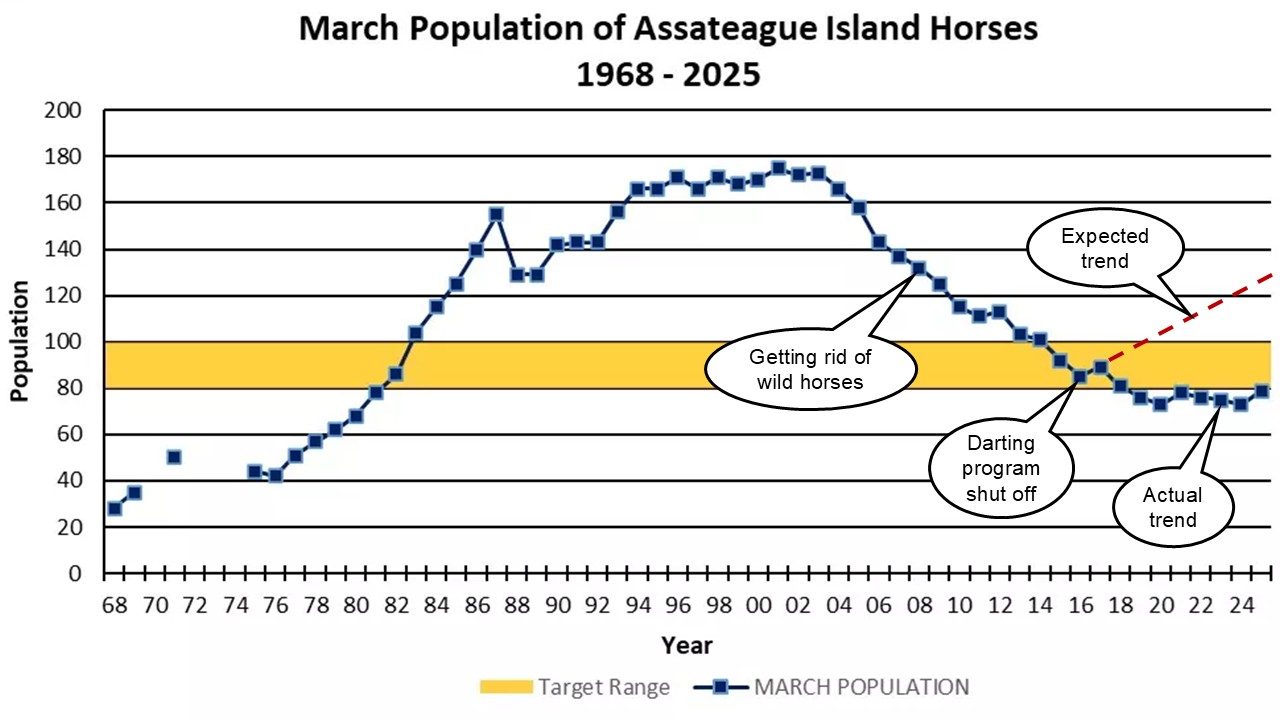
The Park Service reported in an undated news release that the population in March 2025 was 79, up from 73 a year earlier.

The herd consisted of 47 females and 32 males, a ratio of approximately 1.5 to 1.

Four deaths and ten births were recorded.

The article did not indicate if mares had been brought in from other areas to replace those ruined by the darting program.

The population has remained below target for seven years.

RELATED: If PZP Is Reversible, Why Is the Assateague Herd Still Shrinking?

Foal-Free Friday, Attempting the Impossible Edition

The Salt River advocates are trying to cut the herd size in half with PZP, as if they can put it into a nosedive for ten years and have it come in for a soft landing.

The Virginia Range advocates are trying to achieve a reduction of 80% or more with the same pesticide.

The herds will auger in.

The final populations will be zero because most of the mares will be sterile, if they aren’t already.

Those that bear fruit, not enough to overcome the death rate, likely have faulty immune systems, a trait that could be passed on to their offspring.

This is what the advocates bring to the table.

RELATED: Foal-Free Friday, Uproar and Outrage Edition.

Lahontan Planning Documents Out for Public Review

A preliminary environmental assessment has been copied to the project folder with several appendices.

Comments will be accepted through May 12 according to the news release.

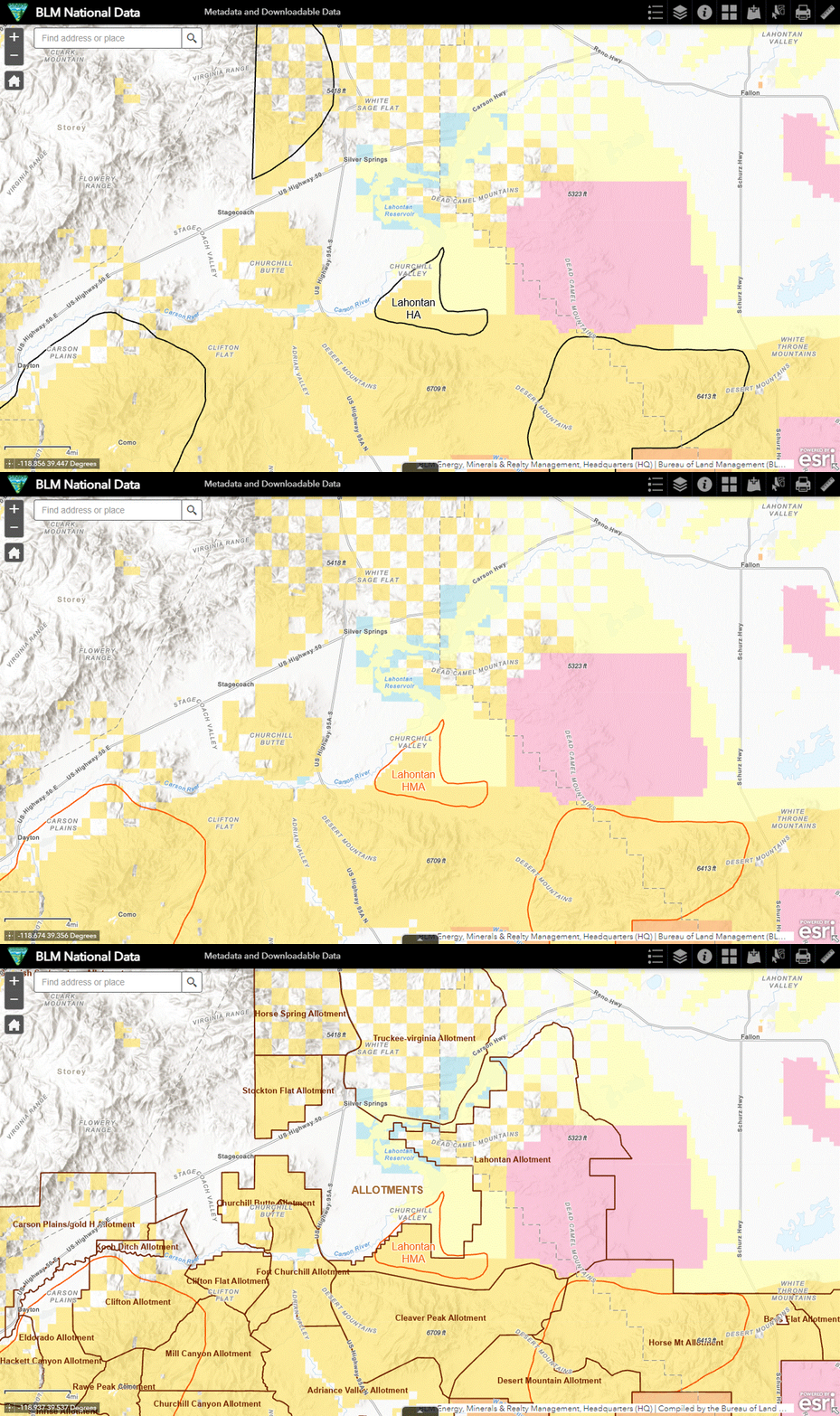
The Proposed Action, discussed in Section 2.3 of the EA, would remove all excess horses from an area that is roughly 25 times larger than the HMA.

Figure 1 shows the arrangement.

The current population is thought to be 518.

The AML is 7 – 10 so 511 animals are on the chopping block.

There are no plans to treat any of the mares with fertility control pesticides and return them to the range.

A roundup does not appear on the latest schedule.

Table 1 says the HMA is 100% within the Lahontan Allotment but Figure 2 suggests otherwise.

RELATED: Scoping Begins for Lahontan Wild Horse Roundup.

San Bernardino County Launches New Plan for Wild Burros

Officials have contracted with DonkeyLand to relocate orphaned, sick or injured animals and castrate 100 jacks over the next year according to a report by the Los Angeles Times.

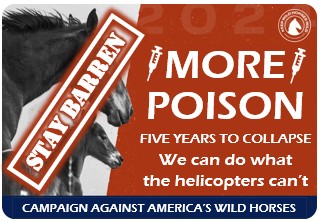
The article did not indicate if the Campaign Against America’s Wild Horses, a leader in nonmotorized removal, had offered to pummel the jennies with pesticide-laced darts at no cost to the government.

RELATED: San Bernadino County Hits Pause on Reche Canyon Burro Removal.

Legislation to Protect TRNP Wild Horses Introduced in Senate

The bill would maintain a genetically diverse herd of at least 150 animals according to a report by KX News.

The story did not indicate if it was prompted by SCR 4006.

The measure was introduced on April 9, read twice and referred to the Committee on Energy and Natural Resources.

The bill text was not immediately available.

RELATED: Breeding Population More Important Than Herd Size.

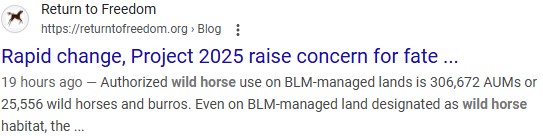
Forage Required by Wild Horses and Burros on BLM Lands

Are the figures in this Google search result correct?

Reagan’s doctrine of “trust but verify” does not apply to the wild horse advocates.

They cannot be trusted.

The final page of the 2025 population dataset gives post-Rock Springs AMLs of 22,637 wild horses and 2,919 wild burros.

Therefore, the total number of animals allowed by plan is correct.

22,637 + 2,919 = 25,556

One AUM will sustain one cow-calf pair, one wild horse, two burros or five sheep for one month.

So the total forage requirement is

22,637 × 12 + 2,919 × 12 ÷ 2 = 289,158 AUMs per year

Like the Campaign Against America’s Wild Horses, Return to Normal (Before WHB Act) is a strong supporter of nonmotorized removal,

The nonprofit works closely with the FREES Network, a ranching advocacy group sponsored by Utah State University Extension, and signed onto the “Path Forward,” a 2019 plan for ranching superiority in the lawful homes of wild horses and burros.

RELATED: BLM Releases 2025 Wild Horse and Burro Population Dataset.

NOTE: Initially CAAWH opposed the Path Forward but now accepts it.