The condition of the Ocracoke and Shackleford horses is still not known, according to a report posted yesterday by WECT News of Wilmington, NC.
RELATED: Dorian Leaving OBX.

Western Horse Watchers Association
Exposing the Hypocrisy, Lies and Incompetence of the Wild Horse Advocates
On the range
The condition of the Ocracoke and Shackleford horses is still not known, according to a report posted yesterday by WECT News of Wilmington, NC.
RELATED: Dorian Leaving OBX.
On Sand Wash Basin HMA with Steve Hostetler.
Trailcam photos from the Virginia Range. OK, hop in!
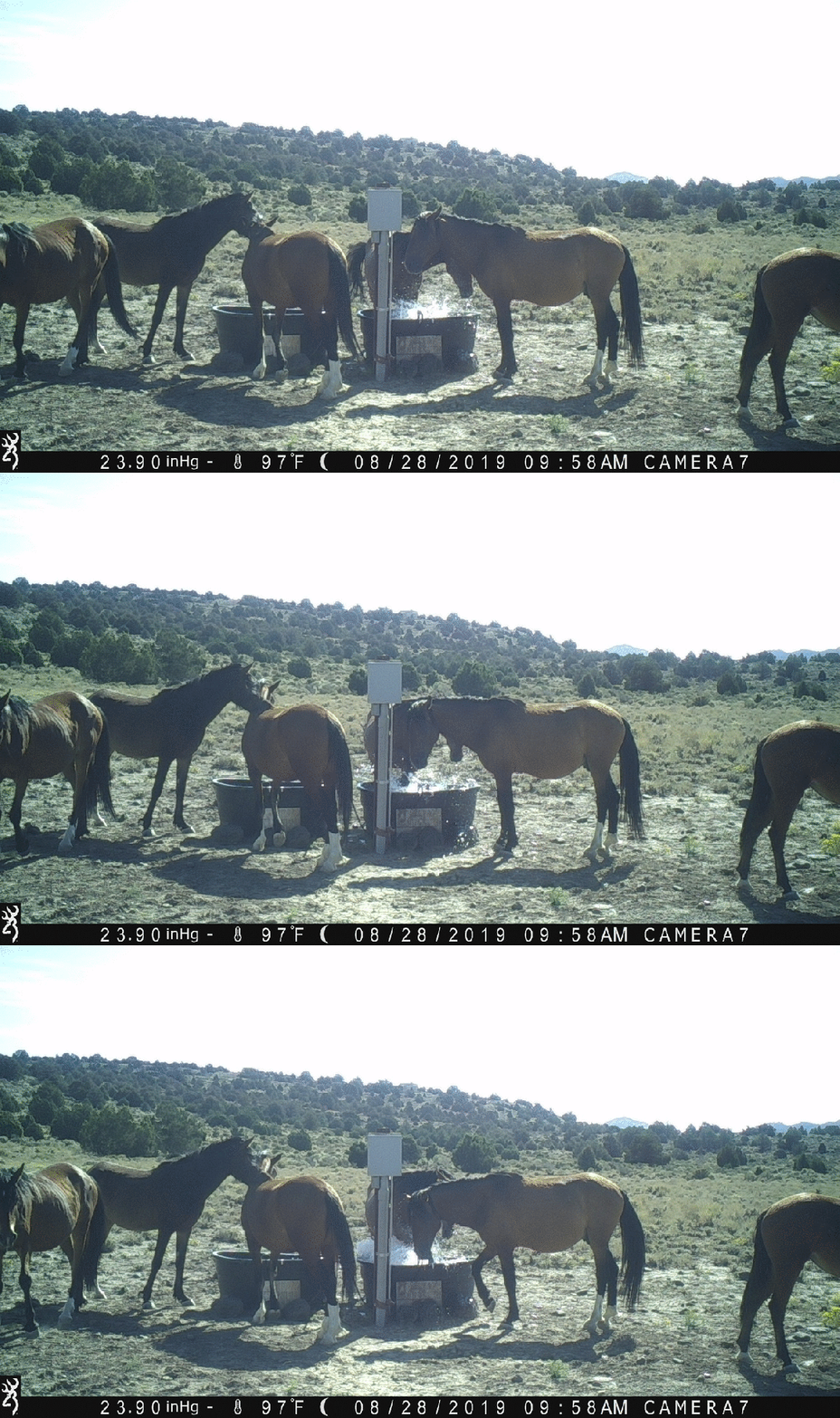
Trailcam photos from the Virginia Range (not enough daylight for full color mode).

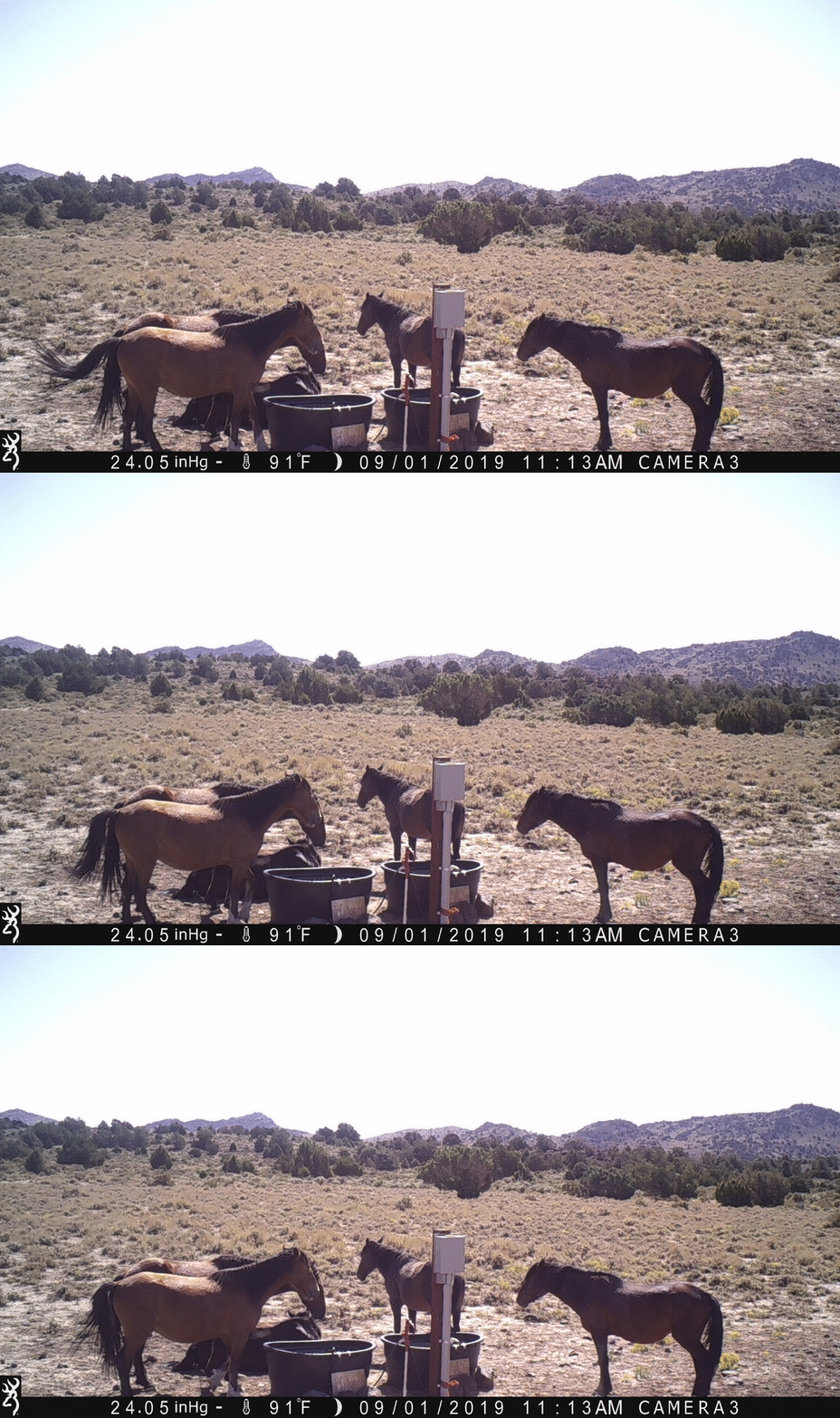
Earlier that day, these guys decided to chill at the same location.
Paddle boarding with the wild ones, by Aging Ethically.
The worst is over for the Banker Horses. The storm has picked up forward speed and is now moving up the coast.

Reports on the condition of the horses may still be a few days away, depending on the amount of storm damage and how easily their territory can be accessed.
RELATED: Dorian Closing in on OBX.
Virginia Range mustangs grazing in the Hidden Valley area, by Scott. Note the Flehmen response at 10:40 and 11:00.
The track hasn’t changed very much in the past 24 hours. The Banker Horses are likely feeling the effects already, with water starting to rise in low lying areas. Their story has been picked up by major news outlets.
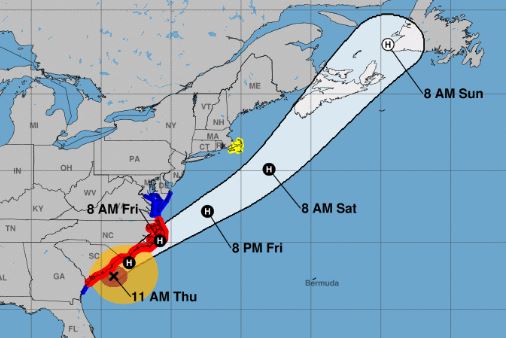
The flow will switch from onshore to offshore as the system passes by tomorrow, with the strongest winds near the center (indicated in red on the map above).
RELATED: Dorian Still Heading to OBX.
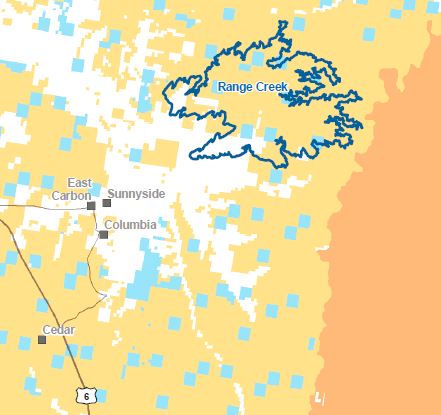
BLM said today that 200 wild horses would be removed from the Range Creek HMA in September but did not give a starting date. Declining rangeland health was cited as a reason for the action. The roundup follows the removal of 92 wild horses from lands surrounding the HMA last year.
The news release did not indicate how the gather would be carried out (helicopters or baiting) and if it would be open to public observation.
The HMA covers 55,023 acres in eastern Utah and has an AML of 125, for an aimed-at population density 2.3 horses per thousand acres. The target density across all HMAs is one animal per thousand acres.
The announcement did not say where the captured horses would be taken and did not provide a link to the gather stats and daily reports.
The HMA lies within a single grazing allotment, according to the Final EA, with grazing activity held to 15% of permitted use for the past six years.
The roundup will not increase the permitted AUMs for livestock grazing but will allow increased grazing activity.
RELATED: Comments Invited on EA for Range Creek Gather Plan.
The latest track has the storm approaching the Outer Banks on Friday but the expected path has bent slightly to the east compared to yesterday. The onshore flow will increase as the storm moves in from the south due to its counter-clockwise rotation.

A syndicated report posted by WBTV News of Charlotte, NC says the horses usually go to higher ground and huddle together to ride out the storm, with their butts to the wind.
RELATED: Dorian to Drench Banker Horses?
The latest track puts the hurricane along the North Carolina coast on Friday, bringing the onshore flow (storm surge) to the wild horses of the Outer Banks.
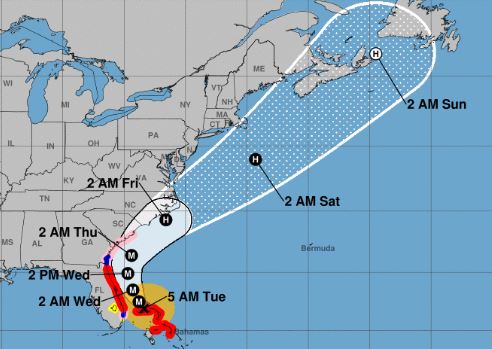
The area took a direct hit from Florence almost a year ago. The counter-clockwise rotation of the system will push seawater inland, flooding low lying areas.
Those evil horses.
“As [their] numbers have grown beyond the AML upper limit, livestock operators have experienced an increasing number of conflicts between wild horses and their permitted livestock use. Fence damage has increased as have maintenance costs. In some locations, wild horses have been very aggressive and kept livestock (and wildlife) from using the available water. In other locations, heavy-severe utilization by wild horses has prevented the [poor] operator[s] from making use of all or a part of their term permitted grazing use [on land set aside for the horses].”
Some ranchers have had to pay (OMG) market rates for rental pastures as a result of wild horse ‘overpopulation.’
The Devil’s Garden Plateau WHT covers 232,520 acres in northeastern California and has an AML of 335, for an aimed-at population density of 1.4 horses per thousand acres.
The Environmental Assessment for the WHT Management Plan indicates that 4,400 AUMs per year were allocated to these animals, a bit more than expected for 335 horses in a 12 month grazing season (335 × 12 = 4,020 AUMs per year).
The latter figure is used in the charts below.
The WHT intersects eight grazing allotments. See Tables 14, 15 and 16, beginning on page 79 in the EA, along with Figure 9 on page 80.
The EA provides the allotment size, authorized AUMs and the portion of the allotments within the WHT, but omits two of the grazing periods, citing them as variable. A term of six months was used for those calculations. Data for the East Grizzlie allotment were not provided because it is 98% outside the WHT.

The total permitted AUMs (26,880 AUMs per year) was used to scale the authorized AUMs to permitted AUMs but those figures were not used in the calculations.
Assuming that forage is uniformly distributed across the allotments, Carr contributes 1,701 AUMs to livestock inside the WHT because 40.7% of the land is inside the WHT.
The forage contribution of the other six allotments, added to Carr, yield 15,711 AUMs per year for domestic livestock inside the WHT.
Livestock can occupy an estimated 232,424 acres inside the WHT, computed in the same manner, which, allowing for rounding error, is taken to be all of it.
A six month grazing season yields 283 cow/calf pairs on Carr inside the WHT.
The other six allotments, combined with Carr, yield 2,856 cow/calf pairs on the WHT, for a weighted average grazing season of 5.5 months (15,711 ÷ 2,856) and average population density of 12.3 cow/calf pairs per thousand acres (2,856 ÷ 232,520 × 1,000).
These figures are presented in the following charts.
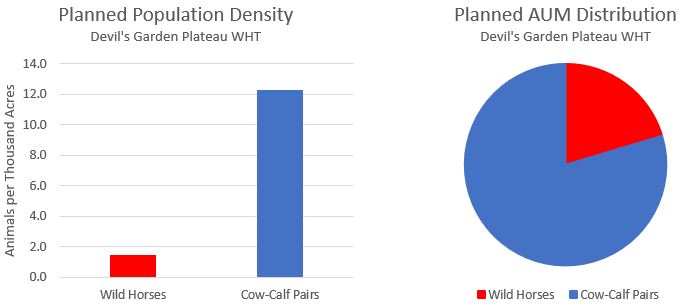
Land that can only support 1.4 horses per thousand acres can support eight times as many cow/calf pairs. The Pine Springs and Timbered Mountain allotments can support eleven times as many. A fine example of ‘thriving ecological balance.’
The current wild horse population at Devil’s Garden yields a pre-gather density of 7.7 animals per thousand acres, well within the range allowed for livestock. The roundup that starts in a few days will shift the numbers closer to those allowed by plan but will not achieve them.
The permitted AUMs for livestock across all of the allotments, inside and outside the WHT, yield an-aimed at density of 9.8 cow/calf pairs per thousand acres, using a grazing season of 5.5 months per year (22,608 ÷ 5.5 ÷ 419,249 × 1,000).
The WHB Act of 1971 was a dark stain on American history. Things will be so much better, at least for the ranchers, now that it’s gone.
On South Steens HMA with Lori Walker.
On the Pryor Mountain WHR with Kris Collett. Somebody done somebody wrong.
The Environmental Assessment for the Fish Creek Gather Plan considers the portion of the HMA on the south side of Highway 50, omitting 19,394 acres to the north. The AML for that parcel is ten.
The area of interest therefore covers 230,675 acres with an AML of 170, for an aimed-at population density of 0.7 animals per thousand acres. The target density across all HMAs is one animal per thousand acres (the land—27 million acres—can only support 27,000 wild horses and burros).
The plan allocates 2,040 AUMs per year to the Fish Creek horses (170 × 12).
The HMA intersects four grazing allotments. See Map 1 on page 4 of the EA and section 3.3 starting on page 66.
Information about livestock grazing is incomplete. The size of the allotments was not provided in the EA and the grazing season for two of them was omitted.
The plan allocates 8,855 AUMs per year to the four allotments, with an estimated 5,279 AUMs per year falling within the HMA. (An assumption here is that forage is uniformly distributed across the allotments. If the HMA contains 60% of an allotment, then it contributes 60% of its forage to livestock inside the HMA.)
If the weighted average grazing season is seven months (a guess), then 754 cow/calf pairs would be found in the HMA (5,279 ÷ 7). Sheep are also permitted in the HMA but results are based on cow/calf pairs, whose forage demand is said to be equivalent to that of wild horses.
The livestock density allowed by plan would be roughly 3.3 cow/calf pairs per thousand acres (754 ÷ 230,675 × 1,000).
These figures are presented in the following charts.

Together, the four allotments cover 417,000 acres (south side of Hwy 50). A seven month grazing season yields a total of 1,265 cow/calf pairs on those parcels, with a population density of 3.0 cow/calf pairs per thousand acres.
Are the horses being denied their fair share of the resources or were they forced to live in an area that is less desirable from a grazing viewpoint?
The current wild horse density is 3.6 animals per thousand acres, comparable to that of the livestock, but the roundup that starts in a few days will shift the numbers closer to those allowed by plan.
RELATED: Fish Creek Roundup Starts Next Week.
A story posted this morning by The Durango Herald says the Park Service is working with the Colorado Chapter of the National Mustang Association to find homes for wild horses that will be removed from Mesa Verde National Park.
The gather will be effected with bait traps, according to the report, and captured animals will be offered to qualified adopters. Gentling may be available through Mustang Camp of Milan, NM.
RELATED: Park Service Denies Media Access to Mesa Verde Roundup.
BLM said today that 200 excess wild horses will be removed from the Onaqui Mountain HMA and surrounding lands in northwestern Utah, starting September 11.
The roundup will be open to public observation and captured animals will be taken to the WHB Facility in Delta, UT.
The news release suggested that the reason for the gather was overpopulation.
The HMA covers 205,394 acres and has an AML of 210, for an aimed-at population density of one animal per thousand acres, in line with the average density for all HMAs.

The final environmental assessment gives few details about domestic livestock grazing.
Page 19 of a document from 2003 says cattle are allowed on the HMA between May and October, with sheep permitted in the Riverbed area between November and April.
The roundup will liberate 2,400 AUMs per year, making greater forage utilization by livestock operators possible. It will not change permitted AUMs on those allotments.
Gather stats and daily reports will be posted to this page (link not working at the time this post went live).
A story posted today by The Argus Observer of Ontario, OR says the agency has ‘altered’ its plan for sterilizing the Warm Springs mares: Animals receiving the procedure would not be pregnant. Otherwise, all aspects of the study remain the same.
None of the horses and burros removed from the HMA last October have been returned to their home range and none have been adopted, according to the report.
The agency is pushing the plan despite objections from the Animal Protection Caucus in Congress, along with many advocacy groups. See for example the commentary by IDA posted last week.
RELATED: Warm Springs Gather Complete.
Report by ABC7 News of Los Angeles. All of the shootings have occurred in the Clark Mountain Herd Area on the north side of I-15 (see page 8 in the California HMA maps).
RELATED: Clark Mountain Reward Increases to $58K.
Approximately 500 wild horses will be removed from the Devil’s Garden Plateau WHT, beginning September 5, according to an undated news release from the Forest Service.
The WHT covers 308,000 acres in northeastern California and has an AML of 402, for an aimed-at population density of 1.3 animals per thousand acres. The target density for WHB on public lands in the western U.S. is about one animal per thousand acres.

The gather will be open to public observation, with roughly 60% of the captured animals going to the Double Devil corrals in Alturas and 40% taken to the BLM off-range corrals in Litchfield.
The announcement said the roundup would support wild horse health by reducing competition for food and water but did not identify the leading contenders for those resources, namely, public-lands ranchers.
The WHT intersects eight grazing allotments, see map on page 80 of the environmental assessment. The roundup will liberate 6,000 AUMs per year, allowing greater forage utilization by livestock operators—on land set aside for the horses. The action will not increase permitted AUMs on those allotments.
A link to the gather stats and daily reports was not provided.
RELATED: Double Devil Corrals Emptied.

