Latest Assateague Census Shows No Improvement

The Park Service found 22 stallions and 54 mares on the Maryland side of the island in September, according to a story published today by WBOC-TV of Salisbury, MD.

One death was reported since the last census but no births.

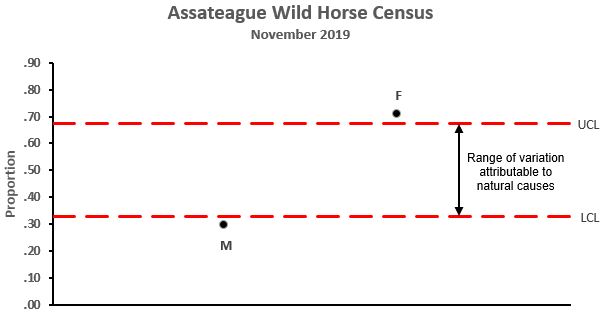
Not noted in the report was the abnormal sex ratio of the herd, roughly 29% males and 71% females.  The range of variation attributable to natural causes for a herd this size is 33% to 67%.  Both of the observed values fall outside these limits.

Assateague Census Sep 2019-1

The upper and lower limits were computed with basic statistical formulas, where n = 76 and p-bar = .5.  The chart says ‘Look for an assignable cause.’

Could it be the contraceptives that have been applied to the herd for the last 25 years?

RELATED: Latest Census Says ‘Search for Trouble’ in Assateague Herd.

Caliente Roundup Ends

BLM announced today that 102 wild horses had been removed from the Caliente Herd Area Complex in an operation that began in late July.  No animals were returned to the range and one death was reported.

The news release said the horses had to go because they were harming private property, which doesn’t make sense in a fence-out state.

RELATED: Mustangs to Be Removed from Eastern Nevada Starting Today.

Warm Springs Horses Get Short End of Stick

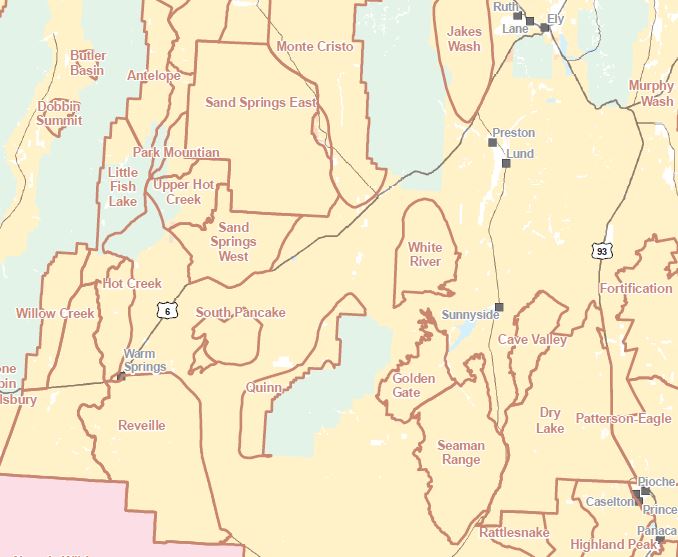
The Warm Springs HMA covers 474,547 acres in southeast Oregon.  Most of the wild horses were captured and removed in 2018 with the intent of supplying mares for sterilization research.  BLM says it’s moving ahead with the study despite objections from most advocacy groups.

The plan was to return 200 horses to the HMA, including those that were ‘altered,’ to monitor herd behavior and growth.  That has not happened and the operators who graze livestock in the area had unfettered access to forage this year, save for the thirty or so horses that escaped the helicopters.

The story at Warm Springs was the same one repeated by the government and major news outlets: The horses are out of balance with ‘other uses of public lands.’  But they rarely say what’s on the other side of the scales.

The HMA has an AML of 202.  The horses graze twelve months per year, so their forage budget is 2,424 AUMs per year (202 × 12).  The target population density is 0.4 horses per thousand acres (202 ÷ 474,574 × 1,000).

Warm Springs HMA Map-1

The pre-gather herd size was around 850 wild horses.

The HMA intersects two grazing allotments, used by seven operators.  The acreage of the HMA differs slightly from the acreage of the allotments but for purposes of this post they are assumed to be coincident (subsequent calculations use 474,574 acres).

Table III-3 on page 87 of the Environmental Assessment for the Management Plan provides the allotment sizes, grazing seasons and permitted AUMs.  Those figures are on the left side of this spreadsheet:

Warm Springs Calcs-1

The forage allocated to livestock by plan amounts to 19,392 AUMs per year, compared to 2,424 AUMs for the horses.  Keep in mind the land was set aside for the horses.

The permitted forage can be converted to cow/calf pairs by dividing the AUMs by the grazing seasons.  The ranchers would have to place 2,030 cow/calf pairs on the West Warm Springs pastures to consume 11,167 AUMs in 5.5 months (11,167 ÷ 5.5  = 2,030).

The population density for livestock on that allotment would be 6.8 cow/calf pairs per thousand acres (2,030 ÷ 297,375 × 1,000).

The population density for livestock on the HMA is 8.1 cow/calf pairs per thousand acres, compared to 0.4 wild horses per thousand acres (3,858 ÷ 474,574 × 1,000).

The weighted average grazing season is five months (19,392 ÷ 3,858).

These figures are compared in the following charts.

Warm Springs Charts-1

Is this what they mean by ‘thriving ecological balance?’

The number of wild horses allowed on the HMA is not based on the carrying capacity of the land, but what’s left over after the lion’s share of the resources have been sold to the public-lands ranchers.

And how do roundups, contraceptives and sanctuaries fix this problem?

They don’t.

It’s time to end the ranching stranglehold on western rangelands and restore the WHB Act to its original form.

RELATED: Preview: Warm Springs Horses Get Short End of Stick.

Saylor Creek Horses Get Short End of Stick

Earlier this week the BLM said that some of the wild horses at Saylor Creek HMA would be removed because there are too many of them.  Let’s take a look at the numbers.

The HMA covers 101,858 acres in southern Idaho.  The AML is 50, yielding an aimed-at population density of 0.5 wild horses per thousand acres (50 ÷ 101,858 × 1,000).

Saylor Creek HMA Map-1

The 50 horses allowed by plan would consume 600 AUMs annually, given they graze 12 months per year (50 × 12).

The 137 horses currently on the HMA consume 1,644 AUMs per year (137 × 12).

The HMA intersects eight grazing allotments, see Map 1 in the Final Environmental Assessment for the roundup (page 36)*.  Some allotments are 100% inside the HMA, others overlap partially.  None of the HMA is livestock-free.

Table 2 in Section 3.3 of the EA shows the grazing season and permitted AUMs for each allotment (page 17).

The allotments contribute forage to livestock according to their percentage in the HMA, assuming the resource is evenly distributed across the parcels.  For example, Black Mesa provides 785 AUMs per year because 78% of the land is inside the HMA (1,007 × .78).

The total forage allowed by plan for livestock inside the HMA is 11,193 AUMs per year, compared to 600 AUMs per year for wild horses.

The forage contributions can be converted to cow/calf pairs by dividing them by the number of months in their grazing seasons.  (Wild horses are said to be equivalent to cow/calf pairs in terms of their forage demand.)

The grazing season for Dove Springs is 8.5 months.  It is 100% inside the HMA, with 1,360 AUMs per year allowed by plan, yielding, 1,360 × 1 ÷ 8.5 = 160 cow/calf pairs in the HMA.

The total number of cow/calf pairs allowed in the HMA is 1,321, compared to 50 horses.

Saylor Creek Calcs-1

The average grazing season across the eight allotments is 8.5 months (11,193 ÷ 1,321).

The aimed-at population density for livestock inside the HMA is 1,321 ÷ 101,858 × 1,000 = 13 cow/calf pairs per thousand acres, compared to 0.5 wild horses per thousand acres.

These figures are displayed in the following charts.

Saylor Creek Charts-1

The roundup will come very close to achieving these goals.

Six of the allotments have been granted temporary increases in forage consumption, indicated as TNR AUMs in Table 2.  If those figures had been used in the calculations, the disparity between horses and cattle would be even greater.

Clearly, the land can support way more than 50 wild horses.  But the truth is masked by the deceit and greed of the public-lands ranchers and their allies in government.

*If you can’t view the map, click here.  BLM is aware of the problem.  If you can’t access the EA, click here.

Fifteenmile Roundup Begins Mid Month

BLM announced today that 600 wild horses will be removed from the Fifteenmile HMA in northern Wyoming beginning on or about October 17.

The operation, which will reduce the size of the herd by 85%, will be carried out with helicopters and will be open to public observation.

mccullough_peaks_hma_map-1

Captured animals will be taken to the BLM off-range corrals in Rock Springs.

Gather stats and daily reports will be posted to this page.

RELATED: Fifteenmile Roundup to Occur Later This Year.

Buffalo Hills / Granite Range Roundups Begin Next Week

BLM said yesterday that 100 wild horses and 175 wild burros would be removed from the HMAs starting on or about October 7.  The burros were found in the Buffalo Hills HMA, which is not managed for them (no AML).  The roundup will remove all of them.

The gather will be carried out with helicopters and will be open to public observation.

The Buffalo Hills HMA covers 131,861 acres in northwestern Nevada and has an AML of 314, for an aimed-at population density of 2.4 animals per thousand acres.

The Granite Range HMA, a few miles east of Buffalo Hills, covers 103,804 acres and has an AML of 258, for an aimed-at population density of 2.5 animals per thousand acres.

Buffalo Hills Granite Range HMA Map-1

The aimed-at population density across all HMAs is one animal per thousand acres.

Captured animals will be taken to the Litchfield Off-Range Corrals.

The Buffalo Hills HMA intersects one grazing allotment, according to Section 3.9 of the Final Environmental Assessment for the roundup (see page 48).

The same allotment intersects Granite Range but the full extent of livestock grazing on that HMA cannot be determined from the documents provided with the news release.

Livestock grazing in the area has been reduced slightly in recent years, with authorized AUMs running at approximately 90% of permitted AUMs.

Removal of wild horses and burros does not increase the permitted AUMs but can lead to relaxation of the curtailments.

Gather stats and daily reports will be posted to this page when the operation begins.