Forage Requirements of Wild Horses and Burros

If you want to compare the resource loading of burros to horses, cut the burro numbers in half.

A herd of 200 burros is equivalent to 100 wild horses.

An AML of 50 burros is equivalent to an AML 25 wild horses.

An allotment that supports livestock equivalent to 1,200 wild horses supports livestock equivalent to 2,400 wild burros.

An allotment that supports livestock equivalent to 5.6 wild horses per thousand public acres supports livestock equivalent to 11.2 wild burros per thousand public acres.

An allotment that offers 3,600 AUMs per year to livestock offers 3,600 AUMs per year to horses or 3,600 AUMs per year to burros.

RELATED: Equivalent Horses and Stocking Rates for Allotments.

Caisson Platoon Returns to Work

They went back on the job this week with the burial of Private Bernard Curran who died in 1942 after being captured by the Japanese.

The horses have pulled the flag-draped coffins of America’s war heroes to their final resting place at Arlington National Cemetery for more than 70 years according to a report by Fox News.

The program was halted two years ago after the Army linked the deaths of several animals to poor living conditions.

RELATED: Return of Caisson Platoon Delayed Indefinitely?

Article About Salt River Contract Uses the S-Word!

One of the challengers to the Salt River Wild Horse Darting Group said in a story by the Payson Roundup that “…horses receiving multiple doses of PZP over the course of several years can become functionally sterile,” a condition nobody wanted to talk about until today.

The group’s ringleader claimed responsibility for herd reduction via mass sterilization, ratifying a June 2 commentary by Western Horse Watchers: “We invented this humane management protocol…”

No foals have been born this year according to the report.

RELATED: Who Would Want to Be Responsible for Salt River Herd?

Foal-Free Friday, Humane Disposal Edition

In the introduction to a 2012 Q&A about PZP, Jay Kirkpatrick of the Billings School of PZP Darting and Public Deception stated that “…oversight by The Humane Society of the United States assures that the vaccine is used only to slow reproduction and may not be used for the extermination of entire herds.”

Further, “PZP is designed to bring about short-term infertility and is reversible, if not used beyond five consecutive years.”

On page 29 he refutes the remarks on page 3: “The HSUS will permit the use of PZP to manage, even reduce, but not to eliminate wild horses.”

Writing about the disaster at Assateague Island, which he did not live to see, “the first sign of population reduction took about eight years, but herd reduction has been moving more quickly since then.  The following eight years, herd numbers went down from 175 to 114, without any removal of horses, treating anywhere from 48% to 79% annually.”

If a helicopter took the herd from 175 to 114, 61 horses would be removed and the advocates would be howling, but if it’s done with pesticides, no horses are removed.

Moreover, the job took eight years to complete and eight is greater than five, so most of the mares had been ruined by the time the population hit 114.

This is evident today.

You cannot shrink a population without driving the birth rate to zero, or nearly so, for an extended period, which usually exceeds five years.

Herd reduction leads to sterilization and sterilization leads to extermination, which the Humane Society won’t allow, supposedly.

NOTE: HSUS is now HWA.

RELATED: Foal-Free Friday, One Track Mind Edition.

Four Organizations Bidding on Salt River Management Contract

The Arizona Department of Agriculture will reopen the RFP soon according to a story by Phoenix New Times but a date was not given.

The article looks at the incumbent and one of its challengers, a group led by historian John Mack and Forest Service contractor Jacquelyn Hughes.

Hughes was involved in the removal of wild horses from the Apache-Sitgreaves National Forest in 2022.

Simone Netherlands of the Salt River Wild Horse Darting Group suspects the contract will go to the group that proposes the smallest population goal.

That will raise questions in some circles about genetic diversity but the point is moot when most of the mares have ruined by PZP.

RELATED: Salt River RFP Cancelled.

AMLs Don’t Indicate Genetic Diversity or Carrying Capacity

Those who would combat myths about wild horses are often the greatest spreaders thereof.

Genetic viability correlates with breeding populations, not AMLs or herd sizes.

You have to correct the figures for the number of mares that have been ruined or are in the process of being ruined with fertility control pesticides.

For example, the current population at the Salt River is approximately 260 and most advocates would conclude that genetic diversity is satisfactory when in fact most of the mares have been sterilized by PZP and the breeding population can be counted on one hand.

As for carrying capacity, if a wild horse area is subject to permitted grazing, which is almost always the case, the AML is small relative to the available resources and the land can support many more animals than the bureaucrats admit.

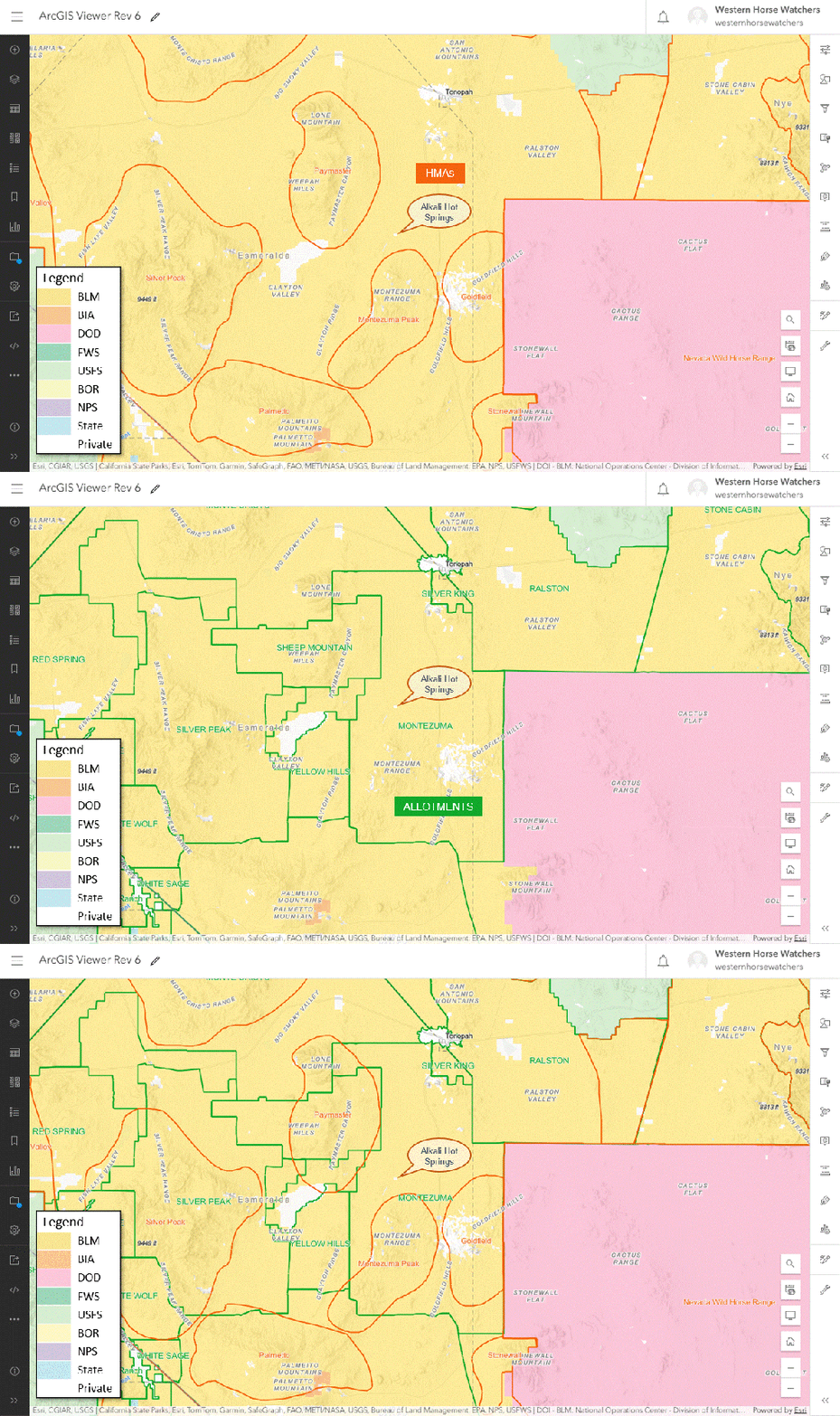
The Silver King HMA in eastern Nevada supports livestock equivalent to 2,530 wild horses, on top of the 128 allowed by plan.

A herd that large is not safe from the advocates.

Volunteers with the Campaign Against America’s Wild horses are wiping out the Virginia Range mustangs with PZP, a population that exceeded 3,000.

Montana Permit Renewals Show Abundant Forage

From the project description in ePlanning:

The Wolf Creek allotment would contain 8,253 acres of BLM administered land, 2,712 deeded acres and 640 acres of state lands.  The BLM administered acreage would have 1,242 AUMs of active use, equivalent to 103 wild horses or 12.5 wild horses per thousand public acres.

Your faithful public servants insist the public lands in the western U.S. can only support one wild horse per thousand acres (25,500 animals on 25.6 million acres).

The Square Butte allotment would contain 5,039 acres of BLM administered land, 2,280 deeded acres and 663 acres of state lands.  The BLM administered acreage would have 754 AUMs of active use, equivalent to 63 wild horses or 12.5 wild horses per thousand public acres.

The Ely allotment would contain 1,563 acres of BLM administered land and 480 deeded acres.  The BLM administered acreage would have 326 AUMs of active use equivalent to 27 wild horses or 17.4 wild horses per thousand public acres.

The 7-W allotment would contain 6,201 acres of BLM administered land, 6,729 deeded acres and 640 acres of state lands.  The BLM administered acreage would have 1,430 AUMs of active use, equivalent to 119 wild horses or 19.2 wild horses per thousand public acres.

The Six-X allotment would contain 10,327 acres of BLM administered land, 8,978 deeded acres and 1,920 acres of state lands.  The BLM administered acreage would have 2,125 AUMs of active use, equivalent to 177 wild horses or 17.1 wild horses per thousand public acres.

The D.K. North Pasture allotment would contain 4,470 acres of BLM administered land, 13,686 deeded acres, and 640 acres of state lands.  The BLM administered acreage would have 758 AUMS of authorized active use, equivalent to 63 wild horses or 14.1 wild horses per thousand public acres.

The advocates don’t want you looking at the numbers because they contradict their allies, expose the gravy train and destroy the rationale for their darting programs.

RELATED: Montana Allotment Split Reveals Abundant Forage.

Words Not in WHB Act

The Preliminary EA for the Antelope-Triple B pest control plan states at the top of page 169 that “The WFRHBA of 1971 specifically provides for contraception and sterilization (16 U.S.C. 1333 section 3.b.1).”  [It’s actually 16 USC 1333(b)(1), a comment you can submit on the EA.]

A keyword search of the statute yielded these results:

  • Contraception – Not found
  • Fertility – Not found
  • Vaccine – Not found
  • Pesticide – Not found
  • Growth – Not found

There is no warrant for the application of PZP and GonaCon Equine unless those products are used for sterilization.

Application to slow population growth, the oft-cited reason for their use, is not covered.

In the discussion of the effects of PZP on ovaries, the EA states at the bottom of page 177 that “…if some number of mares become sterile as a result of PZP treatment, that potential result would be consistent with the contraceptive purpose that motivates BLM’s potential use of the vaccine, and with Congressional guidance that condones such treatment in the management of wild horses and burros, in WFRHBA section 1333(b),” suggesting that sterility is a goal, not an unintended consequence of its use, as stated previously.

RELATED: Antelope-Triple B Preliminary EA Out for Review.

Antelope-Triple B Preliminary EA Out for Review

The Proposed Action, discussed in Section 2.4 of the EA, features motorized removal, application of fertility control pesticides and sex ratio skewing.

Creation of a new HMAP is still in the project scope.  Refer to Appendix XIII.

The comment period ends on June 29 according to the news release.

The project supports three tenets of rangeland management.

RELATED: Scoping Begins for Antelope-Triple B HMAP.

BLM Releases Rock Springs Final Planning Documents

The Decision Record authorizes Alternative II, the Proposed Action, discussed in Section 2.2 of the Final EA.

Approximately 3,371 wild horses will be removed from Herd Areas formerly known as the Great Divide Basin, Salt Wells Creek and Adobe Town HMAs.

There are no plans to treat any of the mares with fertility control pesticides and return them to the range.  The goal is 100% removal, which may take several years to achieve.

The project folder also includes a summary of public comments.

The incident is on the latest schedule with a start date of July 15.

AMLs in the affected areas were reduced to zero as a result of legal action taken by the Rock Springs Grazing Association.

RELATED: Draft EA for Rock Springs Wild Horse Removal Out for Review.

Wild Burros Reported at Spencer Hot Springs?

Have you ever wanted to soak in a hot tub, hang out with wild burros and camp in a BLM grazing allotment?

You can do all three at Spencer Hot Springs near Austin, NV.

The ArcGIS Viewer puts it in the Hickison HMA, which is overlapped by the Simpson Park Allotment.

This YouTube video tells you how to get there.

The news release about a public lands closure in Oregon says that dispersed camping for up to 14 days is generally allowed on BLM lands.

Salt River RFP Cancelled

The Arizona Department of Agriculture announced last week that the request for a new management contract had been canceled because of unauthorized conversations involving potential bidders according to a story by KJZZ News of Phoenix.

An email inquiry sent by Western Horse Watchers on Friday was not immediately answered.

Simone Netherlands, ringleader of the Salt River Wild Horse Darting Group, said the population control measures sought by the state threaten the viability of the herd, which may be true but the point is moot because her group has already done that with PZP, an ovary-killing pesticide.

The wild horse population has decreased about 9% per year under her leadership, 50% higher than normal!

“It’s like they don’t understand how amazing that is, that the population has been going down.”

If her group loses the contract, and hopefully they will, that statement could earn her a well-paying job with one of the legacy contractors or ranching advocacy groups.

RELATED: State Not Happy with Salt River Sterilization Program?

UPDATE: Refer to AZDA news release dated May 21.

Pesticides, Not Ladders, Greatest Threat to Currituck Herd

Gravity, not the advocates, rescued a mare who had put her head through a stepladder and was carrying it around, according to a story by The Outer Banks Voice.

In keeping with a policy established earlier this month, her name was not given, as if that will lift the birth rate above the death rate and save the herd from extinction.

RELATED: Currituck Foal Rescued from Canal.