Ranchers Challenged by Water Shortages and Wild Horses

It may cost less to bring the animals to the feed than the feed to the animals, but that’s not always the case for water.  Sometimes public lands have enough forage to support livestock but not enough water, according to a report posted today by AgAlert, a trade publication based in Sacramento, CA.

One of the ranchers interviewed for the story noted that grazing by the AUM makes more sense than grazing by the acre [especially when the fee is five percent, give or take, of the going rate on private lands].  Pay only for what you use.

As for the horses, they’re going after the same water, so in some cases the ranchers have to haul it in for their animals.

RELATED: Montana Grazing Fees.

Triple B Emergency Wild Horse Roundup Begins This Week

BLM announced today that approximately 360 wild horses will be removed from the Triple B and Maverick-Medicine HMAs starting July 24, due to lack of water.

The HMAs belong to the Triple B Complex, which was gathered about a year ago.

The operation will be carried out with bait traps, according to the news release, and will not be open to public observation.

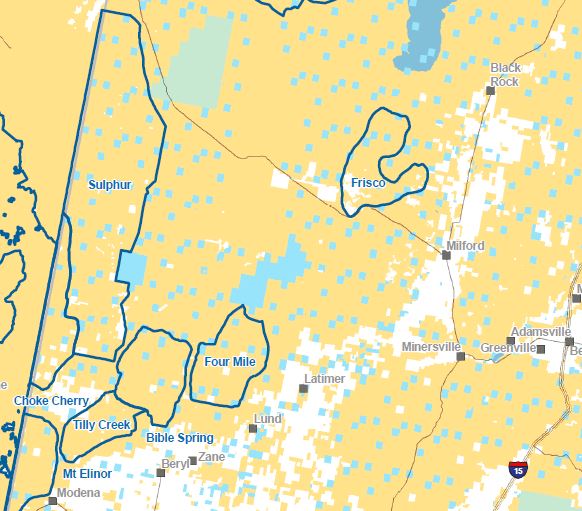
Triple B covers 1,232,494 acres in eastern Nevada.  Maverick-Medicine, to the north, contains 323,562 acres.  The AML at Triple B is 518, for a target stocking rate of 0.4 wild horses per thousand acres.  At Maverick-Medicine, the AML is 276, for a target stocking rate of 0.9 wild horses per thousand acres.

Triple B HMA Map-1

Recall from the discussion in April that fractional stocking rates may indicate large amounts of forage diverted to privately owned livestock.

The estimated population at Triple B is 1,618 wild horses, with an estimated 1,944 wild horses at Maverick-Medicine.

Captured animals will be taken to the off-range corrals at Palomino Valley, about 20 miles north of Reno.

Gather stats and daily reports will appear on this page.

RELATED: Triple B Horses Get Short End of Stick.

Saylor Creek Roundup Pending

BLM said today that all wild horses on the Saylor Creek HMA will be gathered, with 50 to be returned, beginning later this month.  Mares selected for return will be treated with contraceptives.

The operation will be carried out with bait traps, according to the news release, and will not be open to public observation.

The HMA covers approximately 101,900 acres in southern Idaho.  The AML is 50, for an aimed-at stocking rate of 0.5 wild horses per thousand acres.  The current population is 131, including 81 ‘excess’ animals.

Saylor Creek HMA Map-1

The HMA intersects eight grazing allotments.  There are no naturally occurring water sources in the area and the horses survive on water provided by ranchers.

The management plan for the HMA assigns 18 times more forage to livestock than the horses.  That resource would support an additional 932 wild horses, over ten times the number of animals claimed to be ‘excess.’

Captured animals will be taken to the off-range corrals in Boise.  Gather stats and daily reports will be posted at this page.

RELATED: Saylor Creek Horses Get Short End of Stick.

Swasey Progress Report Day 6

The daily reports show 506 wild horses captured through July 20, with none returned to their home range.  The contractor has been removing an average of 84 horses per day.

Most body condition scores over the last two days ranged from three to five, although a few of the horses were rated two.

Foals accounted for 14% of the animals gathered since July 15.

RELATED: Swasey Progress Report Day 4.

Sand Springs Wild Horses Get Short End of Stick

Sand Springs is the third and final HMA in the Barren Valley Complex, an area subject to wild horse management actions per the Decision Record dated June 9.

The number of wild horses and privately owned livestock on the HMA vary with time and rangeland conditions but resource allocations don’t change that much.  What do they reveal about the attitudes and beliefs of those who wrote them?

The management plan allows 200 wild horses on 192,524 acres per Section 1.2 of the Final EA.  The current wild horse population is 422.

The forage requirement for horses is 200 × 12 = 2,400 AUMs per year.  The stocking rate allowed by plan is 200 ÷ 192,524 × 1,000 = 1.0 wild horses per thousand acres and the number of excess horses on the HMA is 422 – 200 = 222.

Like Sheepshead, Sand Springs does not have a fractional stocking rate, so the proportion of forage diverted to livestock may not be as large as Coyote Lake.

The HMA intersects one grazing allotment.  Table 6 in the EA provides the allotment size, permitted forage and grazing season.  Few calculations are required.  The forage budget was converted to cow/calf pairs, as their resource requirements are said to be equivalent to those of wild horses.

The HMA is not 100% subject to permitted grazing but close.  The forage available to livestock inside the HMA is 6,314 AUMs per year.

Sand Springs Calcs-1

The Saddle Butte ranchers would have to place 1,263 cow/calf pairs inside the HMA to graze off 6,314 AUMs in five months (6,314 ÷ 5).  The stocking rate allowed by plan is 6.8 cow/calf pairs per thousand acres (1,263 ÷ 185,636 × 1,000).

These management indicators are compared in the following charts.

Sand Springs Charts-1

The management plan allocates 2.6 times as much forage to domestic livestock as it does for wild horses, on land set aside for the horses.  The plan allows over six times as many cow/calf pairs per thousand acres as it does for horses.

Wild horses were not a priority when the plan was written.  The “principally but not exclusively” clause of the WHB Act was ignored.

The forage assigned to livestock would support an additional 526 horses (6,314 ÷ 12), for a new AML of 726 (200 + 526).

There are no excess horses on the HMA (222 < 526).  Carrying capacity has not been exceeded.  So what is the rationale for roundups and contraceptives?

RELATED: Barren Valley Gather EA Comes and Goes, No News Release.

Jackson Mountains Roundup Ends Early

BLM announced this morning that the roundup was complete, with 85 wild horses removed from their home range on an emergency basis.  No deaths were reported.

The operation began July 4.  The original plan was to remove 300 wild horses over a period of 45 to 60 days.

Captured animals were taken to the Indian Lakes off-range corrals in Fallon, NV.

RELATED: Studs Outnumber Mares 2:1 in Jackson Mountains Roundup.