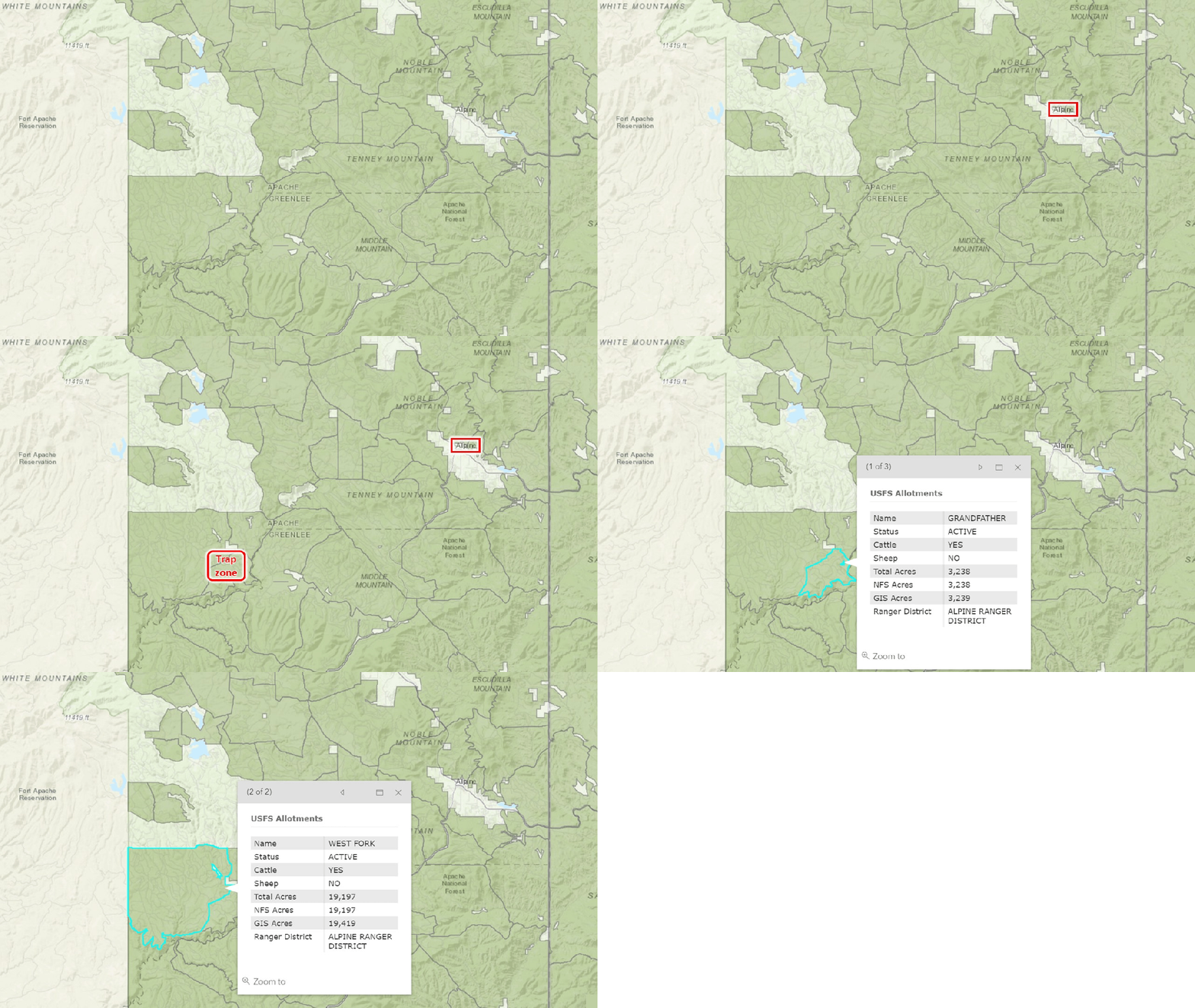
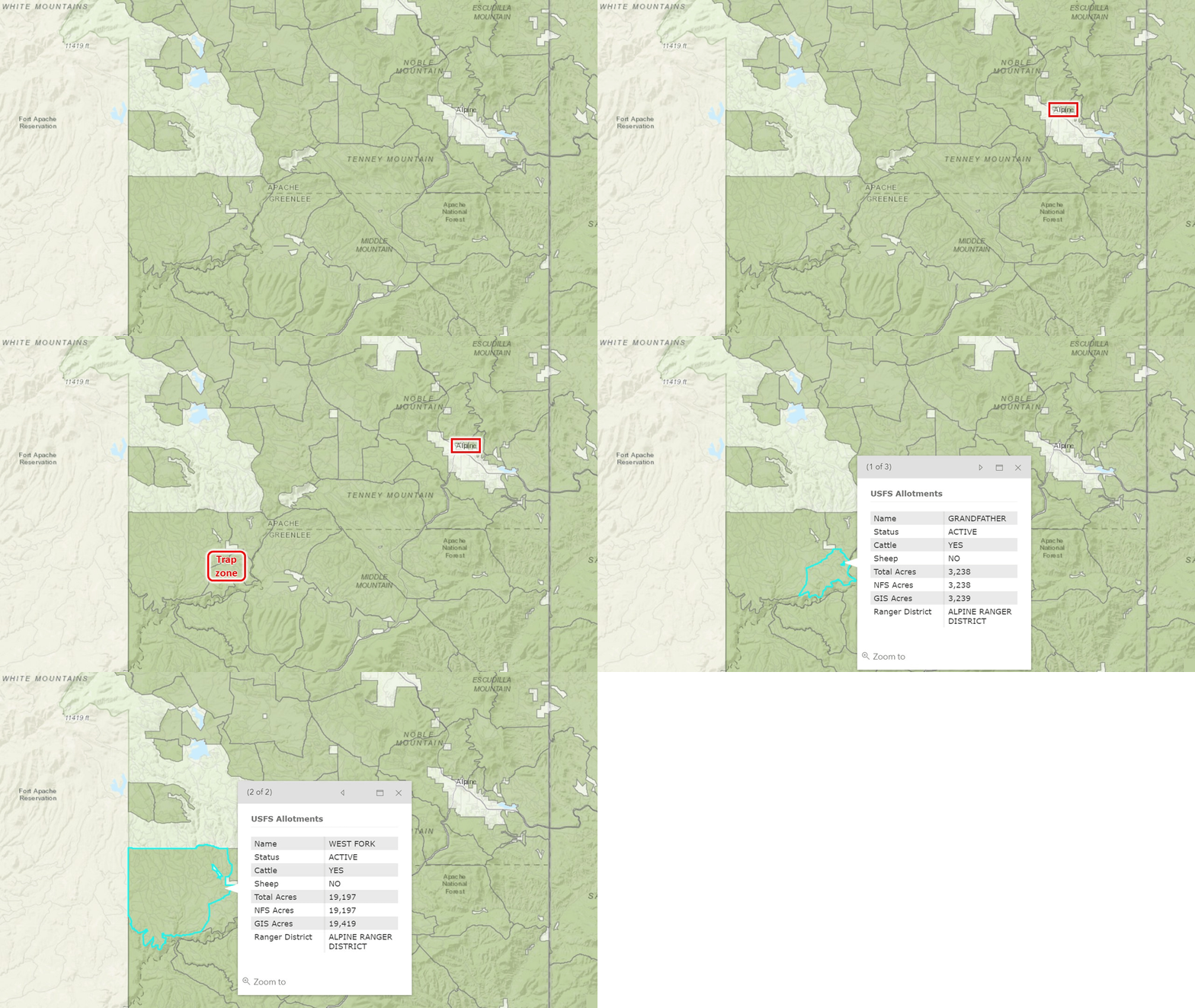
Cedar Mountain Allotments

The new pest control plan is still in the scoping phase and a preliminary EA is still months away, but the Western Watersheds map indicates the HMA intersects four grazing allotments.  Click on image to open in new tab.

Cedar Mountain Allotments 02-18-22

The Allotment Master report puts all of the BLM/public acres in the Improve category.

Cedar Mountain Allotment Calcs 02-18-22

The forage densities (AUMs per thousand acres) provide a basis for estimating the carrying capacities of the allotments.

For example, Aragonite should be able to support 61.5 ÷ 12 = 5.1 wild horses per thousand acres.  North Cedar Mountain should be able to support 7.7 wild horses per thousand acres.

This would be in addition to the horses already allowed by plan.

The aimed-at stocking rate for Cedar Mountain is 0.9 wild horses per thousand acres, in line with the target rate across all HMAs of one wild horse per thousand acres.

Why are those numbers so low?  Because most of the resources have been assigned to privately owned livestock.

RELATED: Scoping Begins for Cedar Mountain Pest Control Plan.

Sulphur Roundup Over

The incident concluded yesterday, according to a statement at the gather page, with 383 horses captured, 352 shipped, 11 dead and 20 returned.

There were no unaccounted-for animals.

The death rate was 2.9%.

The number of horses removed from the HMA was 363.

The capture goal was 376 and the removal goal was 326.

The cumulative total includes 184 stallions, 199 mares and no foals.

Of the adults, 48% were stallions and 52% were mares.

With no youngsters, the herd will shrink without the aid of helicopters.

Body condition scores were not reported.

The BLM claimed the HMA was overpopulated with 600 wild horses, when it authorizes privately owned livestock equivalent to 854 horses in the same area, on top of the 250 horses allowed by plan.

The advocates will likely point to the HMA as a model of wild horse management.

  • No youngsters
  • Ongoing fertility control program
  • Shrinking herd size
  • Over 850 horses displaced by permitted grazing
  • AML corresponds to 23% of authorized forage
  • Has herd management area plan (HMAP)

It might even replace Assateague Island as their favorite.

RELATED: Sulphur Roundup Announced.

PBS to Look at American Horses

Unlike cattle and sheep, horses do appear in the North American fossil record and their story will be told in the next episode of the long-running ‘Nature’ series, set to air on February 23, according to an announcement posted earlier this week by Arizona PBS.

The extent to which the wild vs. feral debate will be considered is not known.

The remark about horses racing across the Pony Express trail may be a reference to the Onaqui Mountain herd, most of them removed from their Congressionally designated habitat last summer, in favor of privately owned livestock.

Refer to local listings for dates and times in your area.

Roy Blames Dearth of Virginia Range Foals on Mountain Lions!

The executive director of the Campaign Against America’s Wild Horses told Nevada Current in a story posted today that the herd is probably at a point of population reduction, “because there is a high mortality rate of foals out on the Virginia range, in large measure because of mountain lions.”

If that’s true, why are they darting the mares?  Let the predators keep the herd in check.

On the contrary, the mountain lions are probably going hungry, thanks to her and her army of volunteers.

RELATED: Lower Speed, More Fencing for Virginia Range Mustangs?

Advocates are the Predators 11-30-21

Sinbad Decision Announced

The BLM has opted for the Proposed Action, minus the use of IUDs, according to the Decision Record signed on February 15.

The news release said a wild burro roundup will occur later this year, although it does not appear on the latest schedule.

Section 3.2.1 of the Final EA notes that “Wild burros, wildlife, and livestock compete directly for the same space, water, and forage resources,” but the DR, which ties substandard conditions and lack of forage to heavy utilization by the burros, indicates that the animals “are also competing heavily with native wildlife” for food and water.

A burro consumes about half as much forage as a horse or cow/calf pair.

The Proposed Action, valid for ten years, is discussed in Section 2.1 of the EA.

The DR and EA have been posted to ePlanning with other project documents.

The HMA is in eastern Utah.

RELATED: Comments Invited on Draft EA for Sinbad Management Actions.

Sulphur Roundup Day 8

The incident began on February 8.  Gather stats through February 15:

  • Target: Horses
  • Type: Planned
  • Method: Helicopter
  • Captured: 377, up from 299 on Day 5
  • Average daily take: 47.1
  • Capture goal: 376
  • Removal goal: 326
  • Returned: 20, up from zero on Day 5
  • Deaths: 11, up from 7 on Day 5
  • Shipped: 308, up from 184 on Day 5

The capture goal has been achieved.

A stallion was euthanized on Day 6, followed by two more on Day 8.  A stallion died on Day 8 of a broken neck.  The death rate increased to 2.9%.

The cumulative total includes 180 stallions, 197 mares and no foals.

The absence of youngsters implies a negative growth rate.  The herd is getting smaller, without the aid of helicopters, which is what the advocates are trying to accomplish in other areas with the Montana Solution.  A growth rate of 20% per year is often used by land managers to predict herd sizes.

Of the adults, 47.7% were stallions and 52.3% were mares.

Body condition scores were not reported.

The location of the trap site within the HMA was not provided.

Twenty stallions were released on Day 8 to an undisclosed location.

Sulphur HMA Map 01-25-22

Day 8 ended with 38 unaccounted-for animals.

The number of horses removed to date is 357.

Mares returned to the HMA, which may correspond to the unaccounted-for animals, will be treated with PZP or GonaCon Equine.

Other statistics:

  • AML: 250
  • Forage assigned to horses: 3,000 AUMs per year
  • Pre-gather population: 600
  • Forage liberated to date: 4,284 AUMs per year
  • Water liberated to date: 3,570 gallons per day
  • Forage assigned to livestock: 10,256 AUMs per year (estimated)
  • Horses displaced from HMA by permitted grazing: 854
  • True AML: 1,104
  • Stocking rate at new AML: 4.8 wild horses per thousand public acres
  • Horses displaced from HMA by drilling and mining: Ask the advocates

RELATED: Sulphur Roundup Day 5.

Pancake Roundup Over

The incident concluded today, according to a statement at the gather page, with 2,054 horses captured, 2,004 shipped, 26 dead and 24 returned.

There were no unaccounted-for animals.

The number of horses removed from the Complex was 2,030.

The capture goal was 2,060 and the removal goal was 2,030.

The cumulative total includes 853 stallions, 954 mares and 247 foals.

Youngsters represented 12.0% of the horses captured, consistent with a growth rate of seven percent per year, assuming a five percent death rate.

Of the adults, 47.2% were stallions and 52.8% were mares.

Body condition scores were not reported.

A coalition of advocacy groups tried unsuccessfully to block the roundup.

The loss of a colt on Day 1 sparked outrage among some advocates and prompted calls for an end to helicopter roundups.

The BLM claimed that the Complex was overpopulated with 3,244 wild horses, when it authorizes privately owned livestock equivalent to 3,612 horses in the same area, on top of the 638 horses allowed by plan.

RELATED: Pancake Roundup Announced.

UPDATE: BLM news release dated February 15 omits deaths.

Pancake Roundup Day 34

The incident began on January 11.  Gather stats through February 13:

  • Target: Horses
  • Type: Planned
  • Method: Helicopter
  • Captured: 2,054, up from 1,980 on Day 32
  • Average daily take: 60.4
  • Capture goal: 2,060
  • Removal goal: 2,030
  • Returned: 18, no change from Day 32
  • Deaths: 26, up from 24 on Day 32
  • Shipped: 1,960, up from 1,871 on Day 32

Gather operations have concluded.

A stallion was put down on Day 34 and another died of a broken neck, lifting the death rate to 1.3%.

The cumulative total includes 853 stallions, 954 mares and 247 foals.

Youngsters represented 12.0% of the horses captured, consistent with a herd growth rate of seven percent per year, assuming a five percent death rate.  A growth rate of 20% per year is often used by land managers to predict herd sizes.

Of the adults, 47.2% were stallions and 52.8% were mares.

Body condition scores were not reported.

The location of the trap site within the Complex was not provided.

Pancake Complex Map 01-07-22

Day 34 ended with 50 unaccounted-for animals.  Some will be returned to the Complex and some will be shipped, with final results announced on Day 35.

The number of horses removed to date is 2,036.

Other statistics:

  • AML: 638 (across two HMAs, one WHT and one HA)
  • Forage assigned to horses: 7,656 AUMs per year
  • Pre-gather population: 3,244
  • Forage liberated to date: 24,432 AUMs per year
  • Water liberated to date: 20,360 gallons per day
  • Forage assigned to livestock: 43,344 AUMs per year (estimated)
  • Horses displaced from Complex by permitted grazing: 3,612
  • True AML: 4,250
  • Stocking rate at new AML: 3.5 wild horses per thousand acres
  • Horses displaced from Complex by drilling and mining: Ask the advocates

RELATED: Pancake Roundup Day 32.

Can the Sulphur Percentage of Foals Be Attributed to Chance?

The gather page for Day 5 of the roundup indicates zero foals captured out of 299.

Sulphur Roundup Results Day 5 02-13-22

If the herd is growing at a rate of 20% per year, as claimed by the bureaucrats and ranchers, it should contain around 25% foals, allowing for a 5% death rate.

Is the observed percentage of foals sufficiently far from the expected percentage to indicate a problem or should it be written off to chance?

The question can only be answered by calculation, using basic statistical formulas.

How to Compute p-chart Limits 02-10-22

The expected range of variation for a simple random process centered at p-bar = .25, with samples of n = 299, is .175 to .325.  Every horse in the sample is a foal or it is not.

The observed percentage of foals is outside this range so the result cannot be attributed to chance.

An investigation should be able to link the observed value with one or more assignable causes, such as a fertility control program.

RELATED: Youngsters Hard to Find at Sulphur HMA.

WSJ Looks at Pancake Roundup

The article can be accessed by subscribers only, but it does include an audio synopsis.

The Complex cannot be overpopulated with 3,244 wild horses, as stated in the story, when the BLM authorizes privately owned livestock equivalent to 3,612 wild horses in the same area, on top of the 638 horses allowed by plan.

The roundup enforces the resource allocations of the land-use plans, and may reduce the effects on the ranchers from a temporary change in the weather.

RELATED: Pancake Roundup Day 32.

Sulphur Roundup Day 5

The incident began on February 8.  Gather stats through February 12:

  • Target: Horses
  • Type: Planned
  • Method: Helicopter
  • Captured: 299, up from 241 on Day 3
  • Average daily take: 59.8
  • Capture goal: 376
  • Removal goal: 326
  • Returned: None
  • Deaths: 7, up from 2 on Day 3
  • Shipped: 184, up from 84 on Day 3

Four horses were put down on Day 4, followed by another on Day 5, lifting the death rate from 0.8% to 2.3%.

The cumulative total includes 145 stallions, 154 mares and no foals.

The absence of youngsters implies a negative growth rate.  The herd is getting smaller, without the aid of helicopters, a result favored by the advocates.  A growth rate of 20% per year is often used by land managers to predict herd sizes.

Of the adults, 48.5% were stallions and 51.5% were mares.

Body condition scores were not reported.

The location of the trap site within the HMA was not provided.

Sulphur HMA Map 01-25-22

Day 5 ended with 108 unaccounted-for animals.

With an average daily take of 60, the capture goal should be achieved by Day 7.

The number of horses removed to date is 299.  Horses returned to the HMA will be treated with population suppression of unspecified type.

Other statistics:

  • AML: 250
  • Forage assigned to horses: 3,000 AUMs per year
  • Pre-gather population: 600
  • Forage liberated to date: 3,588 AUMs per year
  • Water liberated to date: 2,990 gallons per day
  • Forage assigned to livestock: 10,256 AUMs per year (estimated)
  • Horses displaced from HMA by permitted grazing: 854
  • True AML: 1,104
  • Stocking rate at new AML: 4.8 wild horses per thousand public acres
  • Horses displaced from HMA by drilling and mining: Ask the advocates

The HMA cannot be overpopulated with 600 wild horses, when the BLM authorizes privately owned livestock equivalent to 854 wild horses in the same area, on top of the 250 horses allowed by plan.

RELATED: Sulphur Roundup Day 3.

Burro Removal at Chocolate Mountain Gunnery Range?

Last June, personnel at the Marine Corps Air Station Yuma asked the BLM to remove 30 to 40 wild burros from the western edge of the Chocolate Mountain Aerial Gunnery Range in Imperial County, California, according to a new project at ePlanning.

The range is between the Salton Sea and Chocolate Mule Mountains HMA.

The roundup would be carried out with bait traps and captured animals would be taken to the off-range corrals at Ridgecrest.

Chocolate Mountain Gunnery Range Map 02-12-22

The project includes no supporting documents and it has not been announced at the BLM news site.

Opportunities for public involvement may be limited, given that the BLM is seeking approval under a categorical exclusion.

Pancake Roundup Day 32

The incident began on January 11.  Gather stats through February 11:

  • Target: Horses
  • Type: Planned
  • Method: Helicopter
  • Captured: 1,980, up from 1,860 on Day 29
  • Average daily take: 61.9
  • Capture goal: 2,060
  • Removal goal: 2,030
  • Returned: 18, no change from Day 29
  • Deaths: 24, up from 20 on Day 29
  • Shipped: 1,871, up from 1,732 on Day 29

Three horses were put down on Day 30, followed by another on Day 31, boosting the death rate to 1.2%.

The cumulative total includes 822 stallions, 919 mares and 239 foals.

Youngsters represented 12.1% of the horses captured, consistent with a herd growth rate of seven percent per year, assuming a five percent death rate.  A growth rate of 20% per year is often used by land managers to predict herd sizes.

Of the adults, 47.2% were stallions and 52.8% were mares.

Body condition scores were not reported.

The location of the trap site within the Complex was not provided.

Pancake Complex Map 01-07-22

Day 32 ended with 67 unaccounted-for animals.

With an average daily take of 62, the capture goal should be reached by Day 34.

The number of horses removed to date is 1,962.  Mares returned to the Complex will be treated with fertility control of unspecified type.

Other statistics:

  • AML: 638 (across two HMAs, one WHT and one HA)
  • Forage assigned to horses: 7,656 AUMs per year
  • Pre-gather population: 3,244
  • Forage liberated to date: 23,544 AUMs per year
  • Water liberated to date: 19,620 gallons per day
  • Forage assigned to livestock: 43,344 AUMs per year (estimated)
  • Horses displaced from Complex by permitted grazing: 3,612
  • True AML: 4,250
  • Stocking rate at new AML: 3.5 wild horses per thousand acres
  • Horses displaced from Complex by drilling and mining: Ask the advocates

RELATED: Pancake Roundup Day 29.

Lower Speed, More Fencing for Virginia Range Mustangs?

Yesterday’s meeting produced a variety of suggestions for reducing collisions with vehicles, according to a story by the Reno Gazette Journal.

Another meeting was scheduled for May 16, to review data and recommendations from speed studies in south Reno.  The goal is to draft an action plan by the fall.

Not mentioned in the report is the clear and present danger of the advocates.

Every year they eradicate 600 to 750 wild horses with the Montana Solution, compared to a dozen or so killed by motorists.  Why isn’t the city investigating them?

RELATED: City of Reno to Host Meeting on Virginia Range Mustangs.