Two year old colt, left, with his mom, 05/26/18. No imprinting, no weaning. Mom still making milk. Three year old sister present but out of frame. Adopted 2015 from BLM.
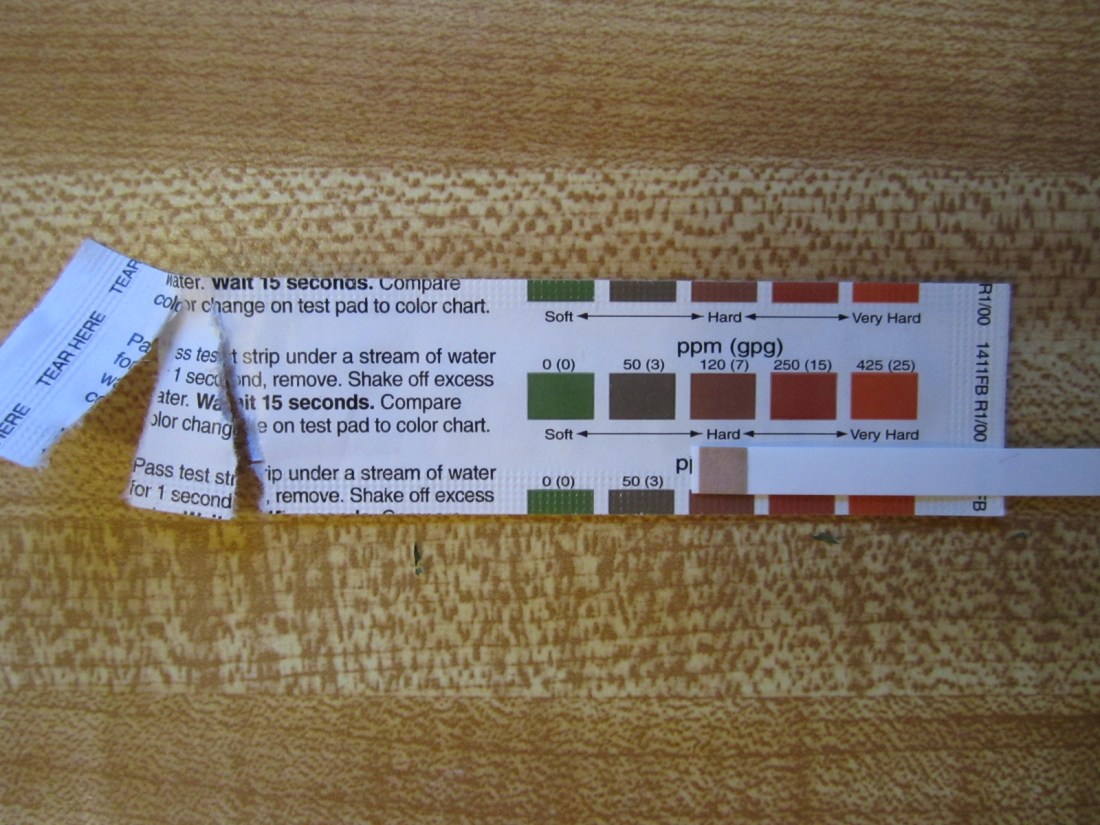
Your water treating supplier can give you test strips to monitor the hardness of water from your well and downstream of the treatment system. In the example below, there is no green tint, no orange tint, so the hardness is around seven grains per gallon. Photo was taken about an hour after the test so the indicator may have faded.
Your supplier may also have kits that measure other properties of your water, such as pH, hardness and alkalinity. If not, try a pool equipment vendor. The kit may also test for chlorine, which typically is not present in rural water systems.
The addition of chlorine or bleach to water creates hypochlorous acid, among other things, which kills bacteria. If you have a pool at your ranch or other body of water you’re trying to disinfect, it’s important to keep the pH between seven and eight so the HA can do it’s job.
Look at a bottle of Vetericyn, a common treatment for wounds in the horse world. The active ingredient is hypochlorous acid.
New adoption site now available according to a news release from the BLM dated 05/18/18.
First-time users will have to create an account at the home page.
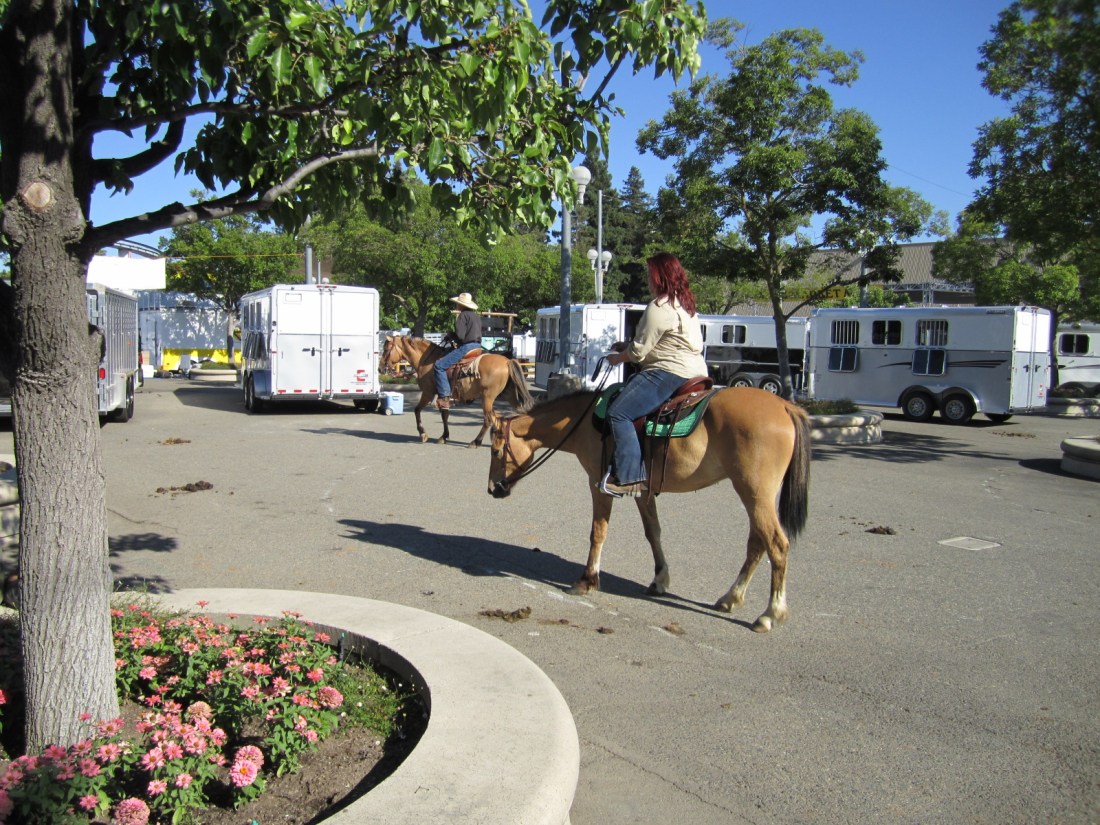
In a related news release, BLM announced that four saddle-trained horses would be offered for adoption at the Western States Horse Expo, June 8 – 10, 2018 in Sacramento, CA.
The last step in installing a pump in your well is to connect it to the water and power systems.
In the photo below, black poly tubing brings water into the pump house, transitioning to white PVC pipe inside the wall. It connects to the water system at the pressure switch, the small grey box above the PVC pipe with corrugated metal conduits on either side.
The wall-mounted box with orange label is the controller for the pump. To the left is a smaller box that monitors for dead-heading and dry-running.
The colored wires going into the slab provide power to the pump, 480 feet down.
The grey panel near the door provides power to all circuits in the pump house. The receptacle at the lower left of the panel lets you plug in your portable compressor, in case the air in the pressure tanks needs to be topped off.
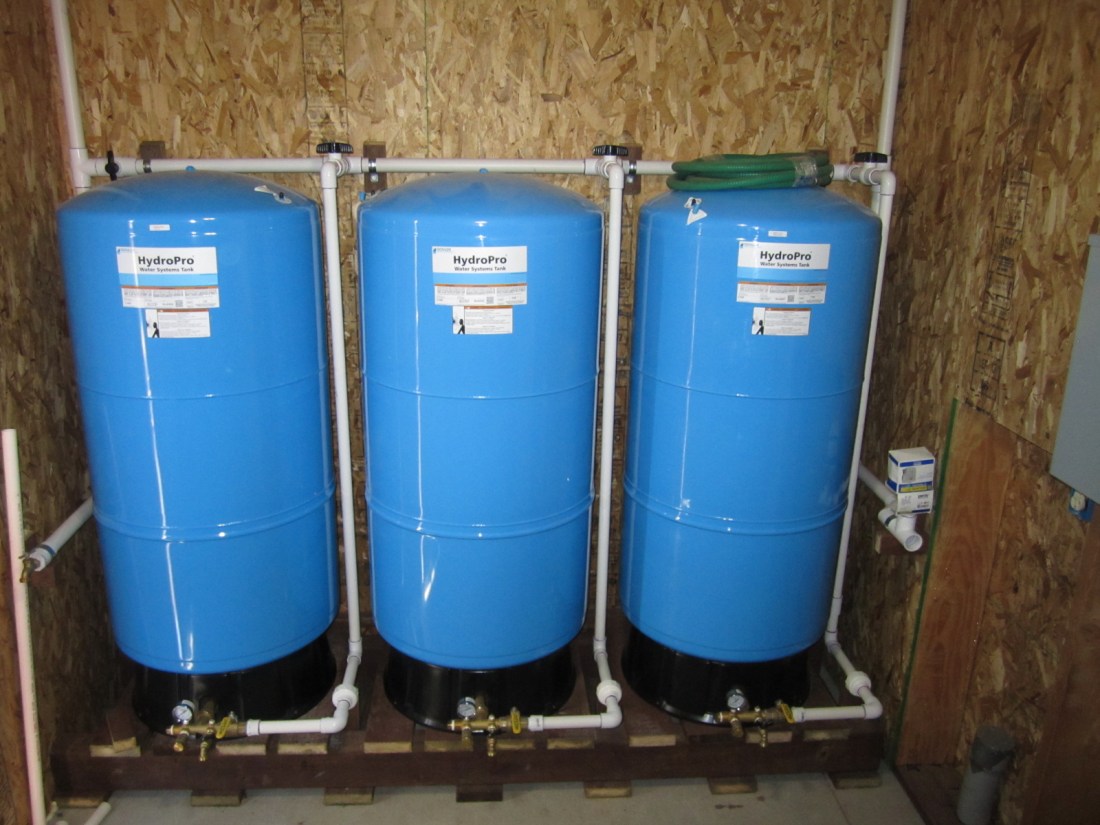
Now you have water to the surface! You’ll want to cycle the system several times to flush out any turbidity (cloudiness). Connect a hose to the drain valve on one of your pressure tanks and let the water run out until the pump comes on (40 psi). When the pump shuts off (60 psi), open the valve and drain the tank(s) again. Repeat until the water is clear.
After you install a treatment system, you’ll have clean, fresh water for your horses.
If you need overnight accommodations, check out Horse Motels International, a listing of individuals and businesses that board horses on a daily basis.
Be sure to read the travel tips before you hit the road. Health certificates (for your horses) will probably be required, especially if you’re crossing state lines.
Horses move other horses by applying pressure. If a lower horse yields to a higher horse, pressure is released. When the lower horse moves, he may protest with a tail swish or kick. If the pecking order is not well established, the lower horse may challenge the higher horse by pushing back, biting, rearing or kicking.
You use the same technique to communicate with your horse. A good horseman tries to achieve a result with the least amount of pressure. For example, he’ll ask his horse to back up with a simple voice command, nod of his head, or light touch to the chest.
If the horse doesn’t respond, he’ll turn up the heat.
Please
Pretty please
You better
You should have
When the horse moves, he gets release. That’s the right answer, and the horse just learned it. No hugging and kissing, no verbal praise, those are pressure.
The mom in this video starts in stage 1 but ends up in stage 4, where she lays down the law. The segment of interest runs from 1:24 to 13:58.
Sadie, Scooter and Trapper enjoying some alfalfa on 05/26/18.
Yeah, the corral needs to be cleaned, their feet need to be trimmed, and they’ve put on a few pounds.
If you find yourself spending a lot of time on the exercise bike, maybe get some land, adopt some horses, and take up the ranching lifestyle. Your biggest problems will be keeping weight on and getting enough sleep.
A fine example of virility and potency, on the part of the mom. This comes as a shock to individuals in western culture, now overrun with effeminacy and cowardice.
If temperatures at your ranch drop below freezing for days or weeks at a time, the riser from your pump (pipe that brings water to the surface) can’t exit the well from the top.
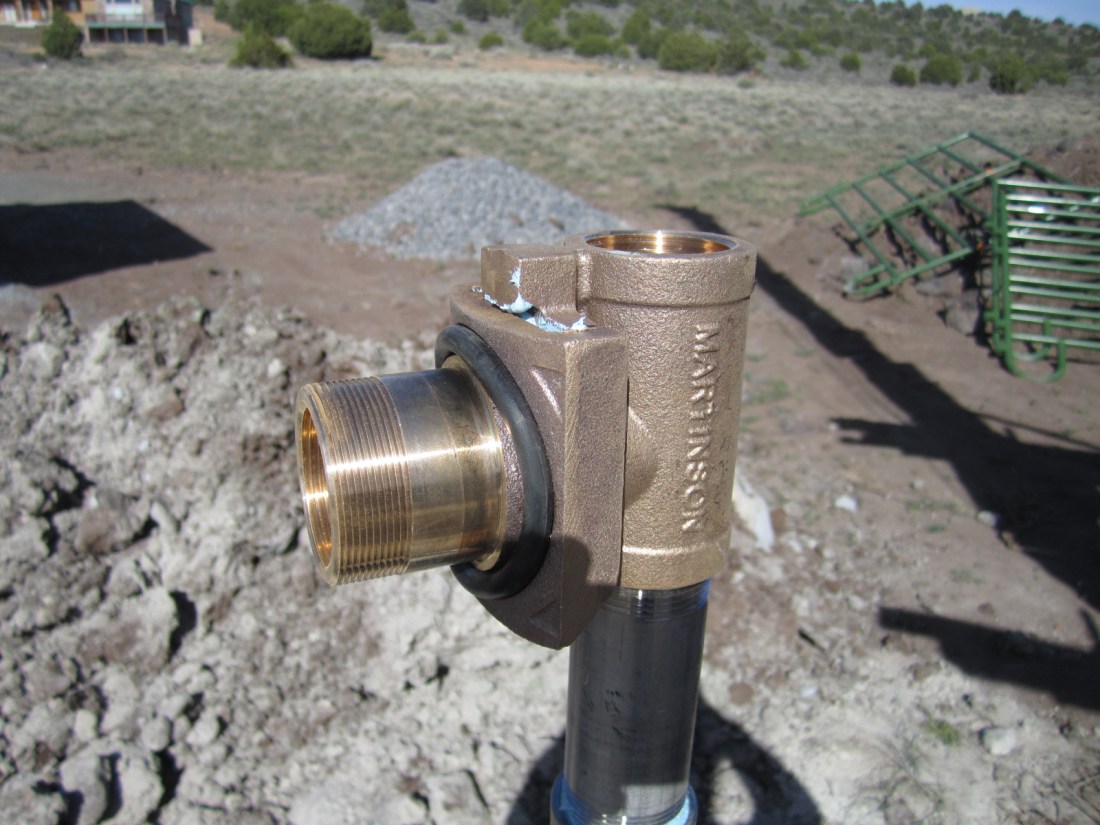
Your contractor will cut a hole in the case at the appropriate depth, 36″ in this example, to install a special fitting known as a pitless adapter.
The adapter functions like a 90 degree elbow, but is threaded at the top so the hoisting rig can lower the assembly (pump, riser and fitting) back into the well. The o-ring seals it to the inside of the casing, preventing surface water intrusion. When installed, the outlet of the fitting (male threads) protrudes from the casing. The contractor will connect an underground line to the fitting and run it over to your pump house.
The line should enter the pump house on an interior wall. The gray conduit stub seen in the lower right of this photo is where that will happen (contractor will push 1.25″ poly tubing from the well up through the stub). The pressure tanks and water treating equipment will also need to be protected from freezing. The pressure switch is on the right in this photo, covered by its box, at the inlet to the system. A 500 watt heater keeps the space warm (above freezing) in the winter.
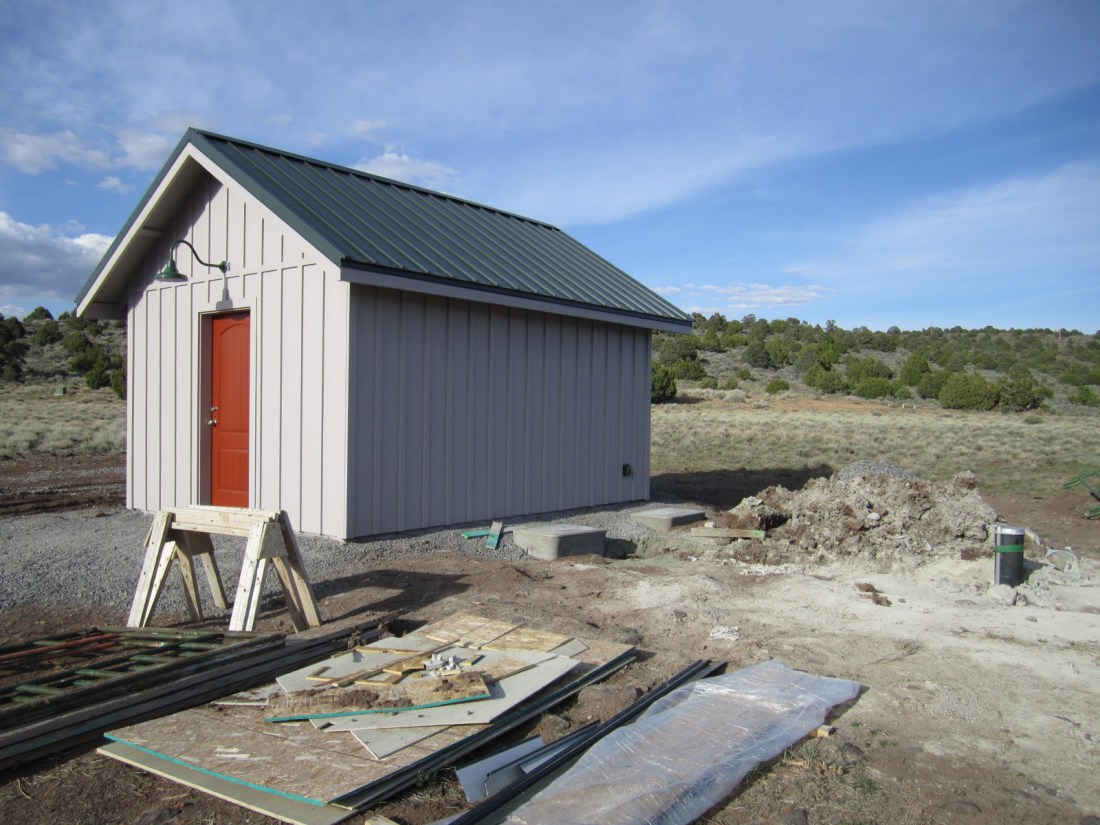
This photo shows the basic arrangement, construction almost complete. The well is on the right. Cement-fiber siding and metal roof for fire resistance. The gooseneck lights (one in the rear also) are on dusk-to-dawn control.
Next to the house and barn, you’ll probably spend more money on the water system than any other part of your ranch. But that’s what you have to do if you want live among the wild horses of the American West.
If you’re in a rural area, you’ll want a means of defending yourself, your family, your livestock and your property (assuming you live in a state where it’s legal to do so).
Your arsenal should include some or all of the following, plus 5000 rounds of ammo (at least) and a working knowledge of said weapons and ammunition.
Handgun with night sights and weapon light
Shotgun, 18″ barrel, with mag extension, night sights, weapon light
Semi-auto rifle configured for close quarters, 16″ barrel, weapon light, red dot sight
Semi-auto rifle configured for medium range, 18″ barrel, magnified optic
Bolt-action rifle for long range, 20 to 24″ barrel, magnified optic
A common handgun size is 9 mm. Ammo is usually plentiful and inexpensive. If you’re nostalgic for the Old West, get a Single Action Army (Colt .45).
The shotgun would likely fall into the tactical category, 12 gauge, with an assortment of rifled slugs and buckshot.
The 16″ semi-automatic rifle could be chambered in 5.56. Bulk ammo (55 and 62 grain) runs around 40 cents per round, match ammo (75 grain) costs about 90 cents per round.
The 18″ rifle would probably be chambered in .308. Match ammo (168 grain) costs about 90 cents per round. Like the 5.56, get extra mags and pre-load them.
The bolt action rifle can be also used for hunting. It can be chambered in .308 or something larger. Ammo may cost $1.00 to $2.00 per round. The optic should cost as much or more as the rifle.
You’ll also want eye and ear protection.
Basic safety rules for guns:
Keep them in a safe (but accessible) place
Always assume they’re loaded
Don’t put your finger on the trigger until ready to fire
Never point them at anything you wouldn’t want to destroy
Know what’s in the background of your shot
There are many Youtube channels, many videos and many opinions out there so take some time to learn what’s right for you. A few examples:
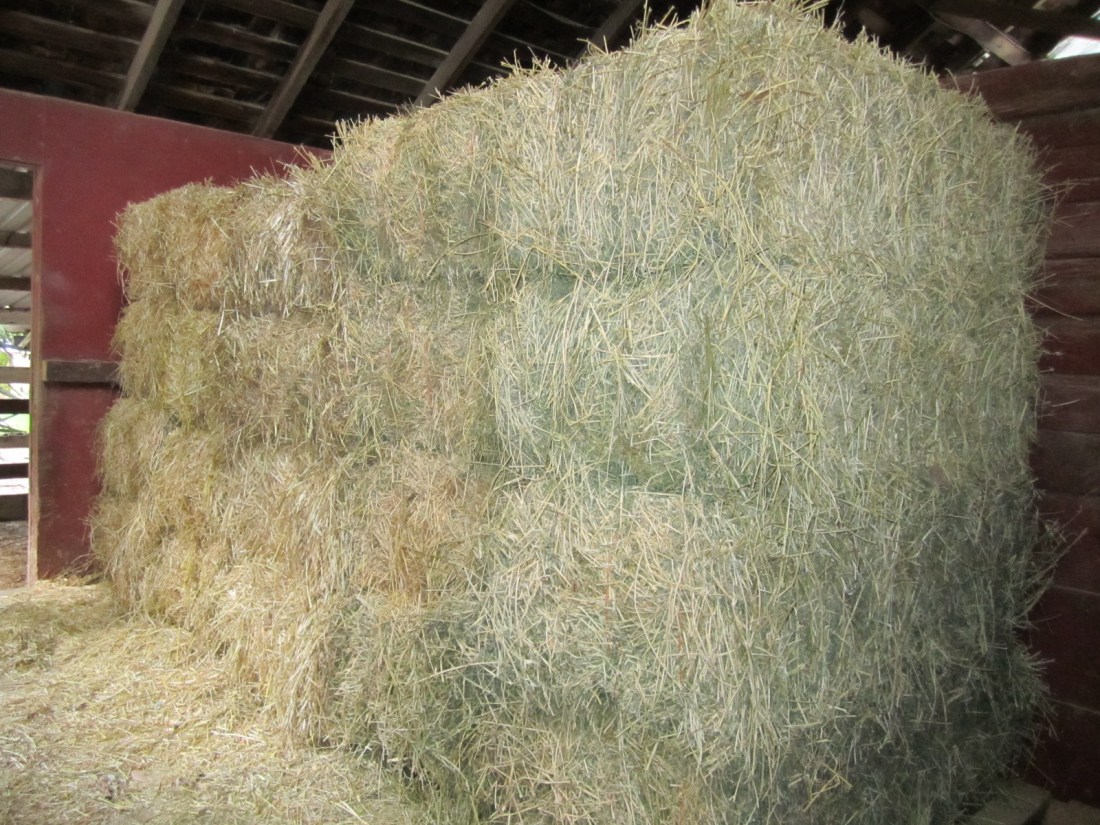
Your emergency preps should include hay for your horses, enough for a month. Keep it dry and away from sunlight.
Natural events, such as earthquakes, wildfires and hurricanes may force businesses to close for weeks. Transportation may be interrupted. Power and fuel may be in short supply.
Your back may go out, where you can’t even scoop poop, let alone stack hay. (You do stack your own hay, right?)
The quality of the hay may deteriorate over time, so after a period of six to twelve months, rotate it out with fresh bales. But always keep a one-month supply on hand and don’t touch it unless there’s an emergency.
Round pens are great. Especially when you have multiple riders and long-shank bits. The horse goes left, he gets pressure. The horse goes right, he gets pressure. Turns to the inside, he gets pressure. Turns to the outside, more pressure. There is no right answer.
Let’s round up more of our wild ones and put them in programs like this.
This episode of Bonanza tells the story of Philip Deidesheimer, inventor of square-set timbering, one of the greatest advances in mining technology of the Old West.
The year is 1860, the setting is the Ophir Mine on the north end of Virginia City. Originally aired 1959.
The map that appears in the opening credits has been turned ‘sideways,’ north is on the left. The Ponderosa Ranch was situated between Lake Tahoe and the Virginia Range.





 Western Horse Watchers Association