“Let the mustang be in charge.”
Can you think of a better way to set him up for failure and put yourself at risk of injury?
The full video runs nearly two hours.
Some equestrians are as nutty as the wild horse advocates.

Western Horse Watchers Association
Exposing the Hypocrisy, Lies and Incompetence of the Wild Horse Advocates
Opinion
“Let the mustang be in charge.”
Can you think of a better way to set him up for failure and put yourself at risk of injury?
The full video runs nearly two hours.
Some equestrians are as nutty as the wild horse advocates.
Lately they’ve referred to it as humane management, in-the-wild management or one of these terms:
They all mean the same thing: Wiping out herds with ovary-killing pesticides.
There are no helicopters, no horses falling out of trailers on the way to off-range corrals and no euthanizing animals for pre-existing conditions.
But the results are the same, with the added benefit that the herds don’t bounce back.
RELATED: Humane Disposal of Wild Horses and Burros?
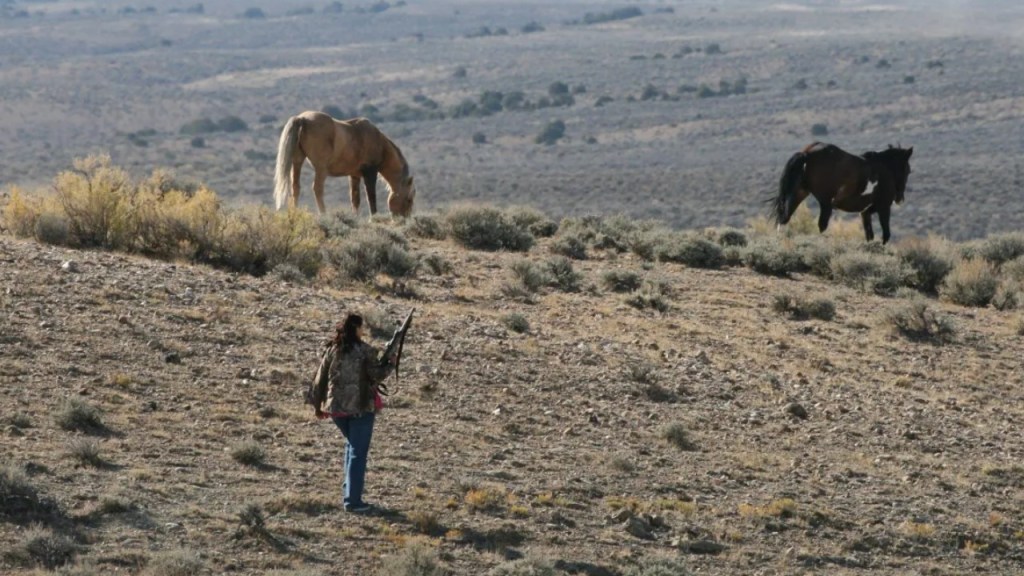
The NGO advising you of a threat to animals in off-range holding is, in fact, humanely disposing the herd on the Virginia Range.

Its affiliate in Arizona, who insists that the state’s new plan will destroy the Salt River herd, is in fact destroying the herd.
Whatever the advocates warn you about, they’re doing times ten, a sure sign they’re liberals.
RELATED: Project 2025 Targets America’s Wild Horses and Burros?

The advocates are obsessed with nonmotorized removal, which they express several different ways:
Their allies in Congress recently formed a pesticide caucus.
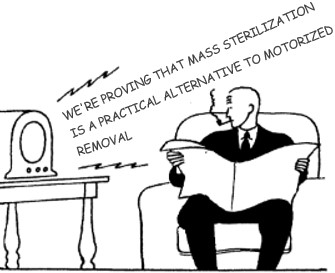
Everything points to mass sterilization as a humane alternative to motorized removal with the goal of ranching superiority in the lawful homes of wild horses.

The advocates know that most of the mares are nonviable, a condition they caused, and the herd is toast.
No big deal if their contract isn’t renewed, they can go elsewhere and ruin another herd or find jobs with the legacy contractors.
The group claiming that the state’s new plan will destroy the herd is, in fact, destroying the herd.
The group that says any other contractor hired by the state will eradicate the herd is, in fact, eradicating the herd.
The group that says the herd will become extinct if they aren’t allowed to manage it is, in fact, driving it to extinction.
RELATED: As the Noose Tightens Around SRWHDG, Will CAAWH Hang Them Out to Dry?
The Deputy Director for Administration and Programs was escorted out of the building yesterday because he opposed staffing directions from DOI’s acting chief human capital officer, according to a report by Politico.
The move punches another hole in the BLM org chart, which still includes a vacancy at the top.
RELATED: Sgamma Nomination Withdrawn.

The Decision Record authorizes the Proposed Action, discussed in Section 2.4 of the Final EA.
A new HMAP was also approved. Refer to Appendix D.
Section 2.3.2.2 refers to outdated registrations for GonaCon-Equine.
The project folder includes a summary of public comments.
The news release said there are currently more than 1,000 wild burros in and around the HMA.
RELATED: Bullfrog EA Out for Review.
Why didn’t the reporter ask Netherlands how many of the mares have been ruined by PZP?
Those who want the horses gone will likely get their wish because the advocates have pushed the birth rate below the death rate with little hope for recovery.
The Salt River Wild Horse Darting Group receives support from the Campaign Against America’s Wild Horses, a leader in nonmotorized removal, fierce opponent of principal use and servant of the public-lands ranchers.
As the truth leaks out in Arizona, look for CAAWH to distance itself from SRWHDG, disavowing any knowledge of their actions.
RELATED: Salt River RFP Cancelled.
The Campaign Against America’s Wild Horses, a leader in nonmotorized removal, fierce opponent of principal use and servant of the public-lands ranchers loves it.

The bill was based on recommendations from the Colorado Wild Horse Working Group.
RELATED: HB25-1283 Now Law.
In a 2020 management plan summary, the Arizona Department of Agriculture noted that the Salt River herd consisted of approximately 450 horses, with a recommendation to reduce it to 100 to 200 horses by the use of birth control and natural attrition.
A third party with a no-cost contract would work to achieve the goal within ten years.
The Salt River Wild Horse Darting Group, an affiliate of the Campaign Against America’s Wild Horses, was recruited for the job.
The weapon of choice was PZP.
The effectiveness of the effort would be assessed in five years and that process has been started.
What the advocates did not tell the bureaucrats, apparently, is that most of the mares would be ruined after five years of treatment and that the herd would not reach the target range but pass through it in irreversible decline.
It’s hard to believe that they would lie about anything, especially EPA-registered pesticides, which they refer to as vaccines.
With few exceptions, their nonprofits revolve around the use of these products, and they’re now trying to position themselves as a humane alternative to motorized removal.
RELATED: Foal-Free Friday, Synonyms for Sterilization Edition.

Dr. Laura’s proprietary formula, peddled at last year’s conference in Reno, made a lot of people sick.

Their strategy is to market an idea that appears to address the issues while leaving the real problem untouched.
Can you say moooo?
A good way to hide a problem is to omit it from the discussion and that’s what the writer does in a May 19 column about wild horses published by The Hill.
From the first paragraph: “With few natural predators and virtually no population control, these animals have multiplied far beyond the landscape’s carrying capacity — leading to degraded rangeland wildlife habitat, brutal horse starvations and mounting taxpayer costs.”
If accuracy was the goal—and it is not—the intro would read “With few exceptions, areas identified for wild horses are overlapped by grazing allotments, and management plans developed by the government favor ranching interests, not wild horses.”
That would explain the symptoms in the opening remarks:
If the writer was honest, he’d tell you that the bureaucrats assign about 80% of the forage in the lawful homes of with horses to ranchers.
Carrying capacities are much higher than the government admits and the off-range corrals are flooded with wild horses because the government manages the land primarily for livestock.
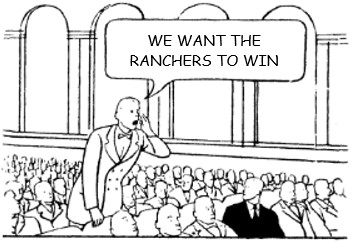
Curiously, the nonprofit that won the case, halting the adoption incentive, wants the horses gone as much as the ranchers.
But they want it done with pesticides not helicopters.
RELATED: Why Are There So Many Wild Horses in Off-Range Holding?
The term was defined in a May 16 article by The Fence Post as purchasing agricultural lands and converting them to wildlife refuges.
The Public Lands Council, a ranching trumpet, opposes the concept and hiring decision.
If a proposed refuge for wild horses does not include public lands and does not displace livestock therefrom, it’s not worthy of your support.
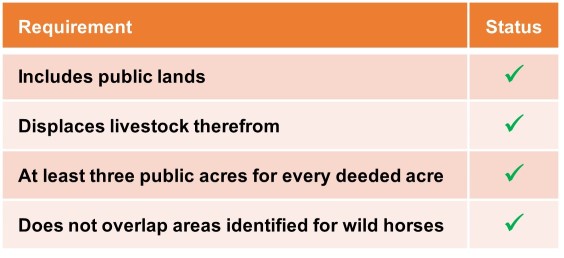
These people are complete phonies.

They’re wiping out the herd with ovary-killing pesticides so ranchers can access most of their food.
Financing was provided by the BLM.
Pick a random acre.
Is it subject to drilling or mining? Probably not.
How about logging? Maybe.
Permitted grazing? Almost certainly.
Does it stand on its own two feet? Pull its own weight? No.
The ranchers pay almost nothing for the resources they consume and the services rendered on their behalf by the government and its partners.
The grazing fee would have to be raised to $15 per AUM just to pay for the wild horse and burro program.
10,000,000 AUMs sold per year × $15 per AUM = $150,000,000 per year
The current fee is $1.35 per AUM.
The advocates portray drillers and miners as the bad guys while giving the ranchers a pass.
Makes you wonder whose side they’re on.
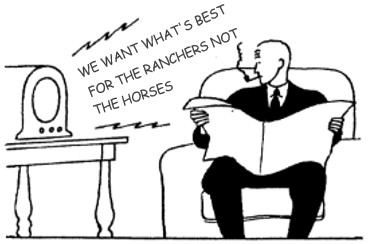
If we don’t get these buffoons off the range we won’t have any wild horses.

RELATED: Pesticide Caucus Serves Ranchers Not Wild Horses.

Added Defending to the list.

RELATED: Synonyms for Wiping Out Herds with Ovary-Killing Pesticides.
Like the NGOs behind it, the membership will not advocate for principal use and management at the minimum feasible level.
Instead, it will support the goal of ranching superiority in the lawful homes of wild horses, sometimes referred to as achieving and maintaining AMLs, but the weapon of choice will be pesticide-laced darts, not low-flying helicopters.

Moreover, they’ll argue that it’s not removal, even though the numbers go down just like they do in roundups.
The major difference is that the herds don’t bounce back.
RELATED: Congress Rides to the Rescue with Wild Horse Caucus?
Do not be fooled by the announcement, brought to you by the Las Vegas Sun in a story dated May 8.
It’s a ploy backed by the big-name advocacy groups to replace motorized removal with mass sterilization.
They want the horses removed in favor of livestock but they want it done with pesticides not helicopters.


