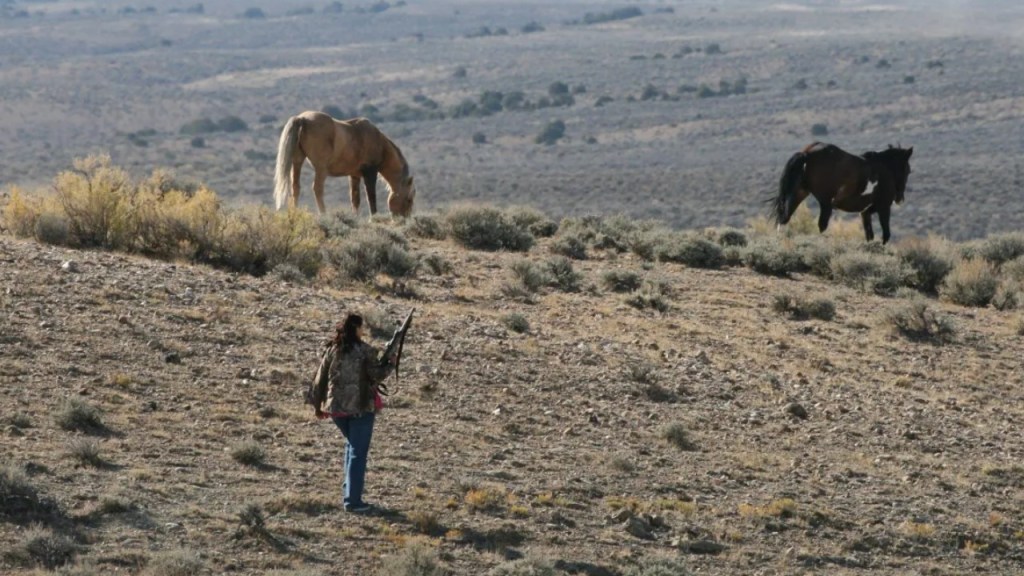
Salt River Herd Doomed?

Consider two options for wild horse management.  One was announced by the Forest Service, the other proposed by the advocates.

Can you tell which is which?

Alternative A

  • Initial population: 400
  • Final population: 0

Alternative B

  • Initial population: 400
  • Final population: 0

Let’s add headings and change the numbers to reflect the way they were sold to the public.

Alternative A – Motorized Removal

  • Initial population: 400
  • Final population: 0

Alternative B – Nonmotorized removal

  • Initial population: 400
  • Final population: 200

Now can you tell the difference?

The bureaucrats decided to implement Alternative B, the plan submitted by the advocates.

Why is it a hoax?

Because the volunteers are sterilizing the mares.

The final population will be zero.

RELATED: Advocates, Not Forest Service, Destroying Salt River Herd

Advocates, Not Forest Service, Destroying Salt River Herd

As you read this article about the fertility control program, think of Simone Netherlands as a marionette with Suzanne Roy pulling the strings.

The events leading to the current situation are discussed in a 2019 report to the Arizona Department of Agriculture and U.S. Forest Service.

In a nutshell, the Forest Service announced that it would be removing wild horses from the Tonto National Forest and the advocates stepped in and said “Let us do that.”

Let Us Fix Your Wild Horse Problem 02-18-23

Recalling the early days, Netherlands said “At that time, we narrowly escaped removal of the Salt River Wild Horses and offered our way of management to both the state and the federal government.”

What she meant was their way of removal.

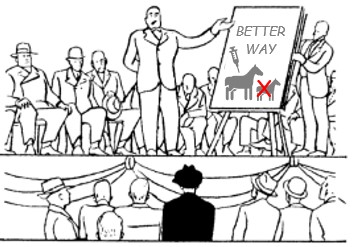
Better Way 10-25-23

One of her most outrageous statements involves birth rates and breeding patterns: “If we do want the mare to have a baby, we just don’t dart her that year,” as if conception can be switched on and off like a light bulb—a reference to the sperm-blocking theory.

The longer a mare has been treated with PZP, the longer she takes to regain fertility, about a year per year.

After five years of treatment, she won’t recover.  She’s said to be self-boosting, a codeword for sterile.

Clearly, the horses are not in control of their future.

The management plan allowed ten years for birth control and natural attrition to reduce the herd to 100-200 head, from an initial size of around 400.

Do you think after a decade of nonstop darting the herd will come in for a soft landing, finally in balance with its surroundings?

That’s what they tried at Assateague Island and the herd was still shrinking eight years after the darting program was shut off.

RELATED: Salt River Darting Program by the Numbers.

ASU Professor to Speak About Compassionate Conservation

Would you attend a lecture based on lies and propaganda?

Consider this statement, taken from the undated announcement:

Wild horse populations grow at a rate of 15-20% per year and compete with cattle, deer, elk, and bighorn sheep for valuable forage and water resources, which threaten fragile riparian ecosystems through soil compaction and overgrazing.  While most U.S. policies advocate for the removal of these “non-native” horses, horse advocates continue to push for more territory and rights.

Cattle are the nonnative species and on public lands they outnumber wild horses by a huge margin.

Growth rates of 15-20% per year require birth rates of at least 20-25% per year and this is rarely seen in roundup data.

In discussions of wild horses, conservation is a codeword for eradication, make sure ranchers get most of the resources.

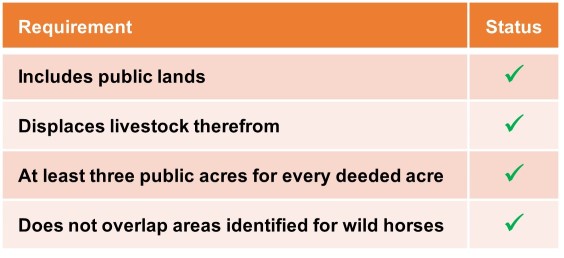
BLM allotments in Arizona support livestock equivalent to 53,662 wild horses on 10,090,546 public acres, or 5.3 wild horses per thousand public acres.

Thriving Ecological Balance-3

Pancake HMAP Proves Advocates Ill-Informed About Wild Horses

Remember last April, at the Save Our Wild Horses Conference in Reno, when they were higher than a kite on HMAPs?

Now that the plans are rolling out, they’ve developed a bad case of amnesia.

Consider the Pancake HMAP, just released.  It’s discussed in Appendix XIII of the Final EA for management actions in the Complex.

  • Area will be managed for 336-638 wild horses
  • Gather and remove excess animals to reach low AML as soon as possible
  • Apply fertility control pesticides and/or IUDs to released mares
  • Maintain a sex ratio of 60% males and 40% females
  • Bring in mares from another HMA if genetic diversity declines

This must be good for the herd because it doesn’t include aerial shooting.

RELATED: Antelope-Triple B HMAP Proves Advocates Are Ill-Informed About Wild Horses.

Surface Management Agencies Along the Salt River

The river flows westward through a mountainous area in the Tonto National Forest until it reaches Saguaro Lake.

Along the way, it passes the Sunflower Allotment to the north and the Reavis, Tortilla, Superstition and Goldfield Allotments to the south.

Then it flows west southwest through Goldfield before crossing into BIA land.

The Saguaro WBT overlaps the southern portion of Sunflower but it is inactive, the equivalent of an HA on BLM land.

Sunflower is permitted for cattle according to the ArcGIS viewer.

Reavis, Tortilla and Superstition are vacant and Goldfield has been closed.

In years past, wild horses were spotted around the lake, including the Butcher Jones Recreation Area at the southern edge of Sunflower.

They can also be found at Coon Bluff and the Phon D Sutton Recreation Area, both of which are at the western end of Goldfield.

Robbing forage from Sunflower livestock would be unacceptable but there are probably fences keeping them out of that area so there must be some other reason the advocates are sterilizing the mares with PZP.

Surface Management Agencies Along the Salt River 03-10-25

Diamond Anniversary of Wild Horse Preservation Movement

Velma’s first encounter with the horse runners occurred 75 years ago.

The Virginia Range was ground zero.

Today, it is the site of the world’s largest mass sterilization program, an insult to her legacy and harbinger of changing attitudes toward wild horses—among those who claim to be their voices.

Women have always been at the forefront of the movement but today’s women are not like those of 1950.

Women at the Forefront 03-08-25

They’re liberals—anti-God, anti-life and anti-family.

For them, wild horse preservation came of age with the advent of PZP, a restricted-use pesticide that sterilizes mares after five years of treatment.

That aligned with their wicked ideology and explains what you see today.

Pesticide Pushers 07-17-23

BLM Issues Montgomery Pass Final Planning Documents

The Decision Record authorizes the Proposed Action, discussed in Section 2.2 of the Final EA, which calls for wild horse removal by helicopter or bait.

Map 1 in Appendix 1 shows the project area.

All documents have been copied to the project folder.

There are no plans to treat any of the mares with fertility control pesticides and return them to the range.

A roundup does not appear on the latest schedule.

The news release said that appeals can be submitted through April 7.

RELATED: Montgomery Pass EA Out for Public Review.

AIP Fallout

What will happen now that the incentive has been abolished?

  • Roundups will continue
  • Wild horses and burros will still be offered for adoption
  • Adoptions will decrease
  • Off-range holding will increase

The government will need new ideas to keep the populations in check.

Better Way 10-25-23

Who will be waiting in the wings to provide those services?

Those who brought the lawsuit.

Totally self-serving.

RELATED: Court Halts AIP.

Author of HB25-1283 Receives Wild Horse Annie Award?

Should this be construed as an endorsement of the bill?

Duran Receives Wild Horse Annie Award 03-04-25

The Campaign Against America’s Wild Horses, a leader in nonmotorized removal and fierce opponent of principal use, wants to replace helicopter roundups with mass sterilization, abnormal sex ratios and faulty immune systems.

Velma would be horrified.

RELATED: Colorado Wild Horse Working Group Calls Special Meeting.

NOTE: If you’re trying to pass yourself off as a voice for wild horses, an endorsement from CAAWH is like an endorsement from Elko County.  It is an albatross, the kiss of death, as is the case for Wild Horse Fire Brigade.

National Horse Protection Day: Not What You Think It Is

Refer to the AdvocateSpeak decoder.  Words have different meanings in the wild horse world, so NHPD could be rebranded as:

  • Interfering with the transmission of life day
  • Nonmotorized removal day
  • Help the advocates buy more pesticides day
  • Managing principally for livestock day
  • Protecting the ranchers day
  • Off the range day

The governor of Colorado made it effective for an entire month.

Then he went back to scandalizing the faithful.