Fraud Alert: Advocates Bawling About Rock Springs HMAs

They’re upset at the prospects of losing around 3,700 wild horses in Wyoming but are silent about the loss of approximately the same number at the Salt River and Virginia Range.

Moreover, if the BLM decided to get rid of the Rock Springs herds in the same manner, they’d drop their opposition and offer to do it at no cost to the government.

What a bunch of phonies!

RELATED: Draft EA for Rock Springs Wild Horse Removal Out for Review.

Too Late to Save Currituck Herd?

The Corolla Wild Horse Fund focuses on the preservation of the animals and the place they call home according to a story by WTVR News.

That involves breed conservation, contraceptive darting, soil and plant studies, DNA testing, emergency response, necropsy, fence and cattle guard maintenance, habitat preservation and advocacy according to their herd management page.

So what does the future hold for this special breed?

The herd manager said the population is holding steady at a little over 100.

New foals are born every year and older horses die.

“We’re holding pretty steady; we’re pretty happy with the stability of the herd right now.”

That suggests, for a herd of 100, five to six foals are born every year (where fifteen or more would be expected) and five to six horses die.

  • Most of the mares have been ruined by contraceptives
  • The breeding population is in the single digits
  • Genetic diversity is poor
  • Mares that bear fruit may have faulty immune systems
  • The sex ratio is probably skewed in favor of females

This is nirvana, a paragon of wild horse management, to the advocates.

Normal folks would say it’s a disaster.

Will mares have to be imported to rejuvenate the herd?

Do not put your faith in the wild horse advocates.

They’re not who they say they are, they don’t practice what they preach, and their methods threaten every herd where they’re applied.

Out west, ranchers are laughing at these buffoons all the way to the bank.

RELATED: Breeding Population More Important Than Herd Size.

Foal-Free Friday, Pounding the Pill for Pesticides Edition

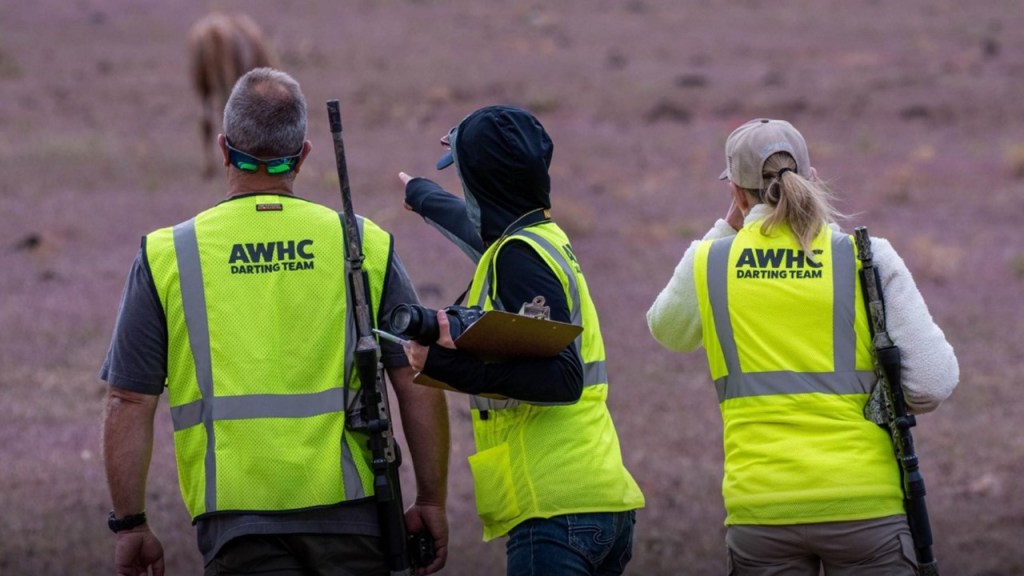
Like their overlords, the Campaign Against America’s Wild Horses, the Salt River Wild Horse Darting Group sells mass sterilization as wild horse preservation.

Here’s the deal: If you hit the links they’ll hit the mares with PZP-laced darts.

Then they’ll quietly slip out of town before you realize they’ve ruined the herd forever.

RELATED: Foal-Free Friday, Attempting the Impossible Edition.

BLM Among Top Ten Donors to CAAWH?

The agency, a servant of the public-lands ranchers, gave $125,682 to the Campaign Against America’s Wild Horses in FY24 according to a report by USA Spending, on top of $91,867 in FY23.

The FY24 payment was likely the second installment on a grant to sterilize the mares at Cedar Mountain.

The nonprofit, which serves commercial interests, appears on the last page of the Cooperative Agreement Summary, one of the documents supplied to the WHBAB at the January meeting.

High Desert Strategies, on page two, received approximately $1,070,000 in FY24 and $391,532 in FY23 for pest control services in Oregon according to the USA Spending report.

It’s another nonprofit that serves a commercial interest.

Costs of Off-Range Holding Going Up?

Figures can be found in the Program Budget section of the Program Data page.

In 2024, the BLM spent 2.3 times as much for off-range holding as it did in 2012.

But as a percentage of total expenditures, are the costs really going up or just escalating with everything else?

A run chart provides some evidence of an increase.

The trendline, in black, also appears to be going up.  It was fitted to the data with the Analysis Toolpak in Excel.

However, the ANOVA table provided by the toolpak tells a different story.

The p-value of the F-statistic is .095—too large to conclude that the passage of time, on the x-axis, is of use in explaining the variations in the percentage, on the y-axis.

Although there is some evidence of a long-term increase, it’s not enough to provide a basis for action.  A p-value smaller than .01 might signal adverse change.

The advocates, on the other hand, believe the costs are spiraling out of control and use the narrative to push their ruinous darting programs.

Colorado Wild Horse Working Group Meets Next Week

The online meeting begins at 8:00 AM local time on April 17.

The agenda covers placement, preserves and pesticides.

A wild horse refuge is not worthy of your support if it doesn’t include public lands and doesn’t displace livestock therefrom.

The group should establish a base property fund and be ready to pounce when the right listing hits the market.

RELATED: Beware of the Sanctuaries.

DOI Taking Bold Steps to Restore Domestic Energy Production

Recent announcements from the BLM news site:

Western Horse Watchers was unable to find a statement declaring man-made climate change to be a hoax, a fine example of communist subversion.

The chicoms don’t have to bomb our refineries and chemical plants, we’ll destroy them ourselves.

EPA Updates RUP Report

The list is current as of March 6.

PZP is on page 33 as Zonastat-H.

GonaCon-Deer is in the report but GonaCon-Equine is not.

Restricted use pesticides are not available for purchase or use by the general public.

You must have a diploma from the Billings School of PZP Darting and Public Deception to sterilize mares with Zonastat-H.

Most wild horse advocates wear their certificates as badges of honor.

Beware of the Sanctuaries

If a proposed project does not include public lands, it’s not worthy of your support.

Moving wild horses off the range and into private care is exactly what the ranchers want.

The best value for your investment, and the best option for the horses, is to buy deeded acreage tied to grazing allotments, as American Prairie is doing for bison in Montana.

RELATED: Key Indicators for New Wild Horse Preserves.

Trump Nominates Sgamma to Lead BLM

She currently serves as president of the Western Energy Alliance according to a report by AP News.

Western Horse Watchers was unable to find a statement opposing wild horses at the WEA public lands page.

You’ll have to go the American Farm Bureau Federation or Public Lands Council for that.

The advocates would have you believe that drilling and mining are the greatest threats to these animals, as permitted grazing devours entire HMAs and beyond.

We Want Whats Best for the Ranchers 04-01-25

As of today, the BLM org chart shows the director’s position as vacant.

RELATED: Shultz to Head Forest Service.

Leadership Harder to Find at Salt River Than Foals!

One of the objectives in the Land Management Plan for the Tonto National Forest is to evaluate at least one vacant allotment every two years to (1) convert it to forage reserves, (2) grant it to a current or new permittee or (3) close it to permitted grazing.

The 2018 report on forage availability states in Appendix 5 that the Goldfield, Bartlett, St. Clair and Sunflower allotments are most similar in vegetation, soil, and topography to the Salt River horse zone.

The ArcGIS viewer indicates that Bartlett and St. Clair are vacant.

Appendix 5 also indicates that the two allotments offered a combined 7,404 AUMs on 116,430 acres, equivalent to 617 wild horses, or 5.3 wild horses per thousand acres.

Your faithful public servants claim the rangelands in the western U.S. can only support one wild horse per thousand acres.

If the advocates had a base property that met Forest Service requirements, they could ask the agency to attach it to one or both of the allotments, securing grazing preference thereon.

The livestock type would be horses and the season of use would be 12 months.

This would probably require a NEPA review, which could span several years, complete with blowback from ranching interests.

But it would be better for the horses compared to their current situation, crammed into a 20,000-acre habitat with the number of viable mares decreasing every year.

RELATED: Leadership Needed at Salt River.

More Options for Salt River Horses 03-18-25

CAAWH Still Looking for Director of Development?

In this role, you’ll sell mass sterilization as wild horse preservation.

The successful candidate will have a demonstrated commitment to animal/wildlife conservation, equine protection and diversity-equity-inclusion.

Even if you didn’t know what they’re doing to the Virginia Range herd, and want to do to other herds, that last qualification is reason enough to withhold your financial support.

RELATED: Help Wanted: CAAWH Seeks Development Director.

Leadership Needed at Salt River

Consider two approaches to herd management:

A. Obtain grazing privileges on one or more allotments in the Tonto National Forest and flip the preference to horses, as Wild Horse Refuge did in Colorado.

B. Sterilize the mares with PZP.

Which one requires a long-term strategy, some diplomacy and tact, a solid donor base and a sincere desire to protect the horses?

Which one can be done by trained monkeys?

RELATED: Salt River Herd Doomed?