Twin Peaks Roundup, Day 3

The incident started on October 1.  Results through October 3:

  • Scope: Twin Peaks HMA
  • Target: Wild horses
  • AML: 758 horses (and 116 burros)
  • Pre-gather population: 1,800 horses (and 140 burros)
  • Type: Planned
  • Method: Helicopter
  • Category: Cruel and costly (according to advocates)
  • Better way: Shoot mares with pesticide-laced darts (according to advocates)
  • Capture goal: 940
  • Removal goal: 870
  • Captured: 260, up from 46 on Day 1
  • Shipped: 95, up from 35 on Day 1
  • Released: 1, up from zero on Day 1
  • Deaths: 2, up from zero on Day 1
  • Average daily take: 86.7
  • Unaccounted-for animals: 162
  • Snippet from statute: It is the policy of Congress that wild free-roaming horses and burros shall be protected from capture, branding, harassment, or death
  • Snippet from manual: To protect wild horses and burros from unauthorized capture, branding, harassment or death

The figures above are based on the daily reports.

The sidebar at the gather page says 266 captured.

Two mares were dispatched on Day 3 for blindness in one eye, bringing the death rate to 0.8%.

The Day 3 report also indicated that the door on a trailer came open as horses were being moved from the capture site to temporary holding, resulting in nine falling out.

They ran to the top of a hill and were not recaptured, yet the sidebar says one released.

The capture total includes 91 stallions, 126 mares and 43 foals.

Youngsters represented 16.5% of the animals gathered.

Of the adults, 41.9% were male and 58.1% were female.

Body condition scores were not given.

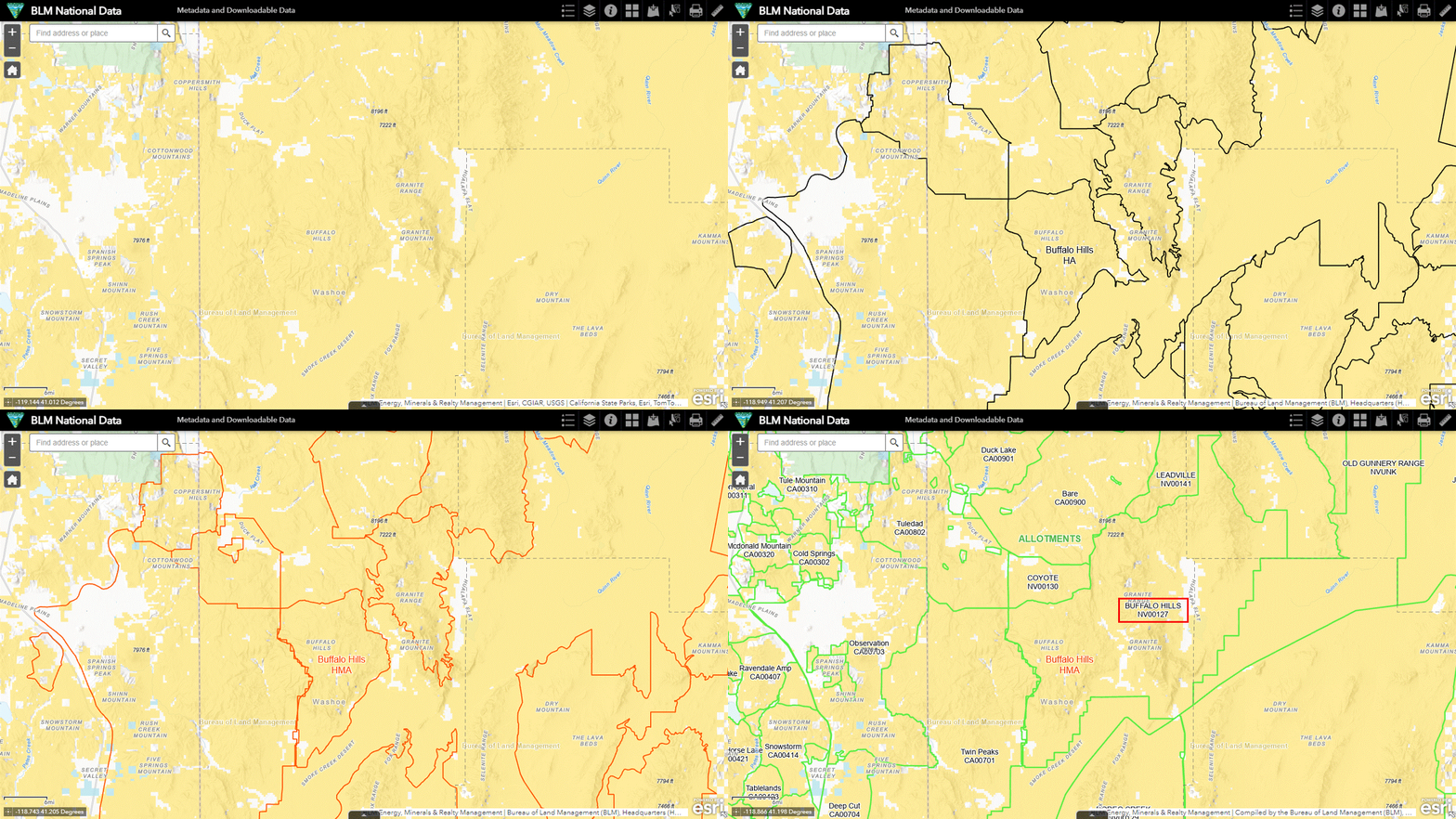
The trap is in the North Observation home range, which may correspond to one of the grazing allotments.

The number of animals removed depends on the number released.  Up to 30 mares will be treated with GonaCon Equine and be returned to the range with up to 42 stallions according to the FY25 schedule.

RELATED: Twin Peaks Roundup Begins.

Twin Peaks HMA with Allotments 09-13-24

City Council to TRNP: Drop the Pesticides and Roundup

The Medora City Council passed a resolution on October 1 urging the park to halt wild horse removals and fertility controls until experts fully assess and provide a report on the genetic viability of the herd, according to a story by INFORUM.

The park’s interim superintendent said the roundup will provide genetic information that is crucial for managing the herd.

RELATED: NPS Posts Backdated News Release for TRNP Roundup?

Buffalo Hills EA Refers to Old GonaCon Registrations

Discussion of the pesticide begins at the bottom of page 21 in the Final EA (page 29 in the pdf).

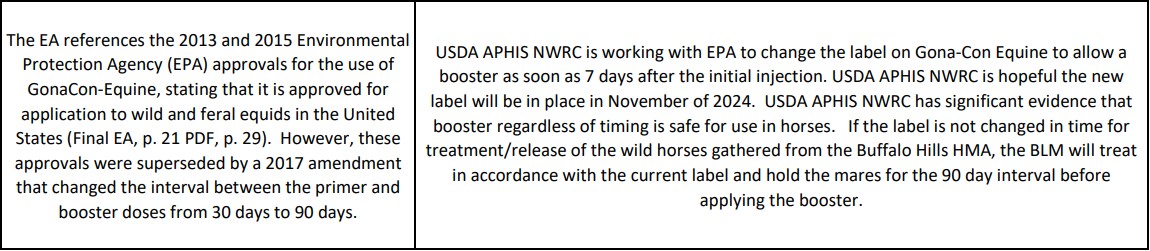
To wit, “GonaCon-Equine is approved for use by authorized federal, state, tribal, public and private personnel, for application to wild and feral equids in the United States (EPA 2013, 2015).”

The 2013 and 2015 versions were superseded by a 2017 amendment that changed the interval between primer and booster from 30 days to 90 days.

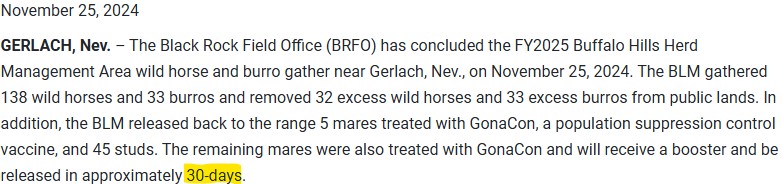
The BLM has adhered to 30 days, representing unlawful use of the product.

If the DNA is put out for public review, you could argue that the EA does not adequately cover the Proposed Action, as claimed therein.

RELATED: Buffalo Hills DNA Out for Public Review?

Indian Lakes Public Tours Set for October 25

The tours, one in the morning and one in the afternoon, can accommodate 20 people each and will last about two hours, according to a BLM news release.

Wild horses are held at the facility not because the land can’t support them, but because the bureaucrats have assigned most of their food to the public-lands ranchers.

The advocates ratify and reinforce the practice with their darting programs.

Fallon Off-Range Corrals 10-03-24

Buffalo Hills Wild Horses Better Off Than Permittees

The HMA, a subset of the allotment, offers 314 × 12 = 3,768 AUMs per year on 125,207 public acres, or 30.1 AUMs per year per thousand public acres.

The allotment offers 4,114 AUMs per year on 440,982 public acres, or 9.3 AUMs per year per thousand public acres.

If wild horses had principal use of the HMA, a feature of the original statute but opposed today by most advocates, the AML would increase by 9.3 × 125,207 ÷ 1,000 ÷ 12 = 97, assuming the resource is evenly distributed across the allotment.

RELATED: Buffalo Hills DNA Out for Public Review?

Buffalo Hills HMA with Allotments 10-02-24

Buffalo Hills DNA Out for Public Review?

The project status says public scoping but the plan has already been determined.

The Draft DNA asserts that a 2017 EA adequately covers the Proposed Action, discussed in Section A.

Up to 235 wild horses and 33 wild burros would be captured by helicopter.

Approximately 100 mares would be treated with GonaCon Equine and be returned to the HMA with 103 stallions.

The remaining horses and all burros would be removed.

The HMA is on the east side of Twin Peaks and inside the Buffalo Hills Allotment.

As of today, Western Horse Watchers has not seen a BLM news release marking the beginning of a comment period.

The DNA said the Stockade Canyon fire burned 14% of the HMA in July but did not indicate if livestock grazing had been curtailed due to the loss of forage.

A roundup appears on the FY25 schedule with a start date of November 15.

Buffalo Hills HMA with Allotments 10-02-24

Pesticide Pushers to Speak at TRI Wild Horse Conference

The Campaign Against America’s Wild Horses, a leader in nonmotorized removal and staunch opponent of principal use, will explain what they are doing to ensure the safety of all employees and drivers at the Tahoe Reno Industrial Center, according to an announcement on Eventbrite.

The facility is the epicenter of their mass sterilization program.  More horses are darted in that area than anywhere else on the Virginia Range.

The event, set for October 30, is sponsored by the Nevada Wildlife Alliance.

Pesticide Pushers 07-17-23

Poisoning of Wild Horses No Longer Allowed?

You can’t poison their water holes per 18 USC 3 §47, a common practice before 1959.

Poisoning Wild Horses Outlawed 09-29-24

Today, the advocates poison the mares with Zonastat-H, a restricted-use pesticide that tricks their immune systems into attacking their ovaries.

Better Way 10-25-23

The ranchers are also involved, but they prefer GonaCon Equine.

Their methods may differ but their goal is the same: Ranching superiority in the lawful homes of wild horses.

RELATED: If You Want to Help the Ranchers Give Money to the Advocates.

If Wild Horses Had Principal Use of East and West Y U Bench et al

The allotments overlap an area known as Y U Bench near Cody, WY, where livestock fencing was modified to facilitate pronghorn migration.

They offer 3,793 active AUMs on 35,181 public acres, according to the Allotment Master Report.

Y U Bench Allotment Calcs 09-29-24

The forage assigned to horses is zero.

How many wild horses could live there?

Using the principle of forage interchangeability, the True AML would be 317, the number of horses the land could support if it was managed principally for them as specified in the original statute.

The stocking rate would be nine wild horses per thousand public acres.

Why is this important?

The bureaucrats and ranchers claim that public lands in the western U.S. can only support one wild horse per thousand acres (27,000 animals on 27 million acres).

The advocates, defeated a long time ago and now in their camp, reinforce the narrative with their darting programs.

If the allotments were an HMA, the AML would be 35 and 282 horses would be consigned to off-range holding because of permitted grazing.

BLM allotments in Wyoming carry livestock equivalent to 158,425 wild horses on 17,312,214 public acres, or 9.2 wild horses per thousand public acres.

Wild horses can be placed on public lands not identified for their use by acquiring base properties associated with grazing allotments and flipping the preference to horses, as American Prairie did for bison in Montana.

RELATED: The Allotments Tell the Story: They’re Lying, All of Them.

Y U Bench Allotments 09-28-24