Little Book Cliffs Mare Dies in Temporary Holding

She was one of two mares held for fertility treatment before being returned to the HMA.

A report by The Grand Junction Daily Sentinel said she spooked and hit her head on a pipe panel during feeding.

She received an initial dose of GonaCon Equine and the contractors were following the CAWP according to the story.

A second dose was to be given after 30 days, which would violate the 90-day interval of the 2017 labeling amendment.

The other mare was treated with PZP and returned to the range.

The BLM has not updated the figures at the gather page, which should indicate 140 horses captured, 98 shipped, 38 released and four dead, for a net removal of 102.

RELATED: Little Book Cliffs Roundup Over.

Foal-Free Friday, Miracles and Wonders Edition

The real estate agent, PZP evangelist and disciple of the Campaign Against America’s Wild Horses is back with the good news of nonmotorized removal in the October issue of Horse Tales.  Go to “Wild Horse Tales” on page 7.

“All we see with PZP is mares who do not get in foal.”

It’s a miracle drug—for those who are willfully blind.

She and her fellow travelers don’t see the abnormal sex ratios.

They don’t see the onset of sterility.

They don’t see the injuries and injection site reactions.

VR Darting Injury 09-15-21

They’re blind to the tiny breeding populations and loss of genetic diversity.

And they damn sure don’t see the government-sanctioned livestock occupying the lawful homes of wild horses.

You cannot give sight to these people.

Blind Leading the Blind 10-17-24

They are phonies, allies of the bureaucrats and ranchers, and don’t deserve a penny of your financial support.

RELATED: Foal-Free Friday, Divide and Conquer Edition.

Little Book Cliffs Roundup Over

Figures for September 19 have been added to the gather page.

The previous update said it was complete with 59 unaccounted-for animals.

The final tally indicated 140 horses captured, 98 shipped, 37 released and three dead, with two unaccounted for.

The capture and removal goals were 140 and 120 respectively.

The death rate was 2.1%.

The average daily take was 15.6.

The capture total included 37 stallions, 82 mares and 21 foals.

Youngsters represented 15% of the animals gathered, consistent with a herd growth rate of 10% per year.

Of the adults, 31.1% were male and 68.9% were female, outside the expected range of variation from a random process centered at 50% males / 50% females.

Abnormal sex ratios are common in herds treated with Zonastat-H.

Two horses remain in holding for fertility treatments, to be returned to the HMA at an unspecified date.

RELATED: Little Book Cliffs Roundup Set for Next Week.

Antelope-Triple B HMAP Proves Advocates Are Ill-Informed About Wild Horses

Go back and read the recommendations published in September by Save Our Wild Horses, an affiliate of Wild Horse Education.

Item 1: Initiate HMAPs promptly, with at least two started per district by year-end, as mandated by 43 CFR 4710.1 with a deadline of 1-year for completion.  Enforce strict adherence to HMAP requirements to maintain ethical, humane, and legal standards in wild horse management practices.

For the Antelope and Triple B Complexes, this means

  • Forcible removal from their lawful homes
  • Application of fertility control pesticides
  • Adjustment of sex ratios in favor of males
  • Castration of stallions
  • Acceptance of forage allocations

Speaking about their conference in Reno and the ideas flowing therefrom, the president and founder of Wild Horse Education said in a news release “We were also able to dispel the long standing myth that advocates are ill-educated on the subject and, hopefully, our words will be taken into thoughtful consideration.”

You betcha.

Even the casual observer now realizes that they want the ranchers to win.

RELATED: Scoping Begins for Antelope-Triple B HMAP.

Sand Wash Roundup Ends Early

The incident concluded today with ten horses captured, ten shipped, none released and no deaths.

The capture and removal goals were 60 and 45 according to the latest schedule.

There were no unaccounted-for animals.

The capture total included three stallions, six mares and one foal.

The operation liberated 120 AUMs per year, a disappointment to the permittees.

RELATED: Sand Wash Bait Trap Removal Set for Mid-August.

Scoping Begins for Antelope-Triple B HMAP

Comments, due by November 14, can be mailed to the Bristlecone Field Office or emailed to the address in today’s news release.

A management evaluation report has been copied to the project folder in ePlanning.

The new plan will support the BLM’s mission to manage healthy wild horses on healthy public lands.

The HMAP would sanction the use of population growth suppression (fertility control pesticides), castration of stallions and sex ratio skewing according to a statement on page 23 of the report (24 in the pdf).

Gather operations would utilize helicopters and bait trapping were feasible.

A remark on page 19 tells you what the HMAP won’t do: “Livestock grazing is administered through the regulations at 43 C.F.R. Part 4100 and must be consistent with multiple use allocations set forth in RMPs.  Changes to livestock grazing cannot be made with a wild horse management decision.”

This project is a wild horse management decision.

RELATED: HMAP for Antelope and Triple B Complexes in the Works?

Advocates Aren’t Political?

If you’re a normal American, yesterday was Columbus Day.

If you’re a liberal, it was Indigenous Peoples Day.

The Campaign Against America’s Wild Horses has bought into the propaganda and no better place to show it than on socialist media.

Columbus Day at CAAWH 10-15-24

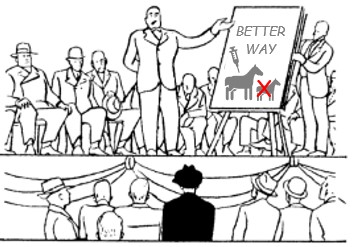
Is Suzanne Roy, executive director of the nonprofit and staunch opponent of principal use, management at the minimum feasible level and nature’s way, ashamed to be white?

Better Way 10-25-23

Is she an apologist for white European migration and the good it wrought?

Why not go all Rachel Dolezal and comport yourself as a person of color, not necessarily female?

Better yet, start another nonprofit that actually serves a charitable purpose and leaves wild horses alone.

RELATED: What Charitable Purpose Do the Advocates Serve?

Pesticide Pushers 07-17-23

They Should Fear the Executions, Not the Roundups

Here are some of the headlines on Drudge.  The link about roundups pointed to a story on Mediaite.

Headlines on Drudge 10-14-24

There may be a few acute injuries and deaths as the traitors are taken into custody but nobody will be dispatched for pre-existing conditions, such as being America-hating liberals who supported our enemies and tried to destroy everything that’s right and good in this country.  We have a justice system for that.

Twin Peaks Roundup Day 7 10-07-24

Kiger-Riddle Management Plan Breaks with Tradition

Due to their popularity, horses captured in these roundups had a very high adoption rate, 100% in some cases.

For this reason the BLM did not apply population suppression in the HMAs, such as fertility control pesticides, sex ratio skewing and castration of stallions.

You won’t find any remarks about that at the HMA pages [Kiger | Riddle] but you can still see them at the 2015 gather page:

Kiger Population Control Statement 10-13-24

That has changed in the new plan, issued in July.

The Decision Record authorized Alternative A, the Proposed Action, discussed in Section 2.2 of the Final EA.

The option, titled “Remove Excess Wild Horses and Implement Intensive Fertility Control Management over a Ten-Year Period,” includes the use of Zonastat-H and GonaCon Equine—a practice that’s been avoided for many years.

More troubling, however, are the inconsistencies in the discussion of these pesticides, starting at the bottom of page 149 in the EA (156 in the pdf).

Like the Buffalo Hills EA, the citation for GonaCon Equine is out of date:

“The EPA required product label associated with the registration for ZonaStat-H is cited in the EA as EPA (2012).  That label states that ‘For maximum efficacy, ZonaStat-H is administered as an initial priming dose followed by a booster dose at least two weeks later.’  The EPA-required product label associated with the registration for GonaCon-Equine is cited in the EA as EPA (2013).  That label states that ‘If longer contraceptive effect is desired, a second vaccination may be given 30 or more days after the first injection or during the following year with no known adverse health effects to the vaccinated animal.’”

The registration was amended in 2015 and 2017.

In 2013 (and 2015) GonaCon was a restricted-use pesticide.  In 2017, that designation was dropped.

In 2013 the shortest interval between treatments was 30 days.  In 2017, the EPA increased it to 90 days.

Zonastat-H is still a restricted-use pesticide, meaning it’s not available for retail sale and you must be certified to apply it.  That’s why the advocates spend three days at the Billings School of PZP Darting and Public Deception.

The EA acknowledges the certification requirement on page 158 of the pdf: “In keeping with the EPA registration for ZonaStat-H (EPA 2012; reg. no. 86833 1), certification through the Science and Conservation Center in Billings, Montana is required to apply that vaccine to equids.”

But there is no such statement for GonaCon Equine, which should be there if they’re referring to the 2013 (or 2015) registrations!

The absence of that remark suggests they’re following the 2017 amendment but violating the 90-day interval between treatments.

Apparently, they want the 30-day interval of the old registrations and the certification-free policy of the new registration.

You can’t have it both ways!

These errors invalidate the EA in this writer’s opinion and the court should halt the roundups as the coalition requested.

RELATED: Coalition Tries to Block Kiger, Riddle Mountain Roundups.

Twin Peaks Roundup Over

The incident concluded on October 11 with 949 horses captured, 906 shipped, 39 released and four dead.

There were no unaccounted-for animals.

Ten mules and one burro were picked up on the last day and released.

The capture and removal goals were 940 and 870 respectively.

The death rate was 0.4%.

The average daily take was 86.3.

The door on a trailer came open during transport on October 3 and nine horses fell out.

The capture total included 343 stallions, 434 mares and 172 foals.

Youngsters represented 18.1% of the animals gathered, consistent with a herd growth rate of 13% per year.

Of the adults, 44.1% were male and 55.9% were female, outside the expected range of variation from a random process centered at 50% males / 50% females.

The October 7 schedule indicates that up to 30 mares will be treated with GonaCon Equine and returned to the HMA.

If they receive two doses, which is common in roundups, they would not be released for at least 90 days, the minimum interval between treatments.

Anything less constitutes unlawful use of the pesticide.

The roundup liberated 10,920 AUMs per year, giving new hope to the permittees.

RELATED: Twin Peaks Roundup Announced.

Coalition Tries to Block Kiger, Riddle Mountain Roundups

The plaintiffs, consisting of the Oregon Wild Horse Organization, Central Oregon Wild Horse Coalition and Western Watersheds Project, argue that the BLM must demonstrate that wild horse removals will restore an ecological balance on public lands but failed to do so, according to an October 11 report by Capital Press.

The claim will likely not hold water once the court realizes that achieving a thriving ecological balance means ranchers accessing most of the food in the lawful homes of wild horses, a result the agency seeks consistently across ten western states.

The advocates, defeated a long time ago, underscore the philosophy with their darting programs.

The final planning documents covering the roundups were copied to the project folder on July 22 and they are on the October 7 schedule.

The wild horse and burro program is a grazing program ancillary, protecting ranchers by minimizing the pests and enforcing resource allocations already on the books.

Other such functions include predator control (mostly at the state level), wildfire recovery, sagebrush restoration and pinyon/juniper eradication.

RELATED: Pest Control Plan for Kiger and Riddle Mountain HMAs Stalled?

Thriving Ecological Balance-3

Foal-Free Friday, Divide and Conquer Edition

The table on page 3 of the September update for the Virginia Range darting program shows how the advocates have set their priorities.

Areas with hit rates of four or more are shown in orange while areas of six or more have been marked red.

Virginia Range Darting Calcs Sep 2024 10-09-24

Mares in the red zone are probably toast, never again to bear fruit, and those in the orange zone are well on their way.

If the advocates can put enough of the mares in the red zone the herd will implode.

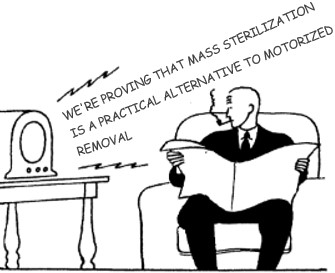
Mass Sterilization and Motorized Removal 08-10-24

RELATED: Foal-Free Friday, Good News and Bad News Edition.

HMAP for Antelope and Triple B Complexes in the Works?

A new project was opened in ePlanning today but no documents were posted.

The description says the new plan will guide future management of the Complexes and the wild horses within.

Is it a response to a protest in Reno?

Contrary to what the advocates say, HMAPs ratify and reinforce existing management plans, which put ranching interests far above those of the horses.

RELATED: Advocates Not Ill-Informed on Subject of Wild Horses?