Plan for Mustang Monument

The project would convert all but the portion of the Spruce Allotment west of Highway 93 to a nonreproducing wild horse ecosanctuary, including 93% of the Spruce-Pequop HMA, 27% of the Goshute HMA and 14% of the Antelope Valley HMA, according to an undated scoping brief.

Portions of the HMAs not in the sanctuary would be evaluated to determine their ability to sustain wild horse populations with reduced acreage and water resources.

When the carrying capacity of the Spruce Allotment was determined in the early 1990s, AUMs were set aside for wild horse and wildlife.  The analysis assumed that the majority of AUMs in the allotment would be utilized by cattle, whereas in the proposed sanctuary there would be no AUM consumption by livestock.

Western Horse Watchers refers to such changes as flipping the grazing preference to horses, the second step after acquiring the base property tied to said allotment.

Forage in the Spruce Allotment was split between the previous permittee, who retained 57 AUMs in the portion on the west side of the highway and Mustang Monument received 10,908 active AUMs and 2,458 suspended AUMs on the east side.

This is apparent today in the allotment master report.

The suspended AUMs require a carrying capacity analysis to determine if they are available before they can be made active.

When Elko County ranchers heard about the plan the battle lines were drawn.

The sanctuary would function like an ORP, except most of the acreage would be public, and up to three breeding populations would be lost.

Western Horse Watchers has been unable to find the project ePlanning.

The status of the NEPA review is unknown.

RELATED: Purpose of Mustang Monument?

Spruce Allotment with Sanctuary 10-27-24

Purpose of Mustang Monument?

The proposal for a wild horse ecosanctuary was submitted by Saving America’s Mustangs in response to a 2011 BLM solicitation, according to a 2012 news release.

The facility would include 14,000 deeded acres that serve as the base property for the 534,000-acre Spruce Allotment.

Up to 900 federally owned wild horses would graze thereon, for a stocking rate of 1.7 animals per thousand public acres.

A 2012 notice in the Federal Register indicated that the agency intended to prepare an EIS and RMP amendment for the project which would “reduce and potentially eliminate livestock grazing within the portion of the Spruce Allotment east of Highway 93.”

RELATED: Where Is Mustang Monument?

Spruce Allotment with HMAs 10-26-24

Where Is Mustang Monument?

It’s about 30 miles south of Wells, NV on the east side of Highway 93.

The National Data Viewer puts it in the Snow Water Lake Allotment.

The Elko County Assessor indicates it’s APN 008-080-001, owned by Tommy LLC, a legal entity controlled by Madeleine Pickens and probably named after one of her dogs.

The Operator Information Report at RAS ties Mustang Monument to these allotments:

  • 2704016 – SPRUCE GRAZING ASSOCIATION LLC – SPRUCE
  • 2703859 – SAVING AMERICA’S MUSTANGS – SNOW WATER LAKE, WARM CREEK

The Allotment Master Report gives management status, acreage and active AUMs.

The Authorization Use Report gives livestock types and season of use.

Pickens acquired base properties tied to these allotments and offered to take wild horses out of BLM pens and put them back on public lands previously designated for livestock.

Initially the BLM agreed but later reneged.

RELATED: Yes to American Prairie, No to Mustang Monument.

Where Is Mustang Monument 10-25-24

Murderer’s Creek Emergency Roundup Pending?

The BLM opened a new project in ePlanning today to assess NEPA adequacy.

No documents have been posted.

The description says the Rail Ridge Fire burned almost 70% of the BLM-managed lands in the HMA, which correspond to about 32% of the total (Forest Service has 68%).

The fire is 92% contained as of today.

The National Data Viewer indicates the BLM lands are subject to permitted grazing.

The Western Watersheds map gives the status of Forest Service lands.

Murderers Creek HMA with Allotments 10-24-24

Advocates Let Currituck Stallion Die Naturally?

He had been removed from the beach and given his condition, they decided the best thing to do was to let him pass slowly and peacefully according to an October 23 report by WITN News.

The size of the herd is unknown.

Wild horse advocates are known for their opposition to nature’s way.

Better Way 10-25-23

RELATED: Advocates Monitor Currituck Stallion, Kill Currituck Mare.

UPDATE: A story by the Augusta Free Press says they euthanized him.

Carter Reservoir EA Out for Public Review

A new project was opened in ePlanning yesterday and a preliminary environmental assessment was copied to the folder with other supporting documents.

The scoping phase was apparently skipped.

The project covers the Carter Reservoir HMA, Coppersmith HMA and Buckhorn HMA on the northern CA-NV border.

Alternative 1, the Proposed Action, features forcible removal, fertility control and sex ratio skewing.  Refer to Section 2.2.3 in the EA.

As in the Kiger-Riddle EA, the discussion of GonaCon Equine on page 49 (50 in pdf) refers to outdated registrations: “GonaCon-Equine is approved for use by authorized federal, state, tribal, public, and private personnel, for application to wild and feral equids in the United States (EPA, 2013; 2015).”

The 2017 amendment, which increased the interval between treatments from 30 days to 90 days, is ignored.

The BLM news release said the current population is at least 700 wild horses, compared to a combined AML of 195.

The HMAs do not appear on the FY25 roundup schedule.

They are subject to permitted grazing.

The new plan supports three tenets of rangeland management.

Carter Reservoir HMAs with Allotments 10-23-24

Sand Wash Partners Protect Ranchers Not Wildlife

When wild horse populations are within AML, other wildlife thrive, according to a BLM article about the 2024 roundup.

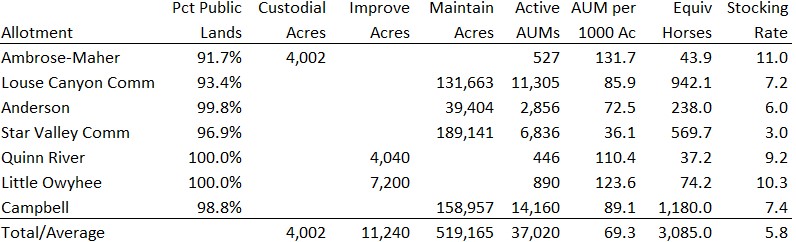
In the case of Sand Wash Basin, you cannot have more than 362 wild horses in the HMA or the land will degrade, but you can have livestock equivalent to 1,402 wild horses in the same area.

Curiously, those animals escaped the writer’s attention.

The permanent bait trap and ever-present footprints of the PZP darters are constant reminders that the horses are not a priority in their lawful home.

RELATED: Sand Wash Roundup Ends Early.

Thriving Ecological Balance-3

How to Build Support for Triple B Roundup

Call a press conference.

Announce that you’ve decided to get rid of the herd with PZP.

A sigh of relief will go up from the advocates.

In a few days, letters and emails will arrive offering to dart the mares for free.

Better Way 10-25-23

After five years they will be sterile and with no new foals hitting the ground, the herd will vanish.

The advocates, led by the Campaign Against America’s Wild Horses, will point to the Salt River and Virginia Range as examples of what can be done.

Mass Sterilization and Motorized Removal 08-10-24

You just need to be patient and let them show their true colors.

RELATED: Triple B Roundup Announced.

How Many Wild Horses Can the Triple B Complex Support?

Table 12 in the Antelope-Triple B Management Evaluation identifies the allotments that overlap the Complex.

The Allotment Master Report at RAS gives management status, public acres and active AUMs by field office (Bristlecone | Wells).

Triple B Allotment Calcs 10-23-24

Approximately 90% of the allotment acreage is in the Improve category.

The allotments, which include territory outside the Complex, support livestock equivalent to 6,533 wild horses.

The forage assigned to livestock inside the Complex is estimated to be 44,758 AUMs per year, assuming it’s evenly distributed across the allotments.

That resource would support 3,730 wild horses, on top of the 821 allowed by plan, for a True AML of 4,551.

The pre-gather population is well within this range.

The BLM spends around $6.8 million per year to care for 3,730 wild horses in off-range holding so it can collect about $60,000 per year from the Triple B permittees.

Nobody in the private sector would do that.

BLM allotments in Nevada support livestock equivalent to 173,144 wild horses on 40,194,360 public acres.

RELATED: Triple B Roundup Announced.

Large-Scale Roundups Good for Wildlife?

The Wind River roundup took about 7,600 wild horses off the reservation in 2023 and 2024.

Their disposition, not discussed in a report by WyoFile, is unknown.  The writer said they were “trucked away.”  Probably to Mexico or Canada.

An aerial survey in late 2022 found 5,500 animals on one million acres.

A biologist with the U.S. Fish and Wildlife Service put the estimate at 9,000 or more, for a stocking rate of nine wild horses per thousand acres.

That is what they were trying to eradicate: An outlier that defied the carrying capacity narrative, namely, that western rangelands can only support one wild horse per thousand acres (27,000 animals on 27 million acres).

The Virginia Range in Nevada, another counterexample, had a stocking rate of at least ten wild horses per thousand acres before the advocates got involved.

The Campaign Against America’s Wild Horses, a leader in mass sterilization and staunch opponent of principal use, was tasked with erasing that evidence.

The author did not indicate who paid for the roundup and if the decision to get rid of the horses had been influenced by outside interests such as hunting and ranching.

Triple B Roundup Announced

The incident will begin on or about November 1 according to a BLM news release.

The capture and removal goals are 2,255 and 2,155, respectively.

The pre-gather population is thought to be 3,319.

The number of horses allowed by plan is 821.

The Complex includes the Maverick-Medicine HMA, Triple B HMA and a portion of the Antelope Valley HMA west of Highway 93.

A helicopter will push the horses into the trap and operations will be open to public observation.

Animals identified for removal will be taken to the off-range corrals at Palomino Valley and Indian Lakes in Fallon.

Up to 50 mares will be treated with GonaCon Equine, a fertility control pesticide, and returned with 50 stallions to the range.

The Complex is subject to permitted grazing.

Allotments are now indicated with brown borders in the National Data Viewer.

RELATED: Scoping Begins for Antelope-Triple B HMAP.

Triple B Complex 10-21-24