The BLM agreed to change the livestock type and season of use on several allotments in response to a request from American Prairie to graze bison instead of cattle.
The nonprofit obtained preference by purchasing base properties tied to the allotments.
Now, bowing to pressure from ranching interests, the agency has flip-flopped on the issue, reversing the original decision and hanging American Prairie out to dry.
In a news release, American Priarie pointed to the state of Montana, North and South Phillips Grazing Districts and the Montana Stockgrowers Association as challengers in the case.
The BLM’s position, according to a story by the Daily Montanan, is that it can only issue permits to applicants who will graze the public lands for purposes of production.
In the new decision, posted to the original project in ePlanning, the agency states that animals to be grazed are used for their meat, milk, fiber or other products.
Animals treated as wild or intended to be released into the wild are not eligible for a grazing permit.
What about the Virginia side of Assateague Island, where the salt water cowboys graze ponies on public lands managed by FWS?
If American Prairie charged an admission fee to visit their preserve, the bison would be producing an income for their owners as cattle and sheep do for the ranchers.
The Decision Record authorizes Alternative A, the Proposed Action, with the best management practices, design features, stipulations and mitigations of Appendices D, E and G of the Final EA.
The AML would change from 166-208 to 140-250.
The new plan includes forcible removal and fertility control.
The news release put the population at 2,303 wild burros in and around the HMA.
The DR and EA were copied to the project folder with related documents.
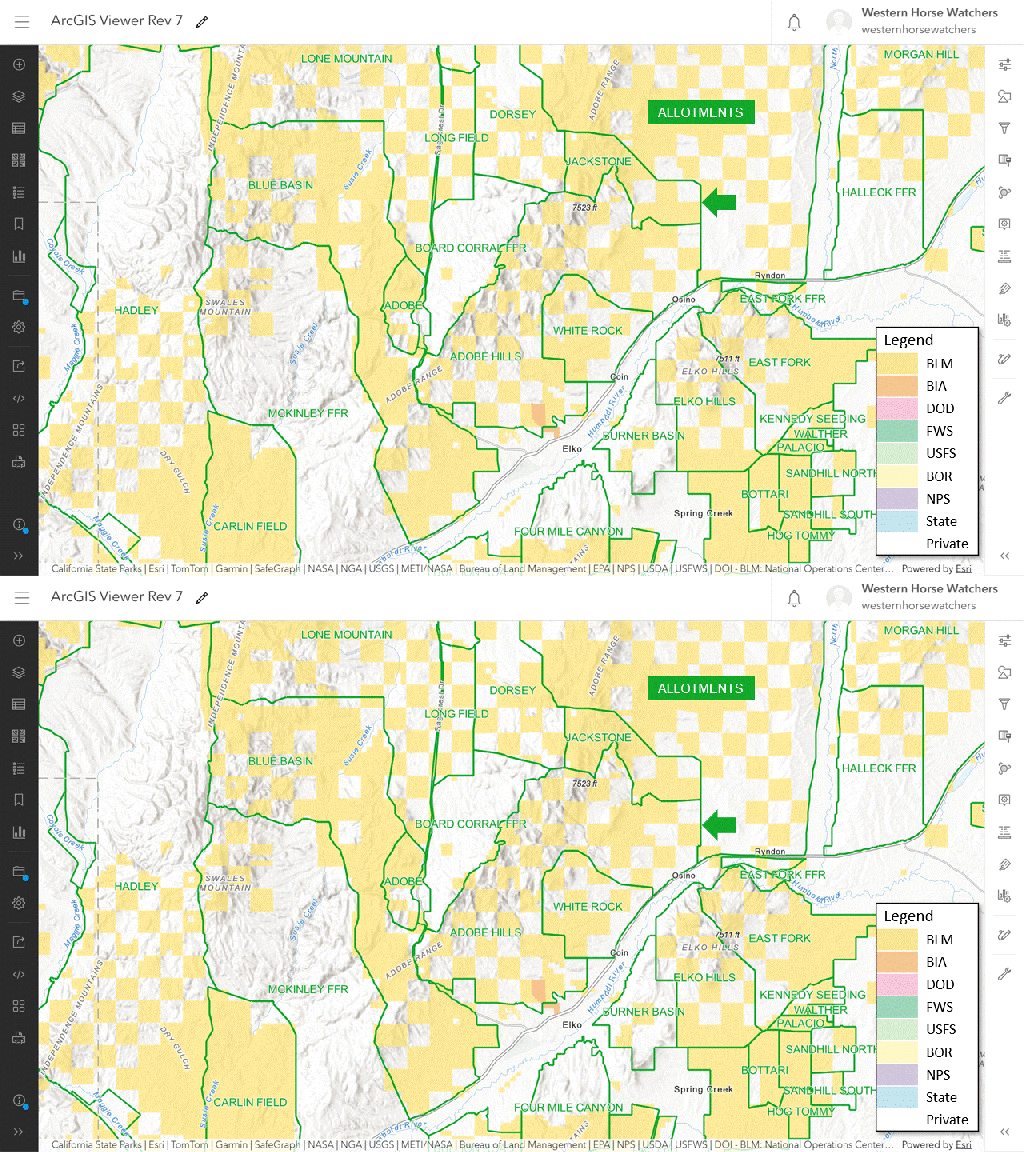
The allotments have a common border but are composed of checkerboard lands.
Together they offer 2,860 active AUMs on 30,107 public acres, equivalent to 7.9 wild horses per thousand public acres.
Your faithful public servants claim that rangeland health will suffer if wild horse stocking rates exceed one animal per thousand acres, yet the allotment master report puts both in the Maintain category.
The permits are up for renewal but the news release did not include a link to the NEPA review.
The Proposed Action would convert 46 horse AUMs in Adobe Hills to cattle but the total authorized forage would not change. Refer to section 3.4.2 in the Draft EA.
Wild horses can be placed on public lands no identified for their use by acquiring base properties associated with grazing allotments and flipping the preference to horses.
Observers were unable to determine the condition of an injured horse according to an opinion piece in the Reno Gazette Journal.
But should you criticize the agency for lack of transparency when you’re guilty of that yourself?
The column was written by the Nevada State Director for the Campaign Against America’s Wild Horses, a leader in mass sterilization and servant of the public lands ranchers, who scrubbed the Virginia Range Darting Resources page from its website, and the monthly reports posted thereto, leaving the public in the dark about the largest attempted eradication of wild horses in the state.
They are trying to develop it into a controlled-release formulation that induces long-lasting infertility with a single injection according to a March 3 news release.
Humane World for Animals, formerly the Humane Society of the United States, provided financial support for the research.
The BLM has funded a three-year project to test it on horses.
What’s the difference between long-term infertility and sterility?
To wit, the new management plan balances the population with available resources while maintaining genetic integrity, which is nonsense, not when the advocates have ruined the mares with PZP.
Breeding, not mass sterilization, assures long-term viability.
Horses removed from their habitat can only go to sanctuaries approved by AZDA.
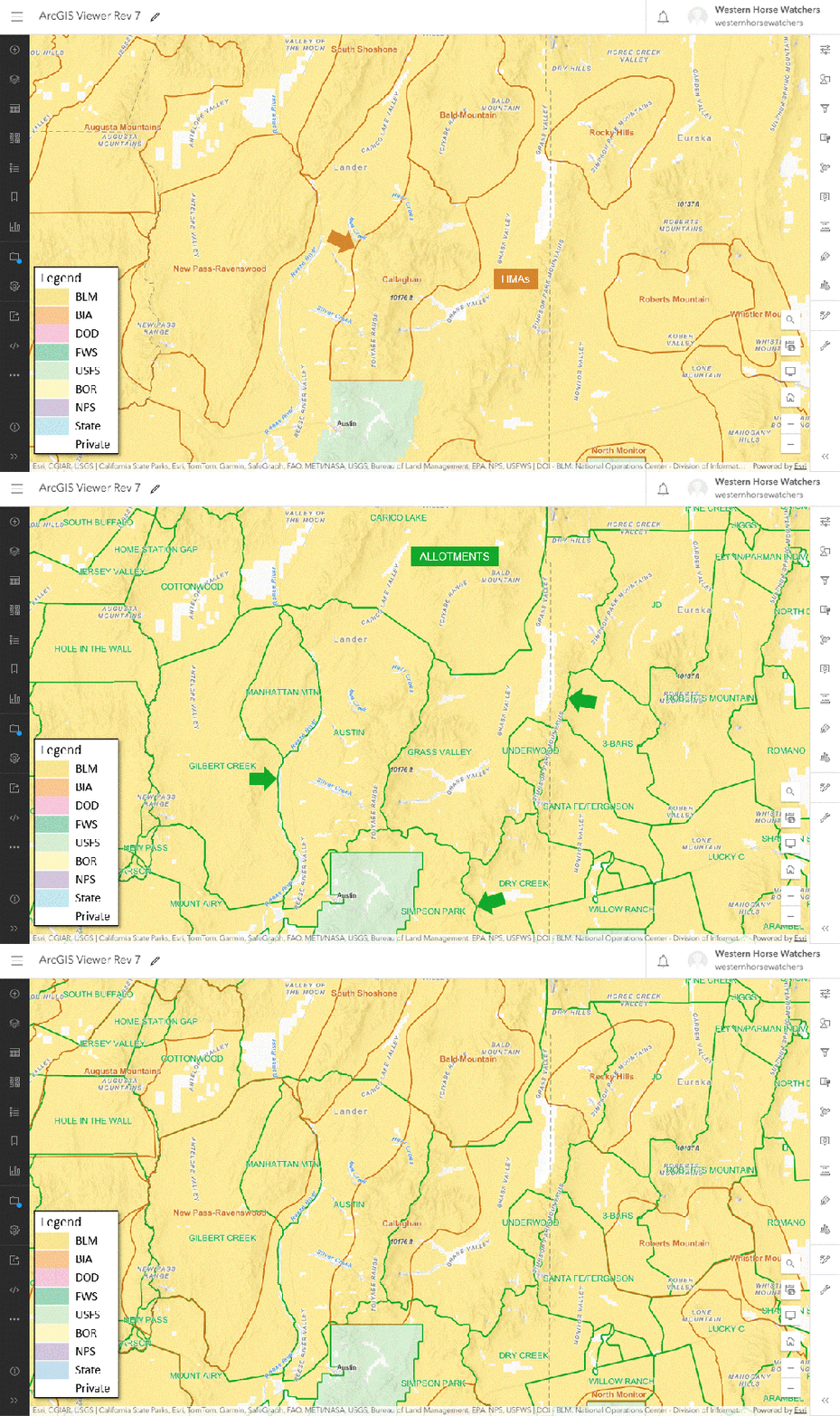
The HMA overlaps the Austin, Grass Valley and Simpson Park allotments, with 51% in Austin, 42% in Grass Valley and 7% in Simpson Park according to Table 5 of the Final EA for the Callaghan Complex.
The 237 wild horses allowed by plan require 2,844 AUMs per year.
Austin offers 14,478 active AUMs on 235,185 public acres, equivalent to 5.1 wild horses per thousand public acres.
Grass Valley offers 17,701 active AUMs on 267,201 public acres, equivalent to 5.5 wild horses per thousand public acres.
Simpson Park offers 3,406 active AUMs on 96,818 public acres, equivalent to 2.9 wild horses per thousand public acres.
These resources are present in the HMA, assuming they’re evenly distributed across the allotments, but they’ve been assigned to livestock.
To estimate the carrying capacity, shift them back to the horses. Forage assigned to wildlife stays with wildlife.
The HMA covers 152,726 public acres so the forage allocated to the Austin permittees inside the HMA should support 152,726 × .51 × 5.1 ÷ 1,000 = 397 wild horses.
The forage allocated to the Grass Valley ranchers should support 152,726 × .42 × 5.5 ÷ 1,000 = 353 wild horses.
The forage assigned to the Simpson Park ranchers should support 152,726 × .07 × 2.9 ÷ 1,000 = 31 wild horses.
The HMA should be able to sustain 237 + 397 + 353 + 31 = 1,018 wild horses (4X AML) if it was managed principally for them as specified in the original statute.
The new stocking rate would be 1,018 ÷ 152,726 × 1,000 = 6.7 wild horses per thousand public acres.
Your faithful public servants claim that public lands in the western U.S. can only support one wild horse per thousand acres.
Austin has more AUMs in the suspended column than active, while everything is active at Simpson Park.
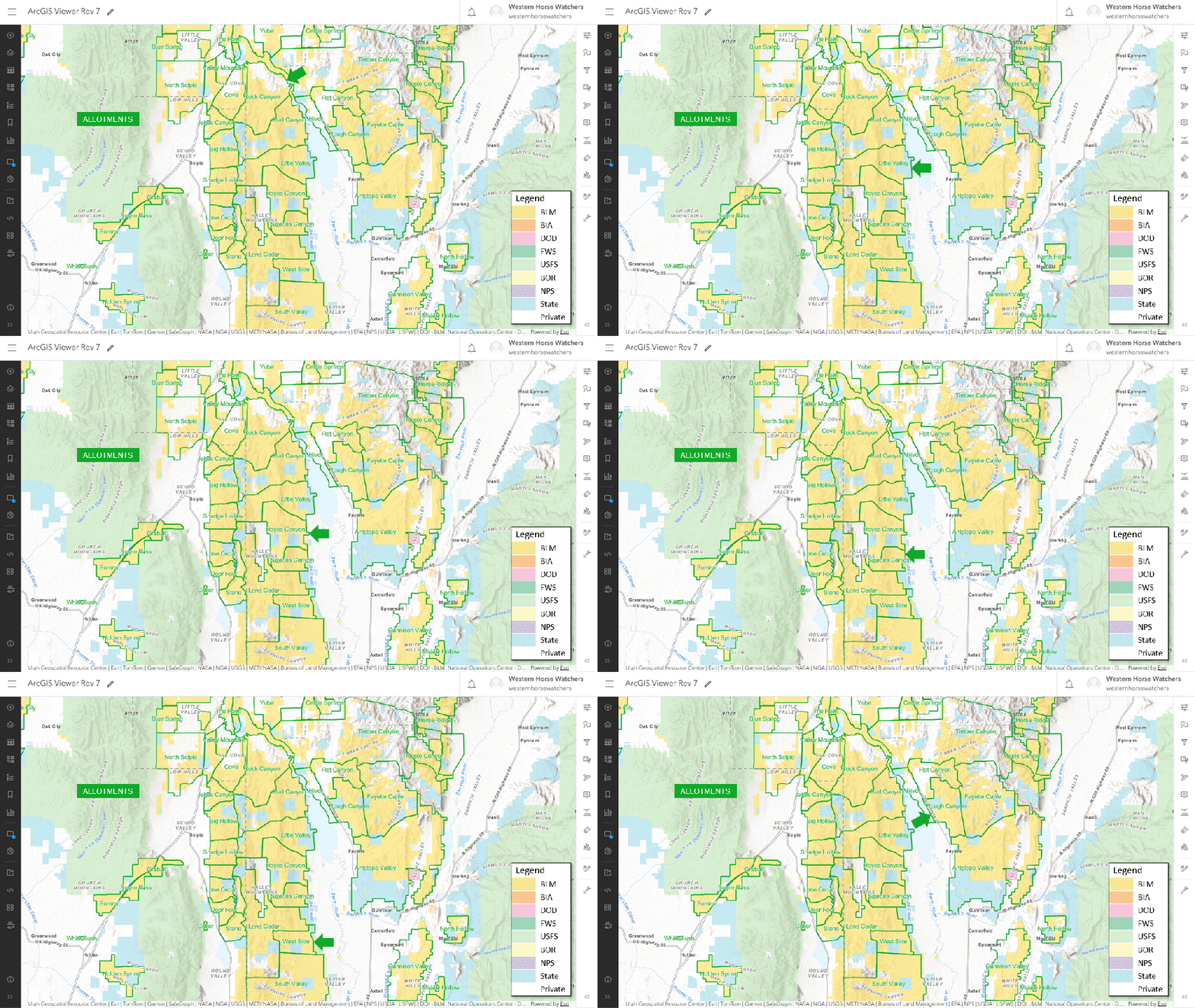
The allotments would not make a good wild horse preserve because they overlap areas identified for wild horses and there is more than one authorization attached to each, so you’d have to acquire or control several base properties to access all of the AUMs.
They’re on the small side and not contiguous but the permits are up for renewal with comments due by March 4.
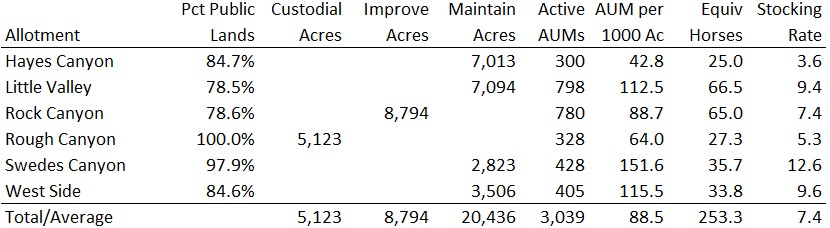
The allotment master report puts Hayes Canyon, Little Valley, Swedes Canyon and West Side in the Maintain category with equivalent stocking rates ranging from 3.6 to 12.6 wild horses per thousand public acres.
Your faithful public servants claim that rangeland health will suffer if wild horse stocking rates exceed one animal per thousand acres.
If a lying contest was held next week, who would win? The bureaucrats or advocates?




 Western Horse Watchers Association