
The Hayden Kids visited Hidden Valley Regional Park to find some wild horses but the horses had other plans!
Author: Western Horse Watchers
SAFE Act Reintroduced in House
A story that appeared yesterday in the Bradenton Herald said that U.S. Representatives Vern Buchanan and Jan Schakowsky have submitted a bipartisan bill, known as SAFE Act, that would prohibit the export of American horses for slaughter.
A similar bill will be announced in the U.S. Senate, according to the report.
Figures from the USDA indicate that more than 100,000 horses are shipped to Canadian and Mexican slaughterhouses each year from the U.S.
What does that tell you about the breeders, the barn witches, the horse racing industry and the Indian tribes?
In 2018, a banner year for the wild horse haters, roughly 12,000 animals were removed from western rangelands by the BLM and USFS, and none of these (supposedly) went to slaughter.
How will the SAFE Act stop the roundups and keep wild horses on the range? It won’t.
It can’t, because it’s focused on the outcomes…too late, too far downstream in the process to be of any help to the horses.
You can sit up and take notice when Congress acknowledges the problem of public-lands ranching and tries to do something about it.
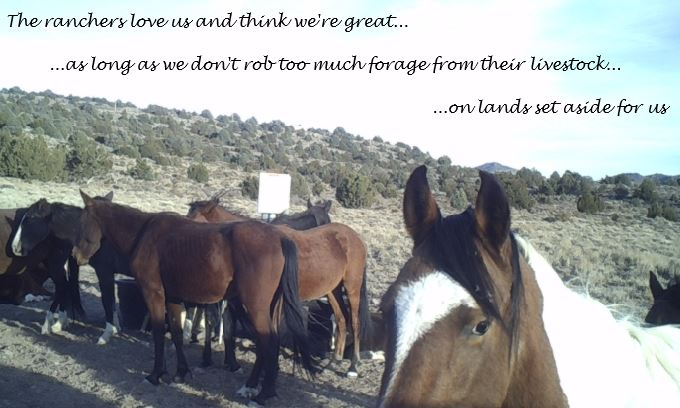
That will probably happen right after they stop the slaughter of pre-born kids in the U.S.
More Wild Horses Found Dead at Heber WHT
Nine horses have been killed since the middle of January, plus one that had to be put down due to injuries. Thanks to ABC15 Arizona for the video.
RELATED: Heber Wild Horse Shooting Still in the News.
Pine Nut Roundup Set for Next Week
BLM announced today that 575 ‘excess’ wild horses would be removed by helicopter from the Pine Nut Mountains HMA beginning on or about February 6. The gather will be open to public observation and captured animals will be taken to the Palomino Valley Off-Range Corrals north of Sparks, NV, where they will be prepared for adoption.
Gather stats and daily reports will be posted to this page.
The HMA covers 104,316 acres in western Nevada and has an AML of 179, for an aimed-at population density of 1.7 animals per thousand acres. Forage consumption would amount to 2,200 AUMs annually.
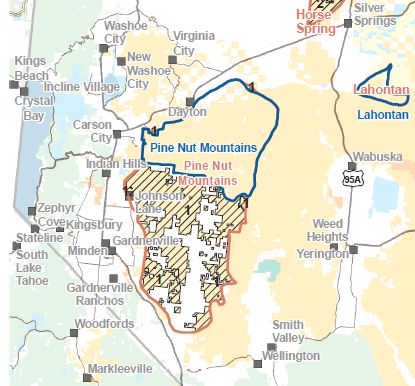
The estimated population in early 2018 was 775 horses. A 20% growth rate would put the herd at roughly 900 horses today, for a population density of 8.6 animals per thousand acres.
Forage consumption would be 10,800 AUMs per year. Resource loading attributable to horses would be 0.1 AUM per acre per year.
Wild horses that interfere with ‘other mandated uses’ of the land are said to be ‘excess.’
Would those uses be recreation, mineral extraction and timber harvesting? No, they don’t require forage. What could the other uses be?
Livestock grazing. The Pine Nut HMA is subject to multiple grazing allotments.

To decide which species is consuming more than its fair share of the available resources, you’d need to know
- How many cattle and sheep are allowed on the HMA, or
- How many AUMs are allocated to livestock, and
- How many AUMs are set aside for wildlife
These figures never appear in the news releases.
Therefore, it must be the horses. Livestock are blameless, always.
RELATED: Livestock Grazing in Nevada.
Heber Wild Horse Shooting Still in the News
ABC-15 in Phoenix filed this report yesterday.
RELATED: Heber Death Toll Now at Seven.
UPDATE: See also this story by the White Mountain Independent, published today.
Comments Sought on Proposed Gather of Fifteenmile Horses
BLM announced today a plan to bring the wild horse population of Fifteenmile HMA in line with the capacity of the land to support them and ‘other mandated uses.’ The news release did not indicate what those other uses might be.
The HMA covers 81,000 acres in northern Wyoming and has an AML of 160, for an aimed-at population density of two animals per thousand acres. The current population, said to be approaching 500 horses, yields a density of six animals per thousand acres and puts the herd at 3X AML.
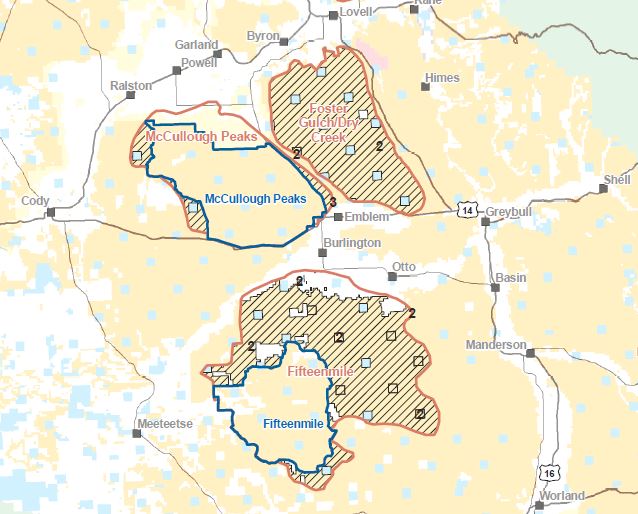
The horses would consume about 1,900 AUMs annually at AML and nearly 6,000 AUMs annually at current population levels.
The announcement did not mention that livestock grazing occurs on the HMA.

The number of livestock allowed on the HMA was not given in the announcement.
The aimed-at population density for livestock was not given in the announcement.
The forage allocated to livestock in the HMA was not given in the announcement.
Until these values are known there is no way of deciding which species needs to go.
But in a state where the BLM allocates 1.9 million AUMs to livestock every year, compared to 45,000 AUMs for horses, you can rest assured it ain’t the horses.
RELATED: Livestock Grazing in Wyoming.
Shannon County Horses Subject of Photo Exhibit
Photographs of wild horses that live in and around Echo Bluff State Park in southern Missouri will be on display at Social on Patton in Springfield starting February 1, as reported yesterday by the Springfield News-Leader.
Dean Curtis, who visits the area five or six times a year, will be present to answer questions and talk about his experiences photographing the horses.
These animals have roamed freely in Shannon County for more than a century and have organized into four herds: Round Spring, Shawnee Creek, Broadfoot and Rocky Creek.
The Broadfoot and Rocky Creek horses are said to be the most elusive.
RELATED: Wild Horses in Missouri?
Bill Aims to ‘Protect’ Corolla Wild Horses
Draft legislation, introduced in the U.S. Senate, would require the Fish and Wildlife Service, along with other stakeholders, to create a new plan for ‘managing’ the Corolla wild horses, according to a report posted yesterday in Coastal Review Online.
The move was endorsed by the Humane Society and ASPCA, groups that favor the use of contraceptives on wild horses.
You only have to look at western rangelands to see how this will turn out.
There will be claims of overpopulation, lack of predators and destruction of habitat.
Managers will be forced to achieve a ‘thriving ecological balance’ with ‘other mandated uses’ of the land. This will come through amendments to the original statute, at the behest of one or more special interests.
Finally, actions will be taken to reduce the number horses, or better yet, replace them with other ‘ventures’ that are more ‘productive.’
Keep the feds out of it.
Wild and Free in Utah
Onaqui Mountain horses, filmed from the air and on the ground by Tag Team Dream.
RELATED: BLM Puts Crosshairs On Onaqui Mountain Horses.
Return to Palomino Valley Wild Horse Corrals
Last day of government shutdown, at least for a while. Two BLM workers were on site.
Service gate was open but visitor gate was closed.
Some of the corrals that were empty on 12/31/18 had horses, some of the corrals that had horses back then were empty. Youngsters seen on 12/31 were not there.
Ranchers like these wild horses best—the ones that are off the range—permanently.
No freedom, no family, no foals, no legacy.
RELATED: Palomino Valley Corrals, Day Ten of Government Shutdown.
Heber Death Toll Now at Seven
That’s since January 12. Refer to this story by FOX-10 News in Phoenix. Also killed were several coyotes (not mentioned in the report).
The WHT is like an Israeli settlement on Arab lands. See the map on page seven of this document. The Arabs view the occupiers with dripping contempt.
Do they have a motive for killing the settlers? Absolutely.
Did they do the deed? We’ll probably never know. You see, they have friends at the U.N., the occupiers don’t.
RELATED: More Horses Found Dead at Heber WHT.
Back to the Hills
Best month to see the Virginia Range mustangs up here is June. Elevation 6,500 feet.
Paiute Lawsuit Dismissed
Legal action against the Pyramid Lake Paiute Tribe, prompted by a tribal horse roundup earlier this month, has been rejected by U.S. District Court Judge Miranda Du because of the tribe’s status as a sovereign government.
Presumably, claims against others named in the case are still pending.
Refer to this report by AP News, posted earlier today.
RELATED: Paiute Roundup Draws Lawsuit.
Pryor Mustangs Passing By
Short one by Mt Man Maxx, filmed late summer 2018. Pryor Mountains WHR.
Alto Colts Subject of Court Battle
Two colts that have been held in a Santa Fe pen since June are wild and not under the jurisdiction of the New Mexico Livestock Board, according to volunteers with the Wild Horse Observers Association. They should be returned to the range, just like the horses released by the court in September of 2018.
A hearing, originally set for January 21, has been rescheduled for next month. Refer to this report, posted today by Ruidoso News.
RELATED: Judge Rules in Favor of Alto Wild Horses.
Mustang Monday
On the Salt River. Filmed in January, 2019. “The weather was very mild, a few bugs around,” according to the video owner, EzTimes HorseRides.
Hat Found in Ring, Says ‘Commie Bint’
She’ll go down like a sack of wheat. H/T KPIX CBS SF Bay Area for the video.
Alto Horses at Creek
Not sure if these are the horses returned to the range in October, 2018. A question about that on YouTube was not answered. H/T StrawBerry Roan Studio.
RELATED: Alto Horses Get Temporary Warning Signs.
The Song Set to the Thing
An example of what you can do in PowerPoint. H/T Valeriu Margescu.
More Horses Found Dead at Heber WHT
The remains of four wild horses and several coyotes were found between January 15 and 22, near State Highway 260, according to a story posted today by the White Mountain Independent of Show Low, AZ.
All were dispatched by gunshots.
The discoveries were reported to the Navajo County Sheriff’s Office. Personnel from the Forest Service were not available due to the federal government shutdown.
A motive was not discussed in the article.
The Heber WHT lies within—and is surrounded by—grazing allotments. See the map on page seven of this document.
That wild horses rob forage from the public-lands ranchers is well established, including mares that have been darted with contraceptives.
Can coyotes take down young calves?
Last October, two stallions were found dead in the WHT, also killed by firearms.
RELATED: USFS Still Silent on Heber Wild Horse Shooting, Advocates Disappointed with Heber Recommendations, Wild Horse Narrative.

