Refer to this report by Associated Press, posted today. The legislation, which goes into effect tonight, keeps the federal government afloat through September 30 of next year.
The non-defense bill provides a hefty down payment on the disastrous ‘Path Forward.’
Oregon’s most infamous public-lands ranchers have lost their grazing privileges, again, thanks to federal court ruling, according to a report posted today by Associated Press.
The ranchers were convicted of arson in 2012 for a fire they started on federal lands.
They claimed it was to stop the spread of invasive weeds but prosecutors said it was to destroy the remains of deer they killed illegally.
The resentencing of the Hammonds sparked the Malheur Incident in early 2016, which led to the death of a public-lands rancher from Arizona.
The horses weren’t federally protected but they were killed just the same. Here’s a recap of similar incidents on federal lands since the summer of 2018:
KNAU Radio of Flagstaff, AZ said today that the appropriations bill approved yesterday by the Senate bars the Forest Service from euthanizing healthy wild horses and burros and selling them for slaughter.
Congress had prohibited the BLM from lethal control of the animals but the ban did not extend to the Forest Service until now, according to the report.
You can’t have a conversation about wild horses without having a conversation about privately owned cattle and sheep, which the government refers to euphemistically as ‘other users’ of public lands (3:27 in this video).
The forage allocated to livestock on public lands in the western U.S. would support at least 750,000 wild horses, enough to empty all of the ‘warehouses’ fifteen times over.
On the Challis HMA, recently gathered, the management plan assigns 80% of the forage to domestic livestock.
At Saylor Creek, soon to be gathered, the ranchers receive 95% of the forage!
The WHB Act, which appears at 3:15, has been amended several times at the behest of the ranchers and no longer affords the protections sought by Velma.
The roundups, corrals, contraceptive darting, sanctuaries, preserves, adoption events and training programs seen in the video reflect that reality.
There is no wild horse crisis on western rangelands, only the deceit and greed of the public-lands ranchers and their allies in government.
It’s one of the best examples of crony capitalism you could ever hope to investigate.
The measure passed by a 71 to 23 vote, according to a story by Associated Press, which includes $21 million for an aggressive wild horse population reduction strategy. Go to Division D, Title I in the HR 1865 text.
The President said he would sign it before tomorrow’s midnight deadline.
The folks at PERC published a commentary earlier this week claiming responsibility for the $1,000 adoption incentive, describing it as a market-based solution that gets horses out of holding facilities and into real homes.
Why are they in holding facilities? Because they compete for water and forage with other wildlife.
Yep, wildlife. Privately owned cattle and sheep were omitted from the story.
So are they guilty of sloppy research or are they shills for the public-lands ranchers?
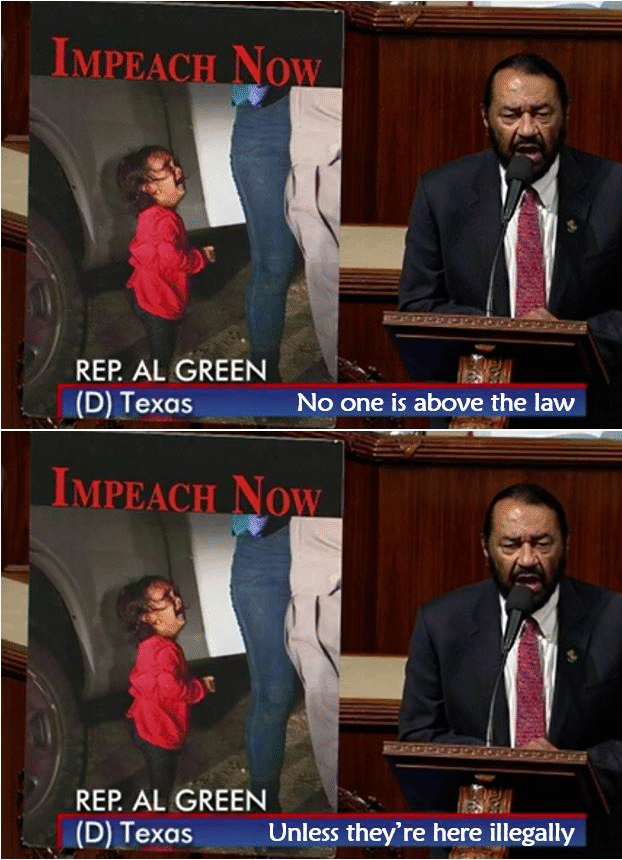
The votes for impeachment were 230-197-1 on the first article and 229-198-1 on the second, according to a report posted this evening by Associated Press.
The remains of fifteen free-roaming horses have been found near a strip mine in Floyd County, according to report posted yesterday by WYMT News of Hazard, KY. They were apparently hunted down and shot with a small caliber rifle.
The reward for information about the case is growing, as donations pour in from around the country.
Almost certainly the brave and loyal Democrats who control the House were able to resist the lobbying pressures of the ranching cabal, but were overwhelmed by the underhanded tactics of oil, mining and timber companies.
That’s why HR 1865 contains $21 million for an aggressive population reduction strategy for America’s wild horses and burros. Control comes later.
Now the bill moves to the Senate, also dominated by liberals, and on to the President, who can only accept it or reject it. No line-item veto.
The non-defense appropriations bill, HR 1865, carried by a vote of 297 to 120, according to a report in Yahoo Finance, presumably with $21 million allocated to “an aggressive, non-lethal population control strategy” for America’s wild horses and burros.
The legislation will be put to a vote in the Senate tomorrow.
Refer to page 8 in Division D for a discussion of the WHB program.
Regarding the ‘Path Forward,’ the bill obligates the BLM to develop a “an aggressive, non-lethal population control strategy” for wild horses and burros.
The plan must include:
The number of additional personnel needed to implement the strategy
The resources needed to substantially increase the number of animals gathered
The additional facilities that will be needed to warehouse those animals
The amount of fertility control needed to minimize future removals
The bill also includes the customary $10 million for range improvements, to be funded by grazing receipts. Yep, approximately 80% of those fees are plowed back into the program every year, to make life better for the public-lands ranchers.
The omnibus spending bill, to be voted on later this week, includes $21 million for the wild horse management plan, according to a news release by Animal Wellness Action.
KIFI News of Idaho Falls reported today that nine mares and fifty two studs captured in last month’s gather have been returned to their home range. The story did not indicate when they were released. Mares were treated with PZP.
The large number of males returned to the HMA, relative to females, skews the sex ratio of the herd, slowing population growth.
The roundup, which starts today, will reduce the herd by about 79%, according to figures supplied in the announcement. The remaining horses will require 804 AUMs per year, to be provided by the HMA and WHT.
Assuming that 60% of the forage comes from the HMA, based on the relative sizes of the two parcels, then the horses will consume 482 AUMs per year while on the HMA (where livestock grazing is allowed), compared to 1,967 AUMs per year for cattle and sheep.
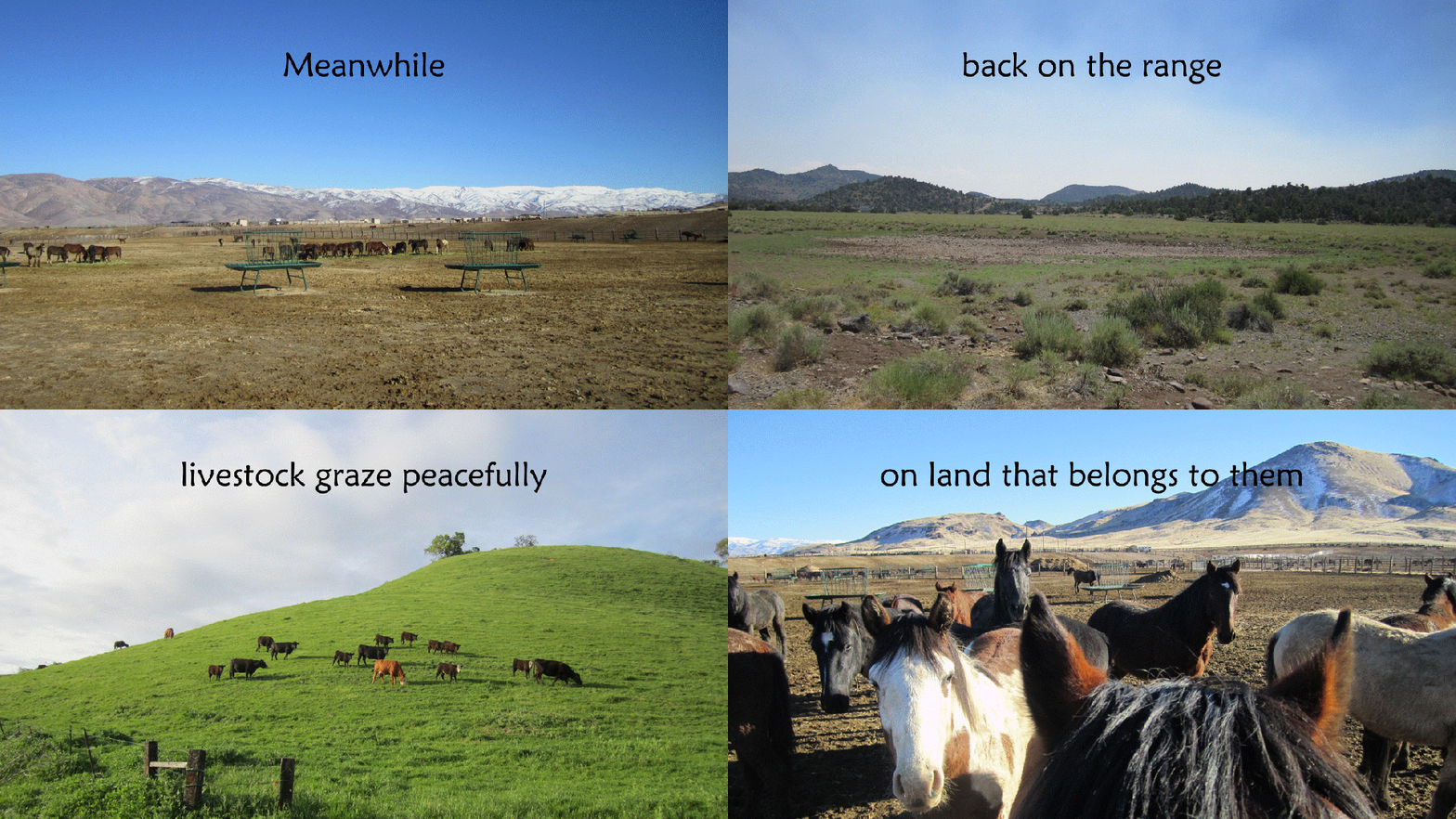
80% of forage to livestock
20% of forage to horses
That this is occurring on land on land set aside for the horses is a sure sign that the WHB Act, signed into law 48 years ago today, no longer functions as Velma intended.