Virginia Range Mustangs Graze Near Carson City Airport

They found some snow-covered grass on College Parkway, according to a story posted yesterday by Carson Now.  Includes photos.

A commenter said it was “Part of the heritage and charm of living in Northern Nevada.”

Couldn’t agree more.

Sometimes the horses can be found by taking Goni Road north, into the hills.

They also graze in and around Centennial Park, east of the airport.

Carson City Airport Map-1

Comments Invited on Reveille Gather Plan

BLM announced on Thursday the opening of a 30-day comment period on a preliminary Environmental Assessment for gathering and removing excess horses on the Reveille HMA in central Nevada.

The HMA covers 105,494 acres and has an AML of 138, for an aimed-at population density of 1.3 wild horses per thousand acres.  The target density across all HMAs is one animal per thousand acres.

Reveille HMA Map-1

The Reveille HA, marked red in the map above, contains the HMA.  Horses were found there in 1971 but the land is no longer managed for them.

The HA and HMA lie within the 650,520 acre Reveille Allotment.  See Map 2 in the EA.

One permittee, who grazes the entire allotment, receives 25,730 AUMs per year from the BLM, per Section 3.2.4 in the EA.

The HMA intersects roughly 16% of the allotment (105,494 ÷ 650,520), suggesting that an additional 4,173 AUMs per year are available in that area, but have been assigned to livestock, with a twelve month grazing season.  See Table 1 in Appendix F of the EA.

The management plan allocates 1,656 AUMs per year to horses in the HMA, according to Section 1.5 (138 × 12).

The livestock AUMs convert to 348 cow/calf pairs, with a population density of 3.3 cow/calf pairs per thousand acres.

Reveille Calcs-1

These figures are presented in the following charts.

Reveille Charts-1

Appendix F states that 2,210 AUMs were allocated to livestock in the HMA, about half of the amount estimated above.

The BLM has limited flexibility in managing wild horses in the HMA, due to a court order that requires roundups whenever the herd size exceeds AML.  Refer to Section 1.3 of the EA and Section 1.4 in the Supplemental Information Report.  The case was brought by the PLR mentioned above.

Comments on the gather plan can be submitted at this page.

Results Pending for Assateague Pregnancy Tests

Field work is complete, according to a report posted yesterday by the Maryland Coast Dispatch, with findings expected later this month.

Last month, a member of the WHBAB pointed to the herd, on the Maryland side of the island, as the gold standard for wild horse management, even though its size declined from 78 in November 2018 to 75 in November 2019 and its sex ratio is far from normal.

RELATED: Baby Boom Next Year on Assateague Island?

Comments Invited on Wild Horse Fertility Control Study

The BLM announced today the opening of a 15-day comment period on the preliminary Environmental Assessment for testing of a single-dose vaccine that will cause long-term infertility in wild mares, to help the agency achieve and maintain a thriving ecological balance [on public lands].

The news release did not indicate what’s on the other side of the scales but more than likely it’s privately owned cattle and sheep.

What they’re really looking for, according to page 5 in Section 1.2, is lifetime infertility, code words for sterilization.

Section 4.4.1 says that the WHB Act of 1971 provides for contraception and sterilization of wild horses.  It does not.  The terms are not in the statute.

The reference should be the WHB Act of 1971, as amended [by ranching interests], which no longer affords the protections sought by Velma.

The proposal adds more weight to the argument that the agency entrusted with the care of these animals actually views them as pests—something to be eradicated.

Where Did All the Horses Go-1

Laramie County Commissioners Mull Rule Change

A 45-day comment period began yesterday, according to a report by the Wyoming Tribune Eagle, to help county commissioners make a decision regarding a proposed wild horse adoption facility near Burns.

Personnel from Equine Elite, the company pitching the project, didn’t like the answer given by residents, so they asked the county to change the rules, silencing those voices.

An interesting and valuable follow-up to the story would be to find out what’s driving it.

Why was ‘No’ an unacceptable answer?  Who benefits as more and more wild horses come off the range?

RELATED: What’s Up with the Laramie County Planning Commission?

Grappling with Survival

The folks at Dictionary.com announced this week that the word of the year for 2019 is ‘existential,’ as in existential threat—something that puts the nation at great risk, such as, you know, wild horses and burros.

Actually, the subject was not included in the list of examples, but climate change, gun violence and the Trump administration were, suggesting that the site is run not by wild horse enthusiasts, but by left-wing ideologues.  Butt sex, baby murder and open borders didn’t make the cut.

Oh wait…the runner-up word was ‘nonbinary.’  That removes all doubt.

Book Tells Story of Shannon County Wild Filly

Fifty wild horses are allowed by law to inhabit the Ozark National Scenic Riverways in southern Missouri, so every year, some of them are gathered and offered for adoption.

“Shawnee, Wild and Tame” chronicles the first year of a filly born in January, 2018.

Although the foal is the central character, the author thought the book would be a good way to tell the story of all the wild horses living near the Current and Jacks Fork rivers, according to a report posted today by The Salem News of Salem, MO.

Park Service Seeks Volunteers for ‘Pony Patrol’

Here’s your chance to become an ambassador for the Banker Horses.  You must be at least 18 years old and able to walk the beach for a four hour shift, once a week.

Openings exist at Shackleford Banks and Rachel Carson Reserve.

Refer to this story by WTVD News of Raleigh-Durham, NC for more information.

UPDATE: See also this news release from NPS.  Includes link to online application.

What’s Up with the Laramie County Planning Commission?

Consent of the governed, it’s so medieval.

You don’t build an 80-acre facility with a capacity of 5,000 animals on the chance that the BLM might want to use it in their wild horse outplacement program.

There must be a Memorandum of Understanding, at minimum, between the BLM and Equine Elite, the LLC that would build it.

Earlier this year, BLM requested bids for long-term care of wild horses and burros in Colorado, Idaho, Kansas, Montana, Nebraska, Nevada, North Dakota, Oklahoma, Oregon, South Dakota, Texas (panhandle only), Utah, Washington and Wyoming.

Contracts would be awarded for 200 to 5,000 animals, with four-year and nine-year renewal options.

The company pitching the project was established on 03-08-19, according to this profile, four days after the solicitation went public.

That the BLM is awarding contracts to private parties for large-scale corrals, or at least signaling its intent to do so, may mean that a wink and a nod have come out of Washington and that funding of the ruinous Path Forward is imminent.

If the proles won’t go along with the glorious plan, silence them or sweep them aside.

Better yet, make an example out of them.

RELATED: Residents Say No to Hi-Cap Adoption Center.

Residents Say No to Hi-Cap Adoption Center

Property owners within three miles of a proposed wild horse adoption center did not approve the project, but Laramie County Commissioners have a solution: Change the radius to one mile, cutting those stakeholders out of the process!

Refer to this story, posted today by the Wyoming Tribune Eagle.

Construction of the facility, a possible stepping stone to mass removals of wild horses and burros from public lands, per the disastrous Path Forward, must be blocked.

RELATED: High Capacity Adoption Center Coming to Wyoming?

Comments Invited on Southern Nevada Nuisance Gather Plan

BLM announced earlier this week the opening of a 30-day comment period on a draft Environmental Assessment for a ten-year plan to remove wild horses and burros in southern Nevada that feed near highways, creating a public safety hazard, or have strayed from their home range onto to private property.

The six HMAs affected by the proposal are highlighted in the following map.

Southern Nevada Gather Plan EA-1

The roundups will not be used as a means for achieving AMLs, according to the news release.  A similar statement appears on page 11 in the EA.

But they could be carried out on an emergency basis.  The meaning of the term and the rules that would be altered or skipped in those cases were not explained.

The resource assessment, summarized in Table 3-1 of the EA, says livestock grazing does not occur on [public lands] within or near the affected HMAs but does not indicate if it happens on private lands that may abut or lie in close proximity to the HMAs.

Given that wild horses and burros are not privately owned and are not considered to be livestock, do they lose their protected status when they exit federal lands and become subject to state and local laws for domestic livestock?  Probably not.

If Nevada is a fence-out state, should private property impacts be part of the analysis?

In cases where land owners have built fences to keep the horses and burros out, do the requirements of NRS 569.431 apply?

Comments can be submitted at this page.  Public input will be reviewed by BLM staff and responses will be included in the final EA.

What’s Up with Muck Boots?

Today may be Black Friday but watch out if you’re shopping for Muck Boots!  The boots in this photo are the same size, men’s 11 / women’s 12.  The boot on the right, purchased in 2014, is longer and wider than the boot on the left, purchased in 2019.

IMG_0044

The old boots were comfortable, the new ones are too small.  They are great around the barn, especially this time of year, but to say they run small is an understatement.

Remarks on TPC Incident

Launching a distillation column several hundred feet into the air, that is the definition of a bad day in the petrochemical industry.

Many refineries and chemical plants dot the Gulf coast in Texas and Louisiana.

The incident began early Wednesday at the old Neches Butane plant in Port Neches, TX, a facility built by the government during WWII to produce synthetic rubber.

Back in those days it was guarded by machine guns.

No one was killed in the explosions and fires but the plant will be down for many months—if it is not a total loss.

Resolutions for the New Year

Let 2020 be the year you did something for the horses, not to the horses.

1. The United States does not receive fair market value for livestock grazing on public lands.  Raise the fee to $40 per AUM, in line with market rates.  Better yet, raise it to $60 per AUM, to bring it in line with the cost of warehousing wild horses (that were removed from those lands at the behest of the ranchers).

2. Your government gave itself the power to manage HMAs principally for domestic livestock.  Other areas, where horses were found when the WHB Act became law, have been zeroed out altogether, no longer designated for wild horses.  Manage these areas principally for wild horses and burros per the statute.  Balance the needs of WHB with those of wildlife, not domestic livestock, per the statute.

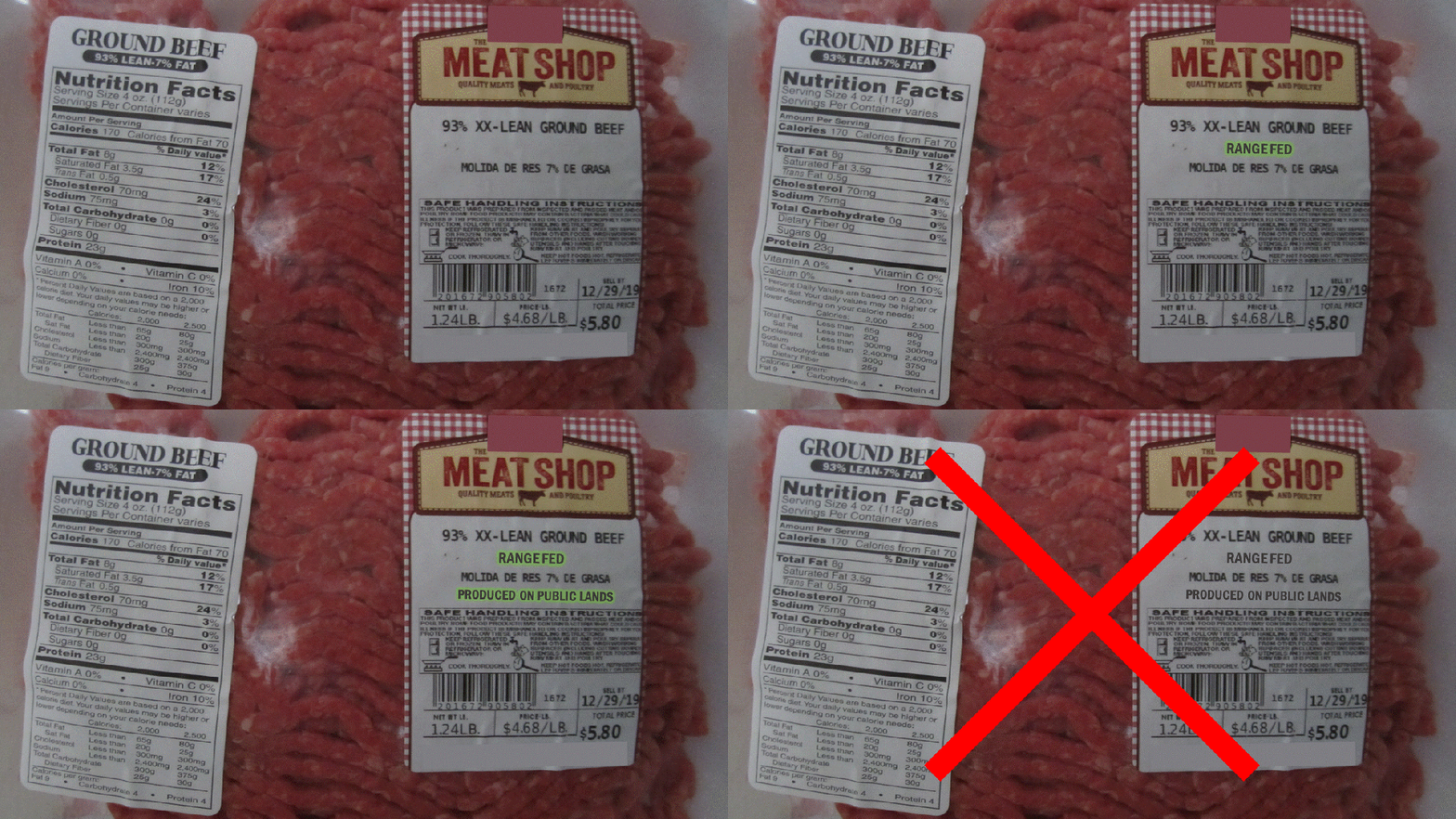
3. Consumers do not know where beef is produced.  Require labels on the product if it is RANGE FED or PRODUCED ON PUBLIC LANDS and let the market sort out the winners and losers.  Cattle raised on private property or at the expense of America’s wild horses and burros.  You decide, not the special interests in Washington.

The PZP zealots and big-name advocacy groups have lost their way.  They are on the same side of the debate as the public-lands ranchers.  Don’t give them a penny.

Where Have All the Horses Gone-1