The Decision Record for wild horse management actions in the Barren Valley Complex authorized the implementation of Alternative 1, the Proposed Action, as identified in Section 2.0 of the Final EA. There will be no significant impacts in carrying out the plan, except on the horses.
The management plan for the Coyote Lake-Alvord-Tule Springs HMA allows 390 wild horses on 559,400 acres, for a stocking rate of 0.7 horses per thousand acres. Recall from the discussion in April that fractional stocking rates may indicate large amounts of forage diverted to privately owned livestock.
The Rule of Four suggests that 4 × 390 = 1,560 wild horses have been denied a spot on the HMA. The Rule of Five suggests the land should be able to support 5 × 390 = 1,950 wild horses. Let’s see how these estimates compare to figures determined the hard way.
The management plan allocates 12 × 390 = 4,680 AUMs per year to the horses, per Section 3.2.1 of the EA. The current population, thought to be around 550 wild horses, requires 6,600 AUMs per year. The current stocking rate is one wild horse per thousand acres, in line with the target rate across all HMAs (27,000 animals on 27 million acres).
The HMA intersects four grazing allotments. Table 4 in Section 3.2.2 provides data on allotment size, authorized AUMs and grazing seasons.
The total estimated forage available to livestock inside the HMA is the sum of the forage contributions of each allotment. For example, 38% of the Alvord allotment lies within the HMA so it contributes 38% of its forage to the HMA, assuming the resource is evenly distributed across the parcel (.38 × 7,355 = 2,795 AUMs per year). The total estimated forage for livestock across the four allotments is 13,421 AUMs per year.

The allotment acreage inside the HMA is computed the same way. The total is less than the size of the HMA, suggesting that some of the HMA, about 21%, is not subject to permitted grazing. The map in Appendix B does not show the allotment boundaries.
Livestock populations and stocking rates are based on cow/calf pairs, as their resource requirements are said to be equivalent to those of wild horses.
The Alvord ranchers would have to place 399 cow/calf pairs inside the HMA to graze off 2,795 AUMs in seven months (2,795 ÷ 7 = 399). The total estimated number of cow/calf pairs inside the HMA is 2,384, for a weighted average grazing season of 5.6 months.
The stocking rate allowed by plan is therefore 2,384 ÷ 441,841 × 1,000 = 5.4 cow/calf pairs per thousand acres. The stocking rates on individual allotments range from 4.2 to 12.1 cow/calf pairs per thousand acres.
These management indicators are compared in the following charts.

These are the goals of the Proposed Action, to be achieved by roundups and maintained by “intensive fertility control”—in an area set aside for wild horses.
The forage assigned to livestock would support an additional 1,118 wild horses (13,421 ÷ 12), for a new AML of 1,508 (390 + 1,118). These figures are lower than those estimated above by the Rule of Four and Rule of Five. The rules might work best on HMAs that are 100% subject to permitted livestock grazing.
Although the HMA is 40% over AML, the current population is well within the carrying capacity of the land (550 < 1,508).
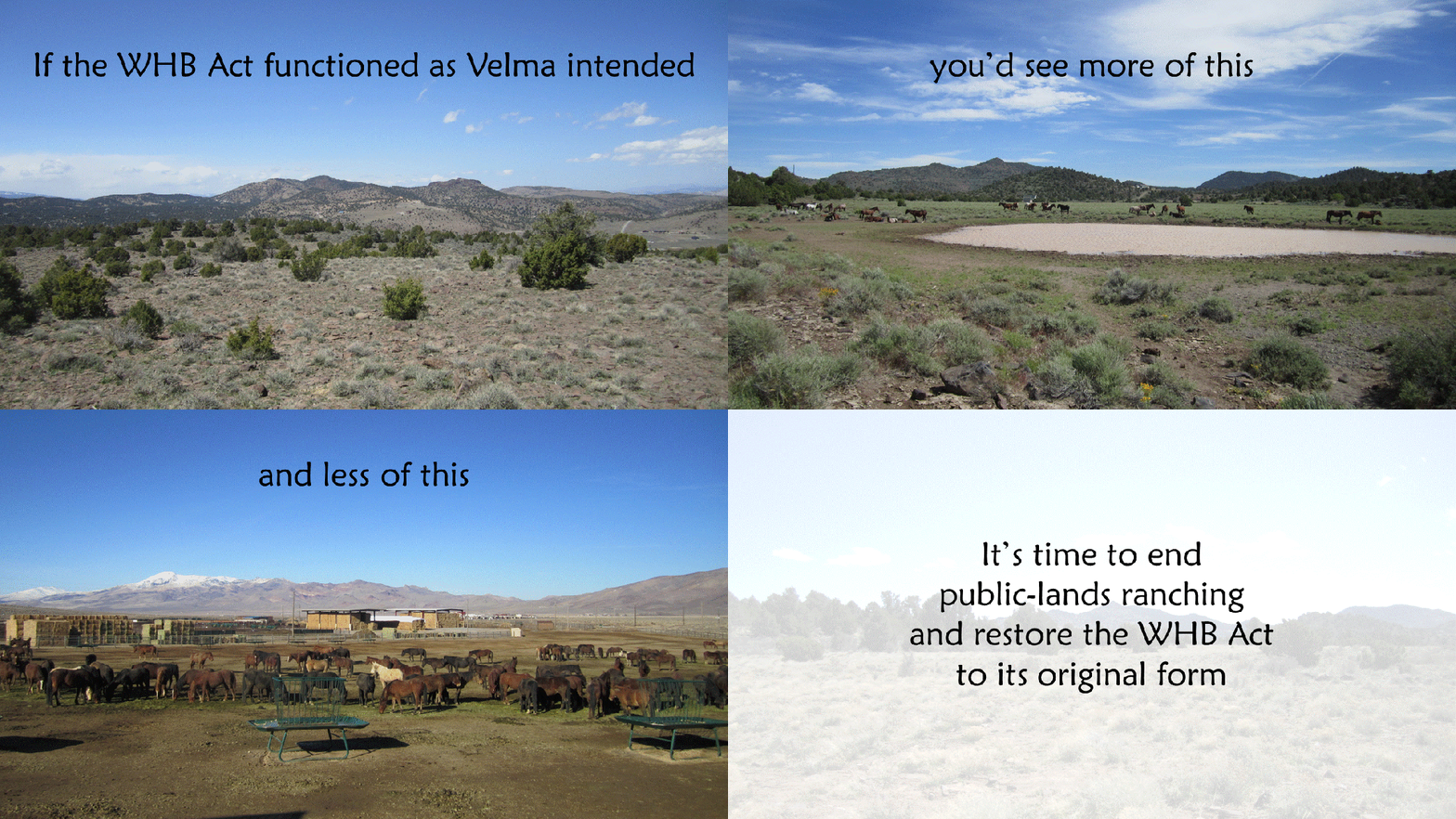
The problem is public-lands ranching, not wild horse overpopulation.
RELATED: Barren Valley Gather EA Comes and Goes, No News Release.