Looks like he’s gone.
RELATED: Missing Foal?


Western Horse Watchers Association
Exposing the Hypocrisy, Lies and Incompetence of the Wild Horse Advocates
We know that cattle and sheep are intelligent, hard working and dedicated to the improvement of western rangelands, so they should be recognized for their efforts.
Unlike wild horses and burros, who are destroying their habitat.
What’s the difference? Human involvement.
Are local advocacy groups allowed to participate?
No! You only need to look at the Sinbad roundup to see what happens when volunteers try to help wild horses and burros.
Every year, 50% of grazing receipts or $10 million, whichever is greater, goes back into the program for rangeland improvements. Wells, tanks and water lines, road, fence and gate repairs, etc. Other funds go to predator management and vegetation control.
In exchange, the ranchers pay the government almost nothing.
What’s invested in the WHB program?
The news release sounds like a mutual admiration society. The president of the Public Lands Council, a cheerleader group for the public-lands ranchers, said “Grazing on federal lands is a critical part of our country’s food supply…,” which it isn’t.
You could end the program tomorrow and nobody would notice.
Only a few seconds earlier she had been digging it into his gums, spurring him on to victory. Then the bit broke—allowing him to give her some feedback on her riding style.
He bolted from the arena, with her on top, down the driveway and over to a busy highway, according to a story posted this morning by the Nashville Tennessean.
He ran wild for 15 minutes but does not appear to be a wild horse. The incident stopped with the help of a firefighter and nobody was hurt.
But what will happen to the horse?
The start date is not known. Gather stats through October 16, courtesy of BLM:
Foals accounted for 21.4% of the total. The sex ratio of captured adults is approximately 43% male, 57% female.
The method of capture is bait traps. Animals removed from the HA have been taken to the off-range corrals in Ridgecrest.
The operation will probably conclude this week.
RELATED: Clark Mountain Roundup in Progress.
The incident started on October 11. Gather stats through October 18:
Foals accounted for 21% of the total. All of the deaths were attributed to pre-existing conditions.
The daily results yield 330 horses shipped but the cumulative total says 436.
Body condition scores are not known.
The imbalance is 256 horses. Some of the gap may be due to the discrepancy in the horses shipped. The contractor should be holding the remainder on site.
The operation will likely conclude this week.
The incident started on October 10. Gather stats through October 18:
No activity on Day 8 due to weather. Foals accounted for 23.7% of the total. The sex ratio of captured adults is approximately 45% males, 55% females.
The reports did not indicate the HMA(s) where the horses were captured or released.
Of the horses returned, 46 were “treated with fertility control.” No details were given.
Body condition scores are not known.
The imbalance is 168 horses. The contractor may be holding them on site.
The release of horses back to their home range may indicate the operation is finished in one area and will resume in another. Five HMAs are affected.
RELATED: Red Desert Roundup Day 7.
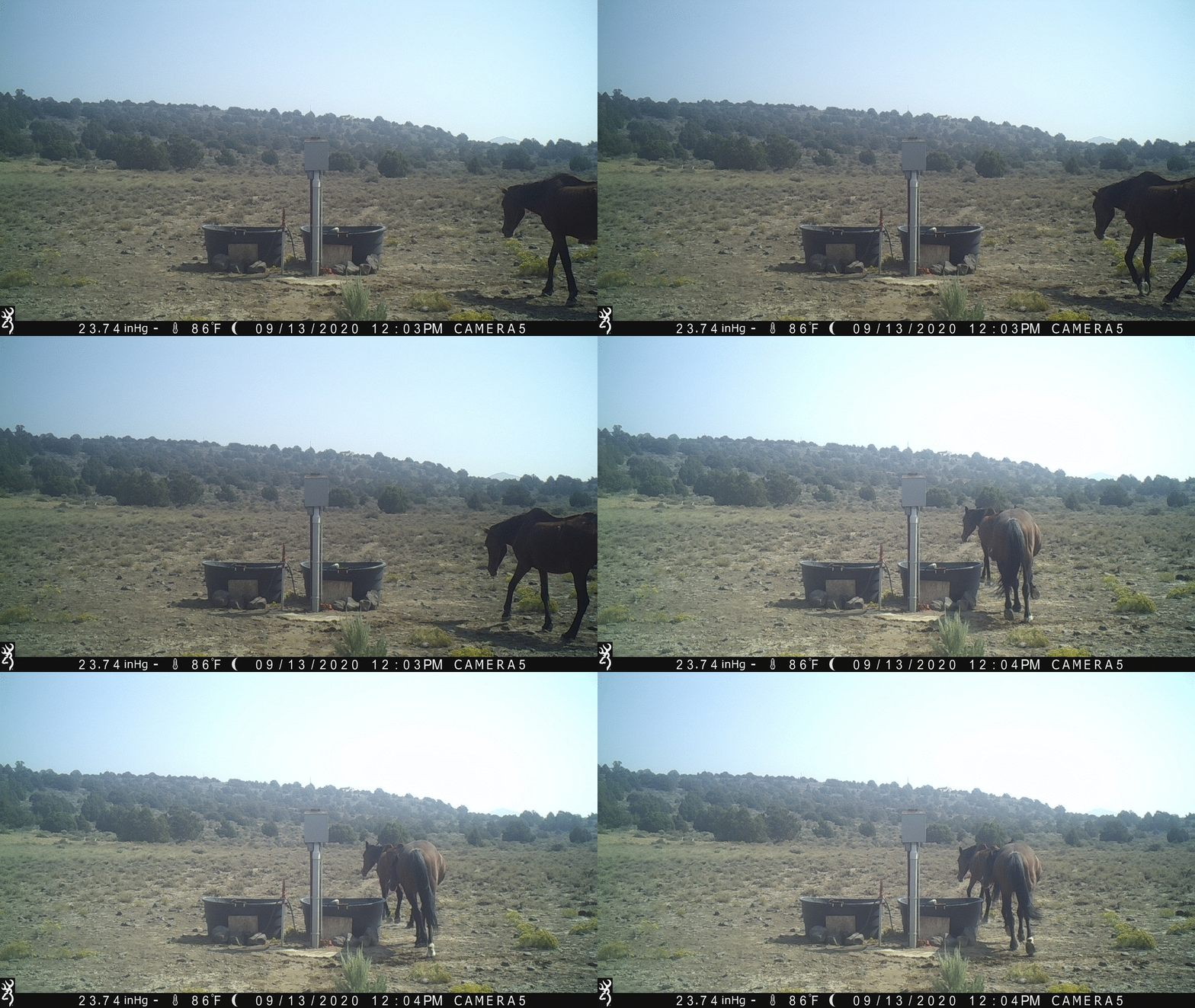
Trailcam photos from the Virginia Range, with smoke from California wildfires.
No youngsters, though. Let’s see what the new year brings.

The following remarks were delivered at the October 2019 WHBAB meeting by a representative of the Society for Range Management, an organization that believes rangelands should be used for livestock grazing and not much else.
Although the group accepts wild horses and burros on those lands, they insist that their numbers be limited to those that existed when the WHB Act became law (0:23 to 0:36).
This is where they’re going with the ‘Path Forward.’
We know from President Nixon’s remarks that only 9,500 wild horses and 11,000 wild burros remained on western rangelands in 1971. That’s equivalent to 15,000 wild horses today on 27 million acres, for a stocking rate of 0.6 horses per thousand acres.
A number that low means only one thing: Large amounts of forage diverted to privately owned livestock.
No new laws are required. Just enforce the plans that are already on the books.
RELATED: ‘Path Forward’ Extinction Target.
Catching up on trailcam photos. He comes in first on the right. He’d be put down on the spot if captured in a roundup, due to a hopeless prognosis for recovery.
RELATED: ‘Hopeless’ Returns to Water Tanks with Buddies.
A man who led a horse from its stall last December and killed it for its meat has been arrested and charged, according to a report posted yesterday by AP News.
In a 2018 interview on Fox News, Dave Duquette, spokesman for Protect the Harvest, a cheerleader group for the public-lands ranchers, said “There was one meat buyer…in the south of…in Florida…that said he had 2.3 million Hispanics down there that would eat it…every day if they could get it.” That video has been scrubbed from YouTube.
Just a run-of-the-mill Saturday afternoon on the Virginia Range.

So says the writer of an opinion piece published this morning by the Las Vegas Sun.
Written by the director of field operations for AWHC, it’s just another attempt to push the PZP Amendment through Congress, an idea so good that even the Rolling Stones would support it.
This is the same guy who’s coordinating the Virginia Range darting program. A former BLM employee, he’s 100% on board with the overpopulation narrative.
Never let the facts get in the way of a good story, especially if you’re a big-name ‘advocacy’ group with a hidden agenda.
Truth is, the helicopters are flying because most of the resources in wild horse areas have been diverted to privately owned livestock. And, apparently, AWHC doesn’t give a damn about that. Just keep the PZP supply chain moving.
 Would you be surprised if they take money from ranching interests? The organization needs a thorough house cleaning, starting at the top.

The incident started on October 10. Gather stats through October 16:
No activity on Day 5 due to weather. Foals accounted for 23% of the total. One death occurred today, Day 7, but no details were provided. It was classified as pre-existing.
The reports did not indicate the HMA(s) where the horses were captured. No details were given for the horses returned.
The imbalance is 240 horses. The contractor may be holding them on site.
RELATED: Red Desert Roundup Day 3.
A story posted today by AP News says that one had to be rescued for medical treatment after it was spotted eating fishing line like it was grass. Others got hooks tangled in their manes as well as the fur on their lower legs.
A story by the Powell Tribune of Powell, WY says the Free Roaming Equids and Ecosystem Sustainability Network met last week in Cody to discuss wild horse overpopulation and its effects on wildlife and multiple use of public lands.
The meeting follows one held last year in Reno.
The group seeks healthy herds on healthy rangelands, according to the report, which means “achieve and maintain AMLs,” code words for “manage HMAs principally for cattle and sheep.”
As the photos roll out, remember that you are watching an enforcement action.
Media coverage—if there is any—will focus on casualties and the treatment of the horses but the real injustice was done years ago, by those who wrote and approved the resource management plans.
On the Lost Creek HMA, for example, the horses receive an estimated four percent of the authorized forage, excluding wildlife. They have been consuming more than their fair share, around 16%, so the herd needs to be cut down to size.
The same is true for the ‘Path Forward,’ a plan with the same goal but much broader scope: Enforce the resource allocations across all HMAs, manage them principally for cattle and sheep.
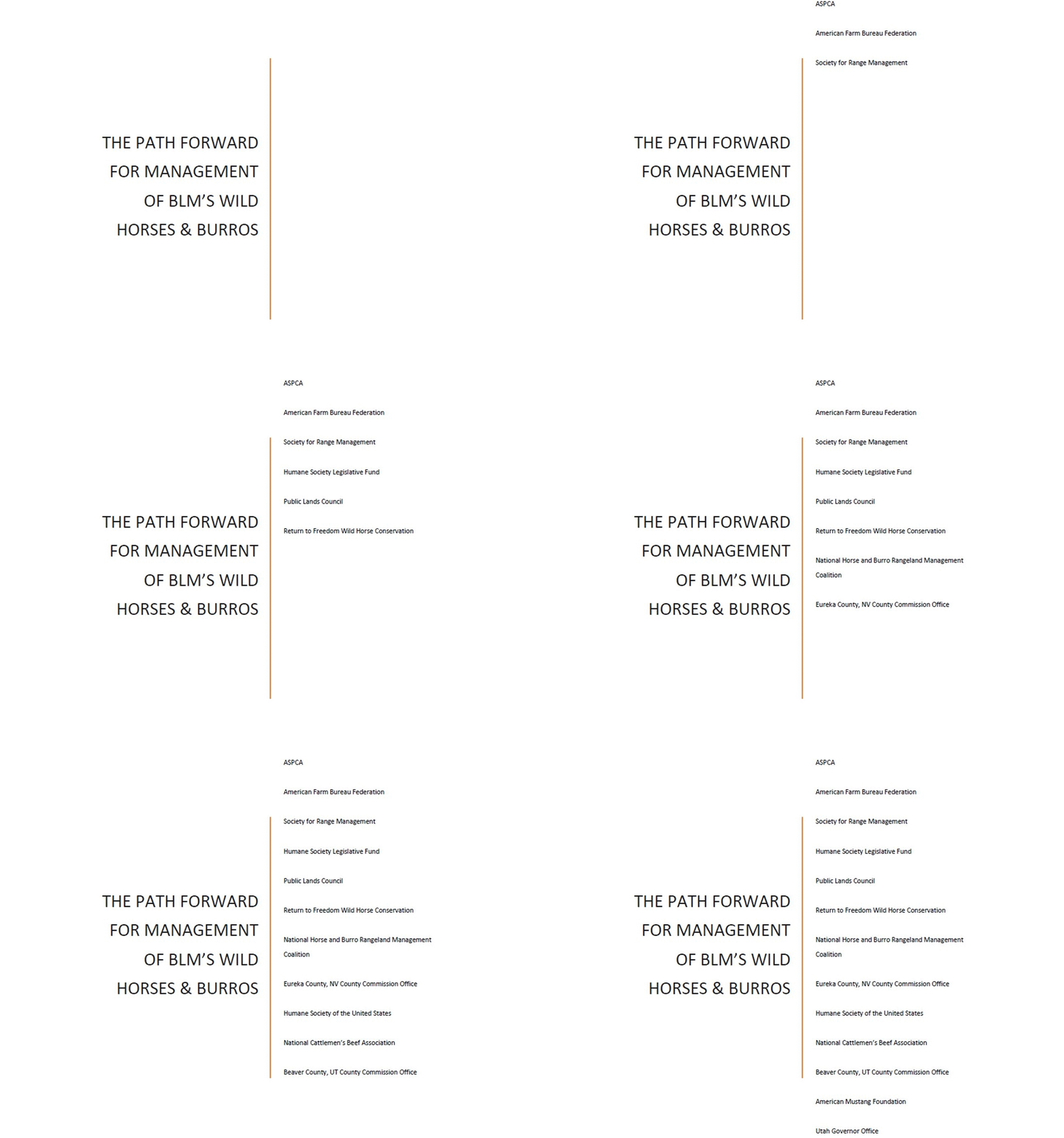
Notably absent from the signatories are drillers and miners, the supposed boogeymen of western rangelands.
But there are dozens of ‘advocacy’ groups that can be added to the list—always begging for your money—so they can make sure those forage allocations never go any higher.
They, like the public-lands ranchers, are enemies of America’s wild horses.
The original statement went something like this: The number of wild horses and burros in off-range holding can be explained by the misappropriation of forage on just a few dozen HMAs.
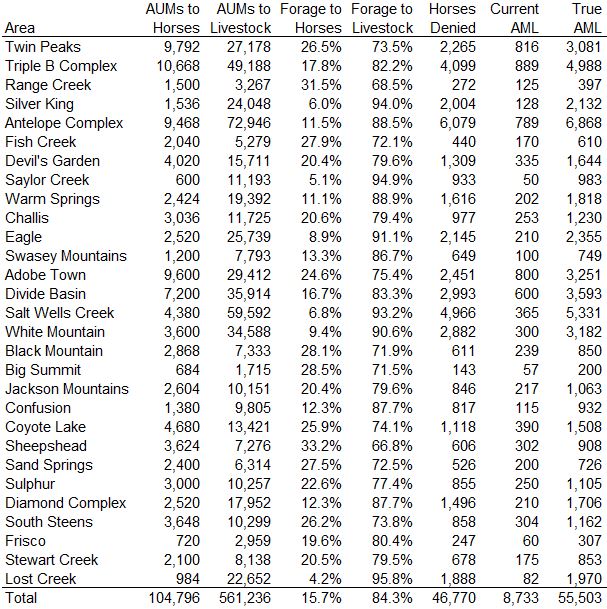
How’s the theory holding up? Twelve more areas have been considered since the last report, they appear in the sidebar on the right titled ‘Short End of Stick.’
Data from those posts have been added to the original list, starting with the Big Summit WHT and ending with the Lost Creek HMA.
Some areas are managed for burros but the calculations are based on wild horses. If you want to know the number of burros displaced from an area by privately owned livestock, multiply the horses denied by two. Same for the AMLs.
For the areas considered so far, livestock receive about 84% of the authorized forage (excluding wildlife), with the balance going to horses. The total number of horses displaced from their home range is 46,770.
If you prefer a mix, you could say 45,000 horses + 2 × 1,770 burros = 48,540 wild horses and burros displaced from their home range, which is roughly equal to the number of horses and burros in off-range holding.
The theory has been validated.
The true AML of 55,503 is six times higher than the current AML of 8,733, slightly more than predicted by the Rule of 5.
Imagine what the true AML would be for all HMAs and WHTs!
The problem is not too many horses or not enough contraceptives. The problem is public-lands ranching.
RELATED: Hypothesis Revisited.

The incident started on October 11 with three deaths. No details were provided.
The daily reports indicate 138 horses captured and 134 shipped through October 12, but the cumulative totals show 158 and 134, respectively.
RELATED: Paisley Desert Emergency Roundup Starts This Weekend.
The ‘Albany bulge’ has broken out to the north, bringing the fire closer to the suspected location of the off-range pasture (area labeled Middle Creek in the following map).
Yesterday’s fact sheet said a fire line has been established in the Middle Creek area between the fire and Centennial.
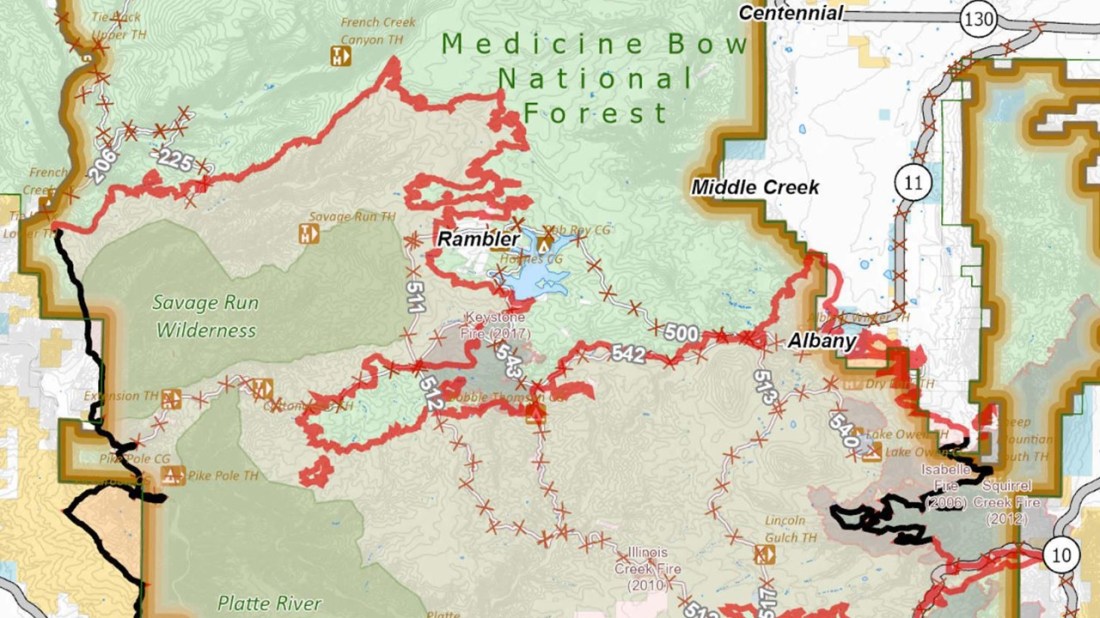
The fire has burned 176,000 acres since September 17 and is now 30% contained.
An email asking about the location of the ranch was never answered.
RELATED: Mullen Fire Moving East.

