Have You Ever Heard of “People Against Mass Sterilization?”

Of course not!

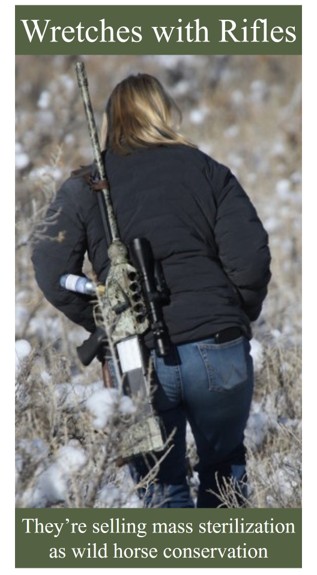
The opponents of motorized removal want to pummel the mares with pesticide-laced darts, which inevitably leads to permanent infertility and herd collapse.

The bureaucrats in Colorado are leading the way in this regard, with close support from the big-name advocacy groups.

► Get the truth about wild horses and the wild horse advocates at westernhorsewatchers.com.

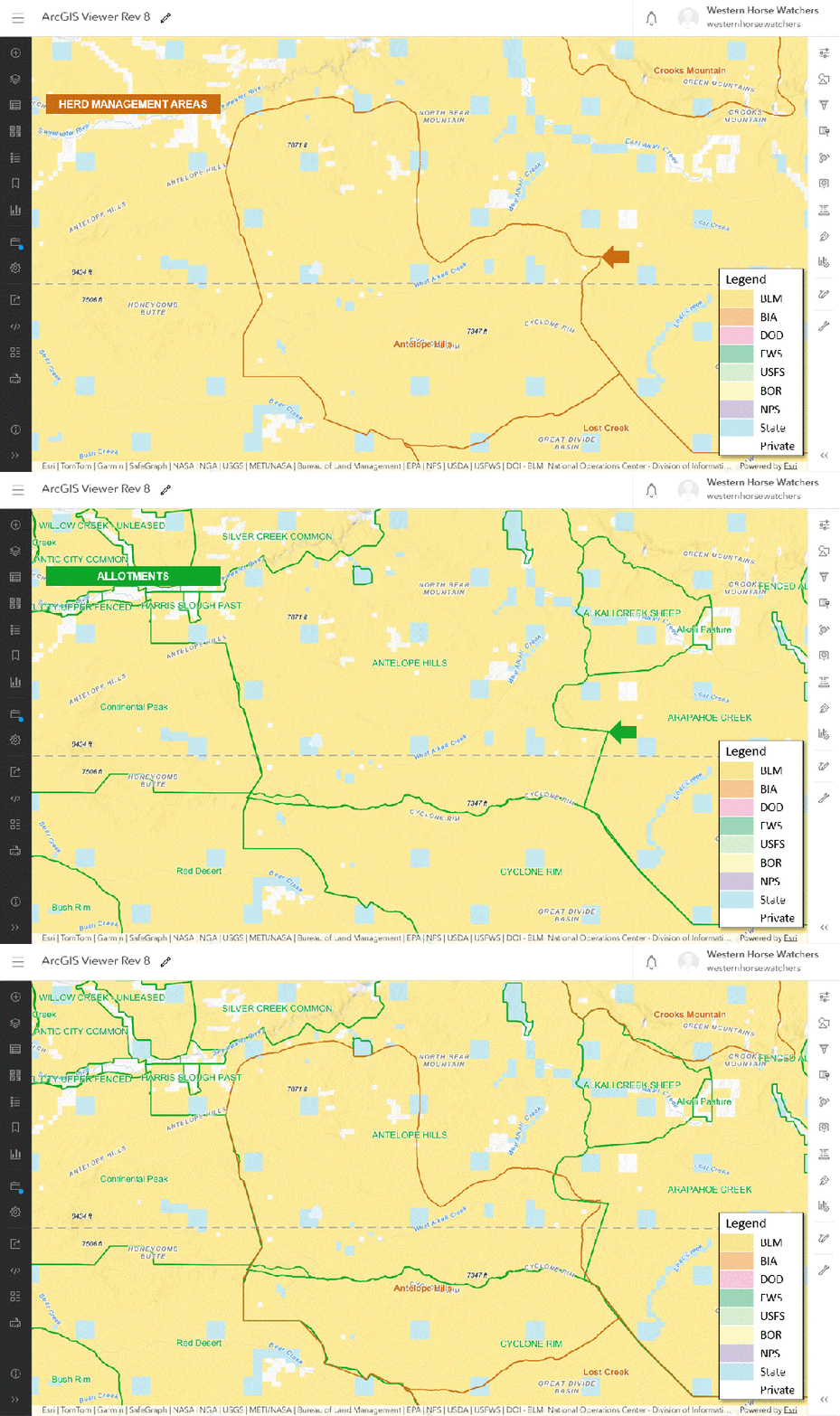
How Many Wild Horses Can Snowstorm Mountains Support?

The HMA lies within the Bullhead allotment.

Its southern border stops short of a checkerboard area and the western edge omits a slice of public lands, but the rest of it coincides roughly with that of the allotment.

The 140 wild horses allowed by plan require 1,680 AUMs per year.

The stocking rate allowed by plan is 1.3 wild horses per thousand public acres, slightly more than the target rate across all HMAs of one wild horse per thousand acres.

The allotment offers 12,050 active AUMs on 142,361 public acres, equivalent to 7.1 wild horses per thousand public acres.

The allotment master report puts it in the Improve category, with 7,233 AUMs in the suspended column.

The HMA should be able to support 1.3 + 7.1 = 8.4 wild horses per thousand acres.

Given that it covers 103,802 public acres, the estimated carrying capacity is 872.

Under the current management plan, the BLM collects $11,858 per year from grazing activity inside the HMA while it spends $1.6 million per year to care for 872 – 140 = 732 wild horses displaced thereby.

Nobody in the private sector would do that.

The advocates would solve the problem by sterilizing the mares, eliminating the need for roundups and off-range holding while ensuring that most of the authorized forage goes to livestock in the lawful home of wild horses.

RELATED: How Many Wild Horses Can Public Lands Really Support?

UPDATE: The authorization use report indicates the allotment is permitted for cattle.

► Get the truth about wild horses and the wild horse advocates at westernhorsewatchers.com.

Pathfinder Ranches Sold

The buyer was Ensign Group of Salt Lake City according to a January 16 report by Cowboy State Daily.

The price was not disclosed.

The Stewart Creek Unit clashes with three HMAs.

The total preference, a little over 90,000 AUMs, is equivalent to 7,500 wild horses.

Taxpayers will receive $121,500 per year for the resource at the current grazing fee, while they spend $6 per day per head, or $16.4 million per year, to care for 7,500 wild horses in off-range holding.

Nobody in the private sector would do that.

But a government agency co-opted by a special interest would, especially when it’s aided and abetted by a cadre of frauds who claim to be voices for the horses.

RELATED: Wyoming’s Pathfinder Ranches Changing Hands.

► Get the truth about wild horses and the wild horse advocates at westernhorsewatchers.com.

HR6938 Now Law

The bill was signed today according to a White House news release, giving the BLM a budget for FY26.

A new roundup schedule should appear at the agency’s gather page.

Remarks about the wild horse and burro program, including links to the House and Senate reports, can be found in the explanatory statement.

RELATED: HR6938 One Step Away from Becoming Law.

► Get the truth about wild horses and the wild horse advocates at westernhorsewatchers.com.

Jakes Fire Emergency Roundup Announced

The incident will begin on or about January 26 according to the news release.

The capture and removal goals are 182.

Horses in and around the burned area, which includes portions of the Snowstorm Mountains and Little Humboldt HMAs, will be pushed into the traps by a helicopter.

The announcement did not indicate if operations would be open to public observation.

Captured animals will be taken to the off-range corrals in Winnemucca.

There are no plans to treat any of the mares with fertility control pesticides and return them to the range.

The fire burned 26% of Snowstorm Mountains and 90% of Little Humboldt according to the project description in ePlanning.

The DNA Worksheet and Decision Record are silent about the Bullhead and Little Humboldt allotments, which overlap the HMAs.

The Complex also includes the Little Owyhee, Owyhee and Rock Creek HMAs.

► Get the truth about wild horses and the wild horse advocates at westernhorsewatchers.com.

Foal-Free Friday, Turncoats and Sellouts Edition

The advocates have abandoned all pretense of caring for wild horses.

They’re using your donations to buy pesticides so they can beat the populations down in favor of livestock.

It’s not mass sterilization, it’s wild horse conservation.

Would you be surprised if the fastest-growing segment in their donor base consists of hunters and ranchers?

PREVIOUS: Foal-Free Friday, Spending Your Money Wisely Edition.

► Get the truth about wild horses and the wild horse advocates at westernhorsewatchers.com.

CRS Publishes FAQ for Livestock Grazing on Public Lands

Fees, permits and base properties are discussed in this report by the Congressional Research Service.

In FY24, the BLM issued 17,045 authorizations for grazing, with 88% written for cattle, yearlings and bison, 6% for horses and burros, and 6% for goats and sheep.

Footnote 158 equates the resource loading of burros with that of cattle and horses while the customary relationship puts the ratio at 2:1, 2 burros = 1 horse = 1 cow/calf pair.

The report gives the acreage identified for grazing but does not give the AUMs sold thereon for a recent fiscal year.

Western Horse Watchers believes the figure is around nine million annually for BLM allotments, equivalent to 750,000 wild horses on 155 million acres or 4.8 wild horses per thousand acres.

Your faithful public servants claim that rangeland health will suffer if horse populations exceed one animal per thousand acres.

RELATED: CRS Looks at Costs of Wild Horse and Burro Program.

► Get the truth about wild horses and the wild horse advocates at westernhorsewatchers.com.

Salt River Management Contract Extended to March 31

The herd reduction program will continue for at least two more months according to a report by the Payson Roundup.

The ringleader of the Salt River Wild Horse Darting Group, a forward base for the Campaign Against America’s Wild Horses, told her followers that “the only thing that’s certain is that the future for the Salt River Horses is extremely uncertain.”

This is nonsense.  The herd has no future because SRWHDG ruined the mares with PZP.

The long-term effects of the pesticide were known from the beginning by everyone involved but swept under the rug to win public assent.

Breeding, not mass sterilization, assures long-term viability.

A new contract, if one is needed, would provide for documentation and mopping up as the herd fades to extinction.

A secondary task would be to bring the liars and frauds to justice.

RELATED: Virus or No Virus, Salt River Herd Is Toast.

► Get the truth about wild horses and the wild horse advocates at westernhorsewatchers.com.
Mono Lake Update

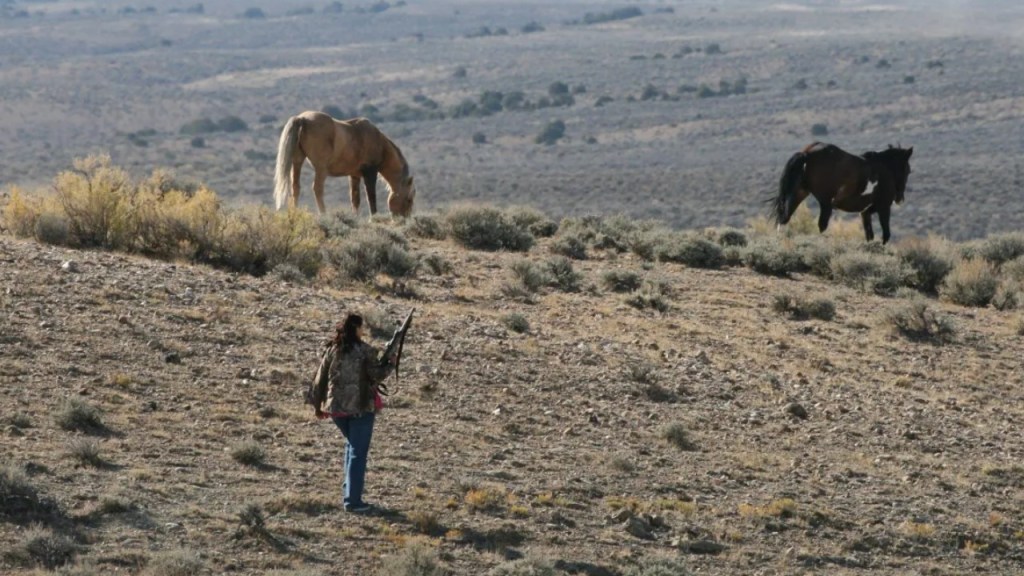
Final results per Forest Service news release:

  • Twenty-four horses captured alive
    • One died
    • Three euthanized
  • Six found dead in field
  • Twenty survivors taken to unnamed facility at Modoc National Forest

RELATED: Mono Lake Roundup Ends.

NOTE: An article by the Los Angeles Times alleges that some of the deaths were caused by people who went into the forest to feed the horses, giving them too much, too fast, without water.

► Get the truth about wild horses and the wild horse advocates at westernhorsewatchers.com.

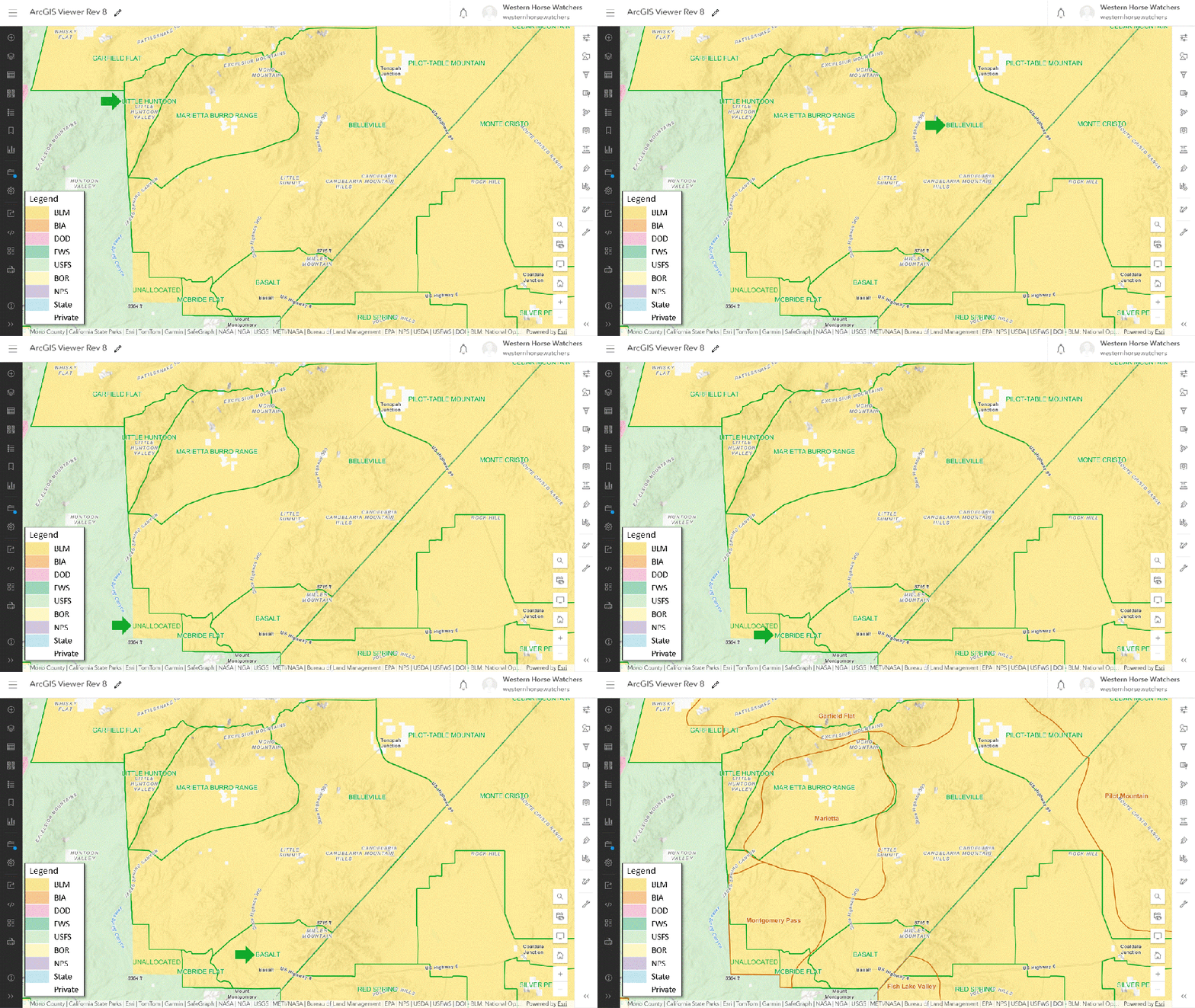
Mono Lake Roundup Ends

The Forest Service captured 23 horses and transported them to a temporary holding facility in Bishop according to the news release.

Three were euthanized due to poor body condition.

Seven were found dead in the field due to starvation and exposure.

The next step might be a trip to the Double Devil Corrals near Alturas.

Recovery is expected to take up to ten months.

The closure order will be lifted on January 22.

RELATED: Forest Service Issues Alert for Mono Lake Emergency Roundup.

UPDATE: Forest Service revised the results.

► Get the truth about wild horses and the wild horse advocates at westernhorsewatchers.com.
Would East Rito Creek Make a Good Wild Horse Refuge?

The allotment is too small but the permit is up for renewal.

The parcel offers 540 active AUMs on 2,371 acres according to the allotment master report, equivalent to 19 wild horses per thousand public acres.

Given that the target stocking rate across all HMAs is one wild horse per thousand acres, the allotment is at 19X AML but it’s in the Maintain category!

Your faithful public servants warn that rangeland health will suffer if wild horse populations exceed AML (25,600 animals on 25.6 million acres).

► Get the truth about wild horses and the wild horse advocates at westernhorsewatchers.com.

Buckeye Lottery Update

Posting a new link due to changes in the NEPA register.

Try your luck!

Previously the search yielded four results but now it gives three.

You’re looking for a project that flips the preference to horses.

Given the attitudes and beliefs of the permit holder, the odds of winning are very low.

RELATED: The Buckeye Lottery.

► Get the truth about wild horses and the wild horse advocates at westernhorsewatchers.com.
Resource Management Paradox

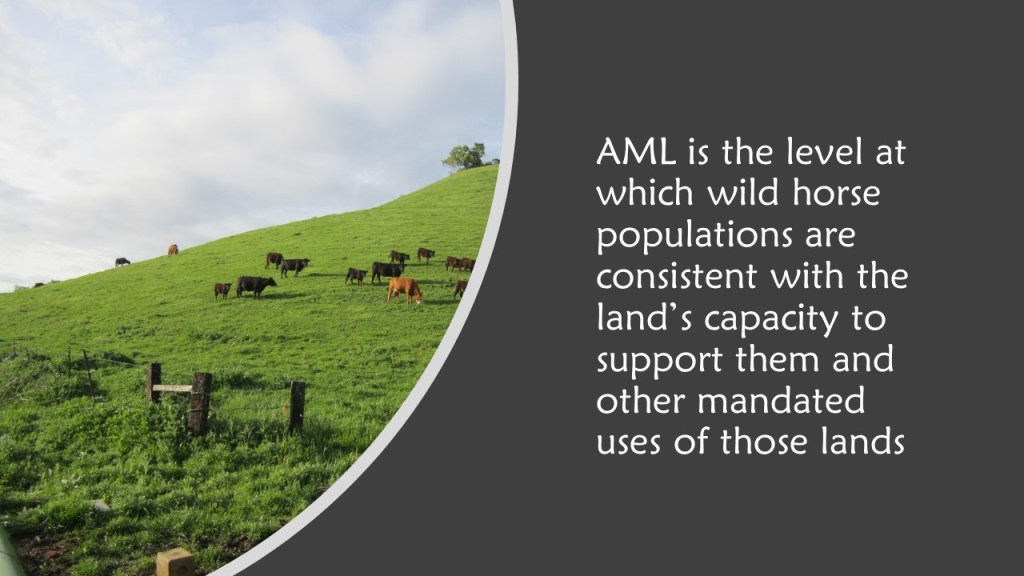
Rangeland health will deteriorate if wild horse populations exceed AML, which corresponds to one wild horse per thousand acres.

Rangeland health will not deteriorate if livestock do not exceed permitted levels, equivalent to seven wild horses per thousand acres.

Rangeland health can be maintained at 7X AML but not 2X or 3X AML.

Ask the advocates to explain it.

RELATED: Protecting Rangeland Health or Maximizing Rancher Prosperity?

► Get the truth about wild horses and the wild horse advocates at westernhorsewatchers.com.
Protecting Rangeland Health or Maximizing Rancher Prosperity?

Two goals of resource management:

1. Keep wild horses at or below AML.

2. Keep livestock at or below permitted limits.

The first criterion corresponds to one wild horse per thousand acres (25,600 animals on 25.6 million acres according to the last page of the 2025 population dataset).

The second criterion is equivalent to seven wild horses per thousand acres.

These two figures suggest that public lands in the western U.S. can support many more wild horses than the government admits.

The advocates, long on zeal but short on truth, want you to focus on #1, an arbitrary value that feeds the overpopulation narrative and maximizes rancher prosperity while supplying a rationale for their darting programs.

If the goal was rangeland health, most acreage grazed by livestock, which includes areas identified for wild horses, would be in the Maintain category.

In reality, not even a third meets the requirements.

RELATED: Double Standard for Rangeland Health?

► Get the truth about wild horses and the wild horse advocates at westernhorsewatchers.com.

Forest Service Issues Alert for Mono Lake Emergency Roundup

The closure notice runs from January 17 to January 27.

The operation will capture and remove up to 25 snow-bound horses located in the Inyo National Forest south of Mono Lake.

The original news release said nine.

Most of the closure area is in the Mono Mills allotment, which is permitted for sheep.

Links to the NEPA review and daily reports were not provided.

The grazing season and active AUMs are not known.

RELATED: Forest Service to Remove Nine Snow-Bound Horses.

UPDATE: Forest Service changed URL of closure notice from “baldy” to “bald.”

► Get the truth about wild horses and the wild horse advocates at westernhorsewatchers.com.