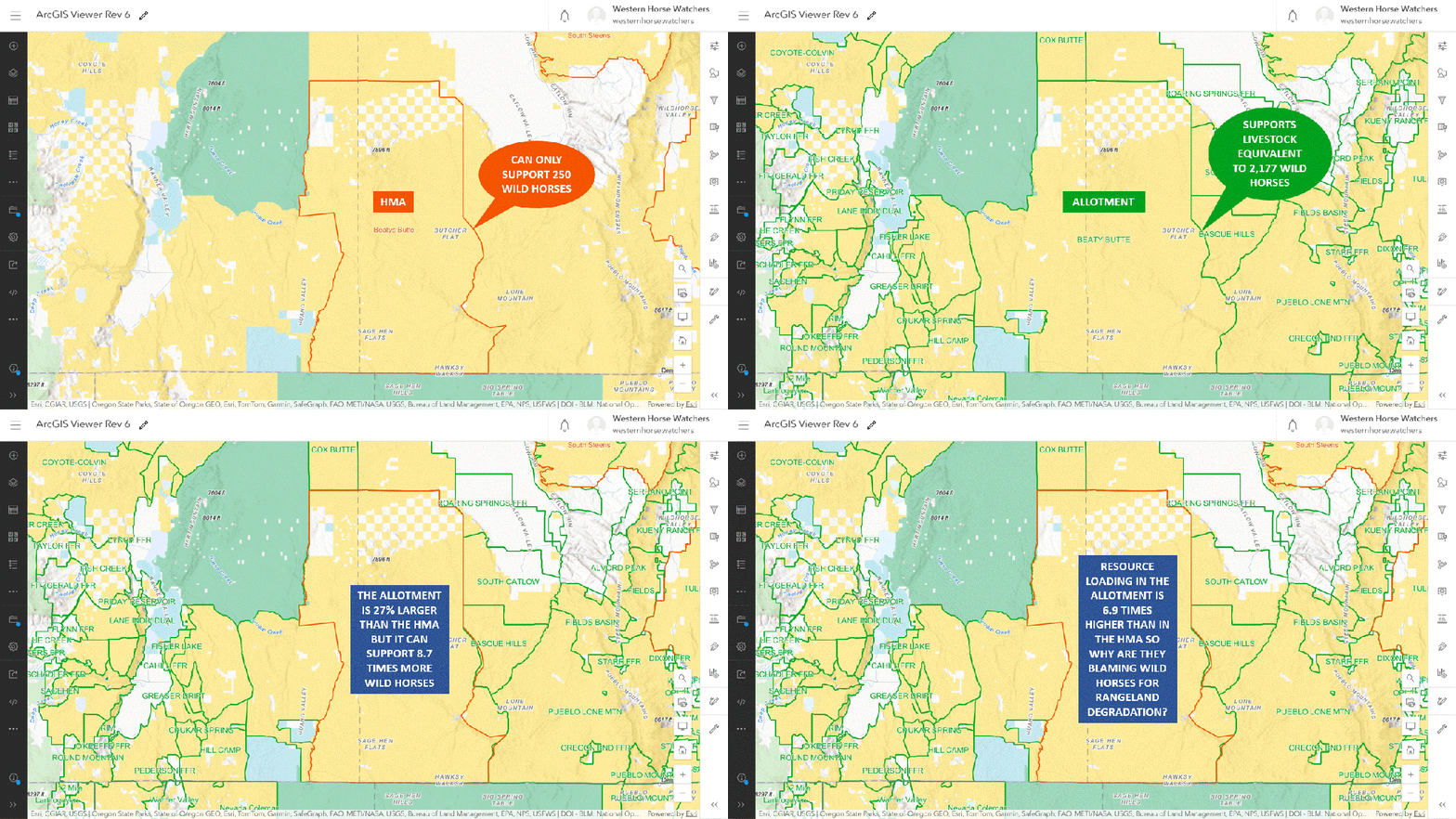
You’d think the advocates would have special funds devoted to the purchase of base properties, so wild horses could be placed on public lands at the expense of privately owned livestock.
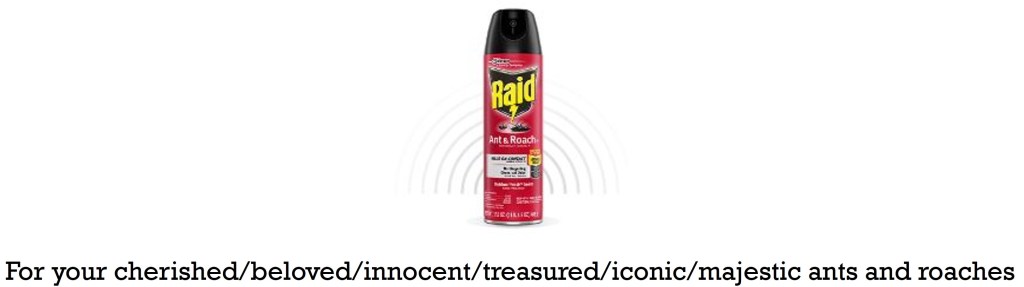
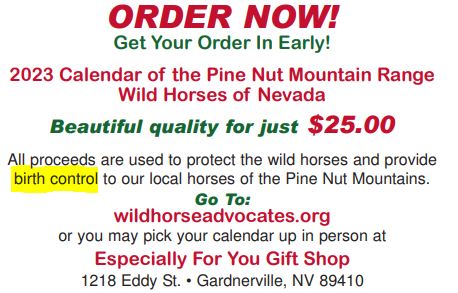
Instead, they use your donations to buy pesticides, so they can beat the horse populations down in favor of livestock.
They are frauds and don’t deserve a penny of your support.
Stocking rate would be 27.3 wild horses per thousand BLM acres
Beulah Belle
98,357 total acres
23,146 deeded
7,962 state
67,248 BLM
2.9 BLM acres per deeded acre
19,810 AUMs
Equivalent to 1,651 wild horses
Stocking rate would be 24.6 wild horses per thousand BLM acres
Stewart Creek
569,053 total acres
22,470 deeded
8,999 state
537,584 BLM
23.9 BLM acres per deeded acre
23,734 AUMs
Equivalent to 1,978 wild horses
Stocking rate would be 3.7 wild horses per thousand BLM acres
Wooden Rifle
68,606 total acres
14,537 deeded
6,797 state
47,272 BLM
3.3 BLM acres per deeded acre
8,991 AUMs
Equivalent to 749 wild horses
Stocking rate would be 15.8 wild horses per thousand BLM acres
Your faithful public servants claim that public lands in the western U.S. can only support one wild horse per thousand BLM acres.
Stewart Creek, the unit with the best land ratio but lowest stocking rate, overlaps three of the five HMAs in the Red Desert Complex. Not disclosed by the agent.
If the operation was repurposed as a refuge, it would support 7,500 wild horses, saving taxpayers an estimated $13.7 million per year and paying for itself in six years.
The project would likely face stiff opposition from ranchers, farm bureaus and stock grower’s associations.
Wild horses can be placed on public lands not identified for their use by acquiring base properties associated with grazing allotments and flipping the preference to horses.
The Campaign Against America’s Wild Horses, a leader in mass sterilization and fierce opponent of principal use, has been ordered to stop the Cedar Mountain darting program according to an October 30 news flash distributed by Lucky Three Ranch.
Further, the grant that funds the effort has not been renewed.
The advocates are now begging for donations to keep the destruction going.
There haven’t been any roundups in the HMA since the program began because the advocates are working with a permittee to poison the mares with PZP, a restricted-use pesticide that tricks their immune systems into attacking their ovaries.
Snake River Land & Cattle covers 38,899 total acres, including 5,675 deeded acres and 33,224 BLM acres according to the agent’s listing.
The map puts the deeded acreage inside the Douglas-Sawmill Allotment, a few miles south of the Sand Wash Basin HMA.
The ranch lies within a game management unit so not only will you get pushback from ranchers in trying to flip the preference to horses but from hunters as well.
The allotment master report shows one pasture, so it may operate as a general use area shared by three permittees.
Livestock owned by the other two would remain.
The active AUMs are probably wrong and may be off by a factor of ten.
One of the bullet points in the listing says the ranch receives 743 AUMs, equivalent to 62 wild horses.
The land ratio is good, almost six public acres per deeded acre.
But the allotment overlaps the Douglas Mountain HA according to the ArcGIS viewer, so the ranch meets two out of four requirements for a refuge.
You don’t have to spend millions of dollars on a base property to get wild horses back on these public lands. You just need to rid the bureaucracy of ranchers and ranching sympathizers and overturn the planning process that zeroed out the HMA.
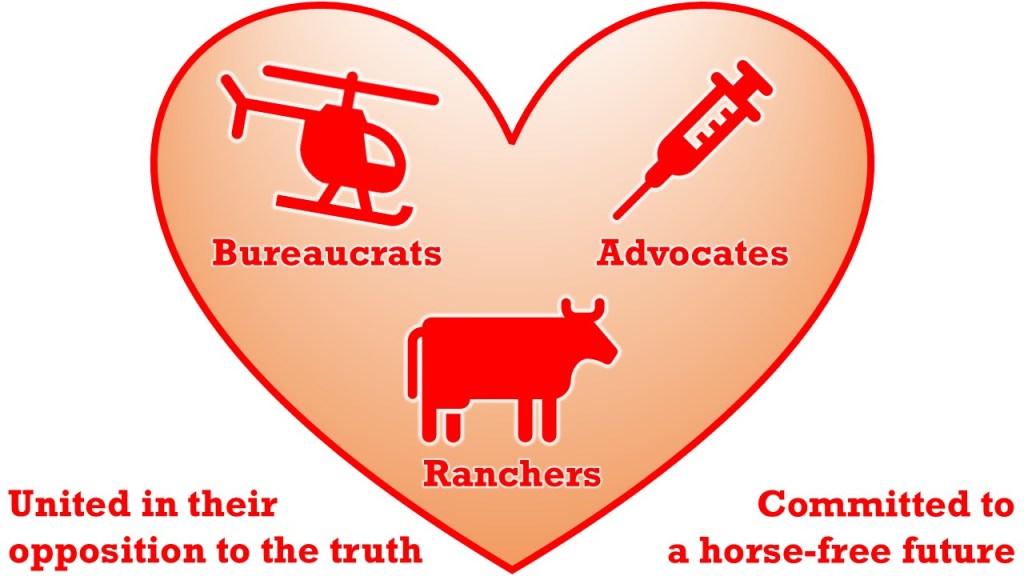
Don’t expect any help from the advocates. They want the ranchers to win.
The nonprofit is expanding its scope from the Virginia Range to all of Nevada’s wild horses and burros.
The news release did not include condemnation of the mass sterilization program inflicted on the Virginia Range herd by the Campaign Against America’s Wild Horses.
The event begins at 4:00 PM on November 1 in Colorado Springs.
The announcement did not indicate if TCF staff would demonstrate their pesticide delivery equipment or discuss their contributions to wild horse sterilization.
Pumpkin Creek is southwest of Gillette and Goblin Gulch is northwest of Kemmerer.
The allotment master report puts Pumpkin Creek in the Improve category, suggesting that your stewards of the public lands are not taking their responsibilities seriously.
The Pumpkin Creek permittee receives 1,456 active AUMs on 13,235 public acres, equivalent to 121 wild horses or 9.2 wild horses per thousand public acres.
Your faithful public servants claim that public lands in the western U.S. can only support one wild horse per thousand acres (25,600 animals on 25.6 million acres according to the last page of the 2025 population dataset).
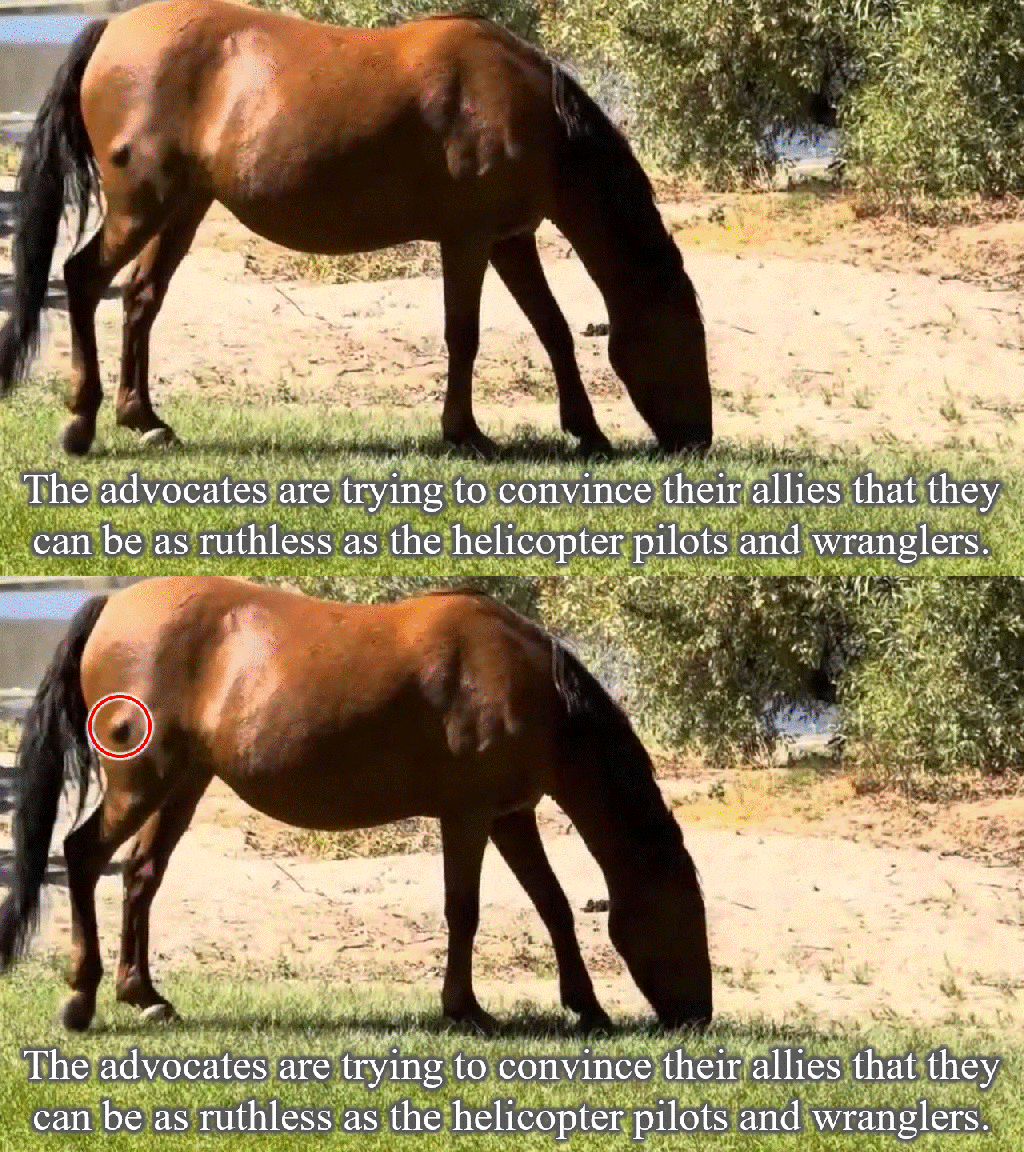
The advocates bolster the narrative with their darting programs.
Goblin Gulch offers 287 active AUMs on 2,845 public acres, equivalent to 24 wild horses or 8.4 wild horses per thousand public acres.
If Pumpkin Creek was an HMA, the AML would be 13 and 108 wild horses would be consigned to off-range holding because of permitted grazing.
If Goblin Gulch was an HMA, the AML would be 3 and 21 wild horses would be shipped to off-range holding.
Both areas would be held to a small fraction of carrying capacity to accommodate high-net-worth individuals who pay almost nothing for the resources they consume, which explains why their wealth grows along with the burden laid on American taxpayers.
Wild horses can be placed on public lands not identified for their use by acquiring base properties associated with grazing allotments and flipping the preference to horses.
Like radioactive decay, the advocates emit a steady stream of harmful information about wild horses.
Equating mass sterilization with wild horse conservation is one example.
Lying about rapid development is another.
Their followers don’t realize they’re being exposed to propaganda that promotes rancher prosperity, not equine welfare.
The only hope for these nitwits is to get them to Betty Ford clinics or similar institutions where they can be deprogrammed and educated in rational thought.
The bill would authorize research to determine if unmanned aerial systems can be used to gather and manage wild horses and burros, including application of fertility control, according to the text.
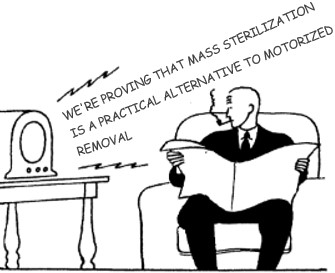
If successful, the technology could advance mass sterilization as an alternative to motorized removal, a dream-come-true for the advocates.
No more bouncing over rough terrain in a 4WD and stalking the animals with clipboards and darting rifles.
They rob too much forage from the most noble and deserving nonnative species on America’s public lands, placed there by high-net-worth individuals who pay almost nothing for the resource and the services rendered on their behalf by the government.
Put simply, they interfere with redistribution of wealth, a hallmark of liberalism.
It’s not “a war on wildlife, propping up special interests while ranchers and communities bear the brunt of unbalanced ecosystems and federal overreach” as stated in the commentary.
Ranchers are the special interest.
Then there’s the unsubstantiated claim that horse meat derived from public lands re-enters U.S. markets illegally from Mexico and Canada as a diluent of ground beef.
And the misallocation of water.
The guy’s as ill-informed about wild horses as the wild horse advocates.
HR 5829 would direct the Secretary of the Interior to establish a grant program to support the use of unmanned aerial systems for the humane roundup and management of wild horses and burros.
As of today, the bill text has not been published.
Its affiliates page displays logos of trade groups representing meat and wool producers but none from the wild horse advocates.
Its policy statement acknowledges the support of some groups in developing the “Path Forward,” a 2019 plan for ranching superiority in the lawful homes of wild horses.
Since then other groups have stepped forward with projects that demonstrate the feasibility of mass sterilization as an alternative to motorized removal, notably at the Salt River and Virginia Range.
So why won’t PLC bring them on board and recognize their contributions to the ranching agenda?
Nowhere is it more evident than in the wild horse world.
Refer to this opinion piece in Compact for a survey of the situation.
It is still controversial, even in conservative circles, to say that there are too many women in a given field or that women in large numbers can transform institutions beyond recognition in ways that make them cease to function well.