She became trapped in mud according to a story by Shore Daily News.
The report did not indicate if she was pregnant.
The herd is known for its highly abnormal sex ratio and unprecedented birth rate, where a handful of stallions produced 103 foals in 2025—the result of social engineering by the saltwater cowboys.
The Ninth Circuit ruled today that the agency can continue to use the privately owned corrals, despite claims of pollution and inhumane conditions by Friends of Animals, according to a report by Courthouse News Service.
The BLM spends an estimated $6 million per year to care for those animals while it collects around $52,000 per year from public-lands ranchers grazing in their stead.
Big Red Creek Ranch covers 2,130 deeded acres and 7,997 leased acres, including 4,363 BLM acres, with support for 500 cow-calf pairs.
The asking price is $7.5 million.
The listing does not provide a map of the deeded acreage and does not give the name of the attached allotment but Western Horse Watchers believes it’s Muddy Mountain.
Thieves Den Ranch covers 3,040 deeded acres and 5,441 leased acres, including 5,286 BLM acres, with support for 125 cow-calf pairs.
The asking price is $9.2 million.
The listing does not include a map of the deeded acreage but identifies the allotment as Posvar.
Big Red Creek meets three out of four requirements for a wild horse refuge.
Same for Thieves Den.
Muddy Mountain currently supports livestock equivalent to 15.3 wild horses per thousand public acres.
Posvar supports livestock equivalent to 7.5 wild horses per thousand public acres.
Your faithful public servants claim that public lands in the western U.S. can only support one wild horse per thousand acres.
The advocates, unable to distinguish between an AUM and AML, underscore the narrative with their darting programs.
Wild horses can be placed on public lands not identified for their use by acquiring base properties associated with grazing allotments and flipping the preference to horses.
The third edition of the National Pesticide Applicator Certification Manual should be available for sale this week—giving you plenty of time to order one for Valentine’s Day.
It’s a no-brainer. What advocate isn’t striving to become a certified applicator of restricted-use pesticides?
Unfortunately, the publisher does not donate a percentage of the selling price to Rifles for WretchesTM or similar charity that equips the advocates with the tools of their trade.
The manual is intended as a study guide for those planning to take the Pesticide Applicator Certification Core Exam.
The 2014 edition states on page 51 that restricted-use pesticides (such as PZP) demand special attention because there is reason to believe they could harm humans, livestock, wildlife or the environment even when used according to label directions.
Such as permanent infertility in mares.
Unlawful use of pesticides is discussed on page 39.
Failure to use the product as directed on the label.
The advocates want you to think of PZP as a medication, always referring to the product as a vaccine.
As stated in its Year Two Report, the Colorado Wild Horse Working Group believes that strategic darting should be the cornerstone of wild horse management.
It’s an indication that the stakeholders are willing to play the long game in support of their goals and a major win for the advocates.
Not mentioned in the discussion are the long-term effects of the fertility control pesticides and the eventual disappearance of the herds.
One of the most amazing statistics in this report by High Country News is the number of individuals who declined to comment.
The article did not mention services provided by the wild horse advocates that benefit the ranchers.
Beating the horse populations down with ovary-killing pesticides.
The aim of the grazing program is to ensure that high-net-worth individuals receive generous government benefits, often at the expense of America’s wild horses, with no means testing and no expiration dates.
They’ll be flying for the Utah Division of Wildlife Resources to capture bighorn sheep according to the BLM news release.
The Decision Record authorizes the Proposed Action, discussed in section 2.1 of the Final EA.
Table 1-2 indicates that “captures could take place in the Muddy Creek Wild Horse HMA as well as the Sinbad Burro HMA. Helicopter overflights may temporarily disturb wild horses and burros in the vicinity of the capture. Impacts beyond short-lived stress are not expected because these animals would not be the target of pursuits, which would already be short in duration, and could readily escape the area.”
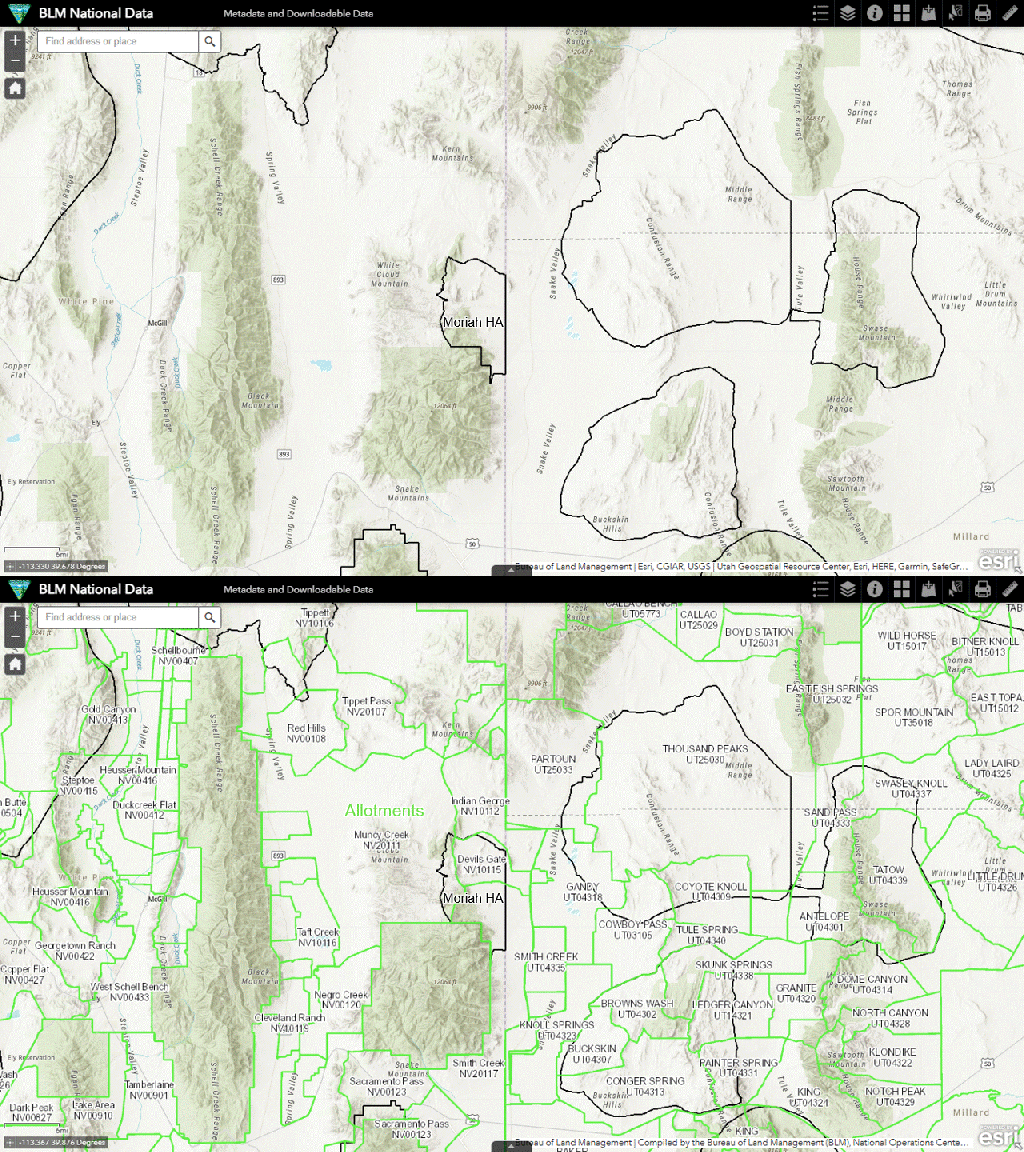
Although the EA mentions livestock grazing, it does not show the allotments in the project area.
One of the greatest threats to wild sheep is illness picked up from domestic sheep.
The Authorization Use Report at RAS would tell which if any of the allotments are permitted for sheep.
To the west is Fort Johnson (previously Fort Polk), an Army base the horses once called home.
The article did not associate the horses with the forest and did not indicate if the advocates had submitted a plan to beat the numbers down with ovary-killing pesticides.
The fertility control program was launched in Magoffin County early last year according to a story by WHAS News.
The report refers to PZP as a contraceptive vaccine, not a restricted-use pesticide.
Contrary to another statement in the article, the product is not reversible if applied for more than five years.
The group expects the population to stabilize in three years.
The story did not indicate if the partner organizations would become obsessed with pesticides as they have out west and if the effort would morph into a mass sterilization program across the nine-county region where the horses are found.
The Senate news release includes links to summaries and explanatory statements for (1) Commerce, Justice, Science and Related Agencies, (2) Energy and Water Development and (3) Interior, Environment and Related Agencies.
The bill for Interior provides $144 million for wild horse and burro management according to the Division C explanatory statement, including $11 million for fertility control.