Foal-Free Friday, Selecting for Weakness Edition

From time to time, you hear about the birth of a foal in an area where the advocates are working vigorously to snuff out new life.

Simone Neterlands with Darting Rifle 09-02-23

They usually rely on predators to take out any youngsters that slip through their darting programs but those who survive may have faulty immune systems.

PZP tricks the immune system into attacking the ovaries.

The pesticide works best (sterilizes faster) on mares with strong immune systems.

They don’t bear fruit, while the immuno-compromised females keep producing foals who inherit that trait.

A herd being treated with PZP undergoes selective breeding for weak immunity, which puts the population—what’s left of it—at risk for disease and ultimately, extinction.

RELATED: Foal-Free Friday, Advocates, Assateague and Amnesia Edition.

TRNP Decision Offers Mixed News to Wild Horse Advocates

The bad news is that Alternative C, a fully contracepted herd that dies off, is not going to happen.

For now, they’ll have to be content with their sterilization programs at the Salt River, Virginia Range and elsewhere.

The good news is that the herd still needs to be whittled down to an appropriate level, and that could be accomplished with ovary-killing pesticides instead of helicopters.

Better Way 10-25-23

RELATED: Park Service Terminates TRNP Livestock Plan.

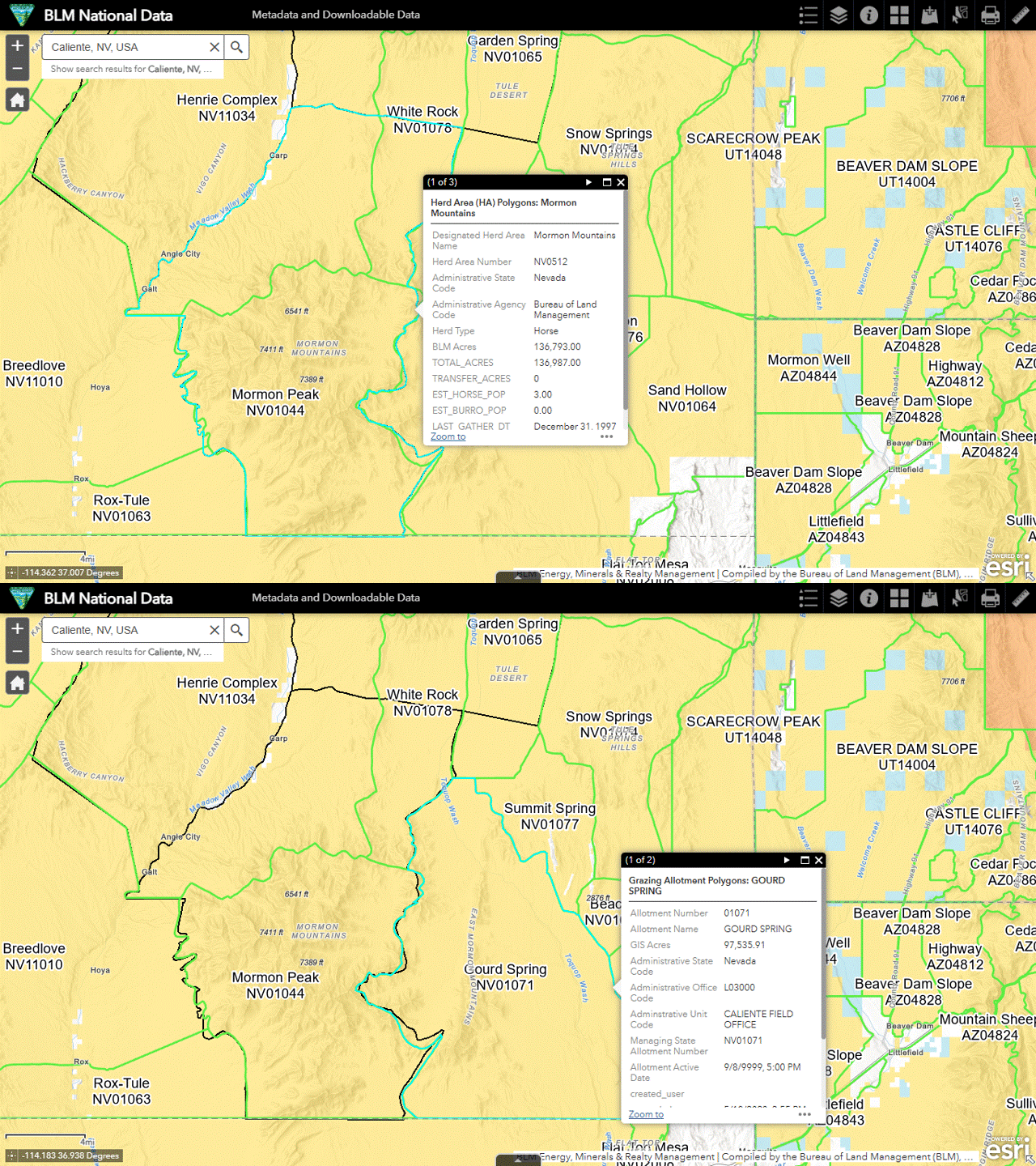
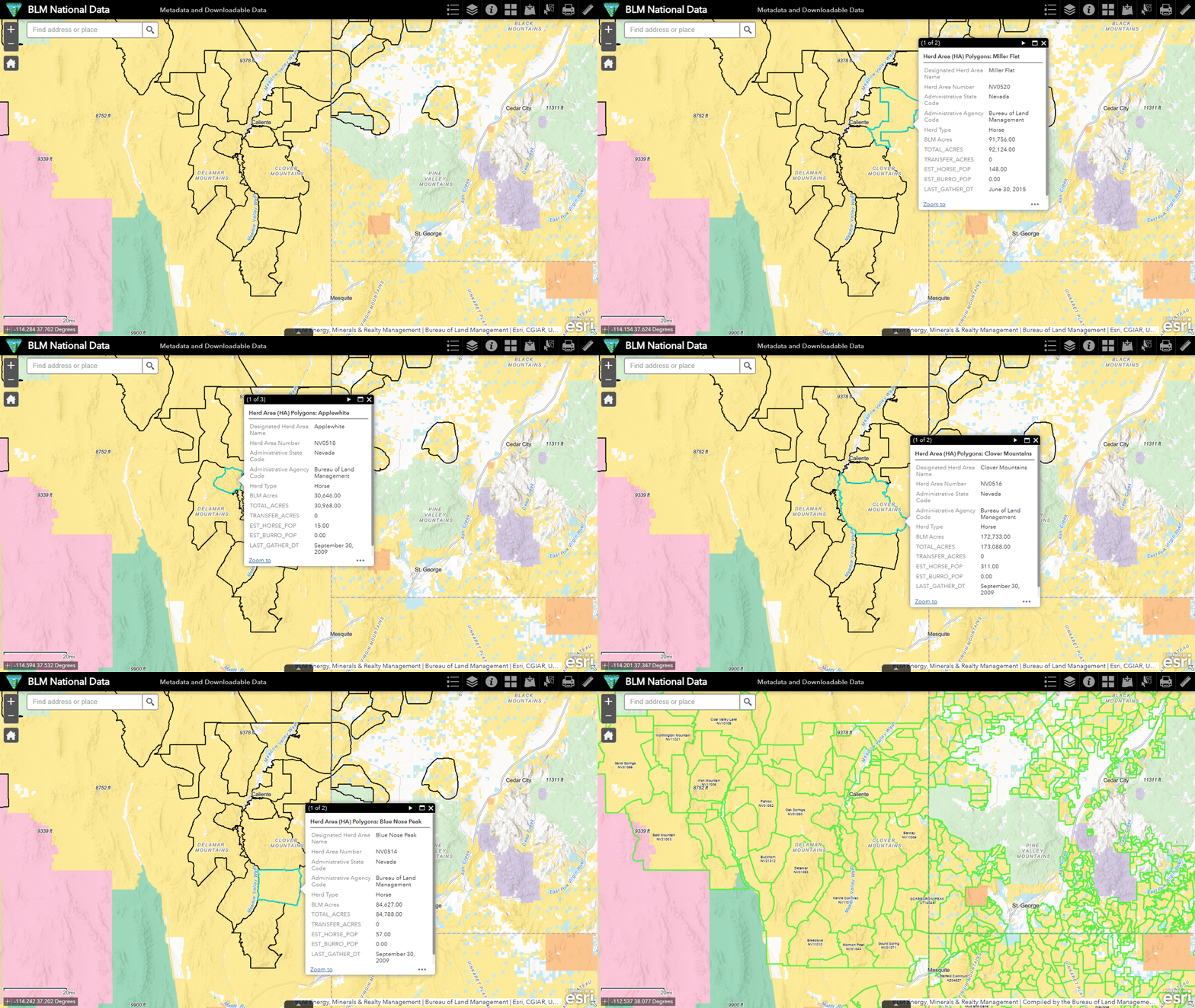
Caliente Roundup, Day 9

The incident started on April 16.  Results through April 24:

  • Scope: Caliente Complex
  • Target: Horses
  • Type: Planned
  • Method: Bait
  • Goals: Gather 350, remove 350
  • Captured: 103, up from 91 on Day 7
  • Shipped: 82, no change from Day 7
  • Released: None
  • Deaths: 3, no change from Day 7
  • Average daily take: 11.4
  • Unaccounted-for animals: 18

The figures above are based on the daily reports.

The death rate is 2.9%.

The capture total includes 41 stallions, 48 mares and 14 foals.

Youngsters represented 13.6% of the animals gathered, consistent with a herd growth rate of eight percent per year.

Of the adults, 46.1% were male and 53.9% were female.

Body condition scores were not given.

The location of the trap site is not known.

The Complex is subject to permitted grazing.

  • Forage liberated to date: 1,236 AUMs per year
  • Water liberated to date: 1,030 gallons per day

There are no plans to treat any of the mares with fertility control pesticides and return them to the range.

The roundup supports three tenets of rangeland management.

RELATED: Caliente Roundup, Day 7.

Caliente Complex with Allotments 03-28-24

Areas Identified for Wild Horses Are Underpopulated, Not Over

Public lands in the western U.S. managed by the BLM currently support livestock equivalent to one million wild horses on 145 million acres, as determined previously.

If you scale that down to 42 million acres, public lands identified for wild horses and burros in 1971, you get 290,000 wild horses.

The current population is 59,000 wild horses and 15,000 wild burros, equivalent to 66,500 wild horses, well below the carrying capacity of their land.

The population target is 27,000, the number of animals allowed by plan.

The advocates are doing everything they can to help the bureaucrats and ranchers achieve this goal.

Advocates are the Predators 11-30-21

Putting Lipstick on the Zonastat Pig

A study of the Virginia Range darting program has yielded surprising new findings according to a story dated April 23 by This Is Reno: Herd size goes down when you poison the mares with ovary-killing pesticides.

The low birth rate and high death rate have resulted in negative population growth, providing further evidence of the feasibility of PZP fertility control as a viable alternative to helicopter roundups, according to representatives of the Campaign Against America’s Wild Horses, a leader in nonmotorized removal.

The article did not mention that the herd on Assateague Island continues to shrink eight years after the darting program was shut off, a pattern that will likely unfold on the Virginia Range.

RELATED: Virginia Range Darting Update for March 2024.

Red Rock Roundup Announced

It’s on the schedule with a start date of April 1 but that’s been moved to April 24 according to today’s news release.

The incident will be carried out with baited traps and operations will not be open to public observation.

The capture goal is 112 wild horses and 70 wild burros, and the removal goal is 92 horses and 70 burros.

Up to ten mares with be treated with GonaCon Equine, a fertility control pesticide, before being returned to the range with up to ten stallions.

The current population is thought to be 114 wild horses and 191 burros, not including this year’s foal crop.

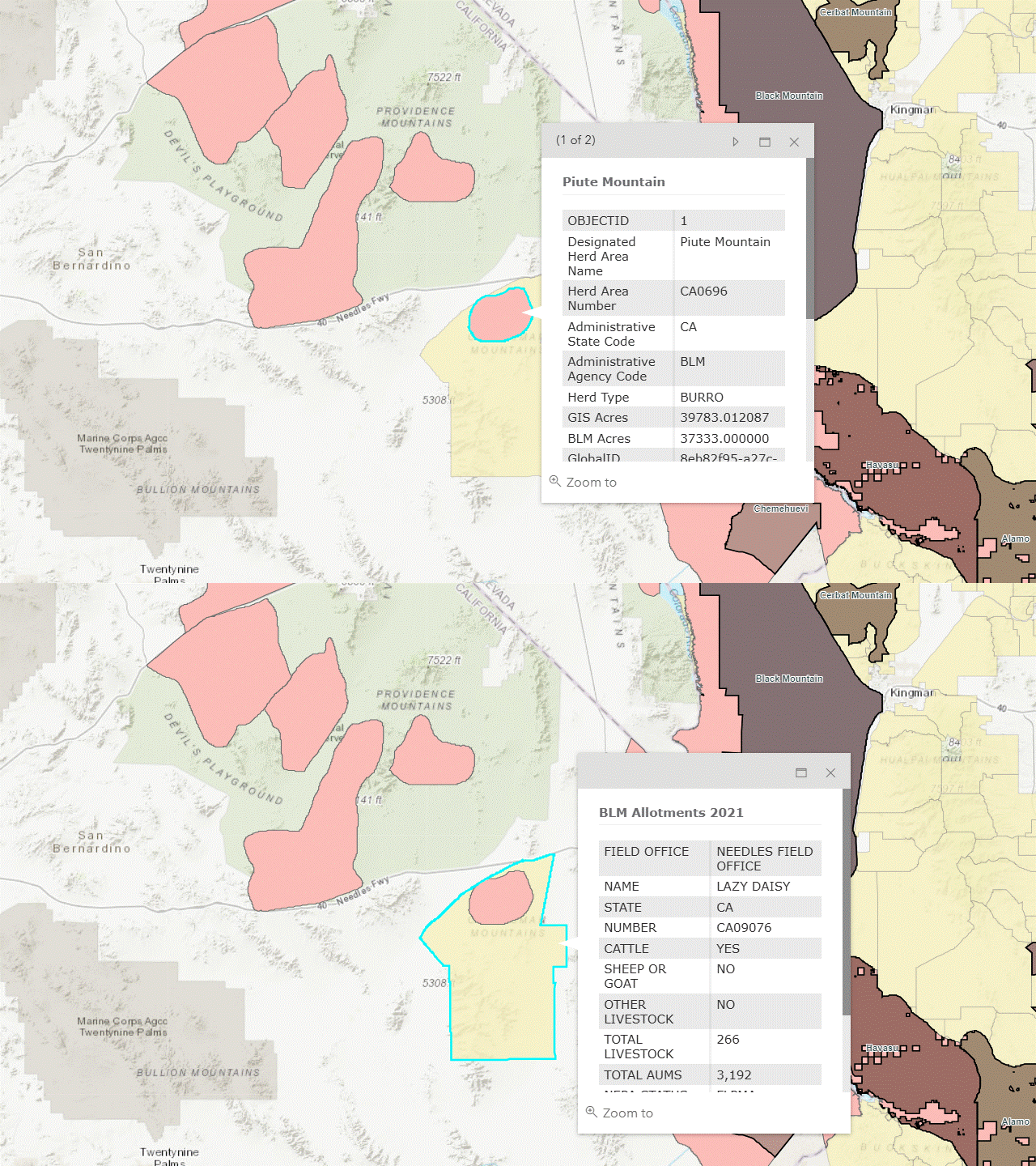
The HMA lies within the Spring Mountain HA and covers 161,969 acres total acres west of Las Vegas, including 157,443 public acres.

The management plan allows 27 wild horses in the area along with 49 wild burros.

Red Rock HMA with Allotments 04-23-24

The HMA is not subject to permitted grazing.

Animals identified for removal will be taken to the Ridgecrest Off-Range Corrals.

Gather stats and daily reports posted to this page.

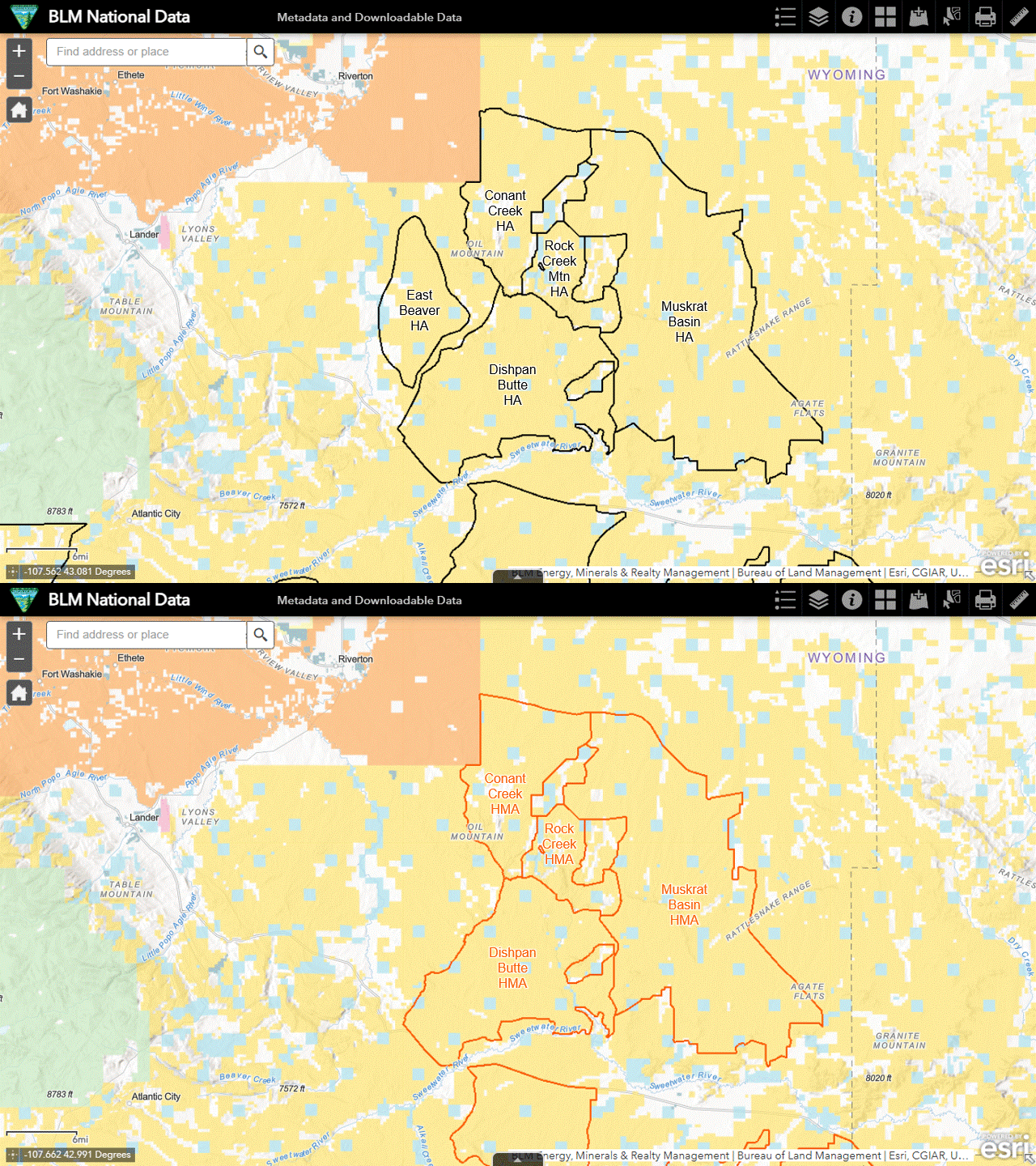
An emergency roundup took 237 wild horses off the range in 2019.

Caliente Roundup, Day 7

The incident started on April 16.  Results through April 22:

  • Scope: Caliente Complex
  • Target: Horses
  • Type: Planned
  • Method: Bait
  • Goals: Gather 350, remove 350
  • Captured: 91, up from 73 on Day 5
  • Shipped: 82, up from 62 on Day 5
  • Released: None
  • Deaths: 3, up from 2 on Day 5
  • Average daily take: 13.0
  • Unaccounted-for animals: 6

The figures above are based on the daily reports.

A stallion was intentionally killed on Day 7 because of a missing eye, lifting the death rate to 3.3%.

The capture total includes 37 stallions, 42 mares and 12 foals.

Youngsters represented 13.2% of the animals gathered, consistent with a herd growth rate of eight percent per year.

Of the adults, 46.8% were male and 53.2% were female.

Body condition scores were not given.

The location of the trap site is not known.

The Complex is subject to permitted grazing.

  • Forage liberated to date: 1,092 AUMs per year
  • Water liberated to date: 910 gallons per day

There are no plans to treat any of the mares with fertility control pesticides and return them to the range.

The roundup supports three tenets of rangeland management.

RELATED: Caliente Roundup, Day 5.

Caliente Complex with Allotments 03-28-24

How Many Wild Horses Can Public Lands Really Support?

Land managers say they can only sustain one wild horse per thousand acres (27,000 animals on 27 million acres).

The Allotment Information Report at RAS provides acreage. management status and active AUMs for BLM allotments in ten western states.

Here is an overview of the dataset.

BLM Allotment Data Summary 04-22-24

Public lands in Arizona support livestock equivalent to 53,662 wild horses.

In California, they sustain livestock equivalent to 26,409 wild horses.

The total across all ten states is 1,023,481 wild horses.

On a per acre basis, Montana was highest and Nevada was lowest.

Overall, public lands in the western U.S. are supporting livestock equivalent to seven wild horses per thousand public acres.

Given that the HMAs are a subset of the allotments, with a few exceptions, they should be able to support an average of 1 + 7 = 8 wild horses per thousand public acres, eight times higher than the bureaucrats admit.

That works out to a capacity of 8 × 27,000,000 ÷ 1,000 = 216,000 wild horses, enough to empty all of the off-range corrals and long-term pastures several times over, at great savings to American taxpayers.

The loss in grazing fees would be negligible.

As it is, for every wild horse allowed on public lands in the western U.S., seven have been consigned to off-range holding because of permitted grazing.

NOTE ON METHODOLOGY: The active AUMs were found by adding the values in column Q of each worksheet.  The public acres were found by removing rows with duplicate entries in column A and adding the remaining values in column E.

RELATED: Why Are There So Many Wild Horses in Off-Range Holding?

Caliente Roundup, Day 5

The incident started on April 16.  Results through April 20:

  • Scope: Caliente Complex
  • Target: Horses
  • Type: Planned
  • Method: Bait
  • Goals: Gather 350, remove 350
  • Captured: 73, up from 64 on Day 3
  • Shipped: 62, up from 36 on Day 3
  • Released: None
  • Deaths: 2, no change from Day 3
  • Average daily take: 14.6
  • Unaccounted-for animals: 9

The figures above are based on the daily reports.

The death rate is 2.7%.

The capture total includes 28 stallions, 37 mares and 8 foals.

Youngsters represented 11.0% of the animals gathered.

Of the adults, 43.1% were male and 56.9% were female.

Body condition scores were not given.

The location of the trap site is not known.

The Complex is subject to permitted grazing.

  • Forage liberated to date: 876 AUMs per year
  • Water liberated to date: 730 gallons per day

There are no plans to treat any of the mares with fertility control pesticides and return them to the range.

The roundup supports three tenets of rangeland management.

RELATED: Caliente Roundup, Day 3.

Caliente Complex with Allotments 03-28-24

Conference Organizers Needed

If the Save Our Wild Horses conference was even halfway sincere, and this is not known, most wild horse advocates would stay away because they are frauds.

They would be attracted, however, to a Save Our Poor Ranchers conference, because that’s what they do.  Actions speak louder than words.

We Want the Ranchers to Win 04-04-24

The event would give them an opportunity to stop pretending that they care about wild horses, let their hair down, and schmooze with the bureaucrats and ranchers, whose approval they seek at all costs.

With more evidence coming out of Assateague Island, soon to be followed by the Salt River and Virginia Range, they can prove that they do indeed have a better way to get rid of wild horses.

Better Way 10-25-23

Forced to live in multi-million-dollar base properties, if they live on site at all (some are investors or corporate owners), the ranchers receive only 80% of the authorized forage in the lawful homes of wild horses.

For this they pay pennies on the dollar compared to market rates.

The bureaucracies keep predators in check, repair wildfire damage and provide funding for range improvements.

They remove wild horses and cram them into off-range corrals, also at taxpayer expense, while the ranchers pocket the profits.

It’s government dependency and redistribution of wealth, no getting around it.

The advocates, desperate for a seat at the table, have a plan that will fix the problem once and for all.

Protect Wild Horses from Advocates 08-29-21

The ranchers can realize their dream of 100%.  They just need to be patient.

RELATED: SOWH Conferees Tour Palomino Valley Off-Range Corrals.

PSA 12-12-19

BLM Cancels Marietta Grazing EA

This does not mean the idea is dead.

The project covered land health assessments for the Basalt, Belleville, Little Huntoon and McBride Flat Allotments to evaluate their potential for livestock grazing and other land uses.

Belleville overlaps the southern half of Marietta, which is managed principally for wild burros.

A subsequent effort, based on findings in the LHAs, may bring the project back to the planning process, resulting in the demotion of the WBR to an HMA, or even an HA, an outcome for which there is well-established precedent.

RELATED: Marietta Wild Burro Range to Become HMA?

Marietta WBR with Allotments 06-09-23

Lake Pleasant Roundup, Day 74

The incident started on February 5.  Results through April 18:

  • Scope: Lake Pleasant HMA
  • Target: Burros
  • Type: Planned
  • Method: Bait
  • Goals: Gather 400, remove 400
  • Captured: 353, up from 247 on Day 63
  • Shipped: 331, up from 180 on Day 63
  • Released: None
  • Deaths: 4, no change from Day 63
  • Average daily take: 4.8
  • Unaccounted-for animals: 18

The figures above are based on the daily reports.  The sidebar indicates 376 animals captured, including one freeze-marked horse.

The death rate is 1.1%.

The capture total includes 140 jacks, 176 jennies and 37 foals.

Youngsters represented 10.5% of the animals gathered.

Of the adults, 44.3% were male and 55.7% were female.

The location of the trap site was not given.

The HA and HMA are the same size.  The area is subject to permitted grazing.

  • Forage liberated to date: 2,118 AUMs per year
  • Water liberated to date: 1,765 gallons per day

There are no plans to treat any of the jennies with fertility control pesticides and return them to the range.

The roundup targets animals that are damaging private property and creating a public safety hazard, purposes for which PZP was not authorized.

The incident supports three tenets of rangeland management.

RELATED: Lake Pleasant Roundup, Day 63.

Lake Pleasant HMA with Allotments 02-06-23

Caliente Roundup, Day 3

The incident started on April 16.  Results through April 18:

  • Scope: Caliente Complex
  • Target: Horses
  • Type: Planned
  • Method: Bait
  • Goals: Gather 350, remove 350
  • Captured: 64, up from 29 on Day 1
  • Shipped: 36, up from zero on Day 1
  • Released: None
  • Deaths: 2, up from zero on Day 1
  • Average daily take: 21.3
  • Unaccounted-for animals: 26

The figures above are based on the daily reports.

A mare died of a fractured neck on Day 3.  Another mare was put down due to blindness in one eye, bringing the death rate to 3.1%.

The capture total includes 24 stallions, 33 mares and 7 foals.

Youngsters represented 10.9% of the animals gathered.

Of the adults, 42.1% were male and 57.9% were female.

The Complex is subject to permitted grazing.

  • Forage liberated to date: 768 AUMs per year
  • Water liberated to date: 640 gallons per day

There are no plans to treat any of the mares with fertility control pesticides and return them to the range.

The roundup supports three tenets of rangeland management.

RELATED: Caliente Trapping Begins.

Caliente Complex with Allotments 03-28-24

Foal-Free Friday, Advocates, Assateague and Amnesia Edition

A few years ago the advocates pointed to the herd as a model of wild horse management.

Now that the Park Service has released another report indicating that it’s still shrinking, eight years after the darting program was shut off, they know nothing about it.

Their safe, proven and reversible vaccine turned out to be an ovary-killing pesticide that plunged the herd into irreversible decline.

It’s great news for the advocates and should convince their allies that nonmotorized removal is more effective in the long run than motorized removal.

RELATED: Foal-Free Friday, More Bang for Your Buck Edition.

Adjectives for Pests 12-01-23

Think in Terms of Abundance, Not Scarcity!

The bureaucrats, ranchers and advocates want you to think there’s not enough food and water for wild horses on America’s public lands, thereby justifying their removal.

It’s all bullcrap, as discussed earlier this week for public lands in Wyoming and a few weeks ago for Nevada.

The off-range corrals, adoptions and long-term pastures are part of the ruse.

Resource availability is already known.  There’s no need for scientific studies.

Most of the forage has been assigned to the public-lands ranchers and this can be quantified with the reports at RAS.

With those numbers in hand, you can estimate the True AMLs, compare them to the current AMLs and show others how the horses are getting the short end of the stick.

If you did this for every HA, HMA and WHT, you’d find that all of the off-range corrals and long-term pastures could be emptied several times over by confining the ranchers to their base properties, at great savings to American taxpayers.

The decrease in grazing fees would be trivial.

RELATED: The Allotments Tell the Story: They’re Lying, All of Them.

Thriving Ecological Balance-3