The BLM, a servant of the public-lands ranchers, gave over $125,000 to the Campaign Against Americas Wild Horses in FY24.
How do you explain that?
They are allies, not enemies.
RELATED: BLM Among Top Ten Donors to CAAWH?


Western Horse Watchers Association
Exposing the Hypocrisy, Lies and Incompetence of the Wild Horse Advocates
The BLM, a servant of the public-lands ranchers, gave over $125,000 to the Campaign Against Americas Wild Horses in FY24.
How do you explain that?
They are allies, not enemies.
RELATED: BLM Among Top Ten Donors to CAAWH?
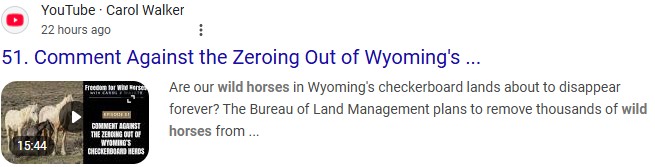
They’re upset at the prospects of losing around 3,700 wild horses in Wyoming but are silent about the loss of approximately the same number at the Salt River and Virginia Range.
Moreover, if the BLM decided to get rid of the Rock Springs herds in the same manner, they’d drop their opposition and offer to do it at no cost to the government.
What a bunch of phonies!
RELATED: Draft EA for Rock Springs Wild Horse Removal Out for Review.

The bill carried today in a 29-6 vote.
RELATED: HB25-1283 Third Reading Today.
The project description says the Decker Unit Allotment will contain 626 acres of public domain and 137 public AUMs, while the South Crosby Unit Place Allotment will contain 80 acres of public domain and 24 public AUMs.
That works out to 219 AUMs per thousand public acres in Decker, equivalent to 18 wild horses per thousand public acres, and 300 AUMs per thousand public acres in Crosby, equivalent to 25 wild horses per thousand public acres.
The state offers some of the finest grazing land in the American West, apparently.
Your faithful public servants claim that western rangelands can only support one wild horse per thousand acres (25,500 animals on 25.6 million acres).
RELATED: How Many Wild Horses Can Public Lands Really Support?
The bill passed with amendments in its second reading on April 17.
A passing vote in the Senate may be followed by a return to the House for acceptance of the changes.
On the Virginia Range with Art.
The Corolla Wild Horse Fund focuses on the preservation of the animals and the place they call home according to a story by WTVR News.
That involves breed conservation, contraceptive darting, soil and plant studies, DNA testing, emergency response, necropsy, fence and cattle guard maintenance, habitat preservation and advocacy according to their herd management page.
So what does the future hold for this special breed?
The herd manager said the population is holding steady at a little over 100.
New foals are born every year and older horses die.
“We’re holding pretty steady; we’re pretty happy with the stability of the herd right now.”
That suggests, for a herd of 100, five to six foals are born every year (where fifteen or more would be expected) and five to six horses die.
This is nirvana, a paragon of wild horse management, to the advocates.
Normal folks would say it’s a disaster.
Will mares have to be imported to rejuvenate the herd?
Do not put your faith in the wild horse advocates.
They’re not who they say they are, they don’t practice what they preach, and their methods threaten every herd where they’re applied.
Out west, ranchers are laughing at these buffoons all the way to the bank.
RELATED: Breeding Population More Important Than Herd Size.

The tiny allotment, consisting of several parcels north of McAllister, MT, offers 137 active AUMs on 1.012 public acres according to the allotment master report.
It’s in the Custodial category, condition unknown.
The management plan assigns zero AUMs to wild horses.
How many could live there?
The forage assigned to livestock is equivalent to 11 wild horses, or 10.9 per thousand public acres.
Why is this important?
Your faithful public servants claim that rangelands in the western U.S. can only support one wild horse per thousand acres (25,500 animals on 25.6 million acres).
The advocates bolster the narrative with their darting programs.
The allotment is too small and too fragmented to be an HMA (or refuge), but if it was, the AML would be 1 and 10 wild horses would be consigned to off-range holding because of permitted grazing.
BLM allotments in Montana support livestock equivalent to 112,120 wild horses on 7,991,479 public acres, or 14.0 wild horses per thousand public acres.
Wild horses can be placed on public lands not identified for their use by acquiring base properties associated with grazing allotments and flipping the preference to horses.
RELATED: The Allotments Tell the Story: They’re Lying, All of Them.

Do you think the 511 horses identified for removal were born in the HMA?
Do you think they lived happily therein until recently?
The EA says on page 11 (of the pdf) that the population has grown exponentially during the past nine years from 78 in the spring of 2016 to 510 in the spring of 2024.
Wouldn’t that be eight years?
The same page indicates the annual growth rate is approximately 10 percent.
These two statements are incompatible.
If the growth rate is correct, a herd of 78 would expand to 167 in eight years.
If the herd sizes are correct, the growth rate would be about 27 percent per year, requiring a birth rate of at least 32% per year, which doesn’t happen.
The gather area covers 239,431 acres so the current stocking rate, based on a population of 518, is 2.2 wild horses per thousand acres, which is too high.
The Lahontan Allotment, which overlaps the HMA, offers 1,155 active AUMs on 52,910 public acres, equivalent to 1.8 wild horses per thousand acres, which is OK.
Like their overlords, the Campaign Against America’s Wild Horses, the Salt River Wild Horse Darting Group sells mass sterilization as wild horse preservation.

Here’s the deal: If you hit the links they’ll hit the mares with PZP-laced darts.
Then they’ll quietly slip out of town before you realize they’ve ruined the herd forever.
RELATED: Foal-Free Friday, Attempting the Impossible Edition.
The agency, a servant of the public-lands ranchers, gave $125,682 to the Campaign Against America’s Wild Horses in FY24 according to a report by USA Spending, on top of $91,867 in FY23.
The FY24 payment was likely the second installment on a grant to sterilize the mares at Cedar Mountain.
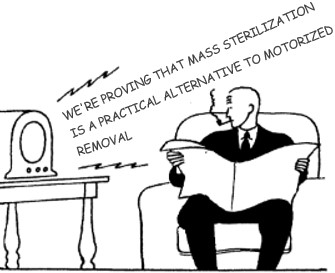
The nonprofit, which serves commercial interests, appears on the last page of the Cooperative Agreement Summary, one of the documents supplied to the WHBAB at the January meeting.
High Desert Strategies, on page two, received approximately $1,070,000 in FY24 and $391,532 in FY23 for pest control services in Oregon according to the USA Spending report.
It’s another nonprofit that serves a commercial interest.
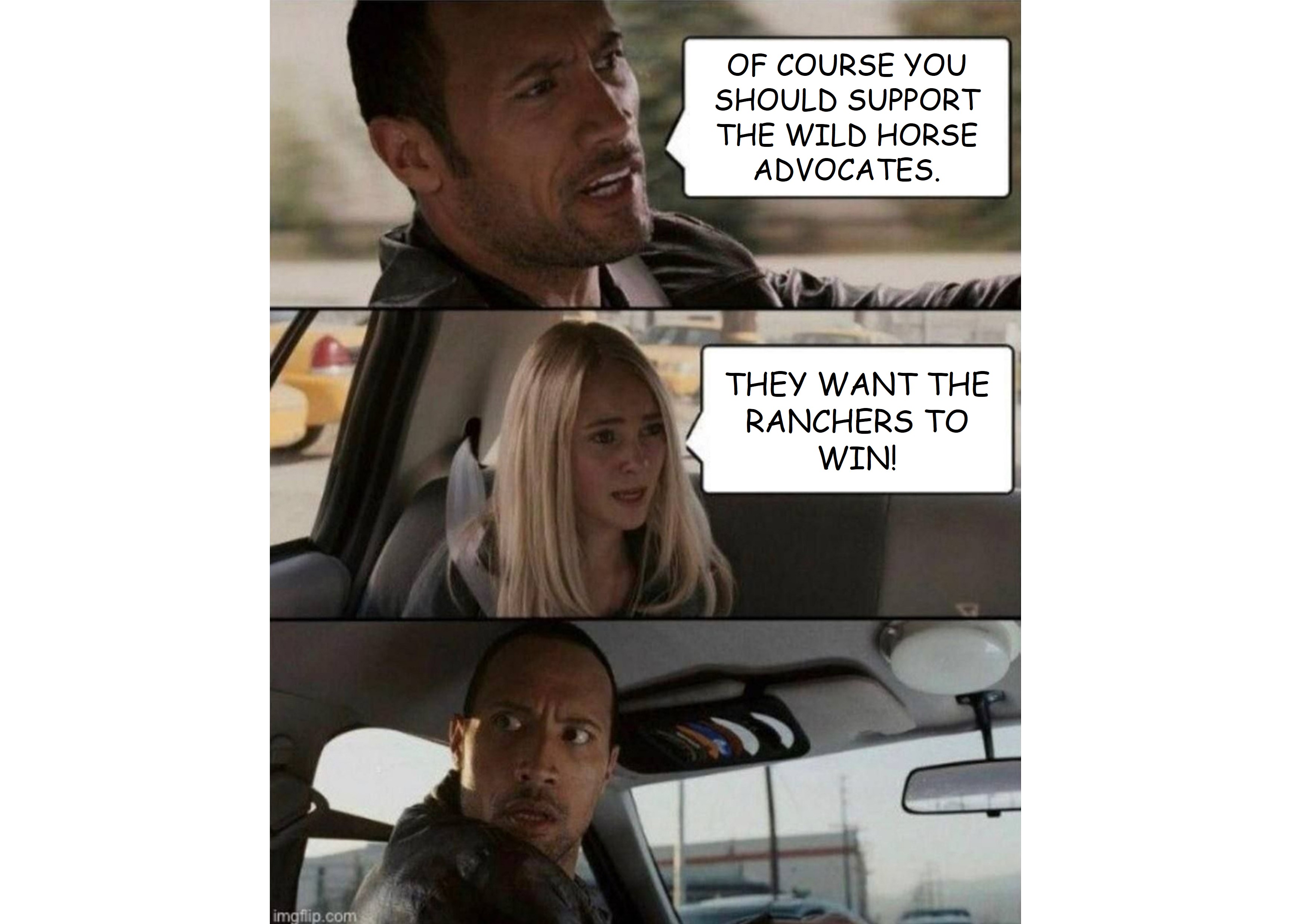
They’re obsessed with pesticides.
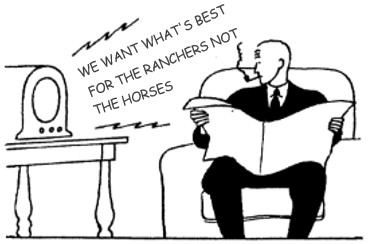
They want what’s best for the ranchers, not the horses.
Don’t give them a penny!
The second reading was scheduled for April 14 but was laid over for a day according to the bill history.
On April 15 it was deferred to April 16.
The procedure was skipped again today, laid over to April 17.
No explanation was given for the delays.
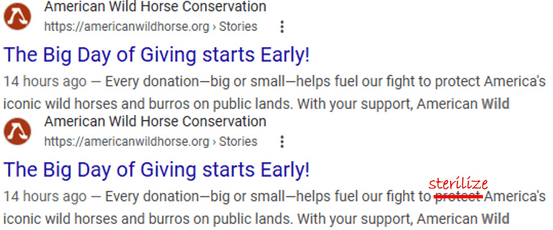
Here’s the latest from the Campaign Against America’s Wild Horses, a leader in nonmotorized removal and fierce opponent of principal use.
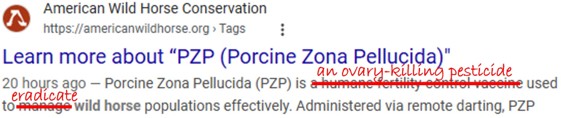
They’re selling mass sterilization as wild horse conservation.
Why are you still giving them money?
RELATED: New Year, Same Lies.
This video shows that trained monkeys can be proficient with firearms, a prerequisite to becoming a PZP darter, and may have higher moral standards.
RELATED: Trunk Monkey Tuesday, One Less Problem Edition.
It’s on the schedule for a second reading.
The Committee on Agriculture & Natural Resources approved the measure on April 10 according to the bill history.
RELATED: HB25-1283 Hearing Delayed?
On Cumberland Island with Mustang Mission.
Figures can be found in the Program Budget section of the Program Data page.
In 2024, the BLM spent 2.3 times as much for off-range holding as it did in 2012.
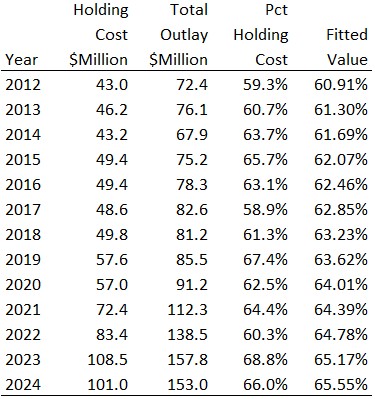
But as a percentage of total expenditures, are the costs really going up or just escalating with everything else?
A run chart provides some evidence of an increase.

The trendline, in black, also appears to be going up. It was fitted to the data with the Analysis Toolpak in Excel.
However, the ANOVA table provided by the toolpak tells a different story.
The p-value of the F-statistic is .095—too large to conclude that the passage of time, on the x-axis, is of use in explaining the variations in the percentage, on the y-axis.
Although there is some evidence of a long-term increase, it’s not enough to provide a basis for action. A p-value smaller than .01 might signal adverse change.
The advocates, on the other hand, believe the costs are spiraling out of control and use the narrative to push their ruinous darting programs.
The online meeting begins at 8:00 AM local time on April 17.
The agenda covers placement, preserves and pesticides.
A wild horse refuge is not worthy of your support if it doesn’t include public lands and doesn’t displace livestock therefrom.
The group should establish a base property fund and be ready to pounce when the right listing hits the market.
RELATED: Beware of the Sanctuaries.
 Western Horse Watchers Association