Trout Creek Base Property Available for $3.45 Million

Situated in southern Oregon along the Nevada border, Cottonwood Ranch lies in the western foothills of the Trout Creek Mountains.

The property covers 1,027 deeded acres with grazing preference on the Sandhills Allotment.

The listing refers to the East and West Sandhills Allotments but RAS and the National Data Viewer refer only to the Sandhills Allotment.

The Allotment Master Report puts it in the Maintain category with 2,294 active AUMs on 12,462 public acres.

The NDV shows two parcels with a combined acreage of 18,146.

Western Horse Watchers asked the Burns office about the discrepancy on October 28 but as of today has received no reply.

The Authorization Use Report shows a small allowance for horse grazing.

A buyer could ask the BLM to flip the remaining AUMs to horses and extend the grazing season to 12 months as Wild Horse Refuge did in Colorado.

That resource would support 2,294 ÷ 12 = 191 wild horses.

The land ratio is good, roughly 1,000 deeded acres give access to somewhere between 12,000 and 18,000 public acres.

At Mustang Monument in Nevada, 14,000 deeded acres secured access to over 500,000 public acres but the BLM did not flip the preference to horses as originally planned.


Sandhills Allotment Map 10-28-24

Pancake EA Refers to Outdated GonaCon Registration

The discussion of PZP and Gonacon begins at the bottom of page 146 in the Draft EA.

References to the EPA registrations appear on page 147:

  • The EPA-required product label associated with the registration for ZonaStat-H is cited in the EA as EPA (2012)
  • The EPA-required product label associated with the registration for GonaCon-Equine is cited in the EA as EPA (2013)

In 2012 Zonastat-H (PZP) was a restricted-use pesticide.

It’s true today and explains why the advocates spend three days at the Billings School of PZP Darting and Public Deception.

The EA reiterates the policy on page 148: In keeping with the EPA registration for ZonaStat-H (EPA 2012; reg. no. 6833-1), certification through the Science and Conservation Center in Billings Montana is required to apply that vaccine to equids.

In 2013 GonaCon was an RUP.  There should be a similar remark about certification on page 148 or 149 but it’s not there.

The 30-day interval between doses on page 151 is consistent with the 2013 registration.

The RUP designation and certification requirement were dropped in 2017.

Like the Kiger-Riddle EA, the BLM appears to be crafting a plan based on an à la carte reading of the EPA registrations.

The advocates will likely dispute the claim on page 145 that contraception alone does not remove excess horses from an HMA’s population, as they are proving otherwise at the Salt River and Virginia Range.

Mass Sterilization and Motorized Removal 08-10-24

RELATED: EA for Pancake HMAP Out for Public Review.

Devil’s Garden Roundup, Day 3

The incident started on October 28.  Results through October 30:

  • Location: Devil’s Garden Plateau WHT
  • AML: 402
  • Pre-gather population: Between 651 and 998
  • Target: Horses
  • Type: Planned
  • Method: Helicopter
  • Goals: Capture 500, remove 500
  • Category: Cruel and costly (according to advocates)
  • Better way: Sterilize mares with PZP (according to advocates)
  • Captured: 49
  • Shipped: Unknown
  • Released: Unknown
  • Deaths: None
  • Average daily take: 16.3
  • Unaccounted-for animals: Unknown

Figures for Day 2 were not provided.

The percentage of foals cannot be determined.

The ratio of males to females is unknown.

The roundup supports three tenets of rangeland management.

RELATED: Devil’s Garden Roundup Begins.

EA for Pancake HMAP Out for Public Review

Like the Antelope-Triple B HMAP, the project provides more evidence that the advocates are ill-informed about wild horses.

The overriding objective of the new plan is to maintain a thriving ecological balance and multiple-use relationship in the Complex, codewords for ranching superiority in the lawful homes of wild horses.  Refer to Appendix XIII of the Draft EA.

Alternative A, the Proposed Action, would implement the plan, putting these techniques into practice:

  • Forcible removal to low AML
  • Application of fertility control (PZP, Gonacon, IUDs)
  • Skewing of sex ratios (60% males / 40% females)

Comments, due by November 29, can be emailed to the address in the news release.

RELATED: Scoping Begins for Pancake HMAP.

Thriving Ecological Balance-3

Monolith Stands Watch Over Teterville Horses

The BLM sends wild horses to two off-range pastures near Teterville, a ghost town east of Cassoday KS.

If those are mares at 0:45, it would be Teterville West.

The population as of September 1 was 332 according to the facility report.

The agency removes wild horses from their lawful homes in the American west and holds them at facilities like this one at a cost of two dollars per head per day so it can collect 4.5 cents per head per day from ranchers who graze livestock in their stead.

Murderer’s Creek DNA Out for Public Review

The project folder now contains a draft DNA which asserts that existing planning documents fully cover bait-trap removal of 350 to 400 wild horses from a herd of 659 in and around the JMA.

Livestock grazing will be deferred for two years in pastures with a high percentage of burned area to allow vegetation to recover.

The map suggests that about 40% of the JMA was affected.

Comments will be accepted through November 5.

RELATED: Murderer’s Creek Emergency Roundup Pending?

Plan for Mustang Monument

The project would convert all but the portion of the Spruce Allotment west of Highway 93 to a nonreproducing wild horse ecosanctuary, including 93% of the Spruce-Pequop HMA, 27% of the Goshute HMA and 14% of the Antelope Valley HMA, according to an undated scoping brief.

Portions of the HMAs not in the sanctuary would be evaluated to determine their ability to sustain wild horse populations with reduced acreage and water resources.

When the carrying capacity of the Spruce Allotment was determined in the early 1990s, AUMs were set aside for wild horse and wildlife.  The analysis assumed that the majority of AUMs in the allotment would be utilized by cattle, whereas in the proposed sanctuary there would be no AUM consumption by livestock.

Western Horse Watchers refers to such changes as flipping the grazing preference to horses, the second step after acquiring the base property tied to said allotment.

Forage in the Spruce Allotment was split between the previous permittee, who retained 57 AUMs in the portion on the west side of the highway and Mustang Monument received 10,908 active AUMs and 2,458 suspended AUMs on the east side.

This is apparent today in the allotment master report.

The suspended AUMs require a carrying capacity analysis to determine if they are available before they can be made active.

When Elko County ranchers heard about the plan the battle lines were drawn.

The sanctuary would function like an ORP, except most of the acreage would be public, and up to three breeding populations would be lost.

Western Horse Watchers has been unable to find the project ePlanning.

The status of the NEPA review is unknown.

RELATED: Purpose of Mustang Monument?

Spruce Allotment with Sanctuary 10-27-24

Purpose of Mustang Monument?

The proposal for a wild horse ecosanctuary was submitted by Saving America’s Mustangs in response to a 2011 BLM solicitation, according to a 2012 news release.

The facility would include 14,000 deeded acres that serve as the base property for the 534,000-acre Spruce Allotment.

Up to 900 federally owned wild horses would graze thereon, for a stocking rate of 1.7 animals per thousand public acres.

A 2012 notice in the Federal Register indicated that the agency intended to prepare an EIS and RMP amendment for the project which would “reduce and potentially eliminate livestock grazing within the portion of the Spruce Allotment east of Highway 93.”

RELATED: Where Is Mustang Monument?

Spruce Allotment with HMAs 10-26-24

Where Is Mustang Monument?

It’s about 30 miles south of Wells, NV on the east side of Highway 93.

The National Data Viewer puts it in the Snow Water Lake Allotment.

The Elko County Assessor indicates it’s APN 008-080-001, owned by Tommy LLC, a legal entity controlled by Madeleine Pickens and probably named after one of her dogs.

The Operator Information Report at RAS ties Mustang Monument to these allotments:

  • 2704016 – SPRUCE GRAZING ASSOCIATION LLC – SPRUCE
  • 2703859 – SAVING AMERICA’S MUSTANGS – SNOW WATER LAKE, WARM CREEK

The Allotment Master Report gives management status, acreage and active AUMs.

The Authorization Use Report gives livestock types and season of use.

Pickens acquired base properties tied to these allotments and offered to take wild horses out of BLM pens and put them back on public lands previously designated for livestock.

Initially the BLM agreed but later reneged.

RELATED: Yes to American Prairie, No to Mustang Monument.

Where Is Mustang Monument 10-25-24

Murderer’s Creek Emergency Roundup Pending?

The BLM opened a new project in ePlanning today to assess NEPA adequacy.

No documents have been posted.

The description says the Rail Ridge Fire burned almost 70% of the BLM-managed lands in the HMA, which correspond to about 32% of the total (Forest Service has 68%).

The fire is 92% contained as of today.

The National Data Viewer indicates the BLM lands are subject to permitted grazing.

The Western Watersheds map gives the status of Forest Service lands.

Murderers Creek HMA with Allotments 10-24-24

Advocates Let Currituck Stallion Die Naturally?

He had been removed from the beach and given his condition, they decided the best thing to do was to let him pass slowly and peacefully according to an October 23 report by WITN News.

The size of the herd is unknown.

Wild horse advocates are known for their opposition to nature’s way.

Better Way 10-25-23

RELATED: Advocates Monitor Currituck Stallion, Kill Currituck Mare.

UPDATE: A story by the Augusta Free Press says they euthanized him.

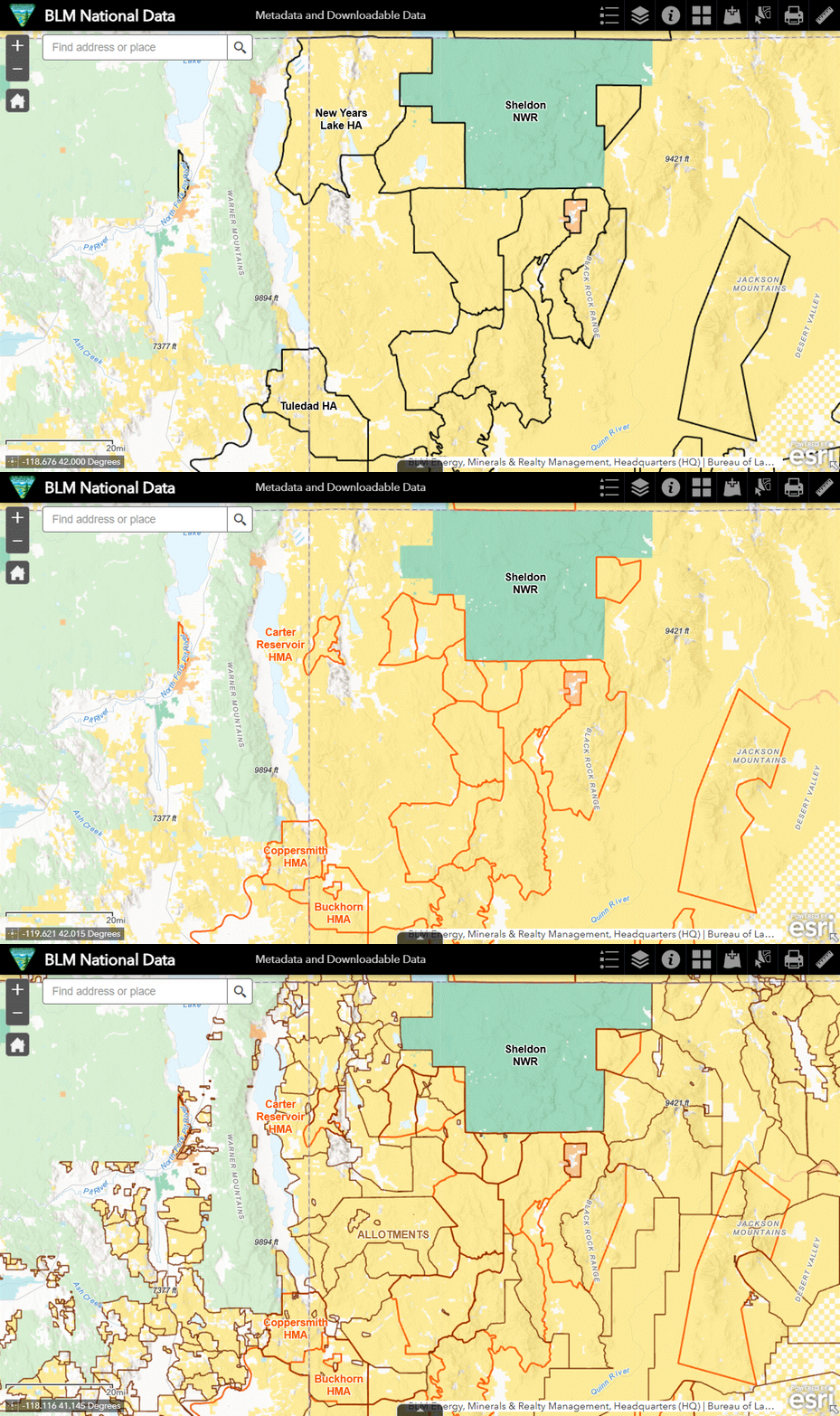
Carter Reservoir EA Out for Public Review

A new project was opened in ePlanning yesterday and a preliminary environmental assessment was copied to the folder with other supporting documents.

The scoping phase was apparently skipped.

The project covers the Carter Reservoir HMA, Coppersmith HMA and Buckhorn HMA on the northern CA-NV border.

Alternative 1, the Proposed Action, features forcible removal, fertility control and sex ratio skewing.  Refer to Section 2.2.3 in the EA.

As in the Kiger-Riddle EA, the discussion of GonaCon Equine on page 49 (50 in pdf) refers to outdated registrations: “GonaCon-Equine is approved for use by authorized federal, state, tribal, public, and private personnel, for application to wild and feral equids in the United States (EPA, 2013; 2015).”

The 2017 amendment, which increased the interval between treatments from 30 days to 90 days, is ignored.

The BLM news release said the current population is at least 700 wild horses, compared to a combined AML of 195.

The HMAs do not appear on the FY25 roundup schedule.

They are subject to permitted grazing.

The new plan supports three tenets of rangeland management.

Carter Reservoir HMAs with Allotments 10-23-24

Sand Wash Partners Protect Ranchers Not Wildlife

When wild horse populations are within AML, other wildlife thrive, according to a BLM article about the 2024 roundup.

In the case of Sand Wash Basin, you cannot have more than 362 wild horses in the HMA or the land will degrade, but you can have livestock equivalent to 1,402 wild horses in the same area.

Curiously, those animals escaped the writer’s attention.

The permanent bait trap and ever-present footprints of the PZP darters are constant reminders that the horses are not a priority in their lawful home.

RELATED: Sand Wash Roundup Ends Early.

Thriving Ecological Balance-3

How to Build Support for Triple B Roundup

Call a press conference.

Announce that you’ve decided to get rid of the herd with PZP.

A sigh of relief will go up from the advocates.

In a few days, letters and emails will arrive offering to dart the mares for free.

Better Way 10-25-23

After five years they will be sterile and with no new foals hitting the ground, the herd will vanish.

The advocates, led by the Campaign Against America’s Wild Horses, will point to the Salt River and Virginia Range as examples of what can be done.

Mass Sterilization and Motorized Removal 08-10-24

You just need to be patient and let them show their true colors.

RELATED: Triple B Roundup Announced.