Clan Alpine Roundup, Day 9

The incident began on November 8.  Results through November 16:

  • Scope: Clan Alpine HMA
  • Purpose: Pest control, resource enforcement, rancher protection
  • Target: Horses
  • Type: Planned
  • Method: Helicopter
  • Category: Cruel and costly*
  • Better way: Sterilize mares with pesticide-laced darts*
  • Captured: 832, up from 601 on Day 7
  • Average daily take: 92.4
  • Capture goal: 1,594
  • Removal goal: 1,381
  • Returned: 1, up from zero on Day 7
  • Deaths: 12, up from 8 on Day 7
  • Shipped: 590, up from 467 on Day 7

A stallion was released (escaped?) on Day 6.

A stallion was dispatched on Day 9 for a broken neck.  Three mares were also put down because of eye issues.

The death rate is 1.4%.

The capture total includes 347 stallions, 378 mares and 107 foals.

Youngsters represented 12.9% of the animals gathered, suggesting the herd is growing at a rate of 8% per year.

Of the adults, 47.9% were male and 52.1% were female.

Body condition scores were not given.

The HMA and surrounding lands are subject to permitted grazing.

*According to advocates.

Clan Alpine HMA with Allotments 06-17-23

Day 9 ended with 229 unaccounted-for animals.

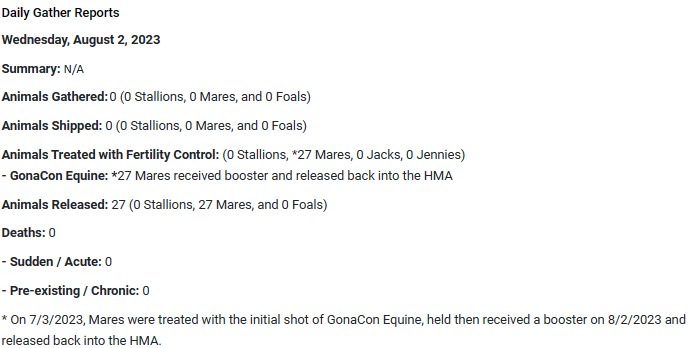
On Day 7, 81 mares were treated with GonaCon Equine, a fertility control pesticide.

They will be returned the range with up to 121 stallions.

Other statistics:

  • Forage liberated to date: 9,972 AUMs per year
  • Water liberated to date: 8,310 gallons per day
  • Horses allowed by plan: 979
  • Pre-gather population: 1,661 plus this year’s foals
  • Forage assigned to horses: 11,748 AUMs per year
  • Forage assigned to livestock: 6,796 AUMs per year
  • Horses displaced from HMA by permitted grazing: 566
  • True AML: 1,545
  • Stocking rate at new AML: 5.2 wild horses per thousand public acres
  • Horses displaced by drilling and mining: Ask the advocates

RELATED: Clan Alpine Roundup, Day 7.

Foal-Free Friday, Praying for the Horses to Die Edition

The advocates are so far gone and so hopelessly lost in their pesticide paradigm that they actually want the horses to die.

One example is McCullough Peaks, where the average age of the herd is increasing, along with the death rate, because few if any new foals are hitting the ground.

The older horses may not survive the winter, which the advocates anticipate and desire.

Anything to avoid motorized removal.  Anything to prove their darting programs are working.  Anything to keep the resources shifted in favor of the public-lands ranchers.

At the Virginia Range, where the Campaign Against America’s Wild Horses operates its flagship darting program, they’re driving the birth rate to zero and letting the herd die off.

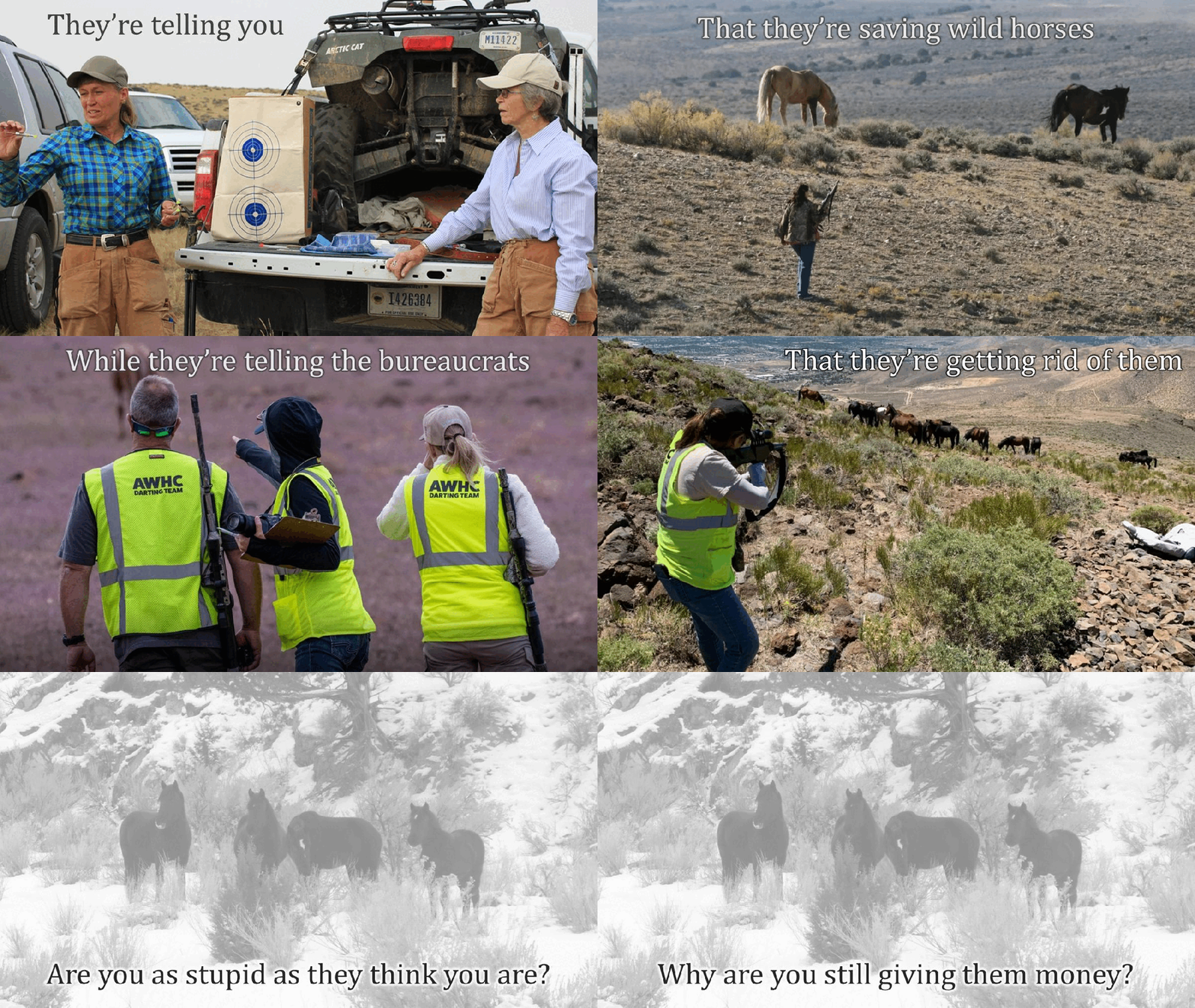
They’re telling you that they’re saving the horses while they’re telling the bureaucrats that they’re getting rid of them.

Their affiliates in Arizona are doing the same thing to the Salt River herd, where a zero percent birth rate and six percent death rate will be needed for ten consecutive years to achieve the population target.

By then the mares will be sterile and the herd will be lost.

Ditto for the Virginia Range.

These groups should be banned from areas identified for wild horses.

RELATED: Foal-Free Friday, Snubbing the Wild Horse Advocates Edition.

Pesticides R Us Better Way 11-07-23

NDA Designates Virginia Range Hatchet Man

His appointment was mentioned in the August 31 Animal Industry Report to the Nevada Board of Agriculture but no details were given.

Now, a Q&A dated November 16 by The Nevada Independent provides a few answers.

He will oversee the horses, fencing projects, contracts for darting and feeding, and will meet with the advocate groups.

The current population exceeds 3,500, compared to a target of 500.

Natural attrition will not achieve that number in a reasonable timeframe.

A long-term goal is to put more horses into good homes through a relocation process.

RELATED: What’s So Important about the Virginia Range?

Advocates File Suit to Stop Removal of Stone Cabin Horses

The case was brought in response to a complaint last month by livestock operators seeking immediate removal of wild horses, according to today’s news release.

The final planning documents for a new pest control plan were published earlier this year, but, as of today, the HMA has not been added to the FY24 roundup schedule.

RELATED: Stone Cabin Permittees Demand Immediate Removal of Horses.

Court Sides with Forest Service in Big Summit Legal Challenge

A U.S. District Judge affirmed the findings and recommendations of a magistrate in May, clearing the way for a reduction in AML and management actions to achieve it, according to a report dated November 15 by Courthouse News Service.

The plaintiffs claimed that the Forest Service’s plan will cause the herd’s extinction through an irretrievable loss of genetic diversity.

The WHT lies mostly within the Reservoir Allotment.

RELATED: Judge Hears Arguments in Big Summit Legal Challenge.

Big Summit WHT Map 11-19-22

Clan Alpine Roundup, Day 7

The incident began on November 8.  Results through November 14:

  • Scope: Clan Alpine HMA
  • Purpose: Pest control, resource enforcement, rancher protection
  • Target: Horses
  • Type: Planned
  • Method: Helicopter
  • Category: Cruel and costly*
  • Better way: Sterilize mares with pesticide-laced darts*
  • Captured: 601, up from 518 on Day 5
  • Average daily take: 85.9
  • Capture goal: 1,594
  • Removal goal: 1,381
  • Returned: None
  • Deaths: 8, up from 7 on Day 5
  • Shipped: 467, up from 373 on Day 5

Capture operations did not occur on Day 7.  No details were given.

A mare was dispatched for a fractured pelvis on Day 6.

The death rate is 1.3%.

The capture total includes 253 stallions, 255 mares and 93 foals.

Youngsters represented 15.5% of the animals gathered, suggesting the herd is growing at a rate of 11% per year.

Of the adults, 49.8% were male and 50.2% were female.

Body condition scores were not given.

The HMA and surrounding lands are subject to permitted grazing.

*According to advocates.

Clan Alpine HMA with Allotments 06-17-23

Day 7 ended with 126 unaccounted-for animals.

Up to 81 mares will be treated with GonaCon Equine, a fertility control pesticide, before being returned the range with up to 121 stallions.

Other statistics:

  • Forage liberated to date: 7,212 AUMs per year
  • Water liberated to date: 6,010 gallons per day
  • Horses allowed by plan: 979
  • Pre-gather population: 1,661 plus this year’s foals
  • Forage assigned to horses: 11,748 AUMs per year
  • Forage assigned to livestock: 6,796 AUMs per year
  • Horses displaced from HMA by permitted grazing: 566
  • True AML: 1,545
  • Stocking rate at new AML: 5.2 wild horses per thousand public acres
  • Horses displaced by drilling and mining: Ask the advocates

RELATED: Clan Alpine Roundup, Day 5.

Centennial Roundup Announced

The incident will begin on November 20, according to today’s news release.

The capture and removal goals are 140 each.

A helicopter will push the horses into the traps and operations will occur inside the China Lake Naval Air Weapons Station, where public access is not available.

The HMA covers 318,499 total acres in southern California, including 71,350 BLM acres, with the remainder controlled by the Department of Defense.

The AML is 134 – 168.

The current population was not given.

The National Data Viewer shows habitat loss and grazing allotments.

Captured animals will be taken to the Ridgecrest off-range corrals.

Gather stats and daily reports will be posted to this page.

A 2021 roundup reduced the population by 214.

Centennial HMA with Allotments 11-14-23

WHB Outplacement Tops 8,000 in FY23

Of the animals placed into new homes, 6,220 were adopted, 1,798 were sold and 27 were transferred to other government agencies.

Approximately 36% of the animals changed hands through AIP, according to today’s news release.

Most herds live in arid environments, lack predators that control growth (man-made) and can quickly overwhelm the (limited) food and water available to them (man-made).

The fiscal year runs from October 1 through September 30.

RELATED: BLM Offers $7.5 Million for WHB Adoption Partnerships.

McCullough Peaks Roundup Set for November 27

Operations will be carried out with baited traps and will probably be closed to public observation, although this was not stated in the news release.

The capture and removal goals are 80 and 41, respectively.

Captured animals will be taken to the Rock Springs off-range corrals.

A link to the gather stats and daily reports was not given.

The incident was billed as catch-treat-release.

The HMA is subject to permitted grazing.

RELATED: Advocates, Not BLM, Ruined McCullough Peaks Herd.

McCullough Peaks HMA with Allotments 07-14-23

Clan Alpine Roundup, Day 5

The incident began on November 8.  Results through November 12:

  • Scope: Clan Alpine HMA
  • Purpose: Pest control, resource enforcement, rancher protection
  • Target: Horses
  • Type: Planned
  • Method: Helicopter
  • Category: Cruel and costly*
  • Better way: Poison mares with ovary-killing pesticides*
  • Captured: 518, up from 295 on Day 3
  • Average daily take: 103.6
  • Capture goal: 1,594
  • Removal goal: 1,381
  • Returned: None
  • Deaths: 7, up from 3 on Day 3
  • Shipped: 373, up from 170 on Day 3

A stallion and mare were dispatched on Day 4 because of cancer.  Another stallion and mare were killed because of abscesses, a treatable condition.

The death rate is 1.4%.

The capture total includes 209 stallions, 225 mares and 84 foals.

Youngsters represented 16.2% of the animals gathered, suggesting the herd is growing at a rate of 11% per year.

Of the adults, 48.2% were male and 51.8% were female.

Body condition scores were not given.

The HMA and surrounding lands are subject to permitted grazing.

*According to advocates.

Clan Alpine HMA with Allotments 06-17-23

Day 5 ended with 138 unaccounted-for animals.

Up to 81 mares will be treated with GonaCon Equine, a fertility control pesticide, before being returned the range with up to 121 stallions.

Other statistics:

  • Forage liberated to date: 6,216 AUMs per year
  • Water liberated to date: 5,180 gallons per day
  • Horses allowed by plan: 979
  • Pre-gather population: 1,661 plus this year’s foals
  • Forage assigned to horses: 11,748 AUMs per year
  • Forage assigned to livestock: 6,796 AUMs per year
  • Horses displaced from HMA by permitted grazing: 566
  • True AML: 1,545
  • Stocking rate at new AML: 5.2 wild horses per thousand public acres
  • Horses displaced by drilling and mining: Ask the advocates

RELATED: Clan Alpine Roundup, Day 3.