Columnist Tries to Prop Up Sand Wash Narrative

Western Horse Watchers offers the following remarks in response to an op-ed appearing in today’s online edition of the Greeley Tribune.

The AML of 362 corresponds to a resource allocation in a land-use plan.  It is not the number of wild horses the HMA can sustain.  If the land can only support 362, how did the pre-gather population reach 896?  Half of them should be dead by now.

Sometimes you limit your spending in one area because other things are more important.

Wild horses are not domesticated animals.  If you think they are, adopt one and try throwing a saddle on him.  He might spin his butt and put a hoof in your face.

Table 2.1 in the Final EA for resource enforcement actions in the HMA shows 499 AUMs per year assigned to cattle in one of the pastures of the Sheepherder Spring allotment, which is inside the HMA according to the paragraph above the table.

If sheep only traverse the HMA on their way to summer and winter feeding grounds, why does the plan authorize over 16,000 AUMs per year to livestock inside the HMA?

Amend the plan and shift the resources back to the horses!  The roundup will no longer be necessary and the darting program can be stopped.

Horses appear in the North American fossil record, cattle and sheep do not.  They are the predominant non-native species on America’s pubic lands.

There are few if any predators in wild horse areas because those animals would also be interested in the offspring of the non-native species.

The Federal Land Policy and Management Act, 43 USC 35, puts domestic livestock grazing at the top of the list of principal uses of public lands, not fish and wildlife development, mineral extraction, recreation or timber production.  Refer to §1702(l).

The use of helicopters and motor vehicles in wild horse roundups, §1338a in 16 USC 30, was authorized by FLPMA, the first formal attack on the WHB Act by the public-lands ranchers, their overlords, cheerleaders and political allies.

RELATED: Sand Wash Horses Consume 95% of Resources?

Pancake Gather Plan

Sand Wash Roundup Day 3

The incident began on September 1.  Gather stats through September 3:

  • Type: Emergency
  • Horses captured: 81
  • Average take: 27.0 horses per day
  • Capture goal: 783
  • Removal goal: 733
  • Returned: 1
  • Deaths: 0
  • Shipped: 64

Helicopters were grounded on Day 2 due to weather.

Foals represented 16.0% of the horses gathered.  Of the adults, 47.1% were male and 52.9% were female.

Body condition scores were not reported.

Day 3 ended with 16 unaccounted-for animals.

Other statistics:

  • AML: 362
  • Forage assigned to horses: 4,344 AUMs per year
  • Pre-gather population: 896
  • Forage liberated to date: 960 AUMs per year
  • Water liberated to date: 800 gallons per day
  • Forage assigned to livestock: 16,827 AUMs per year (estimated)
  • Horses displaced from HMA by livestock: 1,402 (2.8% of off-range holding)
  • True AML: 1,764

RELATED: Sand Wash Roundup Begins.

Sand Wash Horses Consume 95% of Resources?

The statement occurs at 1:36 in the following video by KUSA News of Denver.

Could it be true?  Yes, during the off season.

Table 2.1 in the Final EA for resource enforcement actions shows grazing seasons for allotments that overlap the HMA.  The pastures in rows 1, 2, 4, 6 and 7 are inside the HMA and represent a shifting of resources from wild horses to public-lands ranchers.

Grazing does not occur in June, July and August, so during the summer, the horses are the majority consumer of food and water.

Gates and fences might impede their movement within their home range and some areas may be off limits to help them recover for the next grazing season.  Most of the land does not meet standards for rangeland health.

The management plan assigns 79% of the authorized forage to privately owned livestock over a twelve month period, as explained in this report.  The horses are the minority consumer of resources overall, next to wildlife.

The pre-gather population of 896 is unacceptable—the horses are robbing too much forage, sometimes referred to as ‘their food,’ from the ranchers.

That’s why they have to go.  Resource enforcement.

Livestock AUMs may have been cut due to a temporary change in the weather but the horses are being permanently removed.  When conditions improve, it’ll be business as usual, with the ranchers receiving the lion’s share of the resources.

The BLM rep in the video is not telling the whole story.

Would that be true for your favorite advocacy group?

Comments Invited on Draft EA for New Off-Range Corrals

A preliminary environmental assessment for a high-density animal feeding operation was released today for public review.  The proposed facility would be built on private land north of Winnemucca, NV and east of the Highway 95/290 junction.

The corrals would cover 100 acres and have a capacity of 4,000 wild horses and burros, for a stocking rate of 40,000 animals per thousand acres.

Horses and burros removed from their home range would be held there until they are adopted or transferred to long-term pastures.

The operator would be JS Livestock of unknown city and state.

New Winnemucca Corrals 09-02-21

The word ‘shelter’ appears nowhere in the assessment.

Comments will be accepted through September 17, according to the news release.

Beware of the Advocates!

They couldn’t convert an AML to AUMs if their lives depended on it, but they can tell you exactly how many cc’s of adjuvant to add to the PZP and how long to mix them.

They’re working with government to achieve and maintain AMLs by attrition, which means they’re trying to protect and preserve the lopsided resource allocations that strongly favor the public-lands ranchers—in areas set aside for wild horses.

Charlatans, every one of them.

RELATED: Don’t Be Deceived by the Wild Horse Advocates!

Climate Change Will Bring Us Together?

The greatest threat to our public lands, and the animals living therein, is climate change, according to a story posted yesterday by Reuters.

The signatories to the ‘Path Forward‘—now revealed to be frauds—want you to accept the lie, join their darting army and help them get rid of wild horses.

To save the planet, of course.

RELATED: Support for ‘Path Forward’ Much Greater Than You Think.

Don’t Be Deceived by the Wild Horse Advocates!

AMLs are small because most of the forage in wild horse areas has been assigned to privately owned livestock.

Roundups enforce those assignments.

If you shift the resources back to the horses, the AMLs are much higher.  They represent the number of animals the areas could support if they were managed principally for wild horses, as specified in the statute.  Western Horse Watchers calls them True AMLs.

The ranchers want to get rid of the horses so they can enjoy more of what their allotments have to offer.

Although the advocates protest the roundups, they, like the ranchers, want to see wild horse numbers go down, as a result of their fertility control programs, not helicopters.

They never contest the land-use plans and resource allocations arising therefrom.

They are in business to sell PZP.  You see their influence when state and local officials call for humane management of these animals.

Instead of crashing the horses into pipe panels, stalk them with clipboards and darting rifles, drive birth rates to zero, and let the herds off.

There are few if any voices speaking in their defense.

Welcome to the love triangle on America’s public lands.  It’s a big club but hopefully you’re not in it.

Love Triangle on Americas Public Lands 08-19-21

Barren Valley Emergency Roundup Begins Next Week

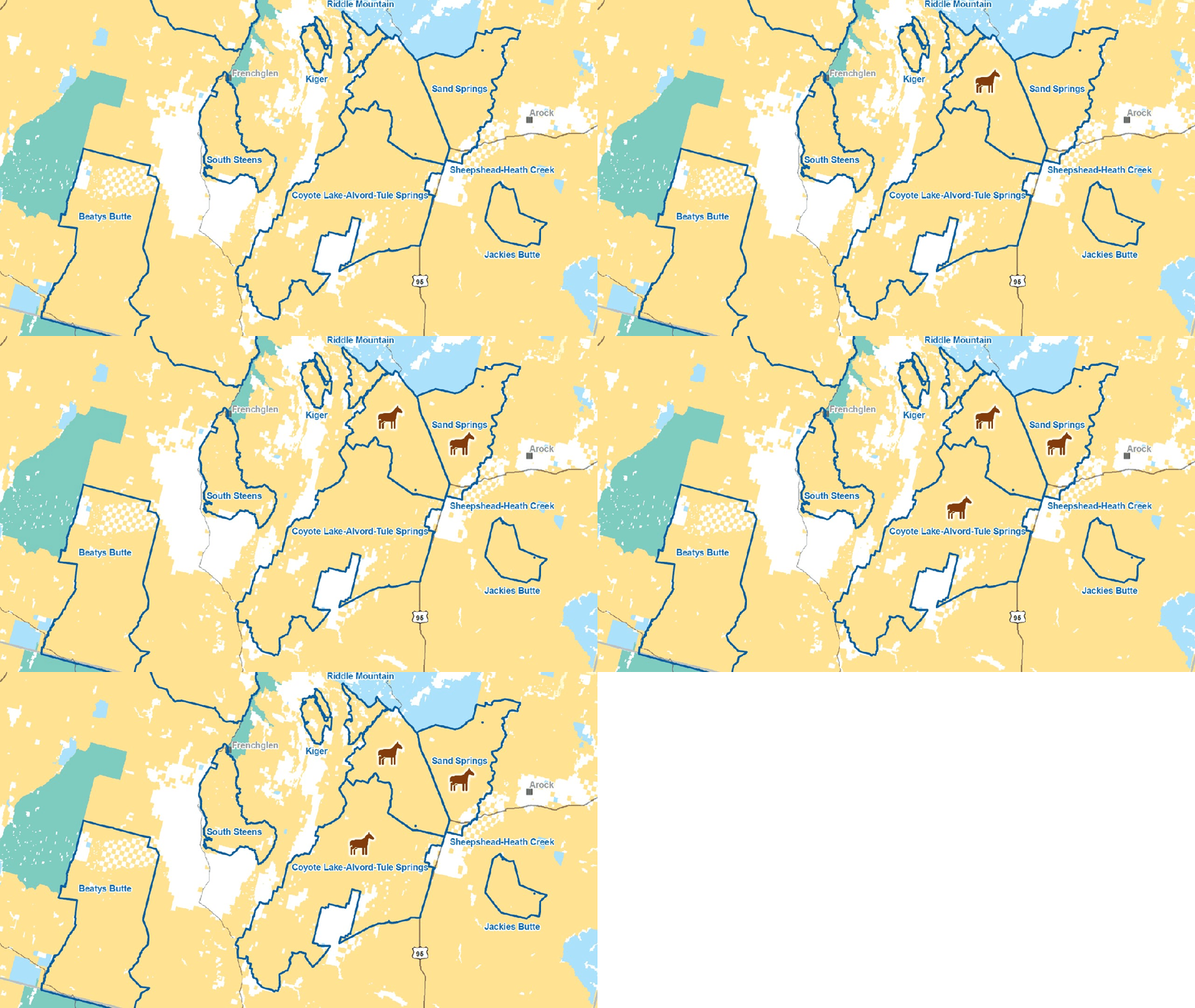
An unspecified number of wild horses will be removed from three HMAs in southeast Oregon, starting on September 8, due to inadequate food and water.

Helicopters will push the horses into the traps, according to the news release, and the incident will be open to public observation.

Around 100 horses will be returned to the area when conditions improve.

The pre-gather population is thought to be around 2,500.

The three HMAs cover approximately 956,000 acres and the 892 horses allowed by plan receive 10,704 AUMs per year.  The stocking rate allowed by plan is 0.9 wild horses per thousand acres, slightly less than the target rate of one wild horse per thousand acres across all HMAs.

Barren Valley Complex Map 09-01-21

The HMAs intersect seven grazing allotments, discussed in these ‘Short End of Stick’ reports: Coyote Lake, Sheepshead, Sand Springs.  Privately owned livestock receive an estimated 27,011 AUMs per year in the Complex, sometimes referred to as public lands set aside for wild horses.

Captured animals will be taken to the off-range corrals Bruneau, ID and Palomino Valley, NV.

Gather stats and daily reports will be posted to this page, which indicates a removal goal of up to 1,900.

The announcement said many of the horses are emaciated and dehydrated but will they disclose the body condition scores when the operation begins?

The forage assigned to livestock would support an additional 2,251 wild horses, for a True AML of 3,143, the number of animals the area could sustain if it was managed principally for wild horses.

RELATED: Barren Valley Gather EA Comes and Goes, No News Release.