Who’s Grazing the Delamar and Meadow Valley Allotments?

The roundup will be coordinated by the Caliente Field Office, Ely District, according to the news release.  Over 400 wild horses will be removed from two HAs—part of the Caliente Complex—due to insufficient food and water.

Curiously, these wastelands can support thousands of privately owned cattle at fire-sale prices.  Who benefits from this arrangement?

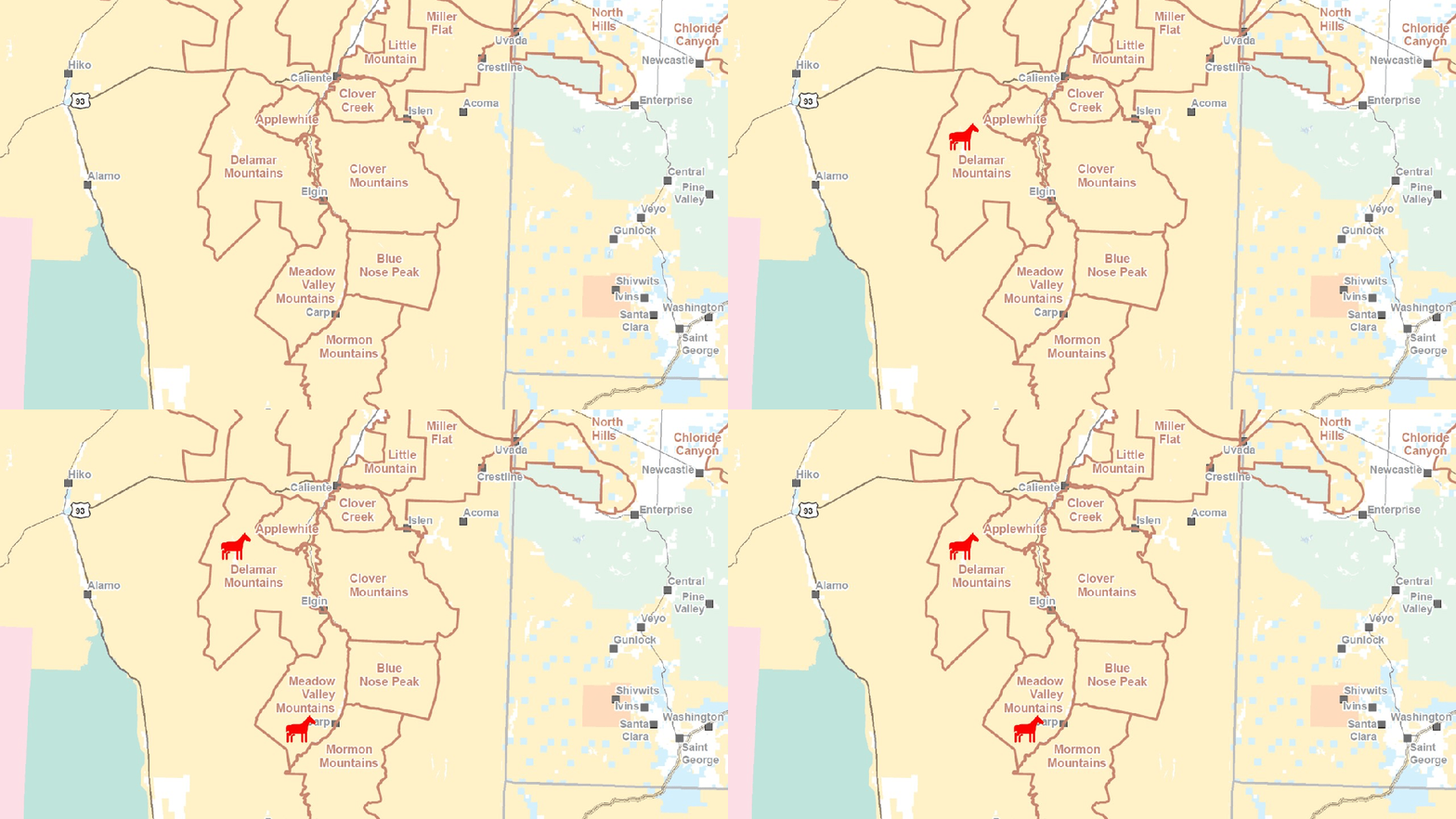
Map 1 in the Final EA for wild horse management actions in the Complex shows the layout (page 5 in the pdf).  The Delamar Mountains and Meadow Valley Mountains HAs, targets of the roundup, are on the west side.

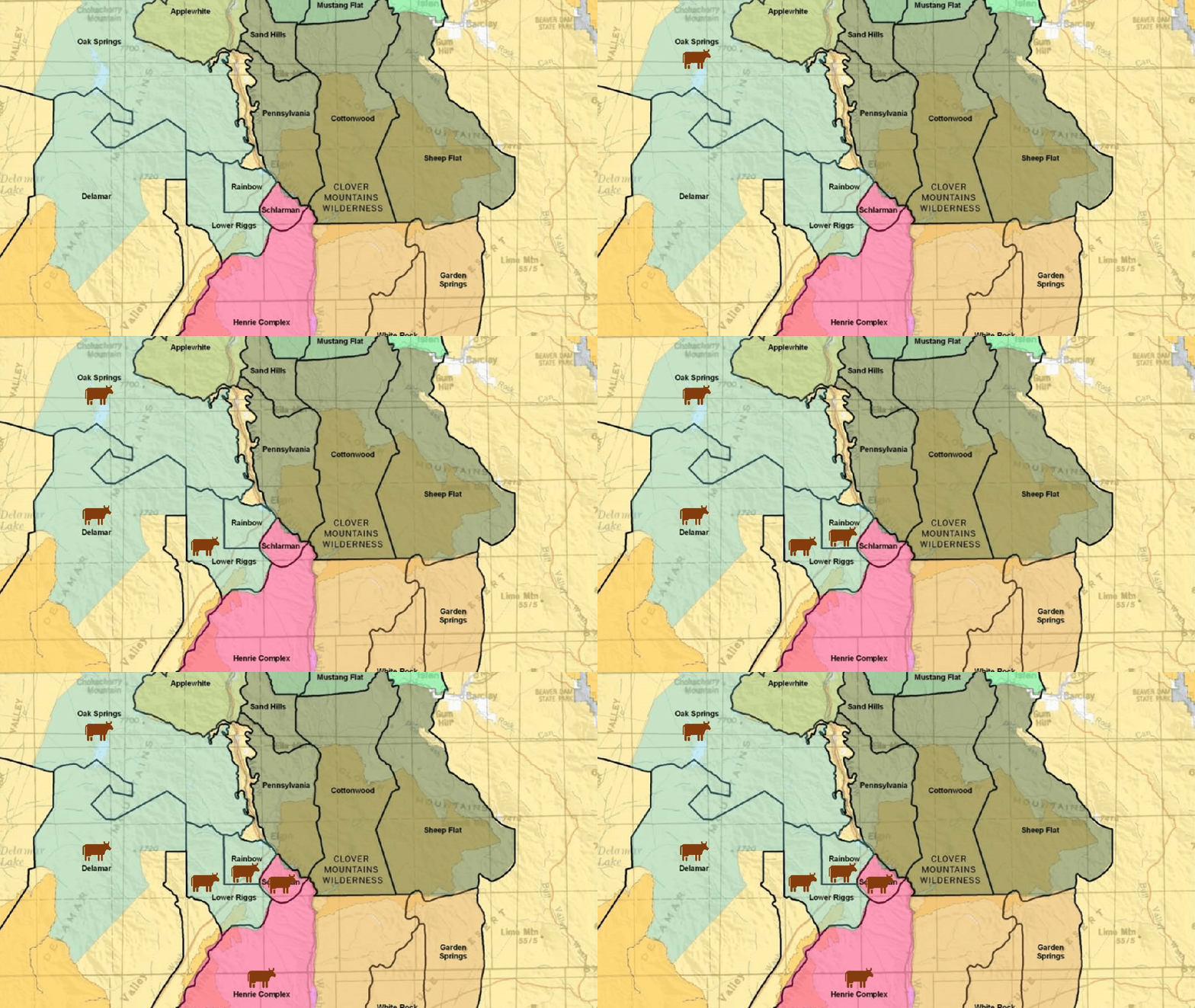
The map in Appendix V, page 81, shows the allotments.  In this section of the map, Delamar, in light green, intersects four allotments and Meadow Valley, in pink, intersects two.
Delamar and Meadow Valley Allotments

Table 3.2, page 41, provides livestock types, grazing seasons and permitted AUMs.  Note that some of the allotments are in use twelve months per year.

Go to the Rangeland Administration System and right-click on Allotment Master to open the report in a new tab.

  • State: Nevada
  • Office: Caliente
  • Allotment: Oak Springs

Click Apply to run the report.  You can download the results as a pdf file.

The allotment covers 195,049 acres with 9,268 active AUMs, which would support 772 cow/calf pairs over a 12 month grazing season.  Or, if you prefer, 772 wild horses.

The permittee is Delamar Valley Cattle, a producer of range-fed beef.

Go back to the top of the page, uncheck Oak Springs, check Delamar and hit Apply.

The allotment covers 203,000 acres and has 5,558 active AUMs, according to the report.  Same permittee as Oak Springs.  The forage would support 463 cow/calf pairs over a 12 month grazing season, equivalent to 463 wild horses.

You can run through the same steps to look up the other allotments.

The stated reason for the roundup—lack of food—is not consistent with these findings.

The horses are robbing forage from the public-lands ranchers, and they’re not supposed to be there according to the resource management plan (AMLs are zero), so send in the helicopters.

RELATED: Delamar Mountains Emergency Roundup Starts This Weekend.
Confusion Roundup Day 5

The incident began November 29.  Gather stats through December 3:

  • Horses captured: 207
  • Goal: 500
  • Returned: 0
  • Deaths: 3
  • Shipped: 160

One horse died on Day 4 due to a broken neck (related to roundup) and another was put down due to emaciation (pre-existing condition).

Foals accounted for 24% of the total.  Of the captured adults, 37% were males and 63% were females.

The number of horses captured is 208 according to the gather page.  The discrepancy is probably in the November 30 figures.

Body condition scores were mostly threes and fours.

The number of unaccounted-for animals is 44.  The contractor may be holding them on site, with some, perhaps, destined for sterilization.

All horses shipped to Axtell since the last report.

RELATED: Confusion Roundup Day 3.

PZP Amendment Linked to Salt River Darting Program

Extrapolation is a bad idea in regression analysis and it’s not appropriate in the wild horse world either.

But a guest column appearing this morning in AZCentral does just that: The “stunning results” of a program in one area justify its replication nationwide.

At least the writer is honest: PZP prevents wild horses, it does not protect them.

That most of the resources have been diverted to privately owned livestock—on lands set aside for the horses—is apparently of no concern.

RELATED: Op-Ed Pushes Contraceptives.

Wild Horse Growth Rates

You have probably read that wild horse herds grow at a rate of about 20% per year.

If you start with 100 horses, 20 foals will have to be born over the next year to bring the herd to 120, a 20% increase over the original 100.  That’s if none of the adults die.  A census would reveal that foals accounted for roughly 17% of the total.

If adults die at a rate of 5% per year, 25 foals would have to be born over the next year to bring the herd to 120.  A roundup would yield 95 adults and 25 youngsters, with foals accounting for approximately 21% of the total.

When you look at gather stats and see foals representing 13% of the total, that herd may not be growing at a rate of 20% per year.  Similarly, if you see foals accounting for 26% of the horses captured, that herd probably doesn’t conform to the 20% rate.

By how much can the death rate vary and not have an appreciable effect on birth rates?

Selenite Roundup Day 4

The incident began November 29.  Gather stats through December 2:

  • Burros captured: 218
  • Goal: 200
  • Returned: 0
  • Deaths: 3
  • Shipped: 215

Foals accounted for 11% of the total.  Of the captured adults, 46% were males and 54% were females.  No deaths occurred on Days 3 and 4.

The number of unaccounted-for animals is zero.

The operation will probably conclude by the end of the week.

RELATED: Selenite Roundup Day 2.

Pancake Comment Period Ends Next Week

Comments on the gather plan will be accepted through December 12.

The Proposed Action (Alternative A in the Draft EA) will achieve and maintain AMLs via roundups, contraceptives, sex ratio skewing and castration.

Concerns about resource allocations and management priorities in the Complex, although valid, are outside the scope of the project and should not be submitted.

A lengthy and coordinated effort will be necessary to ensure that HMAs and WHTs are managed primarily for horses, not livestock, as specified in the original WHB Act.

RELATED: Initial Thoughts on Pancake Gather Plan.

Pancake Grazing Report

Delamar Mountains Emergency Roundup Starts This Weekend

BLM said today that over 400 wild horses will be removed from the Delamar Mountains and Meadow Valley Mountains HAs, starting on or about December 6, due to lack of food and water.

The operation will be carried out with helicopters, according to the news release, and will be open to public observation.

The two former HMAs were zeroed out in 2008 and have no AMLs.  They are part of the Caliente Complex in eastern Nevada.

Delamar HA Map Rev 1

Both are subject to permitted livestock grazing.

Captured animals will be taken to the off-range corrals in Bruneau, ID.

Gather stats and daily reports will be posted to this page.

Two tanker pilots died in a midair collision while fighting a fire in the area last July.

RELATED: Moriah’s Cousins.

Confusion Roundup Day 3

The incident began November 29.  Gather stats through December 1:

  • Horses captured: 114
  • Goal: 500
  • Returned: 0
  • Deaths: 1
  • Shipped: 81

A foal was put down on Day 2 due to injuries related to the roundup.

Foals accounted for 25% of the total.  Of the captured adults, 31% were males and 69% were females.  The number of horses gathered, based on the daily figures, is 113.

Body condition scores were mostly threes and fours.

The number of unaccounted-for animals is 31.  The contractor is probably holding them on site.

Most of the horses shipped to Axtell but one went to Delta.  Its sex was not given but it could be the first of approximately 20 mares designated for sterilization.

RELATED: Confusion Wild Horse Roundup Begins This Weekend.

Black Mountain Roundup Day 60

The operation started on September 23.  Gather stats through November 21:

  • Burros captured: 499
  • Goal: 500
  • Deaths: 3
  • Returned: 0
  • Shipped: 473

A 6 year old jenny died after running into a panel on November 11.

Foals accounted for 13.8% of the total.  Of the captured adults, approximately 51% were jacks and 49% were jennies.

The cumulative total says 503 animals removed.

The number of unaccounted-for animals, based on the daily figures, is 23.

Although the goal has been reached, the page does not say if the operation is finished.

RELATED: Black Mountain Roundup Day 56.

Big Summit AML Reduction Still In the News

A rancher interviewed for the story, posted today by The Bulletin of Bend, OR, pointed to the random grazing patterns of wild horses: “There is nothing uniform.  The horses go to one place one summer then another place another summer.  So grazing allotments are gone.  They don’t work anymore.”

Hard to believe that free-roaming horses would do that.

RELATED: Big Summit AML Reduction In the News.