What is an Excess Horse?

The current population at Saylor Creek is 131 wild horses.  The AML is 50.  How many excess horses are present?  The herd is 2.6 times over AML.

There are 81 excess horses on the HMA, per current wisdom.  It’s overpopulated.

The herd requires 13% of the authorized forage on the HMA but you’re not supposed to know that.  When the roundup ends, the horses will only need about 5%.

RELATED: Comments on Saylor Creek Wild Horse Roundup.

Statutes and Regulations

Exhibit A

16 USC 1332, Definitions, WHB Act, a duly enacted statute.

Paragraph (c) defines “range” as “the amount of land necessary to sustain an existing herd or herds of wild free-roaming horses and burros” that’s “devoted principally but not necessarily exclusively to their welfare.”  It stands as it did in 1971.

Paragraph (f), which defined “excess animals” as those “which must be removed from an area in order to preserve and maintain a thriving natural ecological balance and multiple-use relationship” did not appear in the original Act.  It was added by PRIA.

Exhibit B

CFR 4710.3-2, Wild horse and burro ranges, Part 4700, Subpart 4710, a federal regulation.

Accordingly, herd management areas, a term that did not appear in the original Act, “may also be designated as wild horse or burro ranges to be managed principally, but not necessarily exclusively, for wild horse or burro herds.”

Exhibit A lays down the law.  Exhibit B makes it tentative.

Which one prevails?  Can a regulation override a statue?

Thriving Ecological Balance-3

Sulphur Roundup in the Works?

A project appears in BLM’s NEPA register (sometimes referred to as ‘ePlanning’) but no documents have been posted.

There are three levels of analysis in the NEPA process: Categorical Exclusion (CX), Environmental Assessment (EA) and Environmental Impact Statement (EIS).  Wild horse management actions often fall into the middle category but major changes, such as the Rock Springs RMP Amendments, require an EIS.

A project involving wild horses and burros may begin with a scoping request, to receive input from the public, followed by staff work to formulate an action plan and draft an environmental assessment.  The EA looks at the consequences of a preferred action and one or more alternatives.

The preliminary plan and EA are posted for public review and may be revised in light of substantive comments.

If there are no major issues, a decision record and finding of no significant impact may be is issued, allowing the plan to go forward.  This does not mean the roundup starts the following week!  There are priorities and funding is not unlimited.  The plan may face legal challenges.

The process can take several years to complete although it may be shortened or bypassed altogether in the case of emergencies.

The Sulphur HMA is in western Utah on the Nevada border.

Public-Lands Ranchers May Need More Forage?

A spokesman for the Public Lands Council said earlier this week before the Senate Committee on Energy and Natural Resources that “There may be a need for access to additional forage, including vacant allotments or other available allotments that were not grazed during the summer season.”

His testimony concerned the effects of COVID-19 on public-lands ranchers, according to a news release dated July 23.

He did not indicate where those underutilized allotments would be found but almost certainly could offer a few suggestions.

Western Horse Watchers was unable to find a statement in the organization’s news releases condemning the recent PZP Amendment to H.R. 7608, a spending bill for FY 2021 now under consideration in the House.

The amendment has the full support of AWHC.

RELATED: PLC Wants to Change Image of Public-Lands Ranching.

Nevada WHR Emergency Roundup Starts Next Week

BLM announced today that approximately 125 wild horses will be removed from the Nevada WHR, beginning on or about July 28, due to insufficient water.

The operation will be carried out with bait traps, according to the news release, and will not be open to public observation.

The WHR was gathered two years ago and is now the subject of proposed management actions over a ten-year period.

It covers about 1.3 million acres of military land in southern Nevada.  The AML is 500, for a target stocking rate of 0.4 wild horses per thousand acres.

Nevada_Wild_Horse_Range_Map-1

The WHR is managed principally for wild horses.  Livestock grazing is not allowed and public access is prohibited.

The current population was estimated to be 961, including 461 excess horses.

Captured animals will be taken to the off-range corrals in Ridgecrest, CA.

Gather stats and daily reports will be posted to this page.

Antelope Valley Emergency Roundup Starts This Week

BLM said today that approximately 50 wild horses will be removed from the Antelope Valley HMA, beginning this weekend, due to insufficient water and forage.

The western portion of the HMA belongs to the Triple B Complex, which was gathered about a year ago.

The operation will be carried out with bait traps, according to the news release, and will not be open to public observation.

The HMA covers 463,540 acres in eastern Nevada and has an AML of 259.  The aimed-at stocking rate is 0.6 wild horses per thousand acres.

Triple B HMA Map-1

The fractional stocking rate may correspond to a large percentage of forage diverted to privately owned livestock.

The current population is thought to be 1,144, with 885 excess horses.  The herd is 4.4 times over AML but how close is it to the carrying capacity of the HMA?

Captured animals will be taken to the off-range corrals in Bruneau, ID.

Gather stats and daily reports will be posted to this page.

RELATED: Triple B Emergency Wild Horse Roundup Begins This Week.

House Passes PZP Amendment to FY 2021 Spending Bill

Refer to this news release issued today by Animal Wellness Action.  The full bill will be considered by the House tomorrow.

The amendment requires the BLM to use $11 million from the FY 2021 WHB budget to apply PZP to wild horse herds.  It does nothing to stop the misappropriation of resources that’s forcing them off western rangelands.

The Senate will take up its own spending bill in the coming weeks or months.

RELATED: Swasey Wild Horse Fatality Justifies Contraceptives?

Swasey Progress Report Day 8

The daily reports show 567 wild horses captured through July 22, with none returned to their home range.  One was put down on July 21 but no details were given.  Two deaths have occurred since the operation began.

Body condition scores over the last two days ranged from one to five.

There is an error in the daily reports, probably on July 15.  Sixty stallions were gathered that day along with twenty four mares and no foals, but the total is 150.  The breakdown has 66 missing horses.

If you add all the stallions, mares and foals from the daily reports you get 501 horses captured through July 22.

RELATED: Swasey Progress Report Day 6.

Ranchers Challenged by Water Shortages and Wild Horses

It may cost less to bring the animals to the feed than the feed to the animals, but that’s not always the case for water.  Sometimes public lands have enough forage to support livestock but not enough water, according to a report posted today by AgAlert, a trade publication based in Sacramento, CA.

One of the ranchers interviewed for the story noted that grazing by the AUM makes more sense than grazing by the acre [especially when the fee is five percent, give or take, of the going rate on private lands].  Pay only for what you use.

As for the horses, they’re going after the same water, so in some cases the ranchers have to haul it in for their animals.

RELATED: Montana Grazing Fees.

Triple B Emergency Wild Horse Roundup Begins This Week

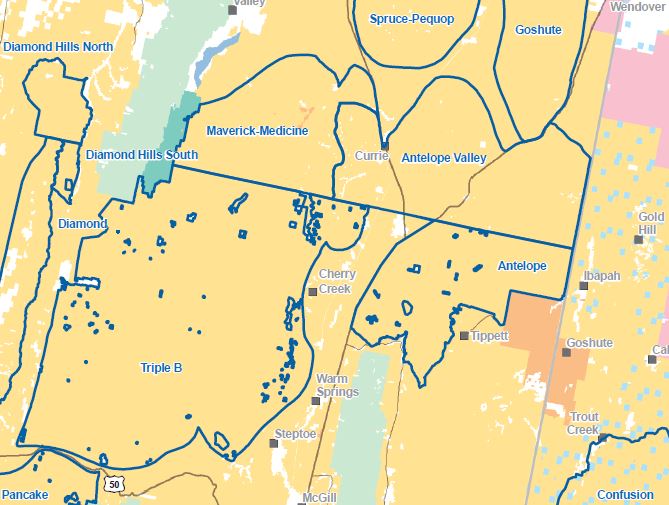
BLM announced today that approximately 360 wild horses will be removed from the Triple B and Maverick-Medicine HMAs starting July 24, due to lack of water.

The HMAs belong to the Triple B Complex, which was gathered about a year ago.

The operation will be carried out with bait traps, according to the news release, and will not be open to public observation.

Triple B covers 1,232,494 acres in eastern Nevada.  Maverick-Medicine, to the north, contains 323,562 acres.  The AML at Triple B is 518, for a target stocking rate of 0.4 wild horses per thousand acres.  At Maverick-Medicine, the AML is 276, for a target stocking rate of 0.9 wild horses per thousand acres.
Triple B HMA Map-1

Recall from the discussion in April that fractional stocking rates may indicate large amounts of forage diverted to privately owned livestock.

The estimated population at Triple B is 1,618 wild horses, with an estimated 1,944 wild horses at Maverick-Medicine.

Captured animals will be taken to the off-range corrals at Palomino Valley, about 20 miles north of Reno.

Gather stats and daily reports will appear on this page.

RELATED: Triple B Horses Get Short End of Stick.

Comments on Saylor Creek Wild Horse Roundup

The stocking rate allowed by plan is 0.5 wild horses per thousand acres.  That should raise an eyebrow.  The plan assigns 95% of the authorized forage on the HMA, omitting wildlife, to livestock, with the balance to horses.

It’s one of the best examples of mismanagement in the WHB program.

The pre-gather population of 131 horses is 2.6 times above AML, yet it represents just 13% of the carrying capacity of the land.

Unlike Swasey, which reached its capacity, the HMA is not overpopulated, at least not with horses, so what’s driving the roundup?  What’s the rationale for contraceptives?

Could it be that the herd was approaching the minimum recommended size for genetic viability?  Or might it be the attitudes, loyalties and beliefs of those who wrote and approved the management plan?

RELATED: Saylor Creek Roundup Pending.

Thriving Ecological Balance-3

Saylor Creek Roundup Pending

BLM said today that all wild horses on the Saylor Creek HMA will be gathered, with 50 to be returned, beginning later this month.  Mares selected for return will be treated with contraceptives.

The operation will be carried out with bait traps, according to the news release, and will not be open to public observation.

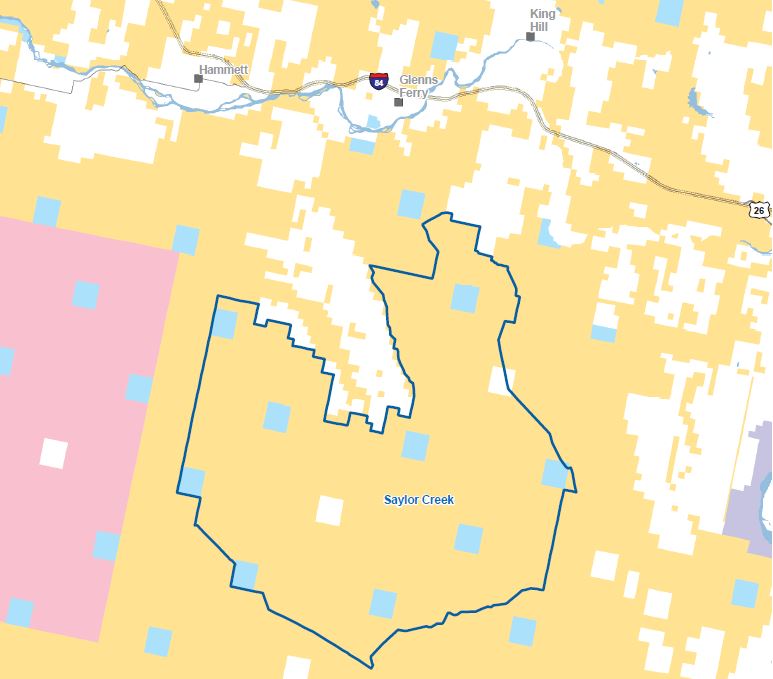
The HMA covers approximately 101,900 acres in southern Idaho.  The AML is 50, for an aimed-at stocking rate of 0.5 wild horses per thousand acres.  The current population is 131, including 81 ‘excess’ animals.

Saylor Creek HMA Map-1

The HMA intersects eight grazing allotments.  There are no naturally occurring water sources in the area and the horses survive on water provided by ranchers.

The management plan for the HMA assigns 18 times more forage to livestock than the horses.  That resource would support an additional 932 wild horses, over ten times the number of animals claimed to be ‘excess.’

Captured animals will be taken to the off-range corrals in Boise.  Gather stats and daily reports will be posted at this page.

RELATED: Saylor Creek Horses Get Short End of Stick.