
Fencing damaged by hurricane Dorian still hasn’t been repaired, so the ponies have been migrating from the 4WD area north of town into the village. But they are escorted back to their home territory on a daily basis, according to a report posted today by The Virginian-Pilot of Norfolk, VA.
Month: February 2020
Lies in Kerrville
Same woman, different venue.
They’re not overpopulated, not even close. The government has diverted most of their food to privately owned livestock, on territory set aside for them. That’s why you’re seeing so many roundups and adoption events.
If you don’t think that’s true, read any of the posts on the right in the section titled ‘Short End of Stick.’
RELATED: Lies at Pauls Valley, BLM News Release.
Eagle Roundup Day 34
Cumulative totals through 02-18-20, per the BLM roundup page for the Eagle Complex:
- 1,536 animals gathered
- 17 deaths (1.1%)
- 687 studs (44.9%)
- 844 mares (55.1%)
- 5 new foals (2019 foals counted as adults)
A 20 year old mare was put down on day 34 due to injuries sustained during sorting.
The proportions of mares and studs are still outside of statistical limits corresponding to n = 1,531 and p-bar = .50. If the herd is growing at a rate of 20% per year, where are the little ones? Coming soon to Palomino Valley?
The thriving ecological balance is now only 64 wild horses away.
RELATED: Eagle Roundup Day 32, Eagle Wild Horses Get Short End of Stick.
Heber Forage Allocation?
The rationale document for setting the AML on the Heber WHT says 50.0% of the forage will be allocated to horses, 25.6% to privately owned livestock and 24.4% for wildlife or “for future adjustments in the livestock grazing level.” See page 36.
Does that sound like a pledge to manage the WHT primarily for wild horses, as required by the statute?
Or are those weasel words that allow the forest supervisor to change the management strategy in favor the public-lands ranchers, without going through the customary reviews and approvals?
See page 19 in the draft management plan for the proposed granting of that authority.
RELATED: New Heber Management Plan Puts Supervisor in Charge?
Reveille Roundup Complete, No News Release
The daily reports ended on February 12, with 113 horses gathered, 74 shipped and no deaths. Thirty nine horses were returned to their home range, including 22 mares that were treated with contraceptives.
Of the horses shipped, 43 were studs and 31 were mares. Do those results look like they came from a process that produces 50% males and 50% females?
Hint: The gather was classified as selective removal.
Captured animals were taken to the Indian Lakes Off-Range Corrals in Fallon, NV.
RELATED: Reveille Roundup Approved.

Nature’s Hoof Cleaning
Found this piece of dried mud in one of the corrals today. It probably came out of a hoof as the horses were playing. The debris included rocks and poop. Having a muddy spot in the corral or pasture is not necessarily a bad thing. Photo taken outside of corral.

Eagle Roundup Day 32
Cumulative totals through 02-16-20, per the BLM roundup page for the Eagle Complex:
- 1,385 animals gathered
- 16 deaths (1.1%)
- 623 studs (45.1%)
- 757 mares (54.9%)
- 5 new foals (2019 foals counted as adults)
The range between males and females is still outside of statistical limits corresponding to n = 1,380 and p-bar = .50. The proportions of mares and studs don’t look like they came from a process that produces 50% of each.
The thriving ecological balance is now only 215 wild horses away (1,700 horses to be gathered − 100 to be returned − 1,385).
The forage allocated to livestock on the Eagle HMA, which represents about 88% of the Complex, would support over 2,000 wild horses, making the roundup unnecessary.
The government is probably spending around $1.5 million on the operation, which won’t increase the permitted AUMs, but it can lead to relaxation of AUM restrictions that were put in place because of the horses.
The incremental revenue will be no more than $26,000 per year (1,600 horses removed × 12 months per year × $1.35 per AUM).
Most of the horses won’t be adopted and will end up in long-term pastures at a cost of $1.2 million per year.
It’s absolutely nuts—the trouble and expense incurred by the government to prop up the public-lands ranchers. There is no economic benefit, no payout and no rate of return.
“Hey WHW, why do you say no economic benefit? These roundups create jobs for helicopter pilots, mechanics, wranglers, truck drivers and office personnel.”
Well, that may be true, but economic activity generated by government programs is always offset by a reduction in activity of those from whom the money is confiscated.
That would be you.
The wild horse ‘problem’ arises from government policy—its insistence on giving more and more resources to the public-lands ranchers, on territory set aside for the horses.

Photo: Studs from the Eagle Complex at Palomino Valley off-range corrals, 02-08-20.
RELATED: Eagle Roundup Day 29, Eagle Wild Horses Get Short End of Stick.
Mustang Monday
On the Salt River with MyKeyBee Photography.
WHW Mail 02-16-20
Q.
Trap Town NCS
Good video! Keep it up! Would you like to be YouTube friends? 🙂
A.
Dear Trap Town NCS,
If you’ve got four hooves and eat hay then yeah.
Regards,
Western Horse Watchers
You Know What They Say, Eat Hay While the Sun Shines
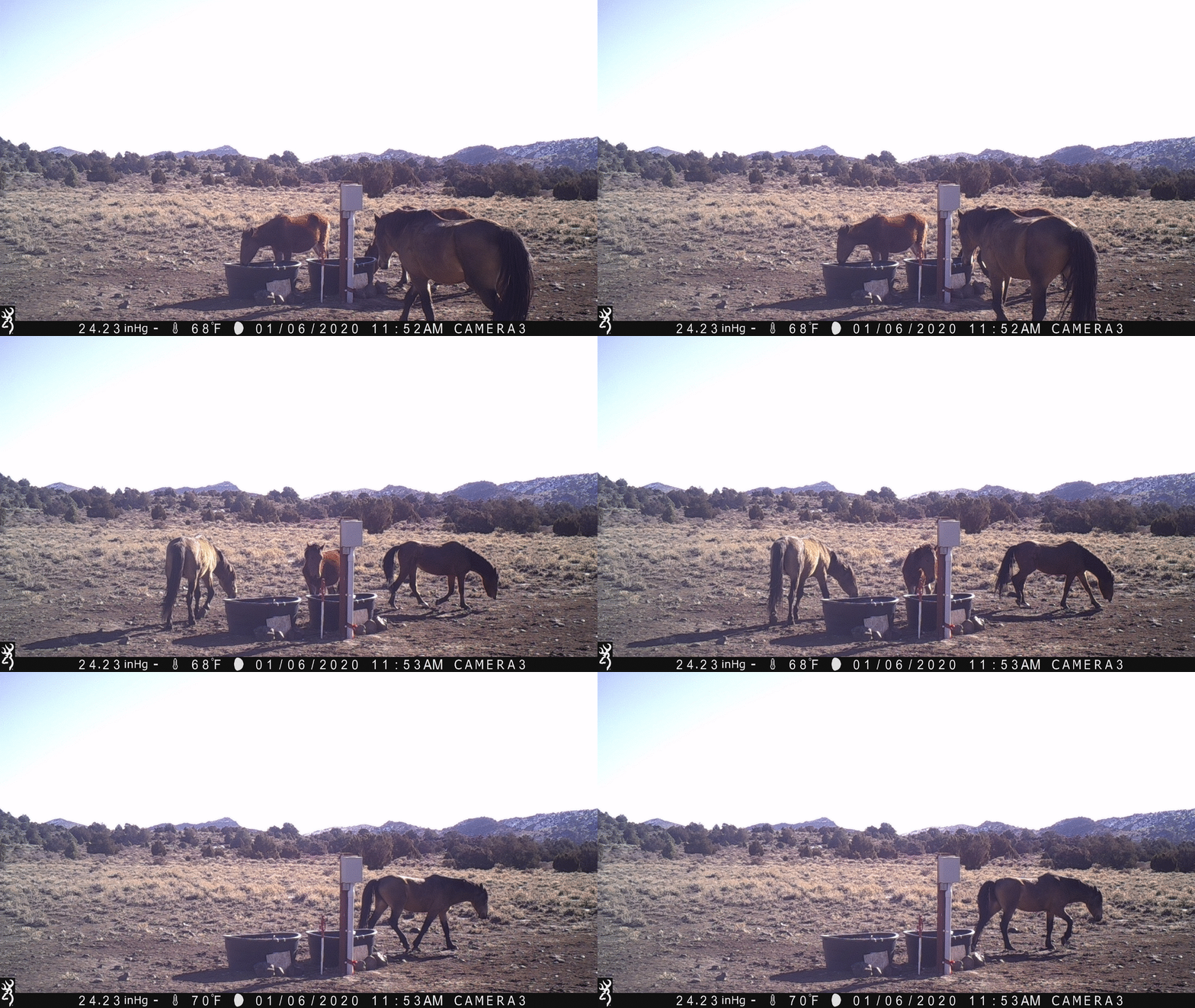
Some Virginia Range mustangs enjoy a brief respite from the snow. Water system off for the season. Elevation 6,200 feet.
New Heber Management Plan Puts Supervisor in Charge?
What matters is the number of wild horses allowed by plan relative to wildlife and privately owned livestock.
RELATED: Draft Management Plan for Heber WHT Released.
Rock Springs AML Amendments
The post about the four HMAs affected by the Rock Springs RMP amendment indicated that over 13,000 wild horses had been denied a place on their home range because of privately owned livestock. How would that number be apportioned if the livestock were removed and the forage reassigned to the horses?
On the Adobe Town HMA, 29,412 AUMs per year consigned to livestock, which would support 2,451 horses (29,412 ÷ 12), for a new AML of 3,251 (800 + 2,451).
On the Divide Basin HMA, 35,914 AUMs per year consigned to livestock, which would support 2,993 horses (35,914 ÷ 12), for a new AML of 3,593 (600 + 2,993).
On the Salt Wells Creek HMA, 59,592 AUMs per year consigned to livestock, which would support 4,966 horses (59,592 ÷ 12), for a new AML of 5,331 (365 + 4,966).
On the White Mountain HMA, 34,588 AUMs per year consigned to livestock, which would support 2,882 horses (34,588 ÷ 12), for a new AML of 3,182 (300 + 2,882).
Are you surprised that AMLs could be this large? Now do you understand why the government is warehousing so many wild horses, ramping up its outplacement programs, and shifting its messaging to ‘Off the Range?’
Draft Management Plan for Heber WHT Released
Today the Forest Service released a draft management plan for the Heber WHT, marking the beginning of a 30-day comment period, according to a story posted this morning by the White Mountain Independent of Show Low, AZ.
The WHT covers approximately 19,700 acres and the proposed AML is 50 to 104, for an aimed-at stocking rate of 5.3 horses per thousand acres. The rationale for setting the AML is presented in this document.
The WHT intersects two grazing allotments. Data in Table 11 of the rationale document suggest that the horses will receive twice as much forage as livestock and that the WHT might be managed primarily for horses.
Substantive comments can be submitted at this page.
An initial comment might involve document quality. The files appear to be scanned images of the originals and are not searchable.
Group Wants Salt River Herd Cut
The size of the Salt River herd should be reduced by 80%, according to the writer of an opinion piece appearing today in Phoenix-based AZCentral.
The ‘collaborative’ pushing for the change includes members from a stock grower’s association and a sportsmen’s group.
The writer describes the current situation as 100 guests at a party with just two large pizzas but it’s really two wolves and a lamb voting on what to have for lunch.
It’s not about healthy horses on healthy rangelands and it’s not about public safety.
It’s about forage consumed by the horses, and managing it to an ‘acceptable’ level.
Eagle Roundup Day 29, ‘Feel the Love’ Edition
Cumulative totals through 02-13-20, per the BLM roundup page for the Eagle Complex:
- 1,288 animals gathered ♥
- 16 deaths (1.2%) ♥
- 574 studs (44.7%) ♥
- 709 mares (55.3%) ♥
- 5 new foals (2019 foals counted as adults) ♥
The range between males and females is still outside of statistical limits corresponding to n = 1,283 and p-bar = .50. Why are there more mares in the traps than studs? ♥
The thriving ecological balance is now only 312 wild horses away (1,700 horses to be gathered − 100 to be returned − 1,288). ♥
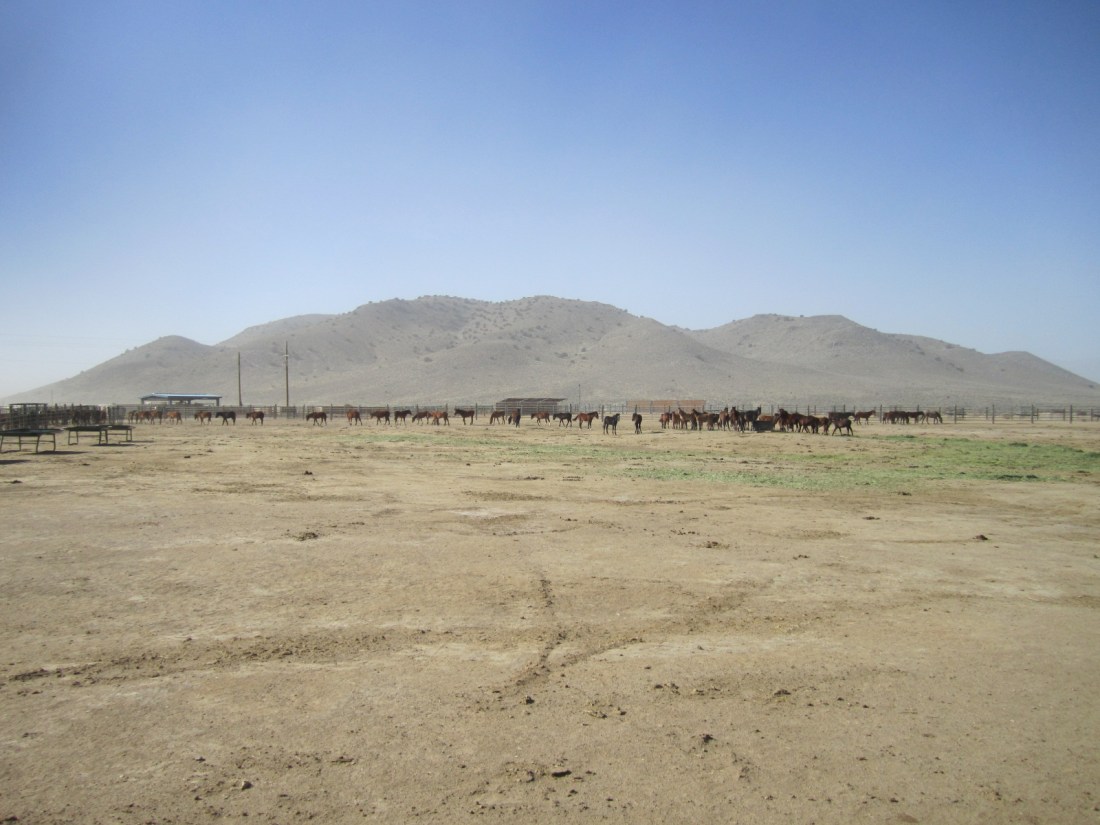
Photo: Youngsters from the Eagle Complex, Palomino Valley corrals, 02-08-20. ♥
RELATED: Eagle Roundup Day 26, Eagle Wild Horses Get Short End of Stick.
Rock Springs RMP Recap
Totals for the four HMAs affected by the proposed RMP amendment:
- 2,810,951 acres available
- 24,780 AUMs per year allocated to horses
- 159,506 AUMs per year allocated to livestock
Other values needed to compute key management indicators for the complex:
- 12 month grazing season for horses
- 4 month grazing season for livestock (assumed)
- 600 pounds dry weight per AUM (assumed)
Herd size
- 2,065 horses allowed by plan (24,780 ÷ 12)
- 39,876 cow/calf pairs allowed by plan (159,506 ÷ 4)
Stocking rate
- 0.7 horses per thousand acres (2,065 ÷ 2,810,951 × 1,000)
- 14.2 cow/calf pairs per thousand acres (39,876 ÷ 2,810,951 × 1,000)
Resource loading
- 0.4 pounds per acre per month for horses (24,780 × 600 ÷ 2,810,951 ÷ 12)
- 8.5 pounds per acre per month for livestock (159,506 × 600 ÷ 2,810,951 ÷ 4)
Livestock receive over six times as much forage than the horses—on lands set aside for the horses. The stocking rate for livestock is 20 times higher.
Over 13,000 wild horses have been cheated out of a place on their home range because of the livestock, about 25% of the horses now in long-term holding (159,506 ÷ 12).
How many more HMAs would you have to evaluate to account for all of the wild horses in long-term holding?
How many wild horses have been displaced from all of the HMAs because of livestock?
How many mares will have to be darted (with contraceptives) before the government starts managing HMAs and WHTs principally for wild horses, per the statute?
“Hey WHW, that doesn’t make any sense. You’d be darting mares if you wanted to manage the land primarily for livestock.”
Exactly.
RELATED: BLM FY 2021 Budget Request Targets Wild Horses, PZP Zealots Go Home.
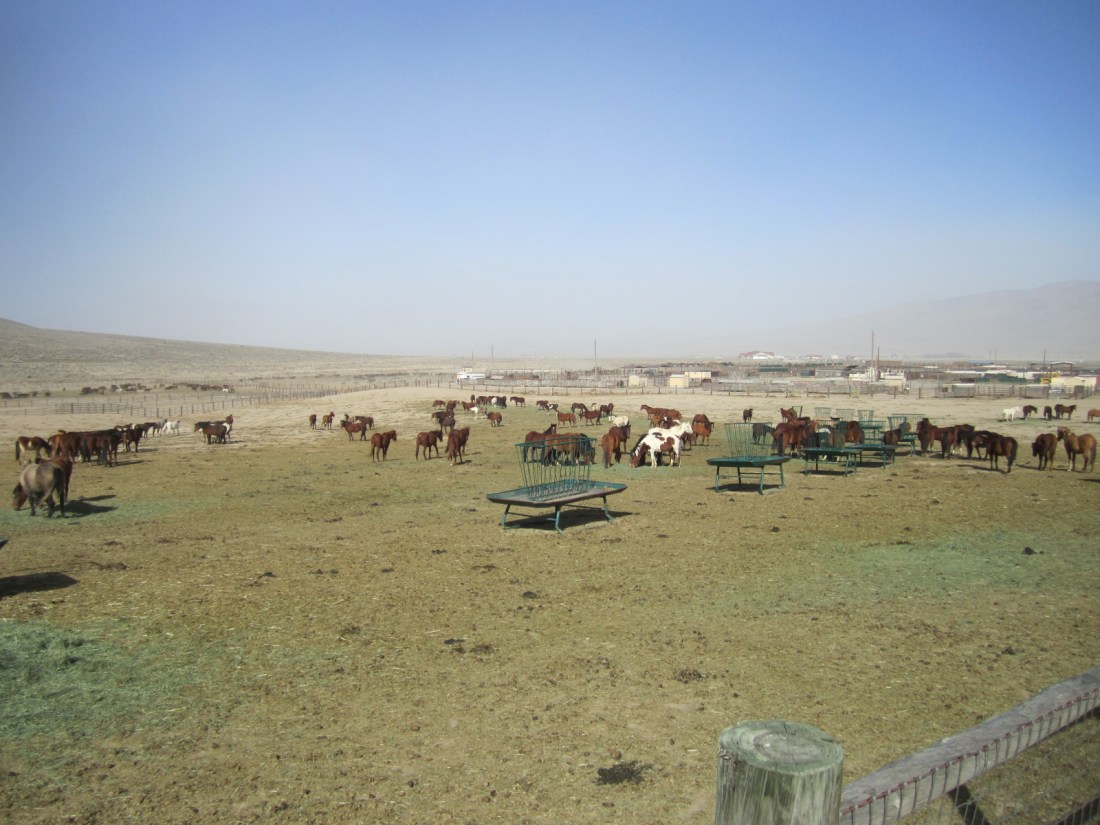
Coyotes Playing at Water Tanks
Water system still off for the season. Mustangs few and far between.
RELATED: Coyotes at Water Tanks.

PZP Zealots Go Home
The government removes wild horses from HMAs not because there are too many of them, but because they’re robbing too much forage from the most noble and deserving inhabitants of western rangelands.
The PZP zealots, who try to pass themselves off as friends of the horses, also want to see their numbers reduced, by widespread application of contraceptives, a process that will turn them into non-reproducing herds. They are allies of the public-lands ranchers.
RELATED: Contraceptives Are a Back-Door Channel to Sterilization.

Eagle Roundup Day 26
Cumulative totals through 02-10-20, per the BLM roundup page for the Eagle Complex:
- 1,263 animals gathered
- 16 deaths (1.3%)
- 563 studs (44.8%)
- 695 mares (55.2%)
- 5 new foals (2019 foals counted as adults)
The variation between males and females is outside of statistical limits corresponding to n = 1,258 and p-bar = .50. The difference cannot be attributed to chance.
The thriving ecological balance is now only 337 wild horses away (1,700 horses to be gathered − 100 to be returned − 1,263).
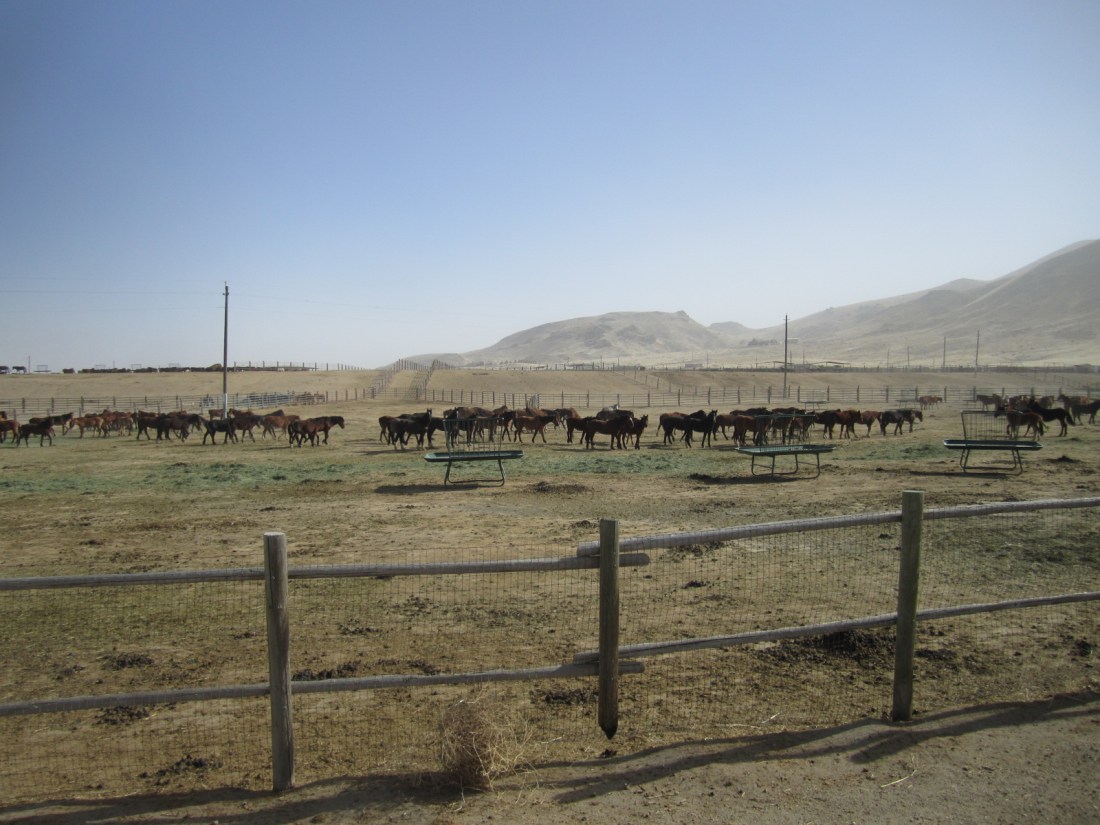
Photo: Studs from the Eagle Complex at Palomino Valley off-range corrals, 02-08-20.
RELATED: Eagle Roundup Day 23, Eagle Wild Horses Get Short End of Stick.
Nokotas in the News
Wow, a report that mentions their tribal ancestry. They’re not the horses of Theodore Roosevelt National Park, they’re the former horses of TRNP.
RELATED: Story of the Nokota Horses.
 Western Horse Watchers Association