Red Rock Gather in the News

Refer to this story in Drovers, posted yesterday.  Those 237 horses were ‘relocated,’ not  ’rounded up’ or ‘removed from their home range.’

Changing the vocabulary and redefining terms, to hide something evil or unpleasant, are sure signs that liberals are involved.

Abortion is not baby murder, it’s ‘women’s health’ or ‘family planning.’

Shooting wild mares in the ass with contraceptive darts is not harassment, it’s ‘humane management.’

RELATED: Red Rock Gather Complete.

IMG_3534

Caliente Update

Sixteen wild horses have been captured as of today.  One death was reported.

The gather may remove as many as 100 wild horses from the Caliente Complex, which includes nine Herd Areas in eastern Nevada: Applewhite, Blue Nose Peak, Clover Creek, Clover Mountains, Delamar Mountains, Little Mountain, Meadow Valley Mountains, Miller Flat and Mormon Mountains.  See Map 1 on page 5 of the Final EA.

All of them were HMAs but were zeroed out according to section 4.2.2 in the EA.

The news release from last week said they didn’t have enough forage and water to sustain wild horses.

Yet the horses are there, over 2,000 of them.

The Complex is overlapped by 26 grazing allotments, per Table 3.2 in the EA, which are permitted for 39,920 AUMs per year.  That means they can support 5,617 cow/calf pairs over a weighted-average grazing period of 7.1 months per year.

Or 3,326 wild horses over a twelve month period.

But the goal is to achieve and maintain a thriving ecological balance and multiple-use relationship on these lands (section 1.1), which apparently means no wild horses.

RELATED: Mustangs to Be Removed from Eastern Nevada Starting Today.

Tassi-Gold Butte Gather Starts This Week

BLM said yesterday that up to 40 wild burros would be removed from private lands in the Tassi-Gold Butte HA in northwestern Arizona.  The gather will be carried out with bait traps and will not be open to public observation, according to the news release.

The HA has no AML and is not managed for wild horses or burros.

Gold Butte Map-1

Captured animals will be taken to the off-range corrals in Florence, AZ.

Gather stats and daily reports will be posted to this page.

The announcement did not indicate if Arizona was a fence-out state.

Horses in Antelope Complex Get Short End of Stick

The Antelope Complex in eastern Nevada includes the Antelope HMA, Antelope Valley HMA, Goshute HMA and the infamous Spruce-Pequop HMA, site of a wild horse shooting in August 2018.

A roundup begins this week at the Antelope and Antelope Valley HMAs so let’s see how resources will be allocated once the gather plan has been fully implemented.

The ranchers and their allies want AMLs achieved ASAP, you know.

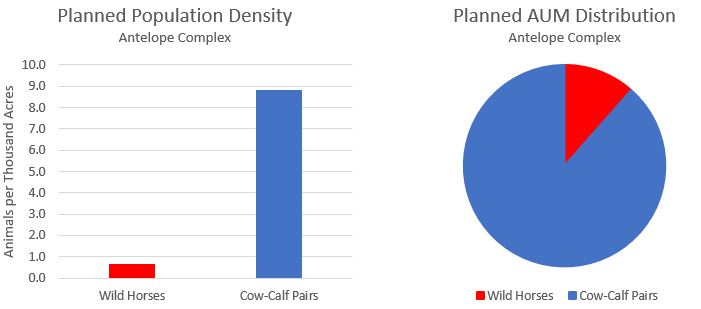
The complex, which covers 1,183,340 acres, has a combined AML of 789 wild horses, according to Table 1.  The forage demand would be 9,468 AUMs per year and the target population density would be 0.7 animals per thousand acres.

The average density for all HMAs is one animal per thousand acres.

The four HMAs are overlapped by 31 grazing allotments per Table 8.  The forage allocation for livestock inside the complex can be estimated as the sum of 31 AUM fractions, each based on the percentage of the allotment falling inside the complex.

For example, the Boone Springs allotment, which is permitted for 2,947 AUMs per year, lies entirely within the complex.  Therefore, it contributes 2,947 AUMs per year to domestic livestock grazing.  Only 5% of the Cherry Creek allotment falls within the complex, so it contributes just 454 AUMs per year to privately owned livestock.

The total forage contribution is 72,946 AUMs per year.

The AUM fractions can be converted to cow/calf pairs by dividing them by the annual grazing periods.  The Boone Springs allotment is active for five months.  Therefore, it can accommodate 2,947 ÷ 5 = 589 cow/calf pairs.  The Cherry Creek allotment, active for 12 months per year, can host 38 cow/calf pairs.  (Wild horses and cow/calf pairs are said to be equivalent in terms of their resource loading.)

The total number of cow/calf pairs is 10,429, which yields a planned population density of 8.8 cow/calf pairs per thousand acres.  (The weighted-average grazing period across all 31 allotments is 7 months per year.)

These figures are presented in the following charts.
Antelope Complex Charts-1

Another fine example of ‘thriving ecological balance,’ on land set aside for the horses!

A Finding of No Significant Impact (FONSI), one of the steps in approving plans like this one, must pertain to everything but wild horses.

The forage allocated to livestock in those 31 allotments, 124,466 AUMs per year (inside and outside the complex), would support 10,370 wild horses, about 1/8 of those roaming freely on public lands in the western U.S.

That these and other lands can only support 27,000 wild horses and burros is pure BS.

RELATED: Roundup Starts Next Week in Lower Half of Antelope Complex.

Roundup Starts Next Week in Lower Half of Antelope Complex

BLM announced yesterday that 1,250 wild horses would be removed from the Antelope and Antelope Valley HMAs in eastern Nevada, starting on 08/05/19.  The operation will require 60 days and will not be open to public observation, according to the new release.

The gather will be carried out with bait traps and will prevent further degradation of public lands by balancing herd size with what the land can support [after deducting a nominal amount—at least 60%—for privately owned livestock].

Antelope Complex Map-1

Captured animals will be taken to the Indian Lakes Off-Range Corrals in Fallon.

The size and AML of Antelope are 399,761 acres and 324 horses, respectively, for an aimed-at population density of 0.8 animals per thousand acres.  The size and AML of Antelope Valley are 502,909 acres and 259 horses, for an aimed-at density of 0.5 animals per thousand acres.

The target density for all HMAs is one animal per thousand acres.

Gather stats and daily reports will be posted to this page.

The roundup will include horses from the Antelope HMA that are in a pilot program, led by a ‘wild horse advocate,’ involving the GonaCon-Equine pesticide.

Sorry, but on-range management of free-roaming horses with this or any other fertility control drug DOES NOT QUALIFY as wild horse advocacy.  The practice aligns nicely with the anti-horse agenda, putting its adherents in the same camp as the ranchers.

PLF: Window Into the BLM?

The mission of the Public Lands Foundation, according to the statement on the first page of their Summer 2019 Newsletter, is to keep America’s public lands in public hands, which, of course, means keeping them in the hands of the federal government.

The belief is explained in a position statement.  Political orientation: Liberal.

The organization has many members who have retired from the BLM, according to the page with other position statements.  Where do they come down on other issues?

Centralized Government – PLF opposes the relocation of the BLM headquarters from Washington, D.C. to Grand Junction, CO, which is consistent with the principle of subsidiarity.  Political orientation: Liberal.

Climate Change – “…the warming of the Earth’s climate system is unequivocal as is now evident from observations of global average air and ocean temperatures, widespread melting of snow and ice, and rising global average sea level,” according to their position statement.  Political orientation: Liberal.

Wind and Solar – PLF says they are needed to alleviate greenhouse gas emissions from traditional energy conversion technologies.  Political orientation: Liberal.

Illegal Immigration – PLF believes that policies should be changed so illegal aliens can enter the country legally “…through established ports of entry…instead of…crossing fragile public lands on foot and in vehicles.”  Political orientation: Liberal.

Public-Lands Ranching – PLF supports it.  They are as hostile to WHB as the ranchers, see item 7 on page 4 of their position statement.

Wild Horses and Burros – PLF believes the “WHB program is unsustainable” and that roundups should be increased “…to achieve AML as soon as practical, selling, without limitation, un-adopted WHBs that have been gathered.”

How would you classify the last two statements, given they were written by a left-leaning organization located just outside of Washington D.C.?  How closely do they correspond to the beliefs of current BLM administrators and staff?

Pine Nut Helicopters Grounded, Bait Traps Next

BLM said today that 36 wild horses were forced off their home range this week, with additional horses to be removed later this month.

Captured animals were taken to the Palomino Valley Off-Range Corrals 20 miles north of Sparks, NV, according to the news release.

One death was reported.  An adult mare with a broken leg was put down on 07/31/19.

RELATED: Pine Nut Roundup to Resume Next Week.

North Hills Gather Plan Inches Closer to Implementation

A story published yesterday by St. George News of St. George, UT said the BLM issued a Finding of No Significant Impact, allowing a plan to move forward that would remove most of the wild horses from the North Hills Joint Management Area in southwest Utah.

The JMA includes the North Hills HMA and North Hills WHT.  It contains 50,127 acres of BLM land (shown in tan on the following map), 24,006 acres of USFS land and 10,511 acres of state and private lands (shown in light green), for a total of 84,646 acres.

North Hills JMA Map-1

The herd size is now about 270 wild horses, according to the report, for a pre-gather population density of 3.1 animals per thousand acres.

A district ranger interviewed for the story went slightly off narrative, saying “The land is supporting that number right now, but that doesn’t mean that that’s a healthy herd.”

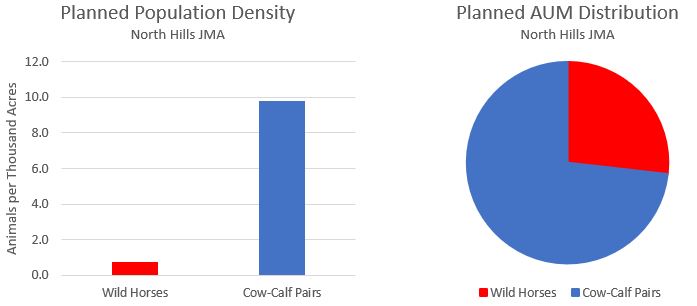
The aimed-at population density, based on an AML of 60, is 0.7 horses per thousand acres (60 ÷ 84,646 × 1,000).  The horses would consume 720 AUMs annually (60 × 12).

The Forest Service prohibits domestic livestock grazing on the WHT but the BLM allows it on the HMA, which is intersected by five allotments.  Privately owned cattle and sheep are eligible for 1,967 AUMs per year inside the HMA, according to page 27 of the plan.

Given an average grazing interval of roughly four months (see page 28), the AUM budget converts to 492 cow/calf pairs (1,967 ÷ 4).  This yields an aimed-at population density of 9.8 cow/calf pairs per thousand acres (492 ÷ 50,127 × 1,000).

These figures are presented in the following charts:

North Hills JMA Charts-1

The proposed gather will come very close to achieving these goals.  As usual, the horses get the short end of the stick, on land set aside for them.

It’s time to end public-lands ranching.