
On the beach near Corolla, NC with Bonnie Waddell.
Month: May 2019
Satellite Adoption in Oakdale, CA
Return to Oatman
On the Black Mountain HMA in Oatman, AZ with Kristoff’s Journey.
RELATED: Get Your Kicks on Route 66.
Journey to Marietta
Off-road trip to the Marietta Wild Burro Range by kingcidtravels.
The designation of ‘Range’ means the area is managed primarily for wild burros in accordance with the WHB Act. It is the only WBR in the western U.S.
There are three ‘Ranges’ for wild horses in the western U.S. Many of the remaining areas—which were set aside for wild horses and burros—are managed primarily for domestic livestock, a twisting of the law by the BLM to pacify the public-lands ranchers.
Reader Pens Rebuttal to Stewart and Lee’s Letter
Refer to this letter by a reader of the St. George News, in response to the letter written by Rep. Chris Stewart and Sen. Mike Lee of Utah. The conversions from AUMs to cattle and sheep are not correct but it’s worth the read.
RELATED: Stewart and Lee: Pleaders for the Public-Lands Ranchers.
UPDATE: The AUM conversions would be correct if the cattle and sheep were on the range for one month per year, but six months might be a better estimate. If that’s true, a cow/calf pair would consume six AUMs annually and the total available AUMs should be divided by six to obtain the number of animals. Horse and burros are on the range year around and therefore the total available AUMs should be divided by 12 to obtain the equivalent number of animals. For example, 1.5 million AUMs would support 250,000 cow/calf pairs or 125,000 wild horses.
Mustang Monday
On the Salt River with Mrs Green Thumb.
Any Day Now
When will a Congressman come out against America’s wild horses on behalf of the oil and mining companies?
The recent letter by Rep. Chris Stewart and Sen. Mike Lee defending the public-lands ranchers must have been a decoy. Everybody knows that the greatest threat to wild horses and burros is the mineral extraction industry.
Stewart and Lee: Pleaders for the Public-Lands Ranchers
A letter to the St. George News of St. George, UT, published yesterday, says “ranchers are being bankrupted by the cost of hay to replace lost forage for their livestock, and the number of starving and diseased wild horses is rising substantially,” because of a wild horse “population boom.”
It was written by Rep. Chris Stewart and Sen. Mike Lee (both R-UT).
Public-lands ranching is government dependency.
Benefits are not transferred directly. Rather, they inure through the program itself.
Ranchers don’t own the land (except for the base properties). Therefore, they pay no property taxes.
The grazing fee, $1.35 per cow/calf pair per month, is so low it can’t even be approached in the private sector. The government pays about $60 per month to feed a wild horse in long-term holding, removed from its home range at the behest of the ranchers.
Some of those funds are plowed back into the program, to improve rangeland conditions for the ranchers.
If the number of wild horses in an area exceeds the amount the ranchers are willing to tolerate, typically one animal per thousand acres, the government removes them, at no cost to the ranchers.
In exchange, government bureaucrats tell the ranchers what to do and when to do it.
American taxpayers are footing the bill for this. It’s a racket, a gravy train, a good ol’ boys network.
The authors noted that the Wild Horse and Burro Act was designed to “protect wild mustangs” but did not say from whom: Livestock ranchers, who nearly eradicated them in the middle of the last century.
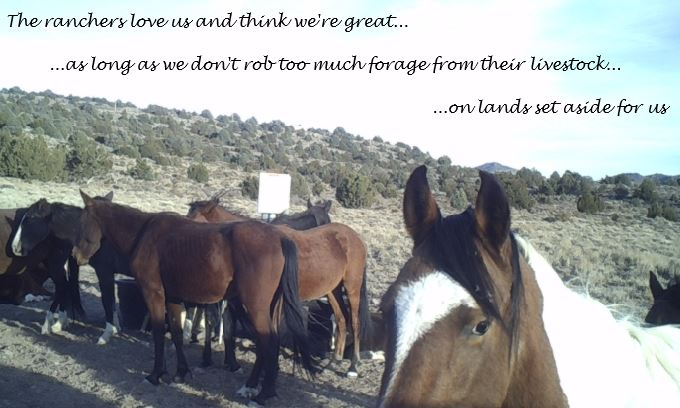
Nothing has changed since it was signed into law. The ranchers still despise these animals, because they rob forage from their cattle and sheep—on lands set aside for horses and burros.
It’s absolutely absurd, but we’re supposed to take these men seriously, you know, because they’re in Congress.
RELATED: Wild Horse Overpopulation?, Republican Senators Push for WHB Euthanasia, Don’t Buy Range-Fed Beef.
Wild Horse Training at WSHE
Audio on the PA system was from a clinic in an adjacent arena and not related to this video. Filmed 05-10-19 at the Western States Horse Expo in Rancho Murieta, CA
Meanwhile, back on the range, privately owned livestock graze peacefully on land that belongs to these horses.
RELATED: Organizers Call WHSE a Success.
Mustang Camp Evicted
The rescue that took in over 70 wild horses from a sanctuary near Placitas, NM that was forced to close has lost its special use permit and must relocate. Refer to this report by KRQE News of Albequerque. Includes video.
RELATED: Placitas Wild Horses Find New Home at Mustang Camp.
BLM Returning Horses to Hardtrigger HMA
Forty five wild horses will be released later this month in three separate areas, according to a news release posted today. One of the releases will be open to public observation.
The Hardtrigger HMA was damaged by the Soda Fire of 2015, which also affected the nearby Sands Basin HMA.

The announcement did not say if the mares will be treated with contraceptives or if the land is subject to permitted livestock grazing.
RELATED: BLM Returning Horses to Sands Basin HMA.
UPDATE: Added video by KTVB News of Boise, ID. Pay attention to the remarks from 0:15 to 0:17.
Photographer Insists Man Was Shooting at Heber Wild Horses
She has photos and videos of the incident but the Forest Service is not interested in them, according to a report posted yesterday by ABC15 News in Phoenix.
RELATED: Photographer Disputes Report on Heber Shooting Incident.
Sterilization Research to Resume
A news release by the Animal Welfare Institute yesterday said the BLM is rebooting its plans to sterilize wild horses, at the behest of a group funded by Lucas Oil Products.

Hacks at the off-range corrals in Hines, OR will cut the ovaries out of mares gathered from the Warm Springs HMA last year. Complications and fatalities related to the procedures will likely be high but are of no concern to these people.
Some of the survivors will be returned to the range to form non-reproducing herds, a dream-come-true for the public-lands ranchers. Others may end up in the demonic Wild Spayed Filly Futurity.
Critics say wild horse populations should be controlled by contraceptives, which can lead to sterilization. In both cases the result is the same—fewer horses on the range.
There is no meaningful opposition here, only a debate on methods and timing.
The ranchers want the horses gone quickly, the wild horse ‘advocates’ want them to decline slowly.
PZP Zealots Join Forces to Stop Wild Horse Management Plan
Refer to this story, published yesterday by Yahoo Finance.
The problem is public-lands ranching, yet these so-called advocates agree in principle with their opponents, differing only in methodology.

Why aren’t they challenging the constitutionality of FLPMA, which gave the federal government control over vast amounts of western rangelands and preferential treatment to the ranchers?
Why aren’t they pushing for an increase in grazing fees to $60 per AUM, in line with the cost of feeding wild horses in long-term pastures?
Why aren’t they demanding labels on beef, so consumers would know if the item was produced at the expense of America’s wild horses and burros?
RELATED: Co-Signers of WHB Management Plan Try to Save Face.
Organizers Call WSHE a Success
The change in venue was well received by those attending the event according to a story by KCRA News in Sacramento. Organizers of the show, one of the nation’s largest, say it will be held at the new location in the future.
RELATED: Western States Horse Expo Starts Next Week.
Mustang Monday
On the Virginia Range and Pine Nut Mountains HMA with Jeff Parr.
Co-Signers of WHB Management Plan Try to Save Face
Refer to this opinion piece posted today in The Hill. They’re trying to justify a massive tactical error. Shills for the public-lands ranchers, every one of them.
Rush Hour On the Salt River
First-hand account by Josh Saverse.
IDA Rejects Proposed Wild Horse Management Plan
In Defense of Animals, an animal protection group based in San Rafael, CA, released a statement yesterday condemning the wild horse management plan pushed by beef producers and cheerleader groups for the public-lands ranchers.
The proposal would reduce wild horse and burro populations on public lands in the western U.S. by 70%.
Not one wild horse advocate with significant knowledge of the wild horse on-range management issues was asked for input on the proposal, according to the statement.
RELATED: More Criticism of Proposed Wild Horse Management Plan?
Photographer Disputes Report on Heber Shooting Incident
The case has been closed by the Navajo County Sheriff’s Office but a witness to the event says the report does not match her experience. Refer to this story, posted yesterday by AZ Family, the CBS affiliate in Phoenix. Includes video.
RELATED: Photographer Claims Man Was Shooting at Heber Wild Horses.
UPDATE: Added video.
 Western Horse Watchers Association