Imprinting and Weaning

Refer to this article in Equus magazine by Dr. Jennifer Williams, president of Bluebonnet Equine Humane Society.

Key points:

  • Be an astute observer
  • Mares tend to foal late at night or early in the morning
  • They may delay foaling until they feel safe and comfortable
  • You may need to leave your mare alone
  • New mothers tend to be protective of their foals
  • A foal bonds with his dam in the first few hours of life

Item 5, Nursing, probably should include a remark about colostrum, the first milk a mom makes for her foal.  Essential for the baby, as it contains antibodies needed to fight infection.  If the foal does not get up and nurse within the first hour or two, you may have to get involved.

Conventional wisdom says wean the baby at four months.  A better time frame is seven to eight months, as the foal’s digestive system is not sufficiently developed to sustain him on solid food alone until then.

Here’s a list of things to do after the foal is born.

  1. Clean up the afterbirth
  2. Take a few photos
  3. Stay out of it

Avoid the temptation.  Let the mom care for the baby and teach it how to be a horse.

An exception would be the rescue of foals born in feedlots while their moms await shipment to slaughter.

Are Wild Horses a Problem?

Not according to an editorial published 01/13/18 in The Salt Lake Tribune.  Their habitat has been cut in half and they’re competing with livestock for food so what do you expect?

Sounds like sabotage.

Keep in mind the WHB Act, in its current form, still gives priority to horses and burros in areas where they lived in 1971.

Principally

No, we need to get rid of the ones in captivity and restrict the growth of those still on the range.

They’ll be born into a world of starvation and thirst, you know.

If the administration wants to reduce spending (generally a good idea), eliminate funding for Planned Parenthood and leave the horses alone.  A child born into poverty without a father certainly faces challenges ahead but that doesn’t mean he should be denied his right to life.

[That statement pretty much guarantees these remarks will never appear in Google search results.]

Related: See the video in this post.  If anyone has film of ranchers sobbing as their cattle are loaded for slaughter please link it here.

What the Heck Is That?

Your new mustang probably doesn’t know what a carrot is.  Nor an apple.  Never heard of crimped oats, rice bran or any of the other grains.

So first time you give him these treats he might just walk away.  May even pee on them.

If that happens try again in a few days.  Eventually he’ll decide he likes them, even waits at the gate while you’re mixing them up in the barn.  (Especially if you have a consistent pattern in your chores around the ranch: It’s dusk, my corral has been cleaned, my water buckets are full, I know what that human is doing in there.)

Also remember that he doesn’t know what worm paste is, never had a syringe shoved in his mouth…at least by you.  So use this opportunity to teach him to take the medicine in his grain.  Smear some paste on a few pieces of carrot, same for the apples.  If you feed cookies, put a dab on them too.  One third of a tube per horse (this is usually less than the recommended dosage).  Repeat tomorrow.

Look at his poop next few days to gauge effectiveness.  Follow the manufacturer’s recommendations for intervals between treatments.

IMG_4902

More on Colors

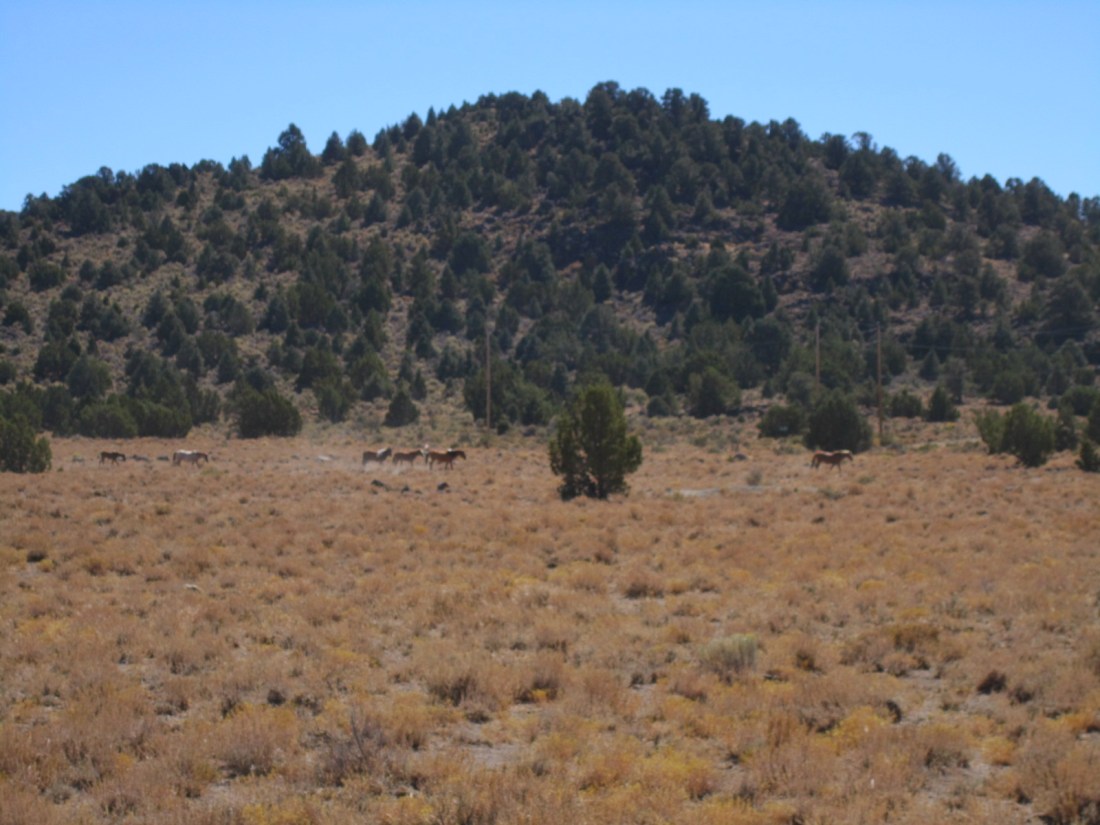
Suppose you visited an HMA in Nevada and found a band of 16 horses near a water hole.  Six had a base color of red and ten were black.

According to the post on horse colors, 25% of horses should be red, 75% should be black.

In your sample, 6/16 = 37.5% are red.

Are red horses over-represented in this group?  Is there discrimination toward black?

Let’s start with the genetics of base color.  There are four possibilities in the Extension Locus: EE, Ee, eE, ee.  Any combination containing E will be black (because it’s dominant).  Therefore, 3/4 = 75% of horses should have a base color of black, 1/4 = 25% should be red.

The expected proportion of red is a property of the population of all horses, not samples of sixteen.  The range of variation of red in samples of sixteen is found by calculation:

Mean ± 3 Standard deviations

Given that a horse is red or not-red, the mean and standard deviation can be supplied by the binomial distribution:

np ± 3 × Sqrt[np × (1 – p)]

where p = .25 and n = 16.

The upper limit of variation is 9.196.  Round ‘inward,’ toward the mean, to 9.

The lower limit is -1.196.  Round to the nearest non-negative integer, 0.

In groups of 16, you should expect to find anywhere from zero to nine red horses.  In this example, six is well within the expected range of variation.  No sign of trouble here.

Now suppose you went to the Kiger HMA in Oregon and found no red horses in a group of 25.

The expected range of variation is 0 and 12 so you might conclude that red is not under-represented in that area.  However, your subject-matter knowledge tells you the HMA is managed primarily for grullos and bay duns so the low number of reds is not surprising.

Imagine you just read a report on the results of a wild horse gather, where 101 mares and fillies were rounded up along with 79 stallions and colts.  Were the helicopter pilots targeting females?

Show your work.

Hint: p = .5 and n = 180.
IMG_6574a