The incident started yesterday as scheduled, with 23 burros captured, none shipped, none released and no deaths.
RELATED: Canyonlands Wild Burro Roundup Announced.

Exposing the Hypocrisy, Lies and Incompetence of the Wild Horse Advocates
The incident started yesterday as scheduled, with 23 burros captured, none shipped, none released and no deaths.
RELATED: Canyonlands Wild Burro Roundup Announced.
They’re celebrating! They rely on predators, illness and other natural causes to take out any foals that slip through their darting program, the goal of which is to prove that mass sterilization is a practical alternative to motorized removal.
RELATED: Salt River Darting Program by the Numbers.
HB25-1283, introduced yesterday, would repeal the wild horse project and transfer statutory duties concerning wild horses to the Department of Agriculture according to the bill text.
The measure, based in part on the group’s Year One Report, was referred to the House Agriculture, Water & Natural Resources Committee.
Nye County sheriff reminds everyone to give them their space.
Rush Limbaugh explains the behavior in this video from 1996.
The advocates love to schmooze with their rangeland partners, telling them how many mares they’ve ruined and which herds are near the tipping point.
Until it’s time for a fundraiser, when they have to interact with their supporters.
Then it’s back to cherished/beloved/innocent/treasured/iconic/majestic wild horses as they try to separate them from their money.
On the Virginia Range with Jeff Martinez.
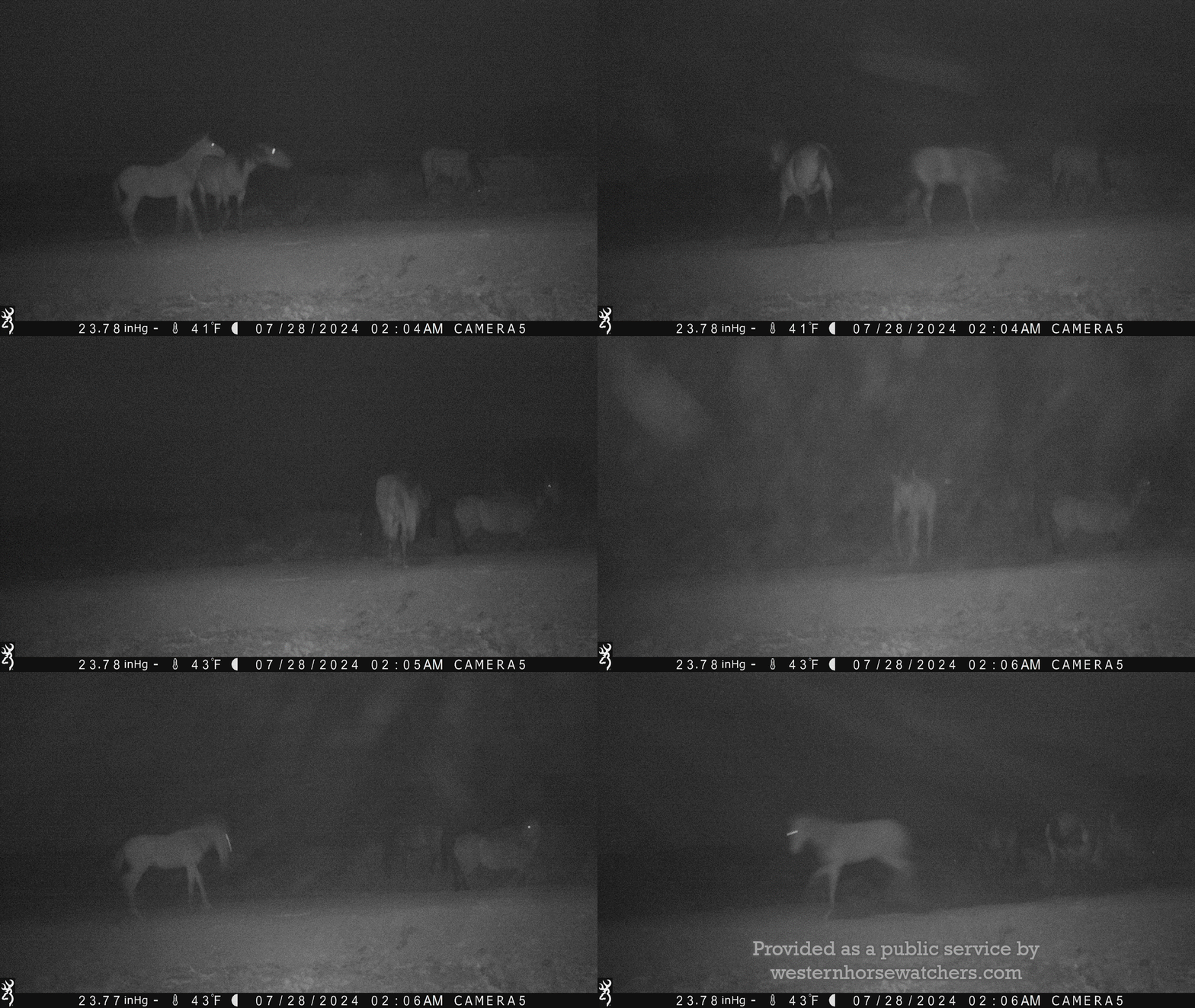
You have to sift through thousands of trailcam photos to find one with a foal and the best one is at night.
His mom may have a faulty immune system. What about him?
This is what the advocates bring to the table.
RELATED: What Does Herd Implosion Look Like?
County officials have ended discussions with Peaceful Valley Donkey Rescue for wild burro rescue and relocation services according to a February 21 story by the San Bernadino Sun.
The county is now working with DonkeyLand for similar services.
For a quick tour of the area, refer to the February 10 edition of Mustang Monday.
Last update was February 12. The capture goal has been reached but the incident has not been marked complete.
One way to trigger the advocates is to talk about keeping wild horses on the range.
It sounds crazy—they’re supposed to be voices for the horses.
But they’re not.
Most are obsessed with pesticides, overpopulation and nonmotorized removal.
You might get blocked if you leave comments on their Facebook pages about
They might come unglued if you talk about mass sterilization, abnormal sex ratios, loss of genetic diversity and selection for faulty immune systems, the inevitable results of PZP darting programs.
If they won’t welcome you into their fold, point out their hypocrisy and treachery, shake the dust from your sandals and leave.
The draft assessment has been copied to the project folder with nine appendices.
The proposed HMAP, discussed in Appendix D, is subordinate to the Tonopah RMP and will affirm management provisions therein.
The EA cites outdated registrations for GonaCon Equine in Section 2.3.2.2 and refers to the pesticide as a vaccine.
Comments will be accepted through March 24 according to the news release.
RELATED: Bullfrog Scoping Begins.

How many mares has this guy ruined? The story does not indicate if he has a diploma from the Billings School of PZP Darting and Public Deception.
She was confirmed 72-28 on February 13 according to a story by The Hill.
She is responsible for wild horses managed by the Forest Service, among other things.
RELATED: Trump Nominates Rollins for Department of Agriculture.
The nonprofit has two positions to fill according to a February 15 help wanted ad on RanchWork dot com.
RELATED: Colorado Wild Horse Refuge Still Needs Ranch Hands.
The resolution was read the first time and referred to the Agriculture Committee according to the February 18 update.
RELATED: SCR 4006 Moves to House.
Leave comments on their Instagram and Facebook pages about repurposing grazing allotments as wild horse refuges or bringing AMLs in line with the total authorized forage, sometimes referred to as principal use.
RELATED: Starting a Nonprofit That Actually Helps Wild Horses.
Ideally, you’d like to see forage availability above 60 and the stocking rate exceed five, as discussed previously.
| Forage availability (AUMs per thousand public acres) | Rating | Stocking rate (Wild horses per thousand public acres) |
|---|---|---|
| Less than 36 | Poor | Less than 3 |
| 36 t0 60 | Fair | 3 to 5 |
| More than 60 | Good | More than 5 |
You also want a land ratio above three.
| Land ratio (public acres to deeded acres) | Percent public lands | Rating |
|---|---|---|
| Zero | Zero | Unacceptable |
| 1:1 | 50 | Unacceptable |
| 2:1 | 67 | Unacceptable |
| 3:1 | 75 | Barely acceptable |
| 4:1 | 80 | Good |
| 5:1 | 83 | Better |
| 6:1 or more | 86 or more | Best |
Sanctuaries consisting of deeded acreage only (no public lands) represent victory for the ranchers and failure for the horses.
RELATED: Scoping Out a New Wild Horse Refuge.
Horses have the day off. At Lake Pleasant HMA with Deb Moye.
A first-pass assessment can be carried out if you know the forage availability or stocking rate, both of which can be determined from the Allotment Master Report at RAS.
Forage availability = Active AUMs ÷ Public acres × 1,000
Stocking rate = Forage availability ÷ 12
| Forage availability (AUMs per thousand public acres) | Rating | Stocking rate (Wild horses per thousand public acres) |
|---|---|---|
| Less than 36 | Poor | Less than 3 |
| 36 t0 60 | Fair | 3 to 5 |
| More than 60 | Good | More than 5 |
For example, the Wallrock Allotment in Oregon offers 6,656 active AUMs on 100,167 public acres according to the report.
That’s 66.4 AUMs per thousand public acres or 5.5 wild horses per thousand public acres, putting it in the Good category.
If the base property tied to the allotment was on the market, you might want to take a closer look.
The allotment supports livestock equivalent to 555 wild horses, which would be the carrying capacity of the new refuge, assuming no on-site hay production.
RELATED: Scoping Out a New Wild Horse Refuge.

