An amendment was adopted but a motion to not pass as amended carried 4-2.
Videos of the hearing have been posted to the bill’s home page.
Exposing the Hypocrisy, Lies and Incompetence of the Wild Horse Advocates
An amendment was adopted but a motion to not pass as amended carried 4-2.
Videos of the hearing have been posted to the bill’s home page.
Scene from 2001: A Space Odyssey.
The ranch operates as a refuge for wild horses rescued from the park.
Thought to be descendants of Sitting Bull’s ponies, they have historical significance.
The herd you see today was put there by the Park Service as an exhibit.
There is too much fuss about the current herd and not enough interest in preserving the original bloodlines.
North Dakota lawmakers should consider this issue as they refine the bill.
RELATED: SB 2331 Testimony List Growing.
There’s only one foal in the following report about SB 2331 by KX News, a sign of long-term problems for the herd.
The advocates claim that a working group would unite state officials, advocates, experts, and interested parties to ensure collaborative, humane, science-based conservation of the Theodore Roosevelt National Park wild horses.

Those are codewords for mass sterilization. The science is flawed, it’s not humane and collaboration is really collusion among those who want the horses gone.
RELATED: Foal-Free Friday, Bringing Them Up on Charges Edition.
L Cross Ranch covers 6,581 deeded acres in southern Colorado, with access to 11,460 BLM acres, 26,140 Forest Service acres and 15,844 state acres, according to the agent’s listing.
The National Data Viewer identifies the BLM allotments as East Carnero Creek, South Carnero, Rio Grande Canal and Hellgate.
The Allotment Master Report gives management status, public acres and active AUMs.
The Western Watersheds map identifies the Forest Service allotments as Pasture and Cave.
The land ratio, neglecting state acreage, is 5.7 public acres per deeded acre.
The ranch does not overlap any areas identified for wild horses.
The legislature expects the Colorado Wild Horse Working Group to identify and pursue long-term solutions for wild horses that are removed from federal horse management areas or held in federal facilities, the best of which is to put them back on public lands at the expense of privately owned livestock.
This can be accomplished by acquiring base properties such as this one and flipping the grazing preference to horses.

The BLM acreage offers 706 active AUMs, equivalent to 59 wild horses, which is not great for the required investment.
On-site hay production will increase that number. The listing says the ranch supports 850 to 900 head year around.
The authorized forage in the Forest Service and state lands is not known.
There were 135 entries this afternoon, up from 81 yesterday, some of which contain bullet points from the CAAWH form letter.
The North Dakota lawmakers probably don’t understand what the advocates mean by “collaborative, humane, science-based conservation of the Theodore Roosevelt National Park wild horses.”
RELATED: CAAWH Mobilizing Drones in Favor of SB 2331?

The story takes place on the west side of I-40 in Yucca, AZ, putting the store in the Black Mountain HMA, an area identified for wild burros.
The old mining town of Oatman, known for its furry panhandlers, is about 20 miles to the northwest.
As of this evening, the testimony list has 81 entries, mostly in favor of the bill.
One of the submittals is a form letter from the Campaign Against America’s Wild Horses, claiming that a wild horse working group would unite state officials, advocates, experts and interested parties to ensure collaborative, humane, science-based conservation of the Theodore Roosevelt National Park wild horses, prevent removals, and provide long-term oversight.
These do-gooders have no idea what they’re talking about. Those are codewords for nonmotorized removal—mass sterilization with pesticide-laced darts.
A working group would provide a forward base from which the advocates can wage war on the TRNP wild horses, as it has in Colorado.
You only need to look at Assateague Island to see how it will turn out.
RELATED: SB 2331 Hearing This Week.
A scoping statement and management evaluation have been copied to the project folder.
Comments will be accepted through March 4 according to the news release.
The HMAP will affirm the current AML and forage allocations, and authorize methods such as forcible removal, fertility control pesticides and sex ratio skewing to achieve them on a long-term basis.
RELATED: New HMAP for Jackson Mountains HMA?
The Senate Committee on State and Local Government will consider the measure at 9 AM on February 7. The deadline to submit testimony is 8 AM.
The bill would create a TRNP working group.
The advocates see it as another opportunity to ruin the mares with PZP.

Don’t give them a penny.
They’re selling mass sterilization as wild horse conservation.
RELATED: Don’t Be Fooled by SB 2331.
Where can you get such a good deal on the cost of feed?
On public lands. That’s what the ranchers pay, equivalent to $1.35 per AUM.
Why is the government paying $150 or more per AUM to feed wild horses in off-range holding when it could reduce that cost by 99% by keeping them on the range?
Elon Musk, are you listening?
One option is suggest that the advocates are working very hard to save the horses from drillers, miners and loggers, but they need more support.
A more accurate assessment would be to explain that the horses have been cheated by the bureaucrats in favor of the ranchers with the cooperation of the advocates.
They receive a tiny fraction of the available resources in their lawful homes.
Forage allocations are enforced by motorized removal, usually carried out by the legacy contractors, and nonmotorized removal, the small but growing domain of the advocates.

This is why the off-range corrals are flooded with wild horses and why the costs of the WHB program are spiraling out of control.
The ranchers pay almost nothing for the resources they consume and the services rendered on their behalf by the government.
The advocates want you to think they’re the good guys.
They have nothing to offer America’s wild horses.
They are the old guard, leaders of the blind, irrelevant.
RELATED: New Year, Same State.

The incident started on November 29. Results through February 2:
The figures above are based on the daily reports.
The low end of the capture goal has been reached.
The death rate is 1.4%.
The capture total includes 123 stallions, 143 mares and 84 foals. The gather page says 123/148/79.
Youngsters represented 24.0% of the animals gathered, consistent with a herd growth rate of 19% per year. The Rule of 72 says the herd size would double in 3.8 years.
Of the adults, 46.2% were male and 53.8% were female, no indication of an abnormal sex ratio in the population at large.
Body condition scores were not given.
The location of the trap site was not disclosed.
The name of the contractor was not provided.
There are no plans to treat any of the mares with fertility control pesticides and return them to the range.
No decisions have made regarding the long-term disposition of horses, which means they could be treated or altered in off range holding, including the stallions.
The status of livestock grazing in the burned area is not known.
RELATED: Murderer’s Creek Roundup, Day 60.
The December 12 schedule has been replaced by the January 28 edition.
At Little Book Cliffs with Tom Zimmerman.
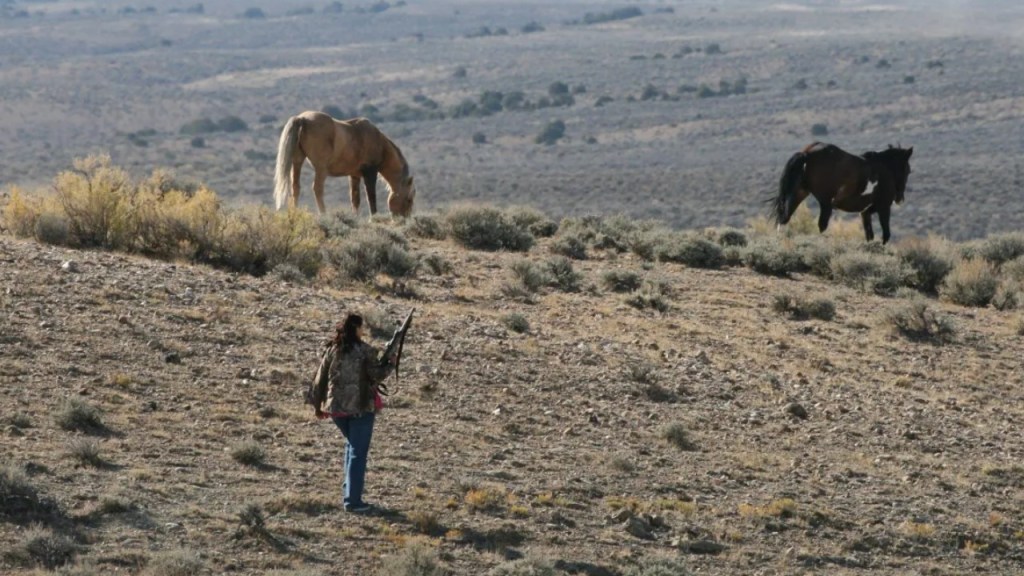
The bill calls for a minimum herd size of 200, a number that will be determined by the Park Service, but the advocates will likely drive the breeding population into the single digits with their projectors and RDDs, as provided in Section 1.3.
This will ruin the mares, increase the risk of inbreeding and spell the long-term demise of the herd, a strategy already in use at the Salt River, Virginia Range and elsewhere.
RELATED: North Dakota Legislature to Create TRNP Working Group?

The group would work with NPS to provide recommendations for managing the wild horse population in Theodore Roosevelt National Park according to Section 1.2 of SB 2331.
The minimum herd size would be 200. The size of the breeding population, which is far more important, was not specified.
The committee would also promote the horses to benefit tourism and assist with educational outreach.
The story was covered by local news outlets but placed behind paywalls.
The measure may be patterned after SB23-275 which created the Colorado Wild Horse Working Group.
He was confirmed on Friday in a 79-18 vote according to a story by The Hill.
No word on the status of Brooke Rollins, Trump’s nominee for Agriculture.
The forecast out of Gobbler’s Knob is six more weeks of winter according to a story by AP News.
Western Horse Watchers predicts an extended period of deception from the advocates, as they peddle chemical sterilization as wild horse conservation.

There will be no reform until you cut them off and they face financial insolvency.
A certified PZP darter will discuss the pros and cons of fertility control, as if the decision to ruin the mares must be carefully weighed before acting.
Two shills for the public-lands ranchers will explain their plan to move the horses from their lawful homes to remote wilderness areas to deter wildfires. The method by which the animals stop lightning is proprietary and not open to public observation.
Refer to the conference home page for dates and times.
RELATED: Notably Absent from Wild Horse Summit.