No, it’s not Glenn Miller’s birthday. H/T Flyin T Hangin A.
RELATED: BLM Puts Crosshairs On Onaqui Mountain Horses.

Exposing the Hypocrisy, Lies and Incompetence of the Wild Horse Advocates
No, it’s not Glenn Miller’s birthday. H/T Flyin T Hangin A.
RELATED: BLM Puts Crosshairs On Onaqui Mountain Horses.
On the south edge of Little Bookcliffs WHR. H/T Dylan Brewer.
Day four of the Octave of Christmas. H/T Megan Smith for the video.
The highest court in the state has upheld a circuit court decision to dismiss a lawsuit brought by the Black Hills Wild Horse Sanctuary to cancel a conservation easement granted to The Nature Conservancy. The easement limits the use of 8,300 acres of sanctuary land, according to a report that appeared today in the Washington Times.
The sanctuary received $230,000 in exchange for the easement.
The report did not indicate who owns the 8,300 acres, what uses were prohibited, and if the ruling would be appealed.
In a related story, seventeen wild horses arrived at the sanctuary in October after being removed from the Fort Polk army base in Louisiana.
Commissioners in Moffat County, CO are concerned about public safety on state route 318 due to recent collisions between vehicles and wild horses. Personnel from Wild Horse Warriors have asked for fencing but officials want a solution that satisfies all stakeholders. Refer to this story, posted today by the Craig Press.
Day two of the Octave of Christmas. H/T Megan Smith.
Not when the other party, and many of your so-called supporters, want you wiped off the map.

No goodwill, no peace.
RELATED: Arab-Israeli Conflict Plays Out on Western Rangelands.
Momma mustang on Christmas Day, freeze mark obscured by winter coat. Still can’t touch her. Worth the wait.

It’s a curling of the upper lip to enhance the sense of smell. Photo taken 12/25/18.

A working group, chartered by Arizona State University, has created a blueprint for managing the 19,700 acre Heber Wild Horse Territory, according to a report that appeared today in the White Mountain Independent of Show Low, AZ.
The proposal, assembled by a diverse group of citizens under the guidance of professional facilitators, will be reviewed by the Forest Service.
A management plan was mandated in 2007 when the WHT was established. The goal is to balance the needs of horses, livestock and wildlife relative to the available resources.
Approximately 300 wild horses live in the territory, for a population density of 15 animals per thousand acres. That figure differs appreciably from the typical one animal per thousand acres on HMAs, many of which lie in the Great Basin.
The article did not indicate how many cattle are allowed in the WHT.
“There is also perception that ranchers don’t want any horses on the landscape because of alleged overgrazing from horses that impacts cattle forage abundance, water, etc.”
It’s not a perception, it’s the truth.
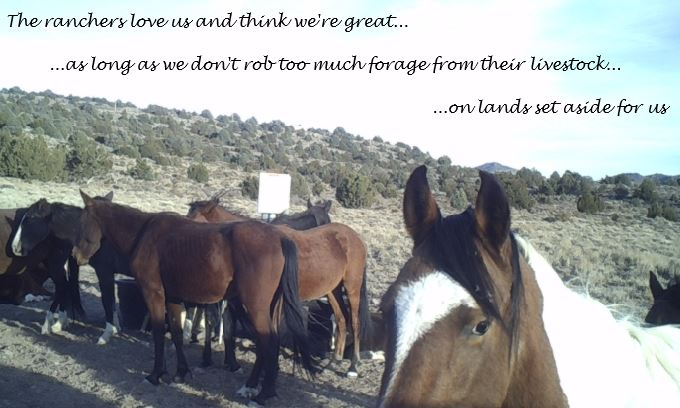
Things may turn out well for the horses if the stakeholders and regulatory agencies remember that’s it’s a HORSE TERRITORY not a cow territory.
RELATED: Conflict Between Livestock and Horses Plays Out at Heber WHT.
The stars in the sky looked down where He lay, the little Lord Jesus asleep on the hay.
A wild horse trapped in an arroyo near Placitas, NM was rescued by volunteers who called in a backhoe to cut a ramp so the horse could climb out. H/T JD Reynolds.
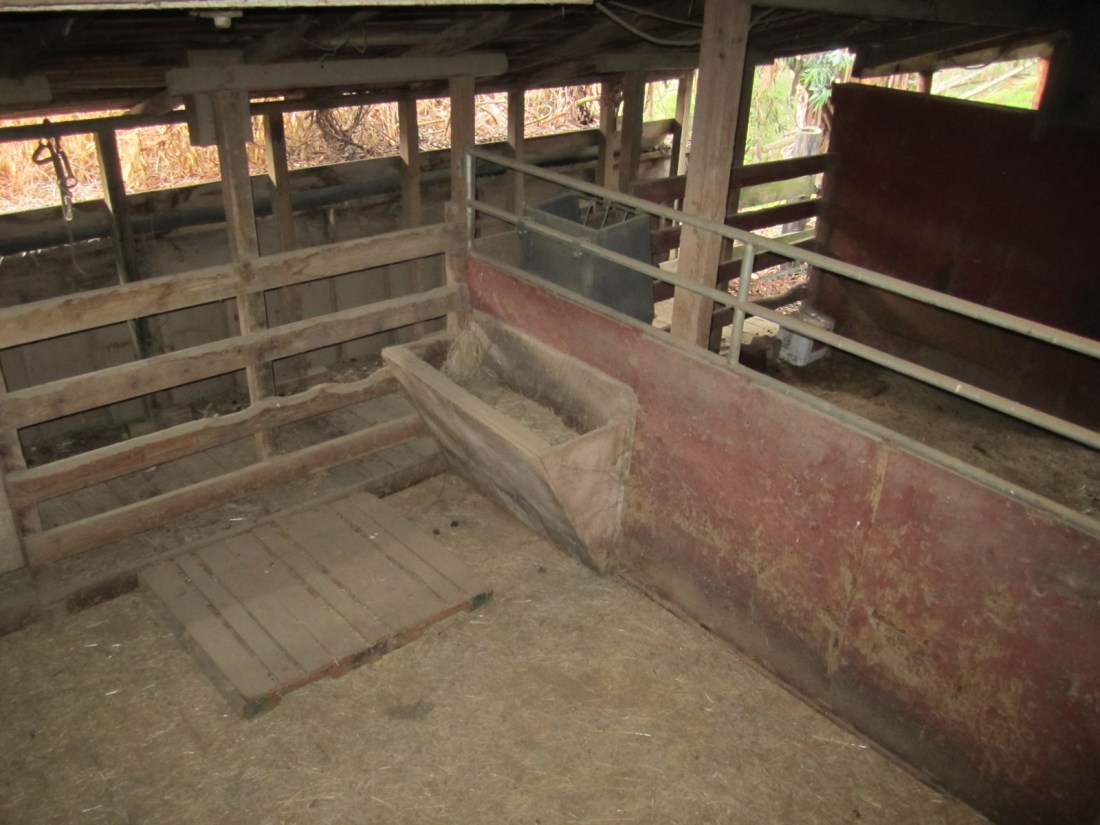
It’s a feeding trough for animals, commonly found in barns.
A light should be on in every room tonight. The inn may be full but there’s room in your home for a Savior, correct? In your heart?
Hell is real and people go there but it need not be you. Video produced in 2010 by Real Catholic TV, forerunner of Church Militant.
On Sand Wash Basin HMA. H/T High Stakes Ranch.
Officials in Medora, ND are worried that the government shutdown may hurt their tourism-based economy, due to lack of services and possibly reduced hours at Theodore Roosevelt National Park. Refer to this syndicated report, which appeared yesterday in The Charlotte Observer.
The park, known for its prairie dogs, bison and wild horses, was created in 1947.
The horses you see today have no historical significance, they are only an exhibit.
The native horses were rounded up and sold 20+ years ago. Some were purchased by Leo Kuntz and moved to his ranch near Linton, ND. He called them ‘Nokotas.’
The descendants of these northern plains horses can be seen today at the Nokota Horse Conservancy in Linton.
RELATED: Story of the Nokota Horses.
More rain means more growth, more fuel. “Oh, but we need it.” You city folk need it.
RELATED: 2019 Wildfire Season Underway.
Refer to this report by AP News. Former wild horses and burros, now in BLM corrals, will receive care.
Planned roundups and other non-essential field work have probably been curtailed.
The PZP zealots will still have access to the HMAs and WHTs, to help the government, and the public-lands ranchers, achieve their goal of fewer horses on the range.
Several wild horses were moved last week from the Ochoco National Forest (Big Summit WHT) to the Malheur National Forest (Murderer’s Creek WHT) and some public-lands ranchers caught the Forest Service doing it, according to a story that appeared today in the Capital Press of Salem, OR.
These people never want to see wild horses coming into their allotments, only going out.
“Wild horses are a contentious subject in the Malheur National Forest, where ranchers say the animals trample stream banks to the detriment of federally-protected fish, preventing cattle from being allowed to graze on affected allotments.”
The transfer may have been carried out to improve the genetic diversity of the Murderer’s Creek horses, a common practice in the Riddle Mountain and Kiger HMAs, where herd sizes are too small to maintain genetic viability.
An explanation of the incident is expected soon, according to the report.

