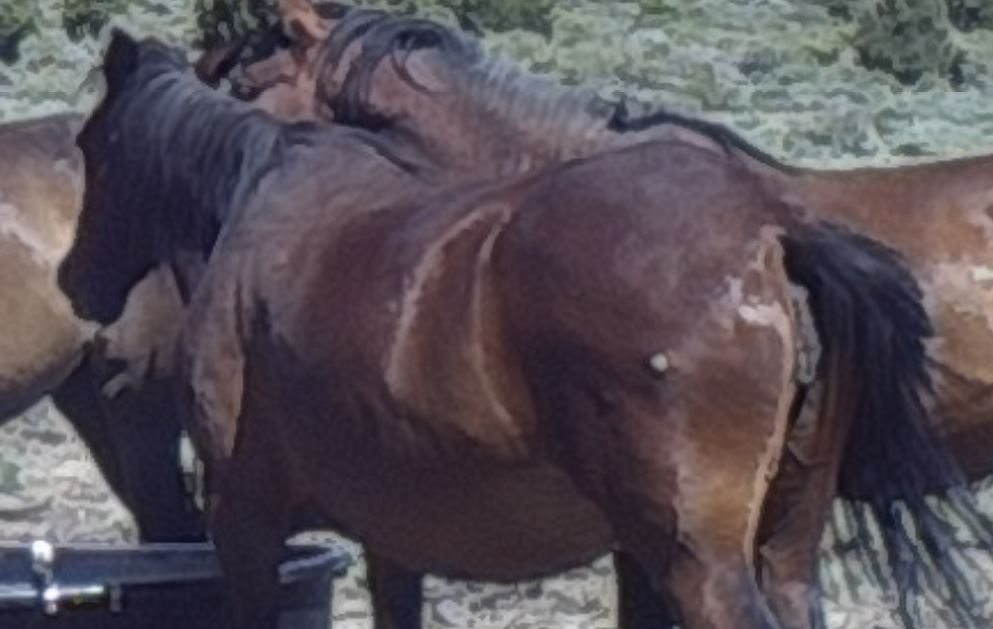
What’s going on at the left hindquarters of this mare? Trailcam photo taken 06/11/19 on the Virginia Range. There were no youngsters in the band.
RELATED: PZP Zealots in Action on the Virginia Range.

Exposing the Hypocrisy, Lies and Incompetence of the Wild Horse Advocates
What’s going on at the left hindquarters of this mare? Trailcam photo taken 06/11/19 on the Virginia Range. There were no youngsters in the band.
RELATED: PZP Zealots in Action on the Virginia Range.
The event kicks off at 8:00 AM MDT with a field trip to a nearby HMA (to see how wild horses are destroying their habitat and hurting the poor ranchers) then resumes with live-streamed proceedings from a conference room.
RELATED: WHBAB Meetings Set.
A story by the Los Angeles Times posted this morning says the facility, and the animals held there, are okay following major earthquakes on July 4 and 5.
The quake on July 5 knocked out power to the area, resulting in a loss of water, but trucks were located and it was hauled in, according to the report.
RELATED: Another Quake Hits Ridgecrest.
On the Virginia Range with Lauri Duke.
A report posted yesterday by The News & Observer of Raleigh, NC says a wild stallion who ran off after he was hit by a vehicle has been located and appears to be okay.
The incident occurred near Corolla, NC in an area frequented by bachelor bands.
Although he’s behaving normally, he will be monitored for internal injuries, according to the report.
News outlets are reporting a magnitude 7.1 earthquake—about five times stronger than the one that occurred yesterday—near Ridgecrest, CA, location of BLM’s Regional Wild Horse and Burro Corrals.
Earthquake scales are logarithmic. Magnitude 7 is ten times stronger than magnitude 6 and 100 times stronger than magnitude 5. The earthquake of July 4th had a magnitude of 6.4 (scale unknown) and the one on July 5th was reported as 7.1. To compute the strength ratio, take the difference in magnitude and use it as an exponent of ten:
10 ^ (7.1 – 6.4) = 5.0
Note that the ‘strength’ of an earthquake depends on the method of measurement.
Same for any other physical quantity, such as global temperature, or the number of wild horses in the Twin Peaks HMA.
This is very important if you have an agenda: Change the method, get a new number.
RELATED: Earthquake Near WHB Corrals?
Data from the news release announcing the roundup and final Gather Plan approved in December, 2017:
The aimed-at population density for wild horses in the Triple B Complex is 0.5 animals per thousand acres, compared to the target density of one animal per thousand acres for all HMAs (the land—27 million acres—can only support 27,000 wild horses and burros per current narrative).
The 889 horses allowed by plan would consume 10,668 AUMs annually, assuming they graze 12 months per year.
The horses found in the Complex today would consume 40,572 AUMs per year, with a population density of 2.1 animals per thousand acres.
Land in and around the Triple B Complex is also used for domestic livestock grazing, with 27 allotments involved. See Table 9 in the Gather Plan.
The forage allocated to livestock inside the Complex must be calculated because some of the allotments extend beyond its boundaries. For example, Gold Canyon contributes 1,068 × 0.59 = 630 AUMs, because 59% of its land is inside the Complex (assuming that forage is uniformly distributed across the parcel).
The 27 fractions, added together, yield 49,188 AUMs for livestock inside the Complex.
If livestock graze an average of six months per year, the AUM budget yields 8,198 cow-calf pairs inside the Complex, which are equivalent to wild horses in terms of their resource loading. The planned livestock density is 5.0 animals per thousand acres.
These results are summarized in the following charts.

Land that can only support 0.5 wild horses per thousand acres can support ten times as many cow-calf pairs. That’s what you’d expect if it was managed principally but not necessarily exclusively for livestock, contrary to the WHB Act.
The following options were considered in the plan but rejected:
Note that the map on page 9 of the Gather Plan shows both the Antelope and Triple B Complexes. Tables 1 and 8 could be used to generate the same charts and figures for Antelope. Any volunteers? The Antelope Complex contains the massive Spruce Allotment, site of the infamous Spruce-Pequop incident last August.
The gather that starts on Monday will shift 9,600 AUMs per year from the Horse column to the Cattle column, moving the plan one step closer to fruition.
RELATED: Triple B Gather Starts Next Week.
News outlets are reporting a magnitude 6.4 earthquake near Ridgecrest, CA, the location of the BLM Regional Wild Horse and Burro Corrals.

Gather stats indicate 128 jacks were removed from the HMA, along with 56 jennies, for a total of 184 wild burros. Four foals were also captured but their gender was not given.
Seventy percent were males, thirty percent were females.
Do those numbers look like they came from a herd where males and females are evenly distributed? The range of variation in these values attributable to natural causes can be found from some basic statistical formulas, where p = .50 and n = 184.
The following chart shows the range between jacks and jennies is larger than expected.

Why would there be an assignably high number of males in the traps (or assignably low number of females)?
Are males and females evenly distributed in the herd? If not, why?
Were there riders in the field steering the jacks toward the traps? Do jennies have an innate ability to see danger ahead and move away?
What else could skew the results?
If 60% of the captured animals were male and 40% were female, you’d be wasting your time trying to explain the difference, because those results fall within the limits.
RELATED: Seven Troughs Gather Complete.
BLM said today that bait trapping has concluded, with 188 wild burros removed from an area near Porter Springs and Empire, NV. One death was reported.
The roundup was justified in part by resource damage around the new Porter Springs Recreation Management Area, according to the news release.
Adoptions resumed this week following the deaths of two horses. Refer to this report by ABC Fox Montana.
RELATED: Quarantine Continues at Ravalli County Fairgrounds.

That’s what a public-lands rancher pays the federal government to graze a cow-calf pair on western rangelands for six months.
Try feeding your horse for that, or your cat.

The State Director in Utah for the Humane Society of the United States responded on Sunday to a critique in Deseret News about the ‘forward-thinking’ management plan for wild horses announced on 04/22/19.
It’s a win-win according to the letter:
Yeah, because most of the horses will be gone and the remaining herds will be sterilized, temporarily or permanently.
Surrender to the cattlemen. It’s the only viable solution, given the political realities.
Horse feathers!
Velma saved the mustangs. It’s time to finish the job by saving their land.
End public-lands ranching, along with the massive bureaucracy that supports it.
RELATED: Save a Wild Horse: Don’t Give the ASPCA or HSUS a Penny.
BLM announced today that approximately 800 wild horses would be removed from the Triple B Complex in eastern Nevada starting on or about 07/08/19.
The roundup will prevent further degradation of public lands, according to the news release, by helping to balance herd size, suggesting there was something on the other side of the scales but did not say what.
The complex consists of the Triple B HMA, Maverick Medicine HMA, Antelope Valley HMA west of Highway 93 and the Cherry Springs WHT, denoted in red on this map.

The event will be open to public observation and captured animals will be taken to the Palomino Valley Off-Range Corrals, about 20 miles north of Sparks.
Gather stats and daily reports will be posted here.
The Complex was the subject of a larger roundup in early 2018, with approximately 1,300 wild horses forced off their home range. The map at this page indicates that it is subject to permitted livestock grazing.
RELATED: Livestock Grazing in Nevada, Economics of Wild Horse Gathers.
East of Pahrump, NV near the Johnnie HMA, with Bearded Patriot.
A letter to the editor of High Country News, posted 06/24/19, says livelihoods are at risk because of unmanaged heavy grazing of wild horses and burros on public lands.
The process is turning them into deserts according to the writer.
Yep, it’s getting harder and harder to make a living off public lands in the western U.S., especially when the government spends tens of millions of dollars every year to make you as successful as possible on land you don’t own, almost as if you’re an illegal alien.
Livestock grazing on public lands is the most cost-effective wildfire prevention tool, according to Ethan Lane, executive director of the Public Lands Council and guest speaker at the mid-year conference of the Oregon Cattlemen’s Association.
He noted that livestock consume large amounts of highly combustible grass and other forage at no cost to the taxpayers, but gave no indication that they might be a factor in overgrazing and rangeland degradation…at least not in the report by Capital Press.
You see, wild horses and burros are responsible for that.
Lane said that cattle grazing was not a significant contributor to global warming, suggesting that he believes in the hoax but doesn’t think the industry should be a target of the emissions police.
He indicated that there were 88,000 wild horses and burros on western rangelands and 50,000 in off-range facilities but did not mention they were outnumbered twenty to one by domestic livestock.
The forage allocated to privately owned cattle and sheep on public lands in the western U.S. (about nine million AUMs annually) would support at least 750,000 wild horses and burros, enough to empty all of those off-range facilities fifteen times over.
You want cost savings? End public-lands ranching.
At or near the Red Rock HMA with Terry Buys Stuff.
Two Virginia Range mustangs watch as another band passes by. There is a hierarchy within the herd and each band knows when it’s their turn to visit the water hole.
The population density in this area is roughly ten horses per thousand acres, maybe a bit more, and as you can see from the condition of these two guys, that’s way too many.
The BLM allows an average of one horse per thousand acres on lands they manage.
Why such a low number? Because it’s not about the horses, it’s about the livestock, privately owned, of course. Never mind that the land was set aside for the horses.

Legislation that would permanently end the slaughter of American horses for human consumption has reappeared in Congress, according to a press release in PR Newswire dated 06/27/19. Sponsors of the bill are liberals, every one of them received a failing grade from Conservative Review.
Many of their big-name supporters are the same jackals who signed on to the Wild Horse Management Plan announced 04/22/19: The American Society for the Prevention of Cruelty to Animals, the Humane Society of the United States, and Return to Freedom Wild Horse Conservation.
You see, horse slaughter might undermine their sanctuary and fertility control ventures.
It’s okay to force wild horses off public lands so their food can be sold to privately owned livestock, just don’t ship them to slaughter for human consumption.

