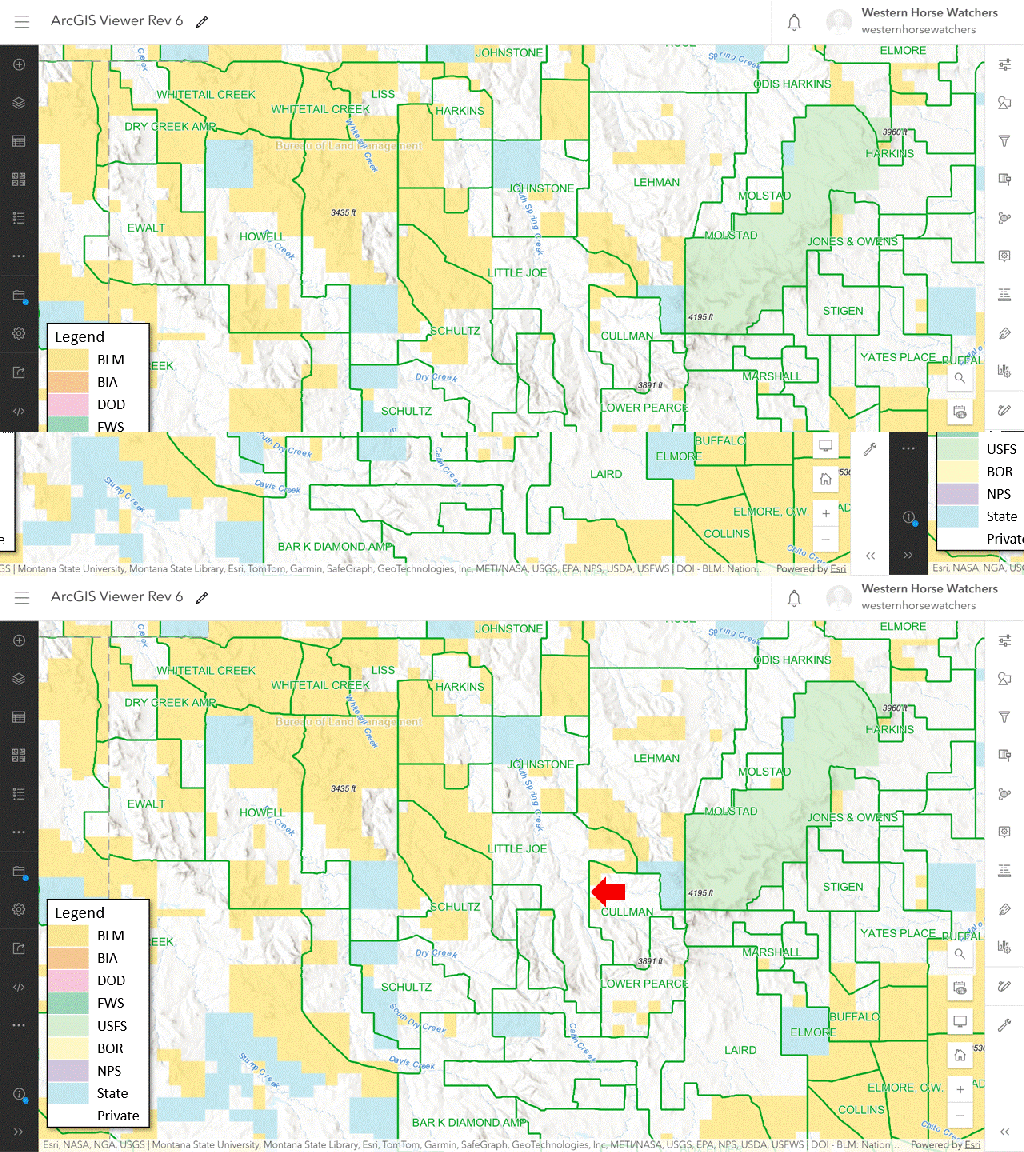
The project would combine the Blair and Stange allotments into the Little Joe allotment.
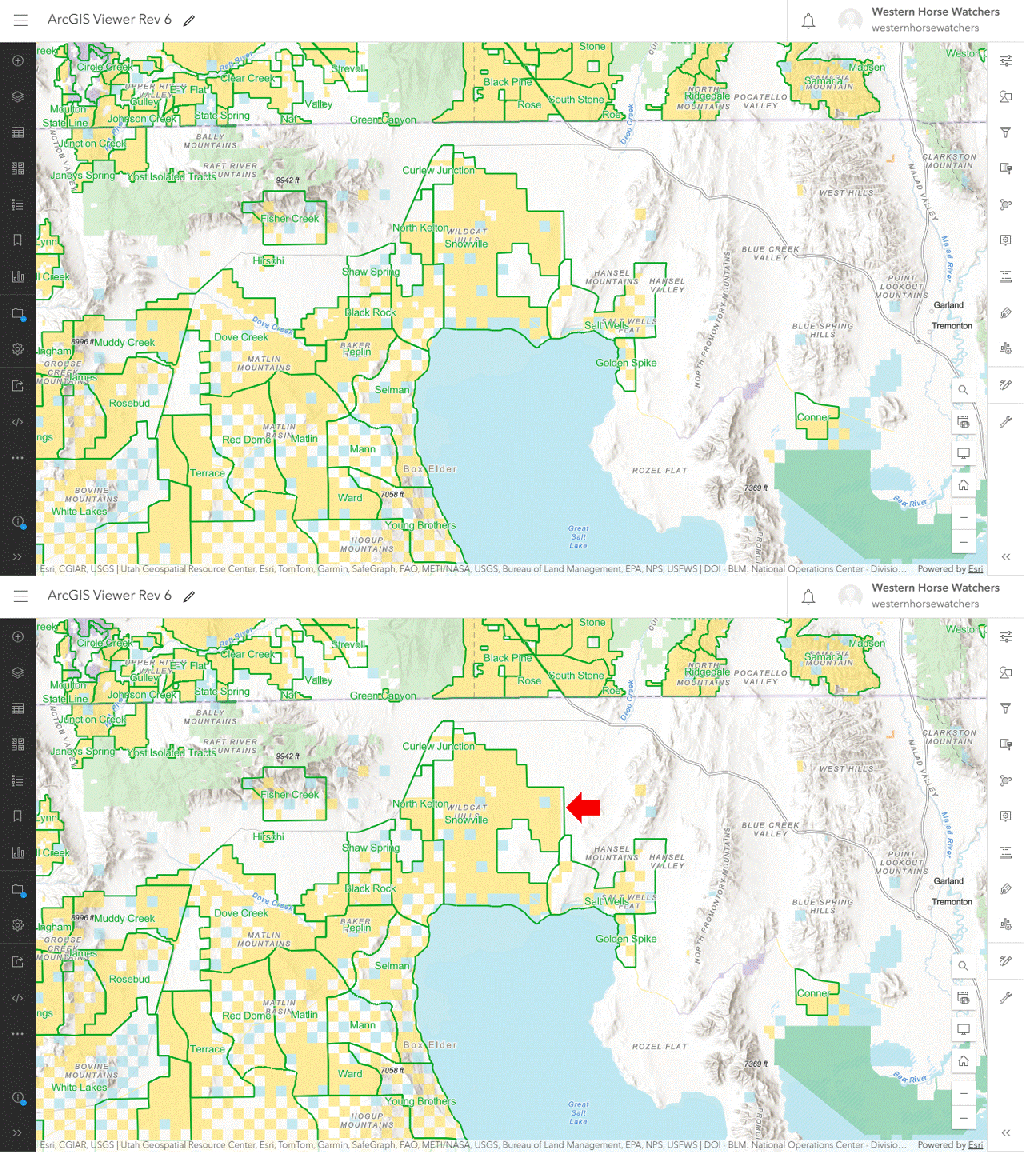
The ArcGIS Viewer shows the outline for Little Joe but not Blair and Stange.
Blair offers 61 active AUMs on 246 public acres according to the allotment master report, equivalent to 20.7 wild horses per thousand public acres.
Stange offers 360 active AUMs on 1,285 public acres, equivalent to 23.3 wild horses per thousand public acres.
Your faithful public servants claim that public lands in the western U.S. can only support one wild horse per thousand acres.
If resources on the deeded acreage were added to the mix, Little Joe would support livestock equivalent to 127 wild horses on 5,358 total acres, or 23.7 wild horses per thousand acres.
The deadline for submitting comments is January 5.
The allotment, due for permit renewal, offers 4,317 active AUMs on 26,099 public acres, equivalent to 360 wild horses or 13.8 wild horses per thousand public acres.
The grazing season is 12 months according to Table 1 of the CX.
Your faithful public servants claim that public lands in the western U.S. can only support one wild horse per thousand acres, so it seems like a good deal.
There is one authorization tied to the allotment, so you’d only need to acquire or control one base property to secure all of the active AUMs.
The allotment includes 9,963 state acres, offering an additional 1,778 AUMs, but there is no assurance the resource would transfer to you—the new permittee.
The 1,960 private acres may correspond to some or all of the base property.
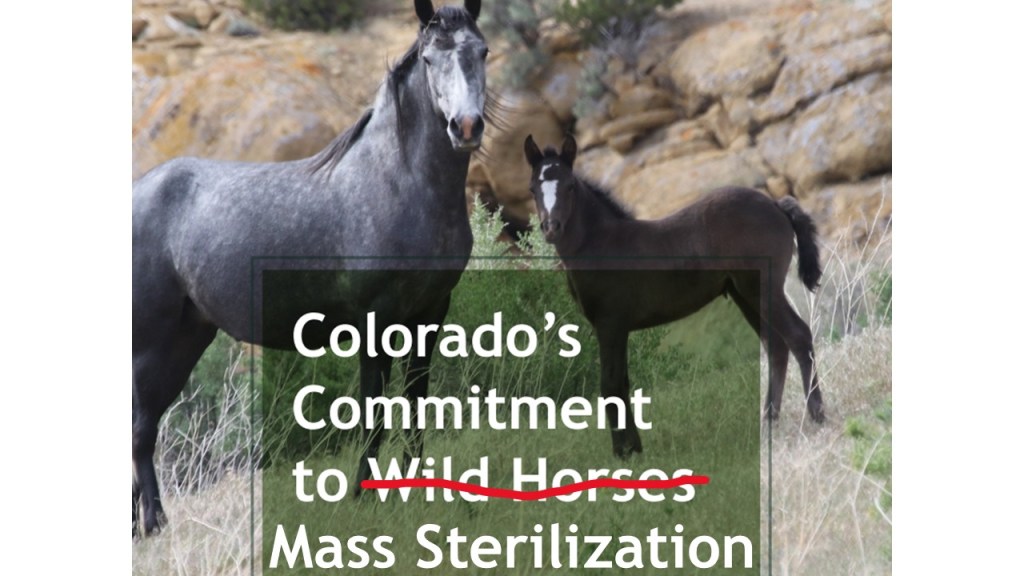
This year’s update to the Colorado Wild Horse Eradication Plan provides the clearest indication yet of what the advocates think about wild horses and who they’re really trying to protect.
Strategic Darting as the Cornerstone of Wild Horse Management
Who will turn this vision into reality? The largest consumers of abortion, contraception and sterilization in the nation.
As they destroy the herds, they’ll tell you they’re living wild and free as nature intends.
The advocates have discovered that lying is the best way to keep their coffers filled.
Sorry, but barren mares, confused stallions, shrinking herds, injuries and infections, abnormal sex ratios, increasing death rates, tiny breeding populations, loss of genetic diversity and acclimation to people do not qualify as living as nature intended.
The allotment, at the north end of the Great Salt Lake, offers 7,707 active AUMs on 71,308 public acres, equivalent to 642 wild horses or nine wild horses per thousand public acres.
Your faithful public servants claim that public lands in the western U.S. can only support one wild horse per thousand acres, so it seems like a good deal.
But there are ten authorizations tied to the allotment, which means you may have to acquire ten base properties to secure all of the active AUMs.
The executive summary argues that strategic darting must be the cornerstone of sustainable wild horse management, and that the group expects the Colorado BLM to champion the method, along with other findings, conveying them forcefully to the national office.
These are the same lunatics who put a couple of sodomites in the governor’s mansion.
A keyword search of the document yielded these results:
Adoption – 125 occurrences
Darting – 53
Fertility control – 10
Immunocontraceptive – 7
Treatable mares – 7
Cattle – 2
Sheep – 0
AUM – 0
Allotment – 0
Permit – 0
Rancher – 0
Pesticide – 0
Reversible – 0
Sterility – 0
Sterilization – 0
Breeding population – 0
Genetic diversity – 1
Principal use – 0
Management at the minimum feasible level – 0
Nature’s way – 0
The group claims on page 33 that large tracts of private land, suitable for wild horse preserves, are scarce, which is nonsense.
There are hundreds of such parcels in the state, known as base properties, that could be repurposed for wild horses, with the added benefit that they have grazing preference on public lands—and therefore provide the best value to taxpayers and/or donors.
But the idea was not supported by some members, who were concerned about removing land from agricultural production.
And that’s the point of the entire exercise: To charter a group that would do what’s best for the ranchers, not the horses.
As of November 21, there were 60,283 wild horses and 3,750 wild burros in off-range holding, liberating 745,896 AUMs per year for “other mandated uses” of public lands.
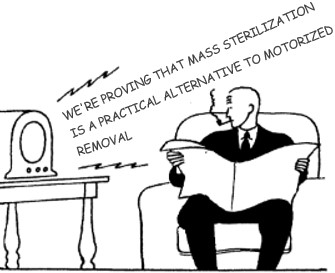
The advocates will point to the report, and costs associated therewith, as justification for their mass sterilization programs.
The bill would limit public comments to citizens of the United States and establish a process to deter attempts at public involvement by artificial intelligence.
The measure received a favorable review on December 17 by the Senate Energy & Natural Resources Committee and now joins S1377 on the chamber floor.
Publicly, the advocates celebrate the birth of filly or colt but privately they hold the animal in contempt because he’s an embarrassment in the face of their allies, a blot on their mass sterilization program and an impediment to their herd reduction goal.
Likewise, they want you to think they’re saddened by the death of a stallion or mare but privately they couldn’t be happier because it moves them a step closer to the goal.
They don’t care about the horses. They care about pesticides and putting the legacy contractors out of business.