Supporters with Southwestern Wilds claimed the warnings would be more effective if they were backed by state law, so the new ones have a reference to NRS 569.040.
Photos in this report by the Pahrump Valley Times.

Exposing the Hypocrisy, Lies and Incompetence of the Wild Horse Advocates
Supporters with Southwestern Wilds claimed the warnings would be more effective if they were backed by state law, so the new ones have a reference to NRS 569.040.
Photos in this report by the Pahrump Valley Times.
The event runs from 9 AM to 3 PM on September 27.
The announcement did not mention the Hickison HMA or Simpson Park Allotment, which overlap the site.
One of the reviews on The Dyrt, a camping directory, said there were no toilets, water or trash, and no trees.
RELATED: Wild Burros Reported at Spencer Hot Springs?
She earned her keep by producing a buckskin colt, first seen on May 27 according to the 2025 list of foals.
But the saltwater cowboys were unable to save her.
The long-term effect is negligible.
The outlook for next year is excellent.
There are still 5.5 females for every male.
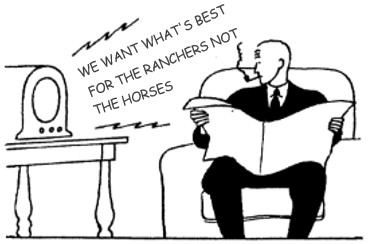
They protect ranchers not wild horses.
Now they’re trying to save themselves from oblivion.
PNWHA is an affiliate of the Campaign Against America’s Wild Horses, a leader in nonmotorized removal, fierce opponent of principal use and instigator of the largest attempted eradication of wild horses in Nevada.
Why are you still giving them money?
Along the Truckee River, northern edge of Virginia Range, with Capture Nevada.
The herd falls under NRS 569 according to the presentation by NDA at the August 26 Washoe County Board of Commissioners meeting.
Slide 5 says it’s illegal to feed or water the horses.
NRS 569.040 says it’s illegal to feed them.
Signs posted in the area refer to feeding and harassing but not watering.
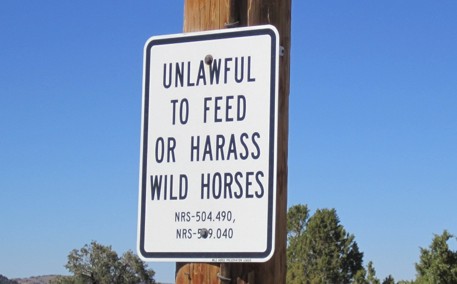
The warning may apply to herds protected by the WHB Act, which does not include the Virginia Range “estrays.”
RELATED: NDA Gives Virginia Range Fencing Update.

Director JJ Goicoechea spoke about the project at the August 26 Washoe County Board of Commissioners meeting according to a report by KOLO News.
To view the presentation, scroll down and click on item 6.C.1. in the lower left corner of the screen. Then hit Go.
Most wild horse advocates are female, which means most are liberal.
Have you seen any that are pregnant?
What does that tell you about their obsession with fertility control for wild horses?
RELATED: Foal-Free Friday, the Company You Keep Edition.
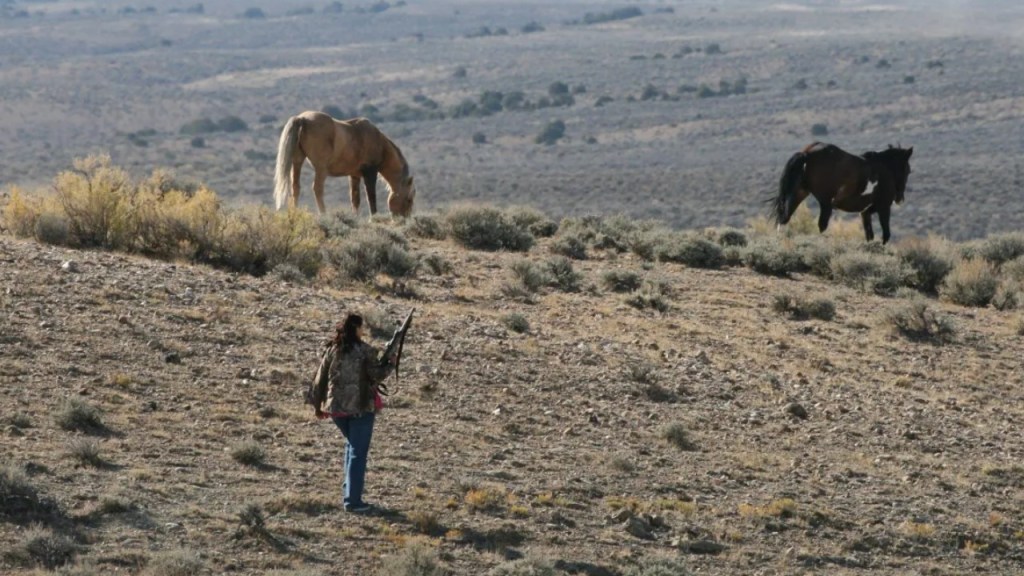
A palomino filly has been added to the list of foals by DSC Photography, boosting this year’s birth record to 102.
She was first seen on August 26.
The Saltwater Cowboys have turned the island into a puppy mill for wild horses by skewing the sex ratio in favor of females, lifting revenues from auctions into record territory as well.
RELATED: Chincoteague Herd Sets New Birth Record.
Why did KNXV News of Phoenix go to the Campaign Against America’s Wild Horses, a leader in nonmotorized removal and instigator of the largest attempted eradication of wild horses in Nevada, to write a report about a herd in its own back yard?
Perhaps the Salt River Wild Horse Darting Group, hired by the state to manage the herd and one of the contenders for the new contract, was not allowed to comment.
Why are statements in the report inconsistent with remarks in the video?
For example, the report says that federal fencing and reduced access to habitat—not the advocates—have pushed the population down from 460 horses to around 280.
But the video says it’s a combination of fertility control—the handiwork of the Salt River advocates—and the boundary fence.
Both include an allegation by CAAWH that the Tonto National Forest and Governor Katie Hobbs’ office discussed a plan with the Arizona Department of Agriculture that would leave as few as 21 horses on the range, which would doom the herd.
The herd is already doomed, thanks to the advocates.
A minimum of 150 to 200 horses is needed to preserve genetic diversity according to CAAWH, which does not take into account the number of mares ruined, or being ruined, by the fertility control program.
A herd of 500 would not be enough when you can count the breeding population on one hand.
Humane disposal of wild horses, demonstrated by Jay Kirkpatrick on Assateague Island and popularized by the advocates, has two components:
The Salt River herd has been shrinking at a rate of 9% per year, more than can be attributed to natural causes.
If there’s any praying going on, it’s for the older horses to die. That’s how they’ll achieve their population target.

AZDA has done a great job of concealing the process and thwarting public involvement, as there are no announcements at its news page.
Western Horse Watchers does not read or link to anything on socialist media because of its left-wing bias.
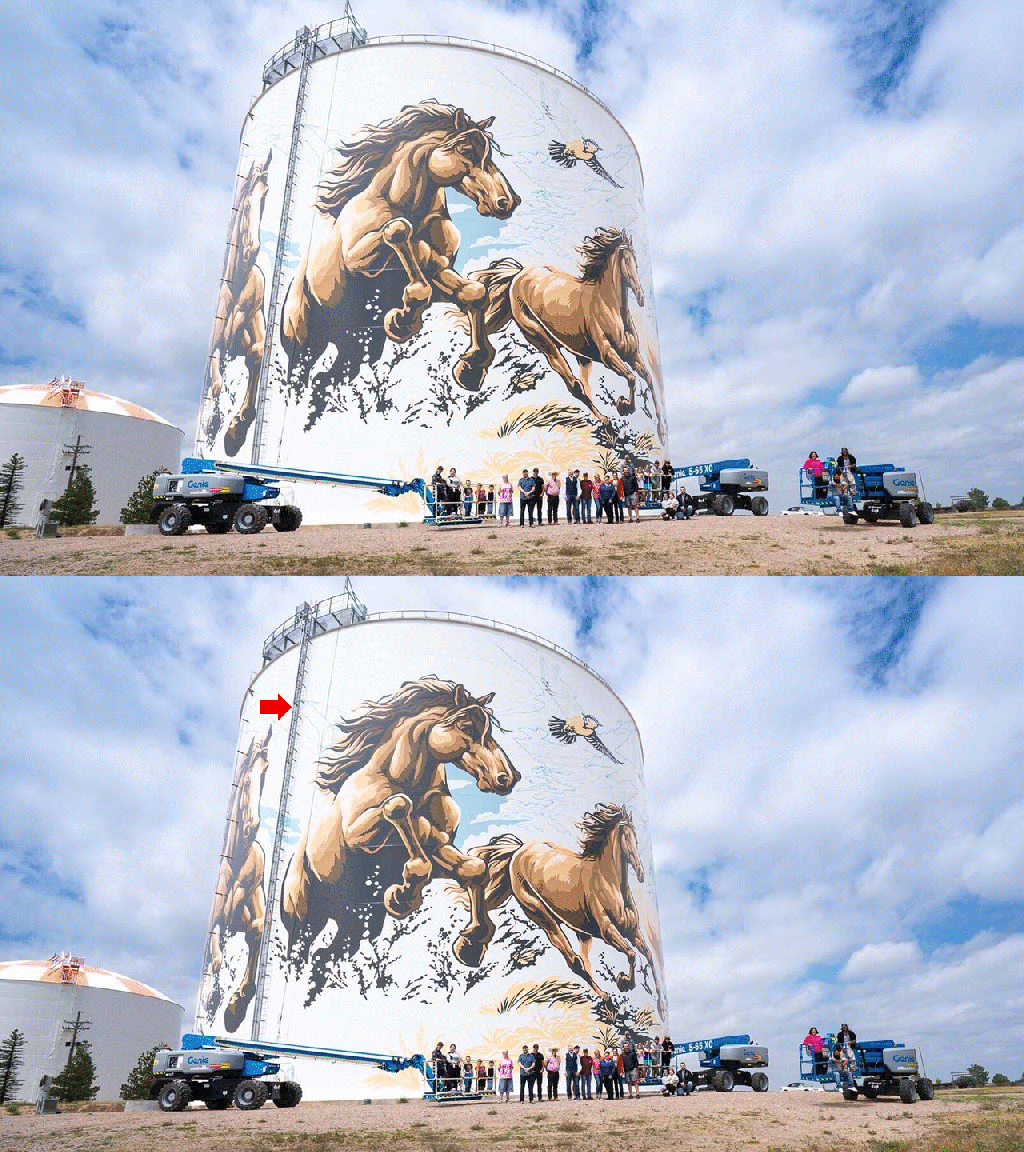
They draw your attention away from the ladder, which is not OSHA compliant.
The article did not indicate if the other tank would be painted with low-flying helicopters or PZP darters.
The Campaign Against America’s Wild Horses does, as stated in an undated solicitation for volunteers on Mobilize, a site for community organizers and other left-wing kooks.
There are more horses than allowed by plan but not more than the land can support.
The problem is the way your public lands are managed.
RELATED: AMLs Don’t Indicate Genetic Diversity or Carrying Capacity.

At the Onaqui Mountain HMA, one of the locations in Utah where the BLM pays the advocates to ruin the mares, with Bear River Blogger.
It’s not Ajax, Riptide or Thunderbolt. It’s Twist.
Those four guys accounted for 36% of this year’s foal crop.
| Name | Foals produced |
|---|---|
| Twist | 12 |
| Ajax | 8 |
| Riptide | 8 |
| Thunderbolt | 8 |
Refer to this spreadsheet for a complete breakdown.
A public relations officer with the Chincoteague Fire Company told Western Horse Watchers on August 19 that the herd consisted of 23 males and 126 females.
The advocates cannot comprehend foal production. Like the legacy contractors, they are experts at herd reduction.
RELATED: Chincoteague Herd Sets New Birth Record.
Hey Western Horse Watchers, I searched that letter and couldn’t find “poison.”
It’s right here: “Stop the politics, continue SRWHMG’s humane management.”
Humane management is a codeword for mass sterilization, the inevitable result when PZP is used for herd reduction.
How stupid do you have to be to believe anything from the wild horse advocates?
RELATED: Horses Vanishing as Salt River Contenders Trade Barbs.
Consider these remarks from the Lahontan Comment Summary:
| Item | Comment |
|---|---|
| 95 | Agree with herd size reduction |
| 98 | Want horse levels at AML |
| 114 | Recommend the use of fertility control |
| 116 | Adjust the sex ratio to 70/30 males/females |
They were submitted by the Nevada Department of Agriculture during the NEPA review of a wild horse gather plan.
They’re pretty much what you’d expect from a government agency whose job is to promote agriculture, which includes permitted grazing.
What you may not realize is that the Campaign Against America’s Wild Horses provides fertility control services to NDA, supporting its mission.
This speaks volumes about the attitudes and allegiances of the nonprofit.
RELATED: Foal-Free Friday, Playing the Long Game Edition.

The incident concluded on August 16 with 210 horses captured, 199 shipped, none released and 11 dead.
The daily reports indicate 198 shipped, leaving one unaccounted-for animal.
The capture and removal goals were 215 each.
The gather page was updated with information about deaths.
Ten horses were “euthanized due to poor body condition with no prognosis for improvement.”
A colt was found dead at a temporary holding facility due to unknown causes.
The death rate was 5.2%.
The capture total includes 94 stallions, 85 mares and 31 foals.
Foals represented 14.8% of the animals gathered.
Of the adults, 52.5% were male and 47.5% were female.
There were no plans to treat any of the mares with fertility control pesticides and return them to the range.
The roundup liberated 2,520 AUMs per year.
The effect of dry conditions on livestock grazing was not disclosed.
RELATED: Maverick-Medicine Emergency Roundup Starts August 8.
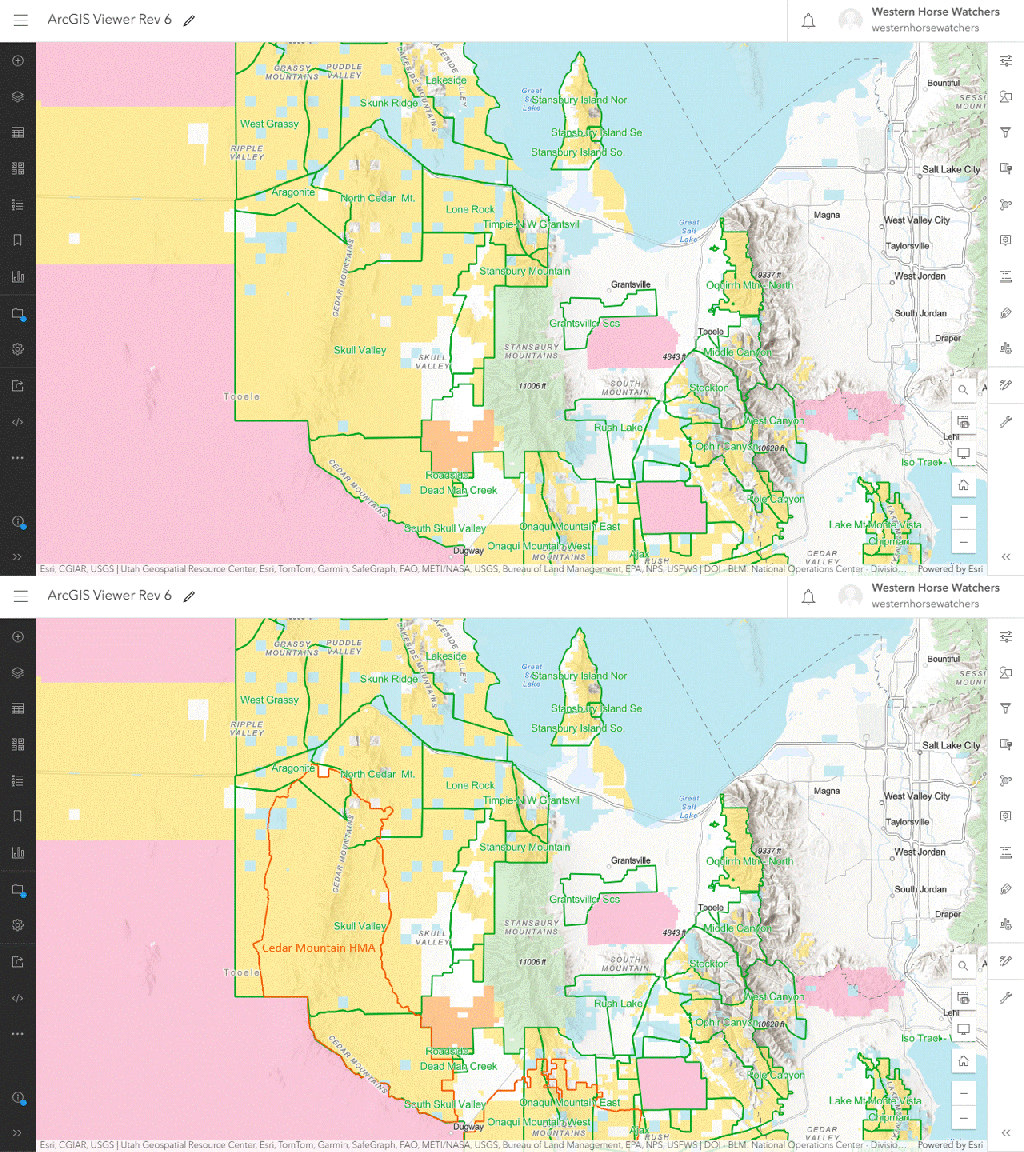
The HMA, located west of Salt Lake City, lies mostly within the Skull Valley and South Skull Valley allotments.
The allotment master report puts both in the Improve category.
Together they offer 20,719 active AUMs on 330,757 public acres, equivalent to 5.2 wild horses per thousand public acres.
As for the HMA, the management plan allows 390 wild horses on 204,674 public acres, or 1.9 wild horses per thousand public acres.
Therefore, it should be able to support (1.9 + 5.2) × 204,674 ÷ 1,000 = 1,453 wild horses, meaning that 1,453 – 390 = 1,063 wild horses have been consigned to off-range holding because of permitted grazing.
What are the advocates doing about this?
Beating the horse numbers down with ovary-killing pesticides.
A report by USA Spending indicates that the Campaign Against America’s Wild Horses has received $173,975 for the service, out of $217,549 authorized.
The August 5 schedule indicates 20 mares treated at Cedar Mountain. If that’s on an annual basis, then 40 mares will be treated over the two-year life of the project, which works out to over $5,000 per head.
Would you say that’s a wise use of taxpayer money?
RELATED: It’s a Conservation Program, Not a Sterilization Program.
 Western Horse Watchers Association