Sand Wash Roundup on Hold?

The incident depends on results from an August census according to a report dated September 13 by the Steamboat Pilot.

It’s still on the schedule with a start date of September 25.

The capture and removal goals are 80 and 20, respectively.

Of the 60 horses to be returned to the range, 30 were to be treated with fertility control.

The pesticide of choice at Sand Wash Basin is Zonastat-H, on the same EPA list as toxic chemicals, administered outside of roundups by SWAT.

The HMA is subject to permitted grazing.  Livestock receive almost four times more forage than the horses.

Use of PZP to control wild horse populations that interfere with animal agriculture is not consistent with instructions on the label and is therefore unlawful.

PZP Approved Uses 09-13-23

Photos posted by SWAT show several examples of advocates mixing and applying the product without the proper PPE, more violations of federal law.

RELATED: Advocates Concur with Sand Wash Trap Project?

New Regulation to Affect Wyoming Wild Horses

The proposed supplementary rule, which addresses public conduct, safety concerns involving exploding targets, flammable devices and target shooting, the possession or use of alcohol and the burning of wood pallets, among other things, would apply to all public lands in Wyoming, according to a notice appearing today in the Federal Register.

The last two provisions involve wild horses.  Accordingly,

15. You must not intentionally engage in any activity within any distance that disturbs, displaces, or otherwise interferes with the free unimpeded movement of wild horses.

16. You must not feed, water, or touch any wild horse.

Would #15 include the filming wild herds with drones, chasing them with manned aerial equipment or poisoning the mares with pesticide-laced darts?

The rule would not apply to federal, state, local and military employees or contractors acting within the scope of their official duties.

Only you.

Comments will be accepted through November 13.

Owyhee Roundups Over

The incident concluded today, with 229 horses captured, 228 shipped, none released and one dead.

There were no unaccounted-for animals.

Up to 38 mares will be treated with GonaCon Equine, a fertility control pesticide, and be returned to the area with up to 40 stallions, according to today’s news release.

The capture total included 74 stallions, 93 mares and 62 foals.

Youngsters represented 27.1% of the horses gathered.

Of the adults, 44.3% were male and 55.7% were female.

The death rate was 0.4%.

Three HMAs were affected, all subject to permitted grazing.

RELATED: Owyhee Roundups Announced.

Owyhee HAs and HMAs with Allotments 07-23-23

Big Sandy Planning Documents Out for Public Review

The Preliminary EA has been copied to the project folder with 17 appendices.

Three HMAs, known as the Three Rivers Complex, are affected.

Alternative A, the Proposed Action, features gathers and removals of excess burros, application of fertility control pesticides and sex ratio skewing in favor of males over a ten-year period.  Refer to Section 2.1 in the EA.

The plan aligns with three goals of rangeland management:

  • Pest control
  • Resource enforcement
  • Rancher protection

As noted in Section 1.5, the project will not set or adjust AMLs nor adjust authorized AUMs for livestock within the HMAs.

The current population is thought to be around 2,300 animals, almost 4X AML, according to today’s news release.

Comments will be accepted through October 11.

RELATED: Comment Period Starts for Big Sandy Pest Control Plan?

Big Sandy Alamo Lake Havasu HMAs with Allotments 09-01-23

Owyhee Roundup, Day 5

The incident began on September 6.  Results through September 10:

  • Scope: Black Mountain, Hardtrigger, Sands Basin HMAs
  • Purpose: Pest control, resource enforcement, rancher protection
  • Target: Horses
  • Type: Planned
  • Method: Helicopter
  • Category: Cruel and costly*
  • Better way: Poison mares with ovary-killing pesticides*
  • Captured: 215, up from 177 on Day 3
  • Average daily take: 43.0
  • Capture goal: 220
  • Removal goal: 142
  • Returned: None
  • Deaths: 1, no change from Day 3
  • Shipped: 214, up from 176 on Day 3

The figures above are based on the daily reports, not the totals posted by the BLM.

Gather results for Day 3 were changed from 25 stallions and 40 mares to 26 stallions and 39 mares.  No change to foals.

Trapping occurred at Hardtrigger on Day 4 and Sands Basin on Day 5.

The death rate is 0.5%.

The capture total includes 71 stallions, 87 mares and 57 foals.

Youngsters represented 26.5% of the animals gathered.

Of the adults, 44.9% were male and 55.1% were female.

Body condition scores were not given.

The HMAs and surrounding lands are subject to permitted grazing.

*According to advocates.

Owyhee HAs and HMAs with Allotments 07-23-23

Day 5 ended with no unaccounted-for animals.

Operations will likely conclude this week.

Up to 38 mares will be treated with GonaCon Equine, a fertility control pesticide, and be returned to the area with up to 40 stallions.

Other statistics:

  • Forage liberated to date: 2,580 AUMs per year
  • Water liberated to date: 2,150 gallons per day
  • Forage assigned to livestock: Undetermined
  • Horses displaced from area by permitted grazing: Undetermined
  • True AML: Undetermined
  • Stocking rate at new AML: Undetermined
  • Horses removed because of drilling and mining: Ask the advocates

Overpopulation means more horses than allowed by plan, not necessarily more horses than the land can support.

RELATED: Owyhee Roundup, Day 3.

Clan Alpine Pesticide Discussion Falls Short

In Section 2.2.2 of the Final EA, the BLM acknowledges that Zonastat-H is a pesticide, but not a restricted-use pesticide, meaning it can only be used by certified applicators for purposes identified on the label.  Go to page 26 in the pdf.

Controlling wild horse populations that pose safety hazards to motorists and/or interfere with animal agriculture is not an approved use.

Application of the product in those circumstances is unlawful.

Regarding GonaCon Equine, the agency cites the 2013 and 2015 registrations, while ignoring the 2017 update.

GonaCon-Equine is approved for use by authorized federal, state, tribal, public and
private personnel, for application to wild and feral equids in the United States (EPA 2013, 2015).

The 2017 amendment dropped the RUP designation and extended the interval between primer and booster to 90 days, which the BLM routinely ignores.

The Reveille HMA is a recent example.

When will law enforcement hold the bureaucrats and nonprofits to account?

RELATED: BLM Publishes Clan Alpine Final Planning Documents.

Devil’s Garden Roundup, Day 6

The Forest Service is not providing a running record of the incident, only the latest results, so a breakdown of the numbers is not possible.

Forty-two horses have been captured through September 9.

The goal is 500.

The number of horses shipped was not reported.

The total number of deaths is unknown.

The percentages of males, females and foals cannot be determined.

Body condition scores on Day 6 averaged 5.

Operations began on September 4.

RELATED: Devil’s Garden Roundup Begins.

Owyhee Roundup, Day 3

The incident began on September 6.  Results through September 8:

  • Scope: Black Mountain, Hardtrigger, Sands Basin HMAs
  • Purpose: Pest control, resource enforcement, rancher protection
  • Target: Horses
  • Type: Planned
  • Method: Helicopter
  • Category: Cruel and costly*
  • Better way: Poison mares with ovary-killing pesticides*
  • Captured: 177, up 24 on Day 1
  • Average daily take: 59.0
  • Capture goal: 220
  • Removal goal: 142
  • Returned: None
  • Deaths: 1, no change from Day 1
  • Shipped: 176, up from 23 on Day 1

The figures above are based on the daily reports, not the totals posted by the BLM.

Trapping occurred at Black Mountain on Day 2 and Hardtrigger on Day 3.

The death rate is 0.6%.

The capture total includes 56 stallions, 74 mares and 47 foals.

Youngsters represented 26.6% of the animals gathered.

Of the adults, 43.1% were male and 56.9% were female.

Body condition scores were not given.

The HMAs and surrounding lands are subject to permitted grazing.

*According to advocates.

Owyhee HAs and HMAs with Allotments 07-23-23

Day 3 ended with no unaccounted-for animals.

Up to 38 mares will be treated with GonaCon Equine, a fertility control pesticide, and be returned to the area with up to 40 stallions.

Other statistics:

  • Forage liberated to date: 2,124 AUMs per year
  • Water liberated to date: 1,770 gallons per day
  • Forage assigned to livestock: Undetermined
  • Horses displaced from area by permitted grazing: Undetermined
  • True AML: Undetermined
  • Stocking rate at new AML: Undetermined
  • Horses removed because of drilling and mining: Ask the advocates

Overpopulation means more horses than allowed by plan, not necessarily more horses than the land can support.

RELATED: Owyhee Roundups in Progress?

West Douglas Roundup Ends

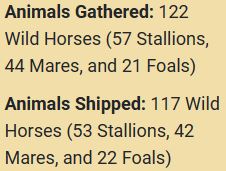
The incident concluded today with 122 horses captured, 117 shipped, none released and four dead.

There was one unaccounted-for animal.

122 – 117 – 0 – 4 = 1

More foals were shipped than caught.

West Douglas Final Results 09-09-23

Youngsters represented 17.2% of the horses captured.

Of the adults, 56.4% were male and 43.6% were female.

A 17% birth rate corresponds to a 12% growth rate.

The HA is unfit for wild horses, supposedly, but well-suited for livestock.

RELATED: BLM to Remove All Remaining Horses from West Douglas HA.

BLM, MHF Part Ways, TIP Ending

The agency will not renew its partnership with the Mustang Heritage Foundation for FY 2024, according to a story dated September 8 by Horse Network.

All animals currently in the Trainer Incentive Program must be placed into private care no later than September 30 or be returned to the BLM by October 1.

The decision follows an announcement last month to spend more taxpayer money on fertility control pesticides, to the delight of the wild horse advocates.

If those efforts succeed, there won’t be any more mustangs to adopt.

RELATED: BLM Awards $1 Million for Wild Horse Protection?

Dust-Up in the Desert Reviewed

Was it truly a presentation of opposing viewpoints or simply a dispute about fine points between two factions of the same coalition?

Three reports have hit the wires in the last 24 hours:

Hansen wants the horses removed with helicopters and Beckstead wants them removed with ovary-killing pesticides.

Are wild horses overpopulated in Nevada?  Yes, there are more animals than allowed by plan.

Are there more horses than the land can support?  No, most of the resources in their lawful homes have been assigned to privately owned livestock.  If you confine the ranchers to their (multi-million dollar) base properties in a year-round off season, and expect them to pay the going rate to feed their animals, there would be plenty of food and water for the horses.

As of this morning, video of the debate has not been posted to the AWA YouTube channel.

RELATED: Dust-Up in the Desert Set for September 7.

PSA 12-07-19

BLM Publishes Clan Alpine Final Planning Documents

The FONSI, DR and EA were copied to the project folder yesterday.

The Carson City District Manager selected Alternative 1 in the EA, the Proposed Action, authorizing forcible removal of excess animals to achieve low AML, sex ratio skewing in favor of males and treatment of mares with immunocontraceptive pesticides over a ten-year period.

The decision, effective immediately, does not mean a roundup is imminent.

Refer to Table 3 in the EA for a summary of the alternatives.  Section 2.2.2 looks at the Proposed Action in detail.

The new plan aligns with three goals of rangeland management:

  • Pest control
  • Resource enforcement
  • Rancher protection

Forage allocations and management priorities are determined by the land-use plans, not wild horse gather decisions.

RELATED: Clan Alpine Decision Published?

AML-1

Identity of High Desert Strategies Revealed

The group received almost half of the $1 million awarded by the BLM in August to manage and protect wild horses and burros.

The nonprofit is a collaboration between the BLM and ranchers, according to a story dated September 8 by the Malheur Enterprise.

These stewards of the public lands are poisoning mares with GonaCon Equine in four Oregon HMAs, indicated in the first part of the August 28 roundup schedule for nonmotorized removals.

RELATED: BLM Awards $1 Million for Wild Horse Protection?

Virginia Range Darting Update for August 2023

The Campaign Against America’s Wild Horses, a leader in nonmotorized removal, said in the August update that 116 mares received 116 doses of PZP during the month, 27 given as a primer and 89 as a booster.  If you can’t access the document, click here.

Over the life of the program, 1,940 mares have received 8,027 doses of the pesticide.

The report will be submitted to the Nevada Department of Agriculture.

If it was written by a stockgrower’s association, farm bureau or cattlemen’s group, there’d be few if any changes.

Of the 158 foals born this year in the primary target zone, a record low, 74 have died.

The causes of death were not discussed but predation is likely a factor.

As usual, the advocates are silent about the long-term population goal and how many horses they intend to eradicate, as well as herd demographics.  What does the sex ratio look like nowadays?

There is no mention of sterility and the growing risk thereof.

The current population is thought to be 3,559, including 395 listed as missing.

RELATED: CAAWH Publishes Virginia Range Darting Resources.

Pesticide Pushers 07-17-23