The National Data Viewer puts Sells and Pisinimo on BIA land in southern Arizona.
No HAs or HMAs there.
KGUN News doesn’t allow embedding so you’ll have to watch the video on YouTube.


Exposing the Hypocrisy, Lies and Incompetence of the Wild Horse Advocates
The National Data Viewer puts Sells and Pisinimo on BIA land in southern Arizona.
No HAs or HMAs there.
KGUN News doesn’t allow embedding so you’ll have to watch the video on YouTube.
They teamed up with Cowboy State Daily in an article dated January 29 to mislead readers about management practices in the HMA, the lawful home of wild horses.
Fertility control, described as “shooting mares with darts containing birth control medication,” has been implemented there for years according to Angelique Rea.
At McCullough Peaks, the darts contain PZP, a restricted-use pesticide that tricks the immune system into attacking the ovaries. It’s not a medication.
Rae said the BLM failed to provide evidence of rangeland degradation and that removing the horses because they’re above AML is not reason enough.
Yes, it is.
The AML represents a limit on forage available to the horses, not the forage available in the HMA or the number of horses it can actually support.
The roundup will remove the pests and protect the ranchers.
The forage assigned to livestock would support an estimated 535 wild horses, on top of the 140 allowed by plan.
The advocates are silent about this.
Sandy Sisti, a PZP darter and ranching sympathizer, noted that the herd is aging out, a codeword for dying off.
She said the birth control has spared mares the rigors of pregnancy and delivering foals (an essential part of their existence), so they’re living longer.
That’s a codeword for abnormal sex ratio.
These buffoons, and others like them, are sterilizing the mares and driving the breeding population into the single digits, which spells disaster for the herd.
RELATED: Cause of McCullough Roundup Death Revealed.

The incident began on December 28. Results through January 29:
The figures above are based on the daily reports, not the totals posted by the BLM.
On Day 33, a stallion was put down for a club foot, a mare was dispatched for swayback and another mare was killed due to a missing eye. Although most won’t be adopted, if they’re deemed unadoptable, they’re toast.
The death rate is 1.2%.
The capture total includes 855 stallions, 941 mares and 258 foals. The sidebar at the gather page says 853/935/260.
Youngsters represented 12.6% of the animals gathered, consistent with a herd growth rate of seven to eight percent per year.
Of the adults, 47.6% were male and 52.4% were female, no evidence of an abnormal sex ratio.
Body condition scores ranged from 3 to 5 on Days 32 and 33.
The name of the contractor was not given and the location of the trap site was not disclosed.
The Complex is managed primarily for animal agriculture. The National Data Viewer shows habitat loss and grazing allotments. Click on image to open in new tab.
*According to advocates.

Day 33 ended with 6 unaccounted-for animals. This result should be zero based on the totals in the sidebar, suggesting there are errors in the daily reports.
There are no plans to treat any of the captured mares with fertility control pesticides and return them to the range.
Other statistics:
Overpopulation means more horses than allowed by plan, not necessarily more horses than the land can support.
The ability of the Complex to sustain wild horses has been limited by the bureaucrats, who have assigned most of their food to the public-lands ranchers.
Refer to these reports for an indication of the problem:
RELATED: East Pershing Roundup, Day 31.
The incident started on January 22. Results through January 26:
The figures above are based on the daily reports.
Activity over the past two days consisted of one mare captured and released.
The death rate is 9.1%.
The location of the trap site was not disclosed.
The HMA is subject to permitted grazing.
The National Data Viewer shows habitat loss and overlapping allotments. Click on map to open in new tab.
An estimated 535 wild horses have been displaced from their lawful home by permitted grazing, making the True AML almost five times higher than the current AML.
The roundup supports three tenets of rangeland management.
RELATED: McCullough Roundup, Day 3.

Charity is not in their wheelhouse.
Previous remarks can be found in the Index under Microcasts.
RELATED: What Charitable Purpose Do the Advocates Serve?

At the White Mountain HMA with kingcidtravels.
The incident began on December 28. Results through January 27:
The figures above are based on the daily reports, not the totals posted by the BLM.
A stallion was put down on Day 31 for arthritic knees. He’d be alive today if there was no roundup.
The death rate is 1.1%.
The capture total includes 814 stallions, 906 mares and 247 foals.
Youngsters represented 12.6% of the animals gathered, consistent with a herd growth rate of seven to eight percent per year.
Of the adults, 47.3% were male and 52.7% were female, no evidence of an abnormal sex ratio.
Body condition scores ranged from 3 to 5 on Days 30 and 31.
The name of the contractor was not given.
The Complex is managed primarily for animal agriculture. The National Data Viewer shows habitat loss and grazing allotments. Click on image to open in new tab.
*According to advocates.
Day 31 ended with 6 unaccounted-for animals. This result should be zero based on the totals in the sidebar, suggesting there are errors in the daily reports.
There are no plans to treat any of the captured mares with fertility control pesticides and return them to the range.
Other statistics:
Overpopulation means more horses than allowed by plan, not necessarily more horses than the land can support.
The ability of the Complex to sustain wild horses has been limited by the bureaucrats, who have assigned most of their food to the public-lands ranchers.
Refer to these reports for an indication of the problem:
RELATED: East Pershing Roundup, Day 29.
They should be in the Yellow Pages under Exterminators.
A 501(c)(3) organization must be operated exclusively for exempt purposes, which include relief of the poor, the distressed, or the underprivileged; advancement of religion; advancement of education or science; erecting or maintaining public buildings, monuments, or works; lessening the burdens of government; lessening neighborhood tensions; eliminating prejudice and discrimination; defending human and civil rights secured by law; and combating community deterioration and juvenile delinquency.
They describe their illicit darting programs as humane and their efforts as conservation, not because they are, but to hang onto their tax-exempt status.
File under: Charlatans.

The incident started on January 22. Results through January 24:
The figures above are based on the daily reports.
The reports don’t indicate the number of stallions, mares and foals captured.
A filly died of a head injury on Day 3, putting the death rate at 10%, but no details were given.
The location of the trap site was not disclosed.
The HMA is subject to permitted grazing.
The National Data Viewer shows habitat loss and overlapping allotments. Click on map to open in new tab.
An estimated 535 wild horses have been displaced from their lawful home by permitted grazing, making the True AML almost five times higher than the current AML.
The roundup supports three tenets of rangeland management.
RELATED: McCullough Roundup Begins!
The report for Day 1 provides a capture total only, no breakdown for stallions, mares and foals.
Questions about sex ratios and birth rates cannot be answered.
RELATED: McCullough Roundup Begins!.

The advocates have a better way to get rid of wild horses and the BLM should embrace it, according to a letter signed by Dina Titus and Steve Cohen.
“The continued implementation of a robust and humane fertility control strategy of reversible immunocontraceptive vaccines is critical to maintaining healthy herd populations and minimizing the need for future human intervention.”
Massive human intervention is needed for the first five years of any darting program, as the foot soldiers pummel the mares with ovary-killing pesticides, but after that most of them will be sterile and the herds will implode.
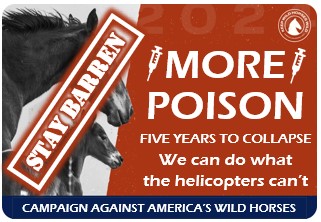
The letter was embedded in story dated January 26 by KLAS News and was no doubt inspired by the lunatics who call themselves advocates.
The 17 horses dispatched for pre-existing conditions were killed because they were deemed unadoptable, not because they couldn’t survive in the wild. They’d be alive today if there was no roundup.
As usual, Titus and her supporters ignore the mismanagement of resources in the lawful homes of wild horses.
AMLs are small relative to the available forage because the bureaucrats have assigned most of it to the public-lands ranchers.
That’s what drives the roundups. The herds are never allowed to fill their niche and manage themselves.
The advocates cooperate in the destruction.
RELATED: FY24 to See More Horses and Burros Off the Range Than On?

The incident began on December 28. Results through January 25:
The figures above are based on the daily reports, not the totals posted by the BLM.
Helicopters did not fly on Day 28. The trap site was moved to an unspecified location.
The death rate is 1.1%. All deaths are chargeable to the roundup.
The capture total includes 758 stallions, 840 mares and 225 foals. The sidebar at the gather page says 756/834/227.
Youngsters represented 12.3% of the animals gathered, consistent with a herd growth rate of seven percent per year.
Of the adults, 47.4% were male and 52.6% were female, no evidence of an abnormal sex ratio.
Body condition scores ranged from 3 to 5 on Day 29.
The name of the contractor was not given.
The Complex is managed primarily for animal agriculture. The National Data Viewer shows habitat loss and grazing allotments. Click on image to open in new tab.
*According to advocates.
Day 29 ended with 6 unaccounted-for animals. The totals at the gather page balance, suggesting the numbers in the daily report are not accurate.
There are no plans to treat any of the captured mares with fertility control pesticides and return them to the range.
Other statistics:
Overpopulation means more horses than allowed by plan, not necessarily more horses than the land can support.
The ability of the Complex to sustain wild horses has been limited by the bureaucrats, who have assigned most of their food to the public-lands ranchers.
Refer to these reports for an indication of the problem:
RELATED: East Pershing Roundup, Day 27.
Nobody talks about wild horse removal more than the advocates.
Their preferred method is to snuff out new life with ovary-killing pesticides and let the herds die off.
The point of no return can be reached in about five years, when most of the mares become “self boosting.” (Refer to the decoder for the meaning of this term.)
Curiously, they market the product as a safe, reversible vaccine, none of which is true.
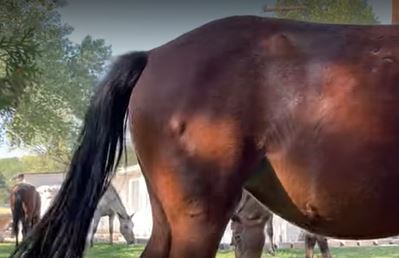
If you think about what happens to the mares, you’ll realize that the sperm-blocking theory can’t be true.
Then you’ll understand why the Assateague herd has not grown seven years after the darting program was shut off, and what’s in store for other herds subject to the Montana Solution.
For a review of the literature and the adverse effects of PZP, go to page 30 in this report by ISPMB.
If you can’t access the file, click here.
RELATED: Foal-Free Friday, Broken Record Edition.
The incident occurred seven to ten days ago according to a news release by the Ochoco National Forest.
The WHT covers 25,434 acres 25 miles east of Prineville, OR and lies mostly within the Reservoir Allotment.

The report for January 24, Day 16 of the roundup, said “Gather goal met,” which would be true if the target was 1,150, but the goal was 1,000.
As of today, there are 184 unaccounted-for animals.
Some will be shipped to Florence and some will be returned to the HMA following treatment with Zonastat-H, a fertility control pesticide endorsed by most advocates.
The event was announced in a January 20 news flash distributed by Lucky Three Ranch.

As a public service, your host has peeled away the veneer, revealing the vision and mission of this shady group and its supporters.
It’s a herd you want to avoid.
The advocates lecture us about family and freedom, yet wherever they’re involved the mares are barren, the herds are shrinking and the ranchers are winning.
RELATED: Assessing the Risk of Sterility in PZP Darting Programs.
As of yesterday, the capture total exceeded the goal by eleven percent and there was no indication that gather operations had concluded.
RELATED: Black Mountain Roundup, Day 15.
The incident began on December 28. Results through January 23:
The figures in this post are based on the daily reports, not the totals posted by the BLM.
Helicopters did not fly on Day 27.
The death rate is 1.1%. All deaths are chargeable to the roundup.
The capture total includes 726 stallions, 811 mares and 218 foals. The sidebar at the gather page says 805 mares captured.
Youngsters represented 12.4% of the animals gathered, consistent with a herd growth rate of seven percent per year.
Of the adults, 47.2% were male and 52.8% were female, no evidence of an abnormal sex ratio.
The name of the contractor was not given and the location of the trap site was not disclosed.
Body condition scores averaged 3 on Day 26.
The sidebar puts the total shipped at 1,728.
The Complex is managed primarily for animal agriculture. The National Data Viewer shows habitat loss and grazing allotments. Click on image to open in new tab.
*According to advocates.
Day 27 ended with 6 unaccounted-for animals. The totals at the gather page show two more horses processed than captured.
There are no plans to treat any of the captured mares with fertility control pesticides and return them to the range.
Other statistics:
Overpopulation means more horses than allowed by plan, not necessarily more horses than the land can support.
The ability of the Complex to sustain wild horses has been limited by the bureaucrats, who have assigned most of their food to the public-lands ranchers.
Refer to these reports for an indication of the problem:
RELATED: East Pershing Roundup, Day 25.
The incident started on January 9. Results through January 23:
The figures in this post are based on the daily reports, not the totals in the sidebar.
The capture goal has been exceeded by 11.2%.
The death rate is 0.2%.
The capture total includes 445 jacks, 505 jennies and 162 foals.
Youngsters represented 14.6% of the animals gathered.
Of the adults, 46.8% were male and 53.2% were female.
The name of the contractor was not given and the location of the trap site was not disclosed.
The HMA is subject to permitted grazing.
The National Data Viewer shows habitat loss and overlapping allotments. Click on map to open in new tab.
The management plan assigns 2.5 times more forage to livestock than the burros.
The roundup supports three tenets of rangeland management.
*According to advocates
RELATED: Black Mountain Roundup, Day 13.


