Coalition Appeals Rock Springs RMP Decision

Attorneys for the American Wild Horse Campaign, Animal Welfare Institute, Western
Watersheds Project and three individuals gave notice on August 16 to the United States Court of Appeals for the Tenth Circuit according to a news release by AWI.

Earlier in the week Judge Kelly Rankin affirmed the BLM’s plan to remove 5,000 wild horses and eliminate two million acres of their habitat in the Wyoming Checkerboard.

RELATED: Court Upholds Rock Springs RMP Amendments.

Sulphur Roundup, Day 4

The incident started on August 13.  Results through August 16:

  • Scope: Sulphur HMA
  • Target: Horses
  • AML: 250
  • Pre-gather population: 606
  • True AML: 1,105
  • Type: Planned
  • Method: Helicopter
  • Category: Cruel and costly (according to advocates)
  • Better way: Shoot mares with pesticide-laced darts (according to advocates)
  • Goals: Gather 420, remove 360
  • Captured: 203, up from 89 on Day 1
  • Shipped: 131, up from zero on Day 1
  • Released: None
  • Deaths: 1, no change from Day 1
  • Average daily take: 50.8
  • Unaccounted-for animals: 71

The figures above are based on the daily reports.

The Day 2 report indicated more foals captured than mares but the actual values are probably 11 and 7, not 11 and 17.

The death rate is 0.5%.

The capture total includes 68 stallions, 97 mares and 38 foals.

Youngsters represented 18.7% of the animals gathered.

Of the adults, 41.2% were male and 58.8% were female.

Body condition scores were not provided.

The location of the trap site was not given.

The HMA is subject to permitted grazing.  Resources liberated to date:

  • Forage: 2,436 AUMs per year
  • Water: 2,030 gallons per day

The July 31 schedule indicates that 30 mares will be treated with GonaCon Equine and be returned to the range with 30 stallions.

The roundup supports three tenets of rangeland management.

RELATED: Sulphur Roundup in Progress.

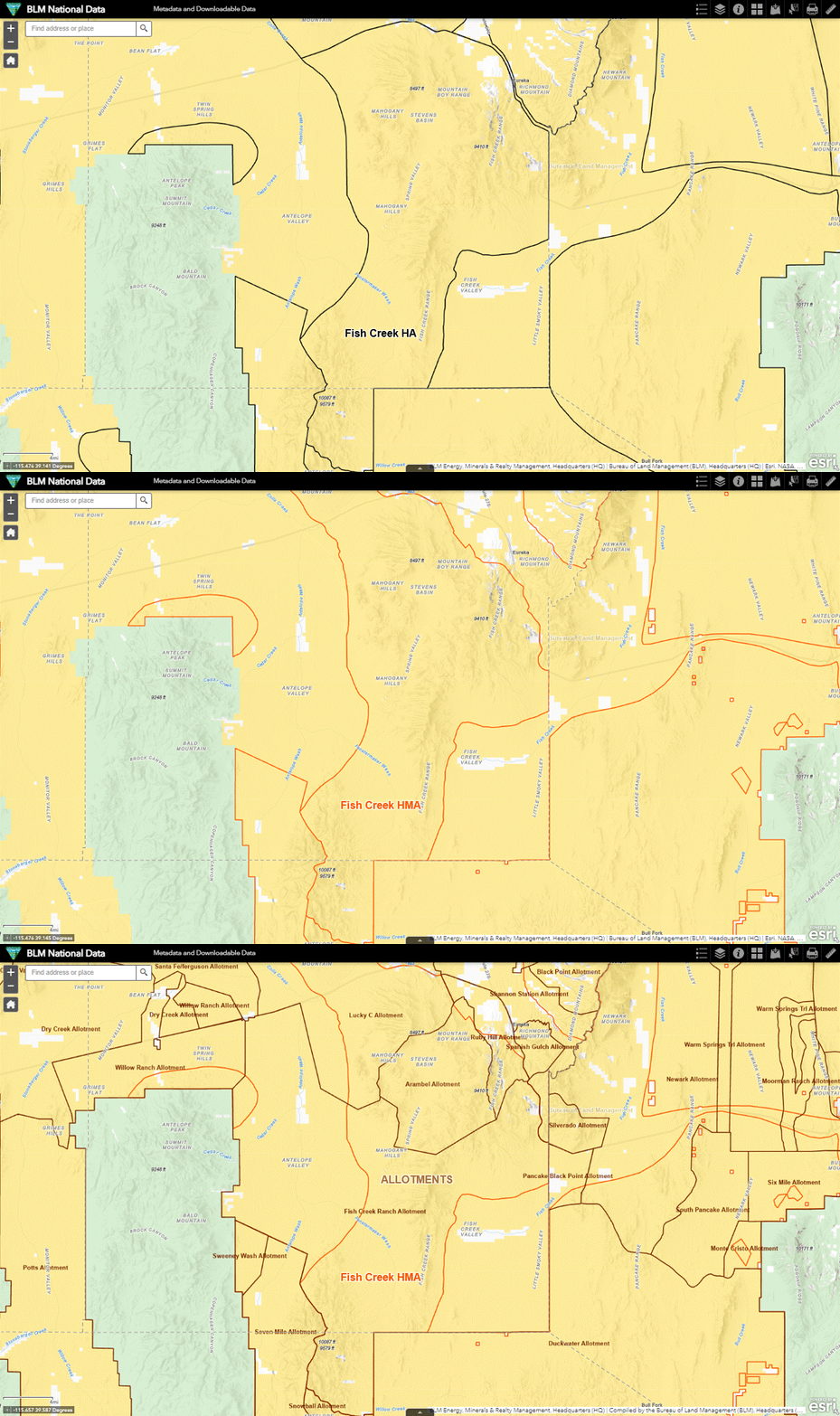
Sulphur HMA with Allotments 08-11-24

Foal-Free Friday, Aiding and Abetting the Ranchers Edition

You could argue that the advocates have abandoned the idea of principal use and have accepted the goal of ranching superiority in the lawful homes of wild horses, sometimes referred to as achieving and maintaining AMLs.  Examples include:

  • Reinforcing policies and plans that drive the removals
  • Monitoring for humane treatment during the removals
  • Picking up the pieces after removals
  • Developing alternate methods of removal
  • Lobbying for alternate methods of removal
  • Lying about alternate methods of removal

Whether it’s HMAPs, videos of abuse during roundups or legislation that promotes the use of pesticides, the wild horse and burro program still operates as a grazing program ancillary, keeping the pests in check so ranchers can access most of their food.

Stay away from the advocates, they are the old guard, leaders of the blind, irrelevant.

RELATED: Foal-Free Friday, Right Versus Wrong Edition.

Moment When Supporter Realizes She's Been Duped 08-14-24

Court Upholds Rock Springs RMP Amendments

A story by E&E News indicates that cases brought by the following groups were dismissed yesterday by the U.S. District Court of Wyoming.

The full article is available to subscribers only.

But a link to the court’s order was provided, which you can read in its entirety.

RELATED: What If the Rock Springs HMAs Were Zeroed Out with Pesticides?

Lake Havasu Roundup, Day 6

The incident started on August 7.  Results through August 12:

  • Scope: West of Havasu HMA, north of Lake Havasu City
  • Target: Burros
  • AML: None
  • Pre-gather population: Unknown
  • Type: Nuisance
  • Method: Bait
  • Goals: Gather 100, remove 100
  • Captured: 90, up from 71 on Day 3
  • Shipped: 48, up from 21 on Day 3
  • Released: None
  • Deaths: 1, no change from Day 3
  • Average daily take: 15.0
  • Unaccounted-for animals: 41

The figures above are based on the daily reports.

The death rate is 1.1%.

The capture total includes 29 jacks, 51 jennies and 10 foals.

Youngsters represented 11.1% of the animals gathered.

Of the adults, 36.3% were male and 63.8% were female.

The location of the trap site is not known.

The July 31 schedule classifies the roundup as an emergency but the gather page says nuisance.

The BLM asserted that an EA from 2008 fully covers the removal.

RELATED: Lake Havasu Roundup, Day 3.

Lake Havasu City 08-05-24

Black Rock Desert Closing for Burning Man

The first part of the closure went into effect on July 25 and runs through September 28, according to the BLM news release.

Phase 2, affecting a wider area, begins on August 19 and runs through September 7.

Refer to the closure map for boundaries.

Black Rock City, “a temporary metropolis dedicated to community, art, self-expression, and self-reliance,” opens on August 25.

The incident was marred last year by rain that turned the playa into a quagmire.

Marietta Roundup Announced

The incident will begin on or about August 20 according to today’s news release.

The capture goals are 31 wild horses and 290 wild burros.

The removal goals are identical, meaning there are no plans to return any of the animals to the HMA.

The current population is thought to be 378 burros and 31 horses.

A helicopter will push the animals into the trap and operations will be open to public observation.

The HMA covers 66,045 total acres southeast of Hawthorne, NV, including 64,466 public acres, according to the 2024 population dataset.

The 104 burros allowed by plan require 624 AUMs per year.

The AML for horses is zero.

Burros identified for removal will be taken to the Axtell off-range corrals.

Horses identified for removal will be shipped to the off-range corrals in Palomino Valley.

Marietta is exempt from permitted grazing although last year the BLM looked at reactivating the Bellville allotment, among others, which overlaps the southern half of the HMA, but then cancelled the project earlier this year.

Marietta HMA with Allotments 08-12-24

Boulders, Not Advocates, Cause of Sunny Hills Roundup?

The head darter-in-charge with the Campaign Against America’s Wild Horses told This Is Reno in the following report that they baited the horses out of the construction area with alfalfa but couldn’t shut the gate behind them because of boulders.

You couldn’t set up some temporary pipe panels to keep them from going back in?

Lash them to existing posts with hay string if necessary?

That should have been plan C.

For those of you in Rio Linda, her remark at 1:36 about putting a lot of money and time and effort into the management of the horses means they’ve spent hundreds of thousands of dollars over the past five years trying to ruin the mares with PZP, a restricted-use pesticide that tricks the immune system into attacking their ovaries.

RELATED: Advocates Bungle Sunny Hills Rescue, 24 Horses Lose Freedom.

Sulphur Roundup Announced

The incident will begin on August 13 according to the BLM news release.

The July 31 schedule puts the capture and removal goals at 420 and 360, respectively.

The current population is thought to be 606.

Free-roaming horses will be pushed into the trap by a helicopter and operations will be open to public observation.

The HMA covers 265,711 total acres in western Utah, including 230,157 public acres, according to the 2024 population dataset.

The 250 horses allowed by plan, a number the bureaucrats and ranchers are willing to tolerate—not the number of horses the land can support, receive 3,000 AUMs per year.

Animals identified for removal will be taken to Axtell off-range corrals.

The schedule indicates that 30 mares will be treated with GonaCon Equine and be returned to the range with 30 stallions, but this is not mentioned in the news release.

Animals removed = Animals capturedAnimals returned = 420 – 60 = 360

As of today, a link to the daily reports has not been added to the Utah gather page.

The roundup supports three tenets of rangeland management.

RELATED: Sulphur Wild Horses Get Short End of Stick.

UPDATE: Gather stats and daily reports will be posted to this page.

Sulphur HMA with Allotments 08-11-24

Tassi-Gold Butte Draft EA Out for Public Review

The former HMA, which was zeroed out in 1998 to protect the desert tortoise, covers 101,816 acres of Mojave Desert in northwestern Arizona.

The environmental assessment analyzes the use of periodic removals to achieve and maintain zero wild burros in and around the HA, according to yesterday’s news release.

The current population is thought to be 219.

The Proposed Action, discussed in Section 2.2, would authorize helicopter and bait trapping over an unspecified period.

Comments will be accepted through September 9.

The EA was copied to the project folder along with the news release.

The HA is not subject to permitted grazing but adjacent lands are.

Refer to the maps in Appendix A.

RELATED: New Management Plan Targets Tassi-Gold Butte Burros?

UPDATE: The NPS news release was published on August 12.

Lake Havasu Roundup, Day 3

The incident started on August 7.  Results through August 9:

  • Scope: West of Havasu HMA, north of Lake Havasu City
  • Target: Burros
  • AML: None
  • Pre-gather population: Unknown
  • Type: Nuisance
  • Method: Bait
  • Goals: Gather 100, remove 100
  • Captured: 71, up from 42 on Day 1
  • Shipped: 21, up from zero on Day 1
  • Released: None
  • Deaths: 1, no change from Day 1
  • Average daily take: 23.7
  • Unaccounted-for animals: 49

The figures above are based on the daily reports.

The capture total includes 24 jacks, 39 jennies and 8 foals.

Youngsters represented 11.3% of the animals gathered.

Of the adults, 38.1% were male and 61.9% were female.

The location of the trap site is not known.

The July 31 schedule classifies the roundup as an emergency but the gather page says nuisance.

The BLM asserted that an EA from 2008 fully covers the removal.

RELATED: Lake Havasu Roundup Begins.

Lake Havasu City 08-05-24

Advocates Bungle Sunny Hills Rescue, 24 Horses Lose Freedom

The number of horses removed from the construction site has climbed to 24 according to an NDA news release dated August 9.

The news release confirms they were taken to NNCC where they will be microchipped and identified to ensure they are not returned to the range.

An inventory of the animals was not provided.

An advocate with the Campaign Against America’s Wild Horses, organizer of the mass sterilization program, told KRNV News in the following report that the horses could be sent to auction, where they could be sold for slaughter.

RELATED: Sunny Hills 20 Taken to NNCC?