Triple B Roundup, Day 29

The incident started on November 2.  Results through November 30:

  • Scope: Triple B Complex
  • Target: Wild horses
  • AML: 889
  • Pre-gather population: 3,335
  • True AML: 4,551
  • Type: Planned
  • Method: Helicopter
  • Category: Cruel and costly (according to advocates)
  • Better way: Sterilize mares with PZP (according to advocates)
  • Capture goal: 2,255
  • Removal goal: 2,155
  • Captured: 2,102, up from 1,953 on Day 27
  • Shipped: 1,938, up from 1,754 on Day 27
  • Released: 20, no change from Day 27
  • Deaths: 24, up from 23 on Day 27
  • Average daily take: 72.5
  • Unaccounted-for animals: 120
  • Snippet from statute: It is the policy of Congress that wild free-roaming horses and burros shall be protected from capture, branding, harassment, or death
  • Snippet from manual: To protect wild horses and burros from unauthorized capture, branding, harassment or death

The figures above are based on the daily reports.

The sidebar says 1,941 shipped.  If that figure was used, there would be 117 unaccounted-for horses.

A stallion died of a ruptured aorta on Day 28.

The death rate is 1.1%.

The capture total includes 776 stallions, 834 mares and 492 foals.

Youngsters represented 23.4% of the animals gathered, consistent with a herd growth rate of 18% per year.

Of the adults, 48.2% were male and 51.8% were female, no indication of an abnormal sex ratio.

Body condition scores were not given.

The location of the trap site was not disclosed.

The name of the contractor was not provided.

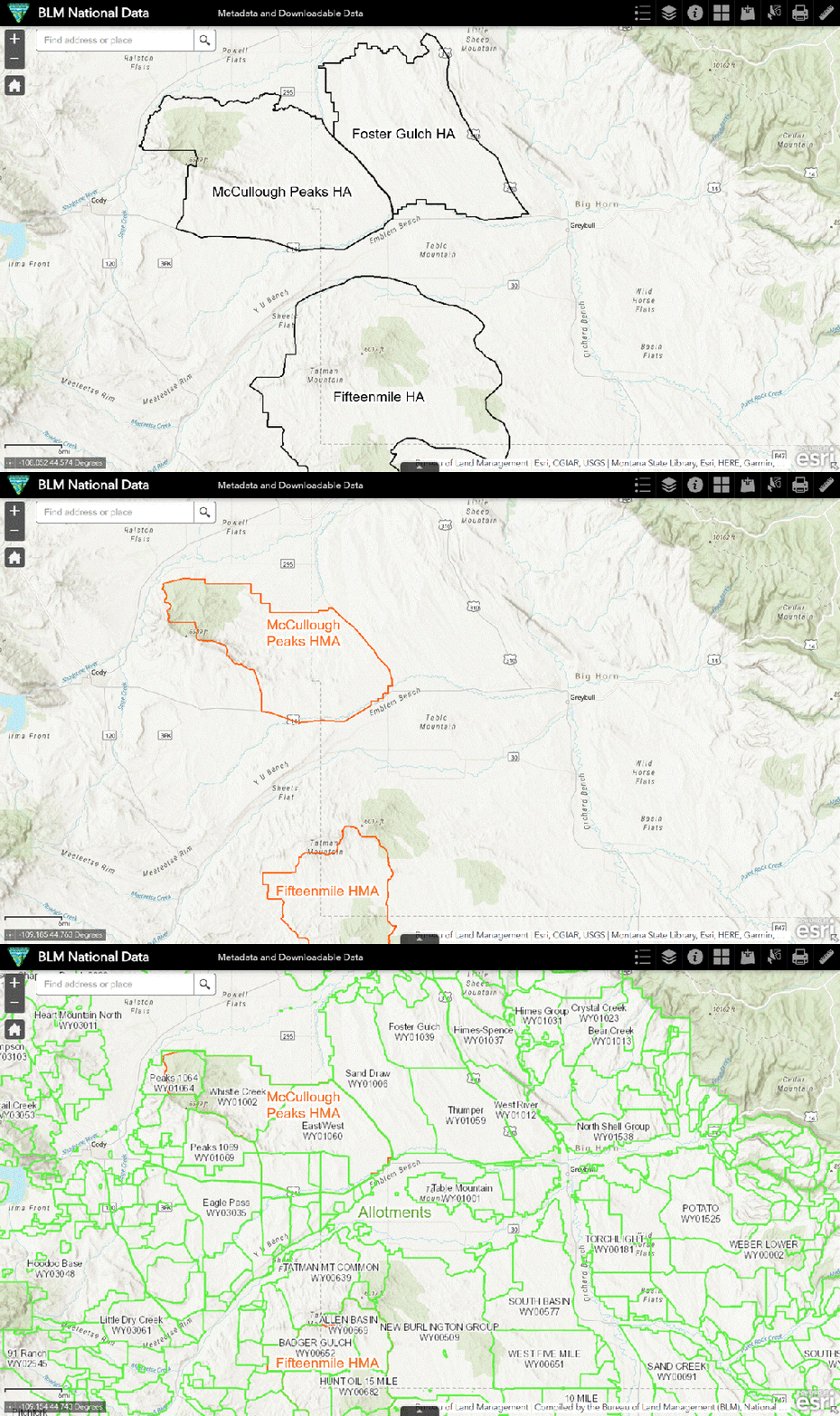
Three HMAs are affected.

Twelve mares have been treated with GonaCon Equine.  The plan calls for up to 50 to receive the pesticide and be returned to the range with up to 50 stallions.

The roundup supports three tenets of rangeland management.

Resources liberated to date:

  • Forage: 24,984 AUMs per year
  • Water: 20,820 gallons per day

The Complex supports livestock equivalent to 3,730 wild horses, so it will always be at 4.2X AML or more.

RELATED: Triple B Roundup, Day 27.

Triple B Complex with Allotments 11-04-24

Triple B Roundup, Day 27

The incident started on November 2.  Results through November 28:

  • Scope: Triple B Complex
  • Target: Wild horses
  • AML: 889
  • Pre-gather population: 3,335
  • True AML: 4,551
  • Type: Planned
  • Method: Helicopter
  • Category: Cruel and costly (according to advocates)
  • Better way: Sterilize mares with PZP (according to advocates)
  • Capture goal: 2,255
  • Removal goal: 2,155
  • Captured: 1,953, up from 1,829 on Day 25
  • Shipped: 1,754, no change from Day 25
  • Released: 20, no change from Day 25
  • Deaths: 23, no change from Day 25
  • Average daily take: 72.3
  • Unaccounted-for animals: 156
  • Snippet from statute: It is the policy of Congress that wild free-roaming horses and burros shall be protected from capture, branding, harassment, or death
  • Snippet from manual: To protect wild horses and burros from unauthorized capture, branding, harassment or death

The figures above are based on the daily reports.

The sidebar says 1,757 shipped.  If that figure was used, there would be 153 unaccounted-for horses.

The death rate is 1.2%.

The capture total includes 726 stallions, 773 mares and 454 foals.

Youngsters represented 23.2% of the animals gathered, consistent with a herd growth rate of 18% per year.

Of the adults, 48.4% were male and 51.6% were female, no indication of an abnormal sex ratio.

Body condition scores were not given.

The location of the trap site was not disclosed.

The name of the contractor was not provided.

Three HMAs are affected.

Twelve mares have been treated with GonaCon Equine.  The plan calls for up to 50 to receive the pesticide and be returned to the range with up to 50 stallions.

The roundup supports three tenets of rangeland management.

Resources liberated to date:

  • Forage: 23,196 AUMs per year
  • Water: 19,330 gallons per day

The Complex supports livestock equivalent to 3,730 wild horses, so it’s always at 4.2X AML or more.

RELATED: Triple B Roundup, Day 25.

Triple B Complex with Allotments 11-04-24

Triple B Roundup, Day 25

The incident started on November 2.  Results through November 26:

  • Scope: Triple B Complex
  • Target: Wild horses
  • AML: 889
  • Pre-gather population: 3,335
  • True AML: 4,551
  • Type: Planned
  • Method: Helicopter
  • Category: Cruel and costly (according to advocates)
  • Better way: Sterilize mares with PZP (according to advocates)
  • Capture goal: 2,255
  • Removal goal: 2,155
  • Captured: 1,829, up from 1,785 on Day 23
  • Shipped: 1,754, up from 1,586 on Day 23
  • Released: 20, no change from Day 23
  • Deaths: 23, up from 18 on Day 23
  • Average daily take: 73.2
  • Unaccounted-for animals: 32
  • Snippet from statute: It is the policy of Congress that wild free-roaming horses and burros shall be protected from capture, branding, harassment, or death
  • Snippet from manual: To protect wild horses and burros from unauthorized capture, branding, harassment or death

The figures above are based on the daily reports.

Helicopters did not fly on Day 25 due to bad weather.

The sidebar says 1,757 shipped.

Four mares were dispatched on Day 24 due to poor body condition.  Another mare died on Day 25 after breaking her neck, lifting the death rate to 1.3%.

The capture total includes 695 stallions, 718 mares and 416 foals.

Youngsters represented 22.7% of the animals gathered, consistent with a herd growth rate of 17% per year.

Of the adults, 49.2% were male and 50.8% were female, no indication of an abnormal sex ratio.

Body condition scores were not given.

The location of the trap site was not disclosed.

The name of the contractor was not provided.

Three HMAs are affected.

Twelve mares have been treated with GonaCon Equine.  The plan calls for up to 50 to receive the pesticide and be returned to the range with up to 50 stallions.

The roundup supports three tenets of rangeland management.

Resources liberated to date:

  • Forage: 21,708 AUMs per year
  • Water: 18,090 gallons per day

The Complex supports livestock equivalent to 3,730 wild horses, so it’s always at 4.2X AML or more.

RELATED: Triple B Roundup, Day 23.

Triple B Complex with Allotments 11-04-24

NDA Schedules Fourth Quarter Board of Agriculture Meeting

The meeting will be held in Las Vegas on December 6.

It will be livestreamed on Zoom according to the notice and video conferences will be available in Sparks and Elko.

The Washoe Lake fencing project was not called out as a line item in the agenda but will probably be included in the Animal Industry discussion.

As of today, no reports have been posted to the meeting page.

RELATED: Washoe Lake Fencing Not a New Idea?

Wild Horse Effect on Rangelands Confounded with Livestock

Consider five HMAs in Wyoming covered by a 2021 EA for management actions therein:

Rock Springs AML Calcs 07-07-24

If all of the horses were removed from Adobe Town, livestock equivalent to 2,688 wild horses would remain, putting the HMA at 3.4X AML.  Not good for wildlife.

If all of the horses were removed from Great Divide Basin, livestock equivalent to 2,993 wild horses would remain, putting the HMA at 5.0X AML.  Bad for rangeland health.

If Salt Wells Creek was depopulated of horses, livestock equivalent to 4,963 wild horses would remain, putting the HMA at 13.6X AML.  A disaster by any standard.

If White Mountain was relieved of equines, livestock equivalent to 1,589 would remain, putting the HMA at 5.3X AML.  Unacceptable.

If Little Colorado was subject to a 100% roundup, livestock equivalent to 3,750 wild horses would remain, putting the HMA at 37.5X AML.  Immediate action required.

Curiously, nobody’s complaining.  The horses are gone and that’s all that matters.

RELATED: Sage Grouse Study Implicates Wild Horses?

Devil’s Garden Roundup, Day 28

The incident started on October 28.  Results through November 24:

  • Location: Devil’s Garden Plateau WHT
  • AML: 402
  • Pre-gather population: Between 651 and 998
  • Target: Horses
  • Type: Planned
  • Method: Helicopter and bait
  • Goals: Capture 500, remove 500
  • Category: Cruel and costly (according to advocates)
  • Better way: Sterilize mares with PZP (according to advocates)
  • Captured: 301, up from 128 on Day 10
  • Shipped: Unknown
  • Released: Unknown
  • Deaths: 3
  • Average daily take: 10.8
  • Unaccounted-for animals: Unknown

The Forest Service added daily reports to the gather page starting on November 1 but results for October 28 – 31 are missing.

The death rate is 1%.

The capture total since November 1 includes 80 stallions, 99 mares and 40 foals, for a total of 219.

That means 82 horses were taken during the first four days which is hard to believe for an operation that’s been averaging ten per day.

The location of the trap site was not disclosed.

More information may be available on socialist media.

Body conditions scores have been averaging 4 to 5, an indication that the horses are not starving and the herd has not exceeded the ability of the land to sustain it.

The roundup will achieve a thriving ecological balance and multiple-use relationship on public lands, codewords for ranching superiority in the lawful home of wild horses.

RELATED: Devil’s Garden Roundup, Day 10.

Thriving Ecological Balance-3

Next WHBAB Meeting Set for Early January

An unpublished announcement will appear in the Federal Register tomorrow.

The meeting runs from January 7 to 9 in Sacramento.

Days 1 and 2 include a public comment session.

The third day is devoted to a tour of the Rio Cosumnes Correctional Center.

The meeting is open to the public and will be livestreamed.

The agenda does not include a session on the unlawful use of pesticides, a growing problem in areas identified for wild horses.

The Wild Horse and Burro Advisory Board supports three tenets of rangeland management.

UPDATE: The announcement has been published.

Triple B Roundup, Day 23

The incident started on November 2.  Results through November 24:

  • Scope: Triple B Complex
  • Target: Wild horses
  • AML: 889
  • Pre-gather population: 3,335
  • True AML: 4,551
  • Type: Planned
  • Method: Helicopter
  • Category: Cruel and costly (according to advocates)
  • Better way: Sterilize mares with PZP (according to advocates)
  • Capture goal: 2,255
  • Removal goal: 2,155
  • Captured: 1,785, up from 1,679 on Day 21
  • Shipped: 1,586, up from 1,459 on Day 21
  • Released: 20, no change from Day 21
  • Deaths: 18, up from 17 on Day 21
  • Average daily take: 77.6
  • Unaccounted-for animals: 161
  • Snippet from statute: It is the policy of Congress that wild free-roaming horses and burros shall be protected from capture, branding, harassment, or death
  • Snippet from manual: To protect wild horses and burros from unauthorized capture, branding, harassment or death

The figures above are based on the daily reports.

The sidebar says 1,589 shipped.

A mare was put down on Day 23 for poor body condition.

The death rate is 1.0%.

The capture total includes 680 stallions, 700 mares and 405 foals.

Youngsters represented 22.7% of the animals gathered, consistent with a herd growth rate of 17% per year.

Of the adults, 49.3% were male and 50.7% were female, no indication of an abnormal sex ratio.

Body condition scores were not given.

The location of the trap site was not disclosed.

The name of the contractor was not provided.

Three HMAs are affected.

Twelve mares have been treated with GonaCon Equine.  The plan calls for up to 50 to receive the pesticide and be returned to the range with up to 50 stallions.

The roundup supports three tenets of rangeland management.

Resources liberated to date:

  • Forage: 21,180 AUMs per year
  • Water: 17,650 gallons per day

RELATED: Triple B Roundup, Day 21.

Triple B Complex with Allotments 11-04-24

Buffalo Hills Roundup Ends Early

The incident concluded today with 138 horses captured, 32 shipped, 50 released and four dead.

Thirty-three burros were caught and shipped.

There were 52 unaccounted-for horses.

The capture goals were 235 horses and 33 burros.

Fifty-seven mares were treated GonaCon Equine and five were released.

The sidebar indicates that the remainder, representing the unaccounted-for animals, will receive a booster after 30 days, making the HMA another GonaCon crime scene.

The minimum interval is 90 days according to the pesticide label.

The death rate was 2.9%.

Youngsters represented 12.3% of the horses captured.

Of the adults, 43.8% were male and 56.2% were female.

The roundup liberated 1,254 AUMs per year and 1,045 gallons of water per day but these numbers will go down when the treated mares are released.

RELATED: Buffalo Hills Roundup Set for Next Week.

UPDATE: The BLM news release reiterates the 30-day interval.

Washoe Lake Fencing Not a New Idea?

The Animal Industry Report for the third quarter Board of Agriculture meeting indicates on page three, under Livestock Identification, that

  • NDA has entered into a contract with a vendor for reconstruction of BLM fences and construction of new fences pending the completion of the NEPA study, in the Virginia Range Area
  • All funding is sourced from the NDA Feral Horse Management Project
  • John Axtell has taken over as project manager

Axtell’s predecessor may have been Jim Wheeler, who was hired for a 15-month term on a USDA grant.

Wheeler noted last year that many wild horses have moved into Washoe Lake State Park, in part because the state hasn’t maintained the fencing.

As for the third quarter meeting, it was cancelled.

A fourth quarter meeting has not been scheduled.

RELATED: NDA Installing Fence Around Washoe Lake?

Triple B Roundup, Day 21

The incident started on November 2.  Results through November 22:

  • Scope: Triple B Complex
  • Target: Wild horses
  • AML: 889
  • Pre-gather population: 3,335
  • True AML: 4,551
  • Type: Planned
  • Method: Helicopter
  • Category: Cruel and costly (according to advocates)
  • Better way: Sterilize mares with PZP (according to advocates)
  • Capture goal: 2,255
  • Removal goal: 2,155
  • Captured: 1,679, up from 1,431 on Day 19
  • Shipped: 1,459, up from 1,324 on Day 19
  • Released: 20, no change from Day 19
  • Deaths: 17, up from 15 on Day 19
  • Average daily take: 80.0
  • Unaccounted-for animals: 183
  • Snippet from statute: It is the policy of Congress that wild free-roaming horses and burros shall be protected from capture, branding, harassment, or death
  • Snippet from manual: To protect wild horses and burros from unauthorized capture, branding, harassment or death

The figures above are based on the daily reports.

The sidebar says 1,462 shipped.

A stallion was put down on Day 21 for a wry nose and a foal died during transportation.

The death rate is 1.0%.

The capture total includes 646 stallions, 652 mares and 381 foals.

Youngsters represented 22.7% of the animals gathered, consistent with a herd growth rate of 17% per year.

Of the adults, 49.8% were male and 50.2% were female, no indication of an abnormal sex ratio.

Body condition scores were not given.

The location of the trap site was not disclosed.

The name of the contractor was not provided.

Three HMAs are affected.

Twelve mares have been treated with GonaCon Equine.  The plan calls for up to 50 to receive the pesticide and be returned to the range with up to 50 stallions.

The roundup supports three tenets of rangeland management.

Resources liberated to date:

  • Forage: 19,908 AUMs per year
  • Water: 16,590 gallons per day

RELATED: Triple B Roundup, Day 19.

Triple B Complex with Allotments 11-04-24

Murderer’s Creek Emergency Roundup Announced

The DNA and DR were copied to the project folder on November 15.

Bait trapping will begin on November 25 according to a USFS news release.

The removal goal is 350 to 400 wild horses, but those numbers could go up throughout the winter depending on forage availability.

The pre-gather population is thought to be around 650.

The announcement did not indicate if operations would be open public observation.

Captured animals will be taken to holding facilities in Burns, OR (probably the Hines corrals) and Alturas, CA (probably Litchfield).

The name of the contractor was not provided.

A link to the daily reports was not given.

The project area covers BLM and Forest Serice lands (HMA | WHT).

RELATED: Murderer’s Creek DNA Out for Public Review.

UPDATE: BLM created a page for gather stats and daily reports.

UPDATE: The BLM news release does not indicate how many horses will be returned to the area when conditions improve.

Buffalo Hills Roundup, Day 7

The incident started on November 15.  Results through November 21:

  • Scope: Buffalo Hills HMA
  • Target: Wild horses and burros
  • AML: 314 horses, no burros
  • Pre-gather population: 314 horses, 33 burros
  • True AML: 408 horses
  • Type: Planned
  • Method: Helicopter
  • Category: Cruel and costly (according to advocates)
  • Better way: Sterilize mares with PZP (according to advocates)
  • Capture goal: 235 horses, 33 burros
  • Removal goal: 32 horses, 33 burros
  • Horses captured: 138, up from 116 on Day 5
  • Burros captured: 33, no change from Day 5
  • Horses shipped: 15, up from zero on Day 5
  • Burros shipped: 33, no change from Day 5
  • Horses released: None
  • Burros released: None
  • Horse deaths: 4, up from 3 on Day 5
  • Burro deaths: None
  • Average daily take: 19.7 horses
  • Unaccounted-for animals: 119 horses, zero burros
  • Snippet from statute: It is the policy of Congress that wild free-roaming horses and burros shall be protected from capture, branding, harassment, or death
  • Snippet from manual: To protect wild horses and burros from unauthorized capture, branding, harassment or death

The figures above are based on the daily reports.

Burros

The capture goal has been reached.

All animals have been shipped.

There were no deaths.

The capture total includes 5 jacks, 21 jennies and 7 foals.

Horses

A death was reported on Day 6.  No details were given.

The death rate is 2.9%.

The capture total includes 53 stallions, 68 mares and 17 foals.  The sidebar says 53, 67 and 18.

Youngsters represented 12.3% of the animals gathered, consistent with a herd growth rate of 7% per year.

Of the adults, 43.8% were male and 56.2% were female, no indication of an abnormal sex ratio.

Body condition scores were not given.

The location of the trap site was not disclosed.

The name of the contractor was not provided.

Up to 100 mares will be treated with GonaCon Equine and released back to the range with up to 103 stallions.

The roundup supports three tenets of rangeland management.

Resources liberated to date (based on horses and burros):

  • Forage: 1,854 AUMs per year
  • Water: 1,545 gallons per day

RELATED: Buffalo Hills Roundup, Day 5.

Buffalo Hills HMA with Allotments 10-02-24

New Management Plan in the Works for Adobe Town HMA?

A new project was started in ePlanning yesterday but no documents have been posted.

The description says the BLM will remove horses from the HMA in the summer or fall of 2026 and will use population growth suppression to slow the rate of reproduction.

The plan would apply to the portion not zeroed out by the RSGA decision.

In June, the BLM opened a project in ePlanning to implement that decision, although it has been challenged by several advocacy groups.

Triple B Roundup, Day 19

The incident started on November 2.  Results through November 20:

  • Scope: Triple B Complex
  • Target: Wild horses
  • AML: 889
  • Pre-gather population: 3,335
  • True AML: 4,551
  • Type: Planned
  • Method: Helicopter
  • Category: Cruel and costly (according to advocates)
  • Better way: Sterilize mares with PZP (according to advocates)
  • Capture goal: 2,255
  • Removal goal: 2,155
  • Captured: 1,431, up from 1,351 on Day 17
  • Shipped: 1,324, up from 1,150 on Day 17
  • Released: 20, no change from Day 17
  • Deaths: 15, up from 13 on Day 17
  • Average daily take: 75.3
  • Unaccounted-for animals: 72
  • Snippet from statute: It is the policy of Congress that wild free-roaming horses and burros shall be protected from capture, branding, harassment, or death
  • Snippet from manual: To protect wild horses and burros from unauthorized capture, branding, harassment or death

The figures above are based on the daily reports.

The sidebar says 1,327 shipped.  On Day 18, 75 mares were shipped with no foals and on Day 19 no mares were shipped with 49 foals.

Two mares were dispatched on Day 19 for poor body condition.  The death rate is 1.0%.

The capture total includes 555 stallions, 552 mares and 323 foals.

Youngsters represented 22.6% of the animals gathered, consistent with a herd growth rate of 17% per year.

Of the adults, 50.1% were male and 49.9% were female, no indication of an abnormal sex ratio.

Body condition scores were not given.

The location of the trap site was not disclosed.

The name of the contractor was not provided.

Three HMAs are affected.

Twelve mares have been treated with GonaCon EquineThe plan calls for up to 50 to receive the pesticide and be returned to the range with up to 50 stallions.

The roundup supports three tenets of rangeland management.

Resources liberated to date:

  • Forage: 16,932 AUMs per year
  • Water: 14,110 gallons per day

RELATED: Triple B Roundup, Day 17.

Triple B Complex with Allotments 11-04-24

Buffalo Hills Roundup, Day 5

The incident started on November 15.  Results through November 19:

  • Scope: Buffalo Hills HMA
  • Target: Wild horses and burros
  • AML: 314 horses, no burros
  • Pre-gather population: 314 horses, 33 burros
  • True AML: 408 horses
  • Type: Planned
  • Method: Helicopter
  • Category: Cruel and costly (according to advocates)
  • Better way: Sterilize mares with PZP (according to advocates)
  • Capture goal: 235 horses, 33 burros
  • Removal goal: 32 horses, 33 burros
  • Horses captured: 116, up from 66 on Day 3
  • Burros captured: 33, no change from Day 3
  • Horses shipped: None
  • Burros shipped: 33, no change from Day 3
  • Horses released: None
  • Burros released: None
  • Horse deaths: 3, up from 1 on Day 3
  • Burro deaths: None
  • Average daily take: 23.2 horses
  • Unaccounted-for animals: 113 horses, zero burros
  • Snippet from statute: It is the policy of Congress that wild free-roaming horses and burros shall be protected from capture, branding, harassment, or death
  • Snippet from manual: To protect wild horses and burros from unauthorized capture, branding, harassment or death

The figures above are based on the daily reports.

Burros

The capture goal has been reached.

All animals have been shipped.

There were no deaths.

The capture total includes 5 jacks, 21 jennies and 7 foals.

Horses

A death was reported on Day 4 and again on Day 5.  No details were given.

The death rate is 2.6%.

The capture total includes 48 stallions, 55 mares and 13 foals.

Youngsters represented 11.2% of the animals gathered.

Of the adults, 46.6% were male and 53.4% were female.

Body condition scores were not given.

The location of the trap site was not disclosed.

The name of the contractor was not provided.

Up to 100 mares will be treated with GonaCon Equine and released back to the range with up to 103 stallions.

The roundup supports three tenets of rangeland management.

Resources liberated to date (based on horses and burros):

  • Forage: 1,590 AUMs per year
  • Water: 1,325 gallons per day

RELATED: Buffalo Hills Roundup, Day 3.

Buffalo Hills HMA with Allotments 10-02-24

Pryor Management Plan Moves to Protest Stage

The Final EA and unsigned FONSI were copied to the project folder on November 15, along with 19 appendices, initiating a 30-day protest period.

Protests are usually limited to those who participated in the planning process but this is not stated in the BLM news release.

No decisions have been issued.

Under Alternative 2, the Proposed Action, the AML would be set at 107 to 120 horses, excluding foals less than one year of age.  The current range is 90 to 120.

Herd size would be limited by removals, fertility control, natural means or a combination thereof.

ZonaStat-H would remain the preferred method.

Mares that don’t respond would be treated with GonaCon-Equine or other approved product or be removed from the HMA.

These and other objectives would be documented in a new HMAP, discussed in Section 2.3.1 of the EA.

The Billings RMP would be amended to improve genetic diversity but not at the expense of rangeland health.  This may include the introduction of horses from other areas, as explained in Section 1.5.1.

The upper end of the AML corresponds to the maximum number of horses that the range can support without deterioration, according to Appendix C.  The lower end represents the population that will grow to the upper limit in four to five years.

The new AML of 107 to 120 implies a 2.4% annual growth rate over five years, suggesting the mares will be heavily “sedated” with pesticides if they aren’t already.

RELATED: Draft EA Released for Pryor Mountain RMP Update.

Triple B Roundup, Day 17

The incident started on November 2.  Results through November 18:

  • Scope: Triple B Complex
  • Target: Wild horses
  • AML: 889
  • Pre-gather population: 3,335
  • True AML: 4,551
  • Type: Planned
  • Method: Helicopter
  • Category: Cruel and costly (according to advocates)
  • Better way: Sterilize mares with PZP (according to advocates)
  • Capture goal: 2,255
  • Removal goal: 2,155
  • Captured: 1,351, up from 1,086 on Day 15
  • Shipped: 1,150, up from 904 on Day 15
  • Released: 20, no change from Day 15
  • Deaths: 13, up from 11 on Day 15
  • Average daily take: 79.5
  • Unaccounted-for animals: 168
  • Snippet from statute: It is the policy of Congress that wild free-roaming horses and burros shall be protected from capture, branding, harassment, or death
  • Snippet from manual: To protect wild horses and burros from unauthorized capture, branding, harassment or death

The figures above are based on the daily reports.

The sidebar says 1,153 shipped.

Two stallions were dispatched on Day 16.  The death rate is 1.0%.

The capture total includes 530 stallions, 519 mares and 302 foals.

Youngsters represented 22.4% of the animals gathered, consistent with a herd growth rate of 17% per year.

Of the adults, 50.5% were male and 49.5% were female, no indication of an abnormal sex ratio.

Body condition scores were not given.

The location of the trap site was not disclosed.

The name of the contractor was not provided.

Three HMAs are affected.

Twelve mares have been treated with GonaCon EquineThe plan calls for up to 50 to receive the pesticide and be returned to the range with up to 50 stallions.

The roundup supports three tenets of rangeland management.

Resources liberated to date:

  • Forage: 15,972 AUMs per year
  • Water: 13,310 gallons per day

RELATED: Triple B Roundup, Day 15.

Triple B Complex with Allotments 11-04-24