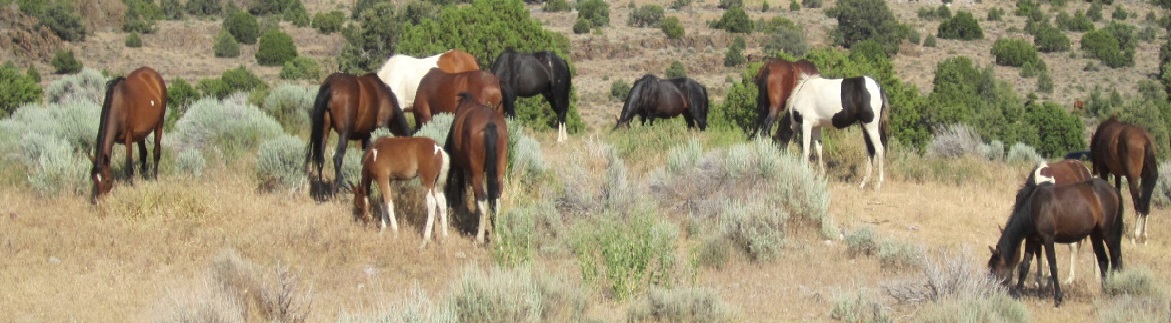
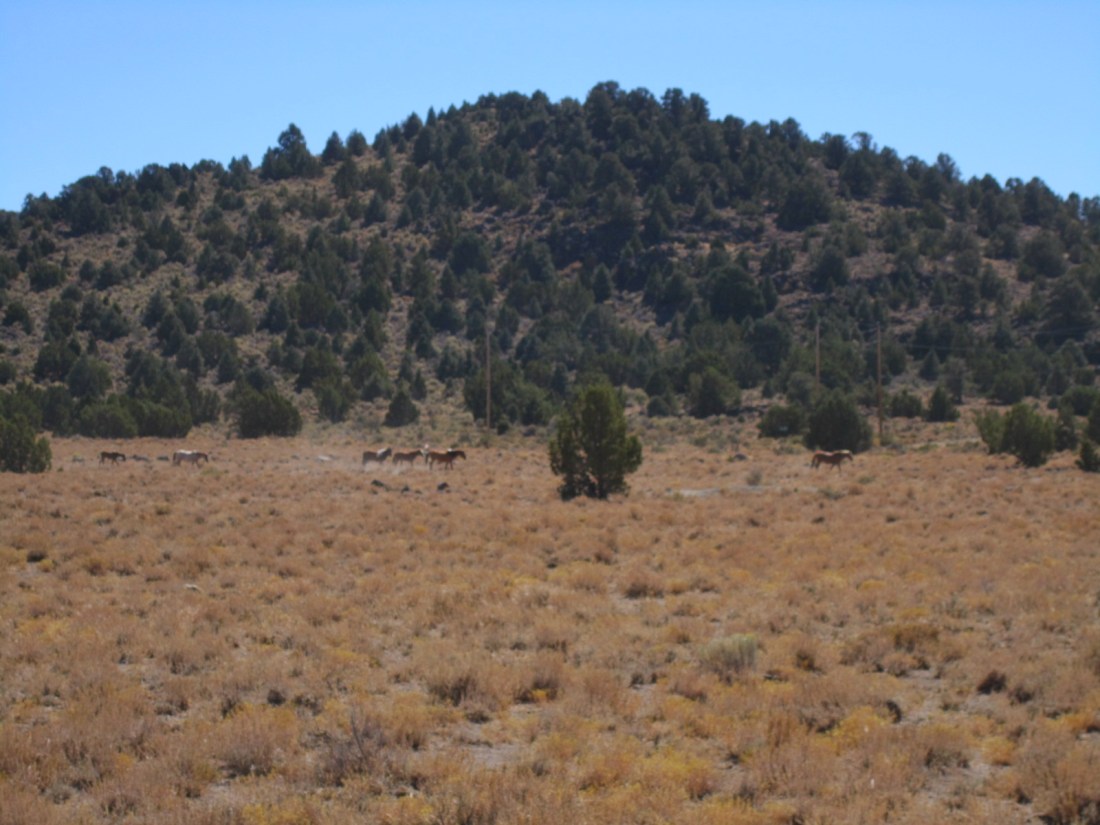
Suppose you visited an HMA in Nevada and found a band of 16 horses near a water hole. Six had a base color of red and ten were black.
According to the post on horse colors, 25% of horses should be red, 75% should be black.
In your sample, 6/16 = 37.5% are red.
Are red horses over-represented in this group? Is there discrimination toward black?
Let’s start with the genetics of base color. There are four possibilities in the Extension Locus: EE, Ee, eE, ee. Any combination containing E will be black (because it’s dominant). Therefore, 3/4 = 75% of horses should have a base color of black, 1/4 = 25% should be red.
The expected proportion of red is a property of the population of all horses, not samples of sixteen. The range of variation of red in samples of sixteen is found by calculation:
Mean ± 3 Standard deviations
Given that a horse is red or not-red, the mean and standard deviation can be supplied by the binomial distribution:
np ± 3 × Sqrt[np × (1 – p)]
where p = .25 and n = 16.
The upper limit of variation is 9.196. Round ‘inward,’ toward the mean, to 9.
The lower limit is -1.196. Round to the nearest non-negative integer, 0.
In groups of 16, you should expect to find anywhere from zero to nine red horses. In this example, six is well within the expected range of variation. No sign of trouble here.
Now suppose you went to the Kiger HMA in Oregon and found no red horses in a group of 25.
The expected range of variation is 0 and 12 so you might conclude that red is not under-represented in that area. However, your subject-matter knowledge tells you the HMA is managed primarily for grullos and bay duns so the low number of reds is not surprising.
Imagine you just read a report on the results of a wild horse gather, where 101 mares and fillies were rounded up along with 79 stallions and colts. Were the helicopter pilots targeting females?
Show your work.
Hint: p = .5 and n = 180.