On this day we count our blessings….which might include too much food and football!

Western Horse Watchers Association
Exposing the Hypocrisy, Lies and Incompetence of the Wild Horse Advocates
On the range
On this day we count our blessings….which might include too much food and football!
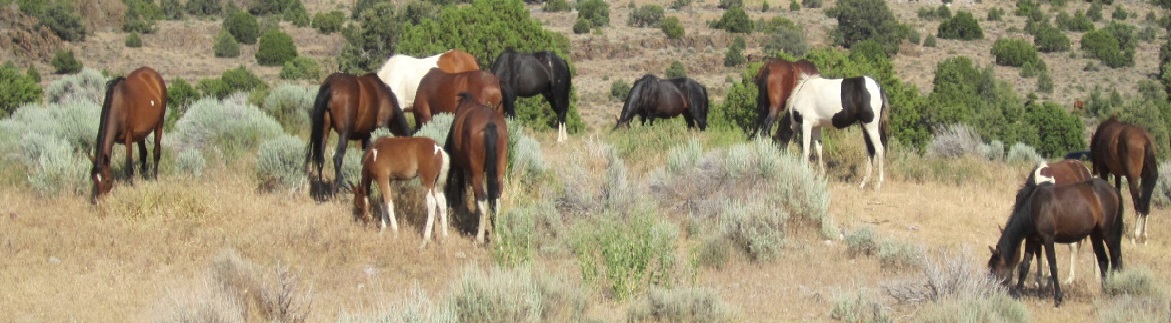
Wild horses of the Virginia Range, south of Virginia City. H/T Base Camp Chris.
Six wild horses that tried repeatedly to cross the North Carolina state line into Virginia have been apprehended and placed at a rescue, according to a story that appeared yesterday in The News & Observer of Raleigh, NC.
They had been returned to their home territory six or seven times, but were determined to reach Virginia. Officials were concerned they would end up in populated areas, so after being declared a nuisance by the Department of the Interior (hard to believe, I know), they were rounded up.
Poor things, they only wanted a better life in Virginia Beach. With a little training, they could have done work that other horses wouldn’t do. What a bunch of equinophobes!
Friends of a Legacy, a group that works with the BLM to manage the wild horses of McCullough Peaks HMA in northern Wyoming, has received a $5000 grant from ASPCA to support a fertility control program started in 2004, according to a story posted today in the Cody Enterprise.
“The program has lowered birth rates in the herd management area and the reduced population has benefitted habitat for the wild horses, wildlife and domestic cattle that share the public land.”
The AML for the area is 140 animals, which has nothing to do with the carrying capacity of the land. Rather, it represents an acceptable forage loss. By keeping the wild horse population in check, more food is available for livestock.
Welcome to the new reality of western rangelands. Areas set aside in 1971 for horses and burros are now managed primarily for cattle and sheep.
Anything for the public-lands ranchers.
Wild horses rounded up in 2016 were released on 10/27/18 into the area they previously inhabited, according to a report posted today by the Ruidoso News.
A district court judge ruled earlier this month that the New Mexico Livestock Board had no jurisdiction in the case, allowing their return to the range.
RELATED: Judge Rules in Favor of Alto Wild Horses.
On the Verde and Salt Rivers. H/T Laurel Strohmeyer.
Advocates from Wild Horse Warriors are no longer hauling water to the herd, as rains have refilled their ponds. Tanks seen in this video will be removed.
RELATED: Volunteers Keep Sand Wash Horses on the Range.
UPDATE: Post edited per WHW FB page.
They actually mentioned livestock and public-lands ranching. The remarks at 1:32 and 1:39 contradict information at the Devil’s Garden web site. Closed for use by cattle ranchers? These areas don’t have cattle in them now? Since when, yesterday?

Has the WHB Act been inverted? With over 10,000 animals gathered so far this year, you might be thinking that lands set aside for wild horses and burros are now being managed primarily for cattle and sheep.
RELATED: Lies of Omission at Devil’s Garden WHT.
A fine example of virility and potency. Filmed 10/19/18 just after sunset.
Piceance Mustangs, an advocacy group for the wild horses at the Piceance-East Douglas HMA in northwestern Colorado, has scheduled a work day for 10/27/18, according to a story posted today in the Rio Blanco Herald Times.
Volunteers work with the BLM to promote healthy horses and rangelands.
Who defines ‘healthy horses and rangelands?’ The BLM, of course. That means—wait for it—a fertility control program starting next year.
Sure would be nice if the wild horse world could move toward ‘What can we do for the horses?’ instead of ‘What can we do to the horses?’ Keeping them on the range would be a good place to start.
The HMA has an aimed-at population density of 1.25 animals per thousand acres.
They’re not a part of the natural ecosystem. They destroy western rangelands and squeeze out wildlife, just like the horses.
A private organization has been hired to remove them, every one, even though they are dispersed at a rate of approximately one animal per thousand acres (in line with the average density of wild horses on BLM lands).
“Burros, natives of North African deserts, were once among the West’s most precious resources: sure-footed in rugged terrain and capable of carrying heavy loads long distances in extreme temperatures. But with wild populations that doubled every five years, they were damaging habitat sought after for cattle grazing, mining, development and off-road vehicles.”
Refer to this story, posted today by the Los Angeles Times. Bait traps have been set up to capture the burros. If that doesn’t work, helicopters will used to finish the job.
It’s not about saving money. There are no plans to close departments, sell buildings and lay people off when the roundup is complete. Who benefits?
From the video owner: “America’s wild horses and burros are fast disappearing from the American landscape. They need our voices and protection….” Regarding the caption at 2:47, darting mares with PZP is not protection, it is capitulation to the public-lands ranchers and their anti-horse agenda. H/T Donna Gentile.
RELATED: Stop the Roundups, Fertility Control is Better!
Ride the train. You might see some Virginia Range mustangs.
“We have wild horses and these big, monstrous open spaces. It’s a pretty spectacular view. That’s why we have these big windows — so people can see the scenery.”
Refer to this story about the V&T Railroad, posted today by Carson Now.
Personnel with the Law Enforcement Division won’t discuss any details or answer any questions until the investigation is complete, according to a report posted this morning by the White Mountain Independent.
Both horses have been buried. Necropsies were not performed and the bullets were not recovered. Apparently, evidence is of no use in these ‘investigations.’
RELATED: Investigation of Heber Wild Horse Shooting Continues.
The Herald and News of Klamath Falls, OR allows itself to become a conduit for government propaganda. Not one word about livestock and grazing allotments that cover the entire territory—lands set aside for the horses!
Two advocacy groups have joined forces to block the unrestricted sale of wild horses removed from Devil’s Garden WHT, some of which might end up in slaughter. Refer to this story, posted today in YubaNet, an online news service in Nevada City, CA.
RELATED: Fate of Devil’s Garden Horses?
UPDATE: See also this story in The Sacramento Bee dated 10/22/18.
Their descendants roamed an area known today as Theodore Roosevelt National Park, until the NPS rounded them up and sold them off, with some ending up at the Kuntz ranch. They are the Nokotas.
“Fun fact, depending on what historians you talk to, some believe Comanche was actually the only true survivor of the tragic Little Bighorn battle.”
Refer to this article about a war horse named Comanche that appeared on 10/04/18 in Cowgirl Magazine. He died in 1890, receiving full military honors.
RELATED: Nokota Horses to Be Dispersed.
On Steens Mountain Wilderness (includes South Steens HMA). H/T RV Travels.
A judge has ruled that the New Mexico Livestock Board has no jurisdiction over the wild horses in Lincoln County and can no longer gather and sell them. The horses live in an area north of Ruidoso, NM. Refer to the story that appeared yesterday Ruidoso News.
The case was brought by the Wild Horse Observers Association, an ‘advocacy’ group that favors fertility control over roundups.
Both stock tanks are now on float control. The underground water supply line and yard hydrant have been installed. Short video posted to WHW YouTube channel.
The idea is to keep the horses up in the hills and away from populated areas, a practice known as ‘diversionary watering.’


