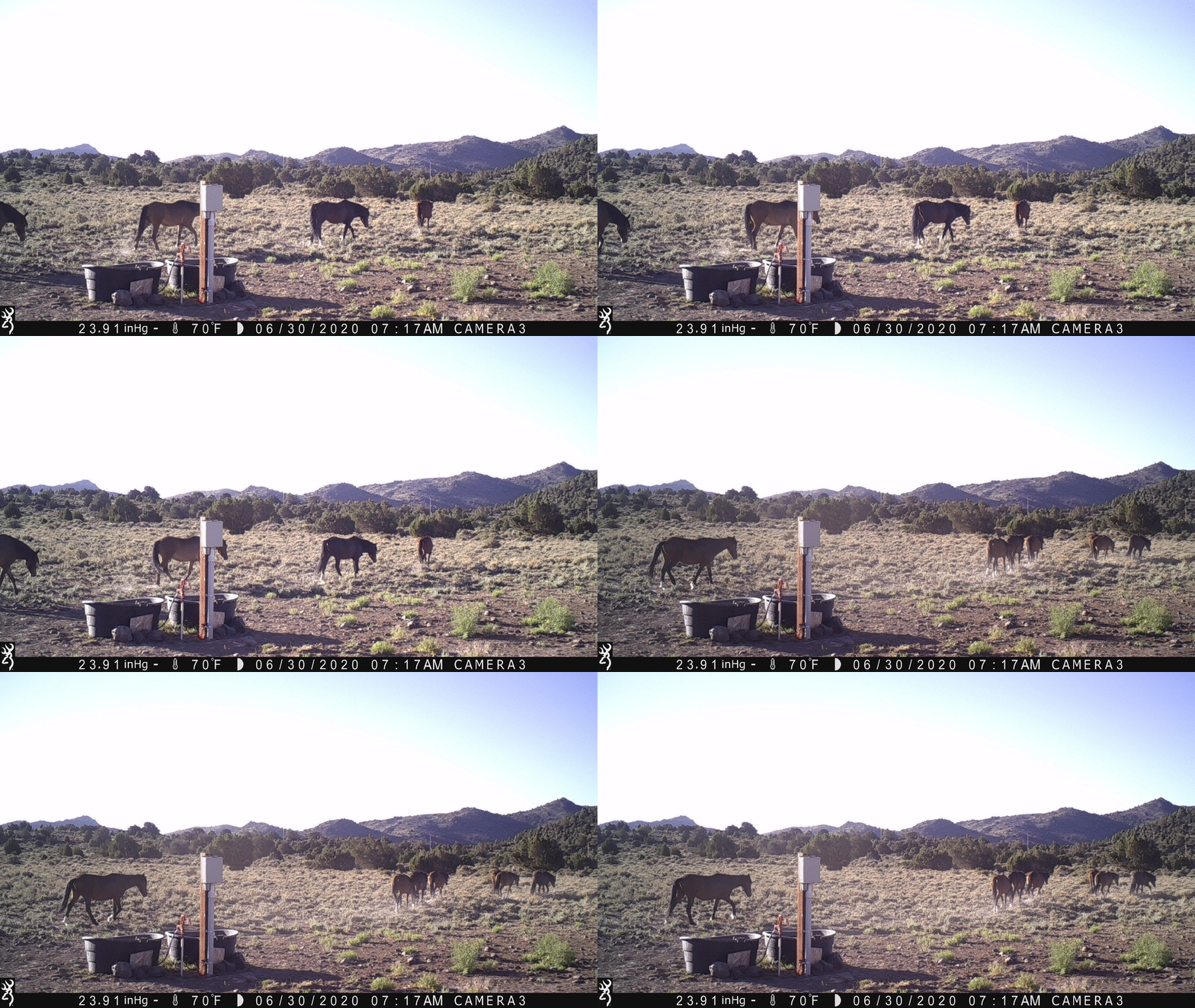
Most horse people know that but for tourists visiting the Currituck wild horses, it can be a bit unnerving. Refer to this report, posted today by The Charlotte Observer.
Category: Range
On the range
AEA Pushes WH Darting Machine
Another press release appeared last week, provided by American Equine Awareness, touting the benefits of the contraption, which can deliver contraceptives to free-roaming horses without human involvement, except to restock the bait and pesticides.
Whose side are they on?
These animals are being forced off their home range because most of their food has been sold to public-lands ranchers, not because they’re overpopulated.
Those who want herd sizes reduced, by roundups, fertility control or any other method, are allies of the ranchers. Don’t give them a penny!
RELATED: Who Invented the Wild Horse Darting Machine?

Assateague Rider in the News
He’s facing a fine of $5,000 and/or six months in prison, according to a story posted today by WMDT News of Salisbury, MD.
RELATED: Man Rides Assateague Pony.
Confusion Wild Horses Get Short End of Stick
The Rule of 5 says the HMA should be able to support 5 × 115 = 575 wild horses, not 115, with 460 horses denied a spot on their home range according to the Rule of 4. Let’s see how those estimates compare to figures determined the hard way.
The management plan allows 115 horses in an area covering 235,005 acres.
The stocking rate allowed by plan is 0.5 wild horses per thousand acres and the forage requirement is 115 × 12 = 1,380 AUMs per year. Recall from the post in April that fractional stocking rates may indicate large amounts of forage diverted to livestock.
The HMA intersects five grazing allotments per Section 3.2.1 of the draft environmental assessment for management actions on the HMA. All of the land is subject to permitted grazing. A map in Appendix D shows the arrangement.
Allotment data can be found in Table 3a of the EA. Although cattle and sheep are permitted, the livestock calculations pertain to cow/calf pairs only, as their resource requirements are said to be equivalent to those of wild horses.
The total estimated forage available to livestock inside the HMA is the sum of the forage amounts contributed by each allotment. For example, 78% of the HMA lies within the Thousand Peaks allotment, which is 183,304 acres (.78 × 235,005). The forage contributed by that allotment would be 6,785 AUMs per year (183,304 ÷ 332,022 × 12,289), assuming the resource is evenly distributed across the parcel.
The sum of these forage contributions is 9,805 AUMs per year. The number of cow/calf pairs that each contribution can support is equal to the forage amount divided by the grazing season. The Thousand Peaks ranchers would have to place 969 cow/calf pairs inside the HMA to graze off 6,785 AUMs in seven months.

The total estimated number of cow/calf pairs inside the HMA is 1,470, with a weighted average grazing season of 6.7 months (9,805 ÷ 1,470).
The estimated stocking rate allowed by plan is therefore 6.3 cow/calf pairs per thousand acres (1,470 ÷ 235,005 × 1,000). The stocking rates on individual allotments range from 5.3 to 12.6 cow/calf pairs per thousand acres.
These management indicators are compared in the following charts.

The forage assigned to livestock would support an additional 817 horses (9,805 ÷ 12), for a new AML of 932 (115 + 817). Both figures are larger than those estimated above by the Rule of 4 and Rule of 5.
The current population is thought to be around 550 wild horses, almost five times higher than AML but well within the capacity of the land to support them (550 < 932).
Roundups are symptoms, not causes. The Confusion wild horses will be forced off their home range not because there are too many of them but because the management plan gives priority to privately owned livestock, contrary to the original statute.
Management actions, such as roundups and fertility control, won’t occur until the EA is finalized, a Finding of No Significant Impact is issued and a Decision Record is signed.
RELATED: Comments Invited on Confusion Wild Horse Gather EA.
Man Rides Assateague Pony
He was eventually located and charged by park rangers, according to a report posted this morning by the Maryland Coast Dispatch of Berlin, MD. The incident occurred on the Maryland side of the island.
Visitors are expected to maintain a 40 foot minimum distance from the animals.
Woman Smacks Assateague Pony, Pony Fires Back
Refer to this story in the Sacramento Bee. Includes video. Probably on the Maryland side of the island.
RELATED: Story of the Assateague Ponies, Keeping a Safe Distance.
Barren Valley Gather EA Comes and Goes, No News Release
The Decision Record, dated June 9, says this about public notification:
The EA was posted to BLM’s ePlanning website and a notice of availability of the EA was mailed to 70 interested individuals, groups, and agencies on April 17, 2020, for a 30-day public comment period. In addition, a notice was posted in the Malheur Enterprise and Argus Observer newspapers.
However, the project was not announced on the BLM news site, unlike this recent EA for management actions on the Confusion HMA.
Looks like Western Horse Watchers isn’t in the club.
The Barren Valley Complex represents three HMAs in southeast Oregon, according to the final EA, which are managed together because wild horses routinely move between them: Coyote Lake-Alvord-Tule Springs, Sheepshead-Heath Creek and Sand Springs.

On Coyote Lake, 390 wild horses are allowed by plan, with a forage demand of 4,680 AUMs per year. Privately owned livestock receive an estimated 13,421 AUMs per year.
The management plan for Sheepshead allows 302 wild horses, with a forage allocation of 3,624 AUMs per year. Livestock receive an estimated 7,276 AUMs per year.
At Sand Springs, the 200 wild horses allowed by plan require 2,400 AUMs per year, while livestock receive an estimated 6,314 AUMs per year.
The wild horse population in June 2019 was thought to be 1,590 adults and 325 foals.
The forage diverted to livestock could support an additional 2,250 horses across the three HMAs. The combined AML could increase from 892 to 3,142. The problem is public-lands ranching, not overpopulation.
Although the project is complete, gather dates have not been announced.
Then again, maybe they have.

Warm Springs Horses Won’t Be Returned to Range
Fifty five wild horses removed from the Warm Springs HMA in October 2018, but slated to be returned, won’t be released, according to a Decision Record dated 12-10-19.
Eleven older horses were returned on 10-30-19.
The roundup yielded 845 horses, 2 mules and 41 burros. Some of the mares were to become test subjects for spay research at the off-range corrals in Hines, OR.
The decision was not announced at the BLM news site.
DNA Testing of Currituck Wild Horses Underway
A story posted this morning by The News & Observer of Raleigh, NC said that mass testing has begun, with the goal of identifying the lineage of every horse on the island.
How are they obtaining genetic material from free-roaming horses? Darts.
The results will be used to manage breeding, according to the report.
With this much human involvement, are the horses really wild?
Don’t forget the fertility control program.
Kiger Scoping Period Comes and Goes, No News Release
The scoping period for management actions on the Kiger and Riddle Mountain HMAs began on January 28 and ended on February 29. The project was not announced on the BLM news site.
The scoping letter gave recipients an opportunity to provide input on a new population management plan for the HMAs.
The next step in the process is to draft an environmental assessment for the plan.
Mustang Monday
On the Stinkingwater and South Steens HMAs with Mustang Meg. (WHW does not agree with the remarks at the end of the video about contraceptives.)
Havasu Roundup Complete, No News Release
Bait trapping ended June 2, with 138 wild burros captured and removed, according to the gather page. No deaths were reported.
The animals were taken to the off-range corrals in Florence, AZ.
RELATED: Havasu Roundup Pending.
No Progress on Jackson Mountains Roundup?
Daily reports have not been posted to the gather page and the cumulative totals are zero.
The incident was set to begin on or about June 15.
RELATED: Jackson Mountains Emergency Roundup Starts Next Week.
Comments Invited on Confusion Wild Horse Gather EA
Yesterday the BLM announced the opening of a 30-day public comment period on a draft environmental assessment for management actions on the Confusion HMA in western Utah. The EA looks at the consequences of a proposed action along with those of one or more alternatives.
The HMA covers 235,005 acres in Juab and Millard counties, according to the EA, but the HMA page linked above says 293,665 acres. The area computed from the data in Table 3a of the EA is 270,574 acres. (WHW has asked the BLM which figure is correct.)

The maximum number of horses allowed by plan is 115, for an aimed-at stocking rate of 0.5 wild horses per thousand acres, based on the area in the EA. Recall the observation from April that stocking rates below one may indicate large amounts of forage diverted to privately owned livestock.
The management plan allocates an estimated 10,259 AUMs per year to livestock inside the HMA (88%), according to data in Table 3a, and 1,380 AUMs per year to wild horses (12%). The AUM distribution will change if the acreage numbers change.
Comments can be submitted online at the project documents page or by US Mail.
Shackleford Ponies Subject of Online Curriculum
WNCT News of Greenville, NC reported today that the Park Service has posted three lesson plans involving wild horses to its Cape Lookout web site. The curriculum, for teachers and homeschool parents, provides environmental education focused on the ponies of Shackleford Banks.
Range Creek Roundup Starts Next Week
BLM said today that that approximately 125 wild horses will be gathered from the Range Creek HMA in Carbon County, UT, starting July 1. The operation will be carried out with helicopters and will be open to public observation.
The HMA covers 55,023 acres and has an AML of 125, for an aimed-at stocking rate of 2.3 wild horses per thousand acres.

The HMA intersects one grazing allotment, with 3,267 AUMs per year authorized across eight pastures. The amount of land falling within the HMA was not given in the EA.
Captured animals will be taken to the off-range corrals in Axtell.
Gather stats and daily reports will be posted to this page.
A roundup occurred on the HMA last September, with 154 wild horses removed.
The current population is thought to be 184, plus this year’s foal crop, according to the news release.
Nye County Commissioners Reject Helicopter Roundups
On June 16, County Commissioners approved a resolution opposing helicopter gathers of wild horses and burros within the borders of Nye County, NV, according to a story posted this morning by the Pahrump Valley Times.
The motion passed with all in favor.
The Stone Cabin, Reveille, Hot Creek, Saulsbury and Bullfrog HMAs can be found in Nye County, along with the Nevada WHR.
RELATED: Public Meeting This Week for Aerial Roundups in Nevada.
PLC Wants to Change Image of Public-Lands Ranching
The executive director of the Public Lands Council said earlier this week that public-lands ranching should be viewed as “a land-management tool to reduce fine fuels that lead to intense wildfires, as well as a tool to cultivate native grasses and reduce invasive species,” according to a report by Capital Press of Salem, OR.
She also claimed that “herd management areas are overstocked” and stakeholders in the west are very interested in additional funding for the WHB program.
Residents to Protest Currituck Wild Horse Tours
No looting and burning expected, just some yard signs over the July 4th weekend, according to a story published this morning by The Virginian-Pilot of Norfolk, VA.
Wild horse tourism is a large part of Corolla’s economy. “People come specifically to see the horses. Visitors stay in rental houses and eat and shop locally.”
The horses roam on marshes and beaches north of town, near the Virginia border.
The barrier that keeps the horses away from town was damaged last September by Hurricane Dorian.
Comments Invited on Moriah Gather EA
BLM announced yesterday the beginning of a 30-day comment period on a draft environmental assessment for the removal of wild horses in and around the Moriah Herd Area in eastern Nevada.
The HA covers 55,300 acres on the Utah border and has no AML. Horses were found there in 1971 but the land is no longer managed for them.

The HA intersects five grazing allotments according to Section 3.2.9.1 of the EA, with cattle and sheep present most of the year.
Note 13 on page seven of the BLM map says “Unsuitable habitat – (unproductive land – inadequate forage),” yet the area can provide an estimated 4,034 AUMs per year to privately owned livestock, based on data in Table 4, enough to support 336 horses.
The current population in and around the HA is thought to be 714, including this year’s foal crop. The animals routinely move outside the HA in search of food and water.
All of the horses have been designated ‘excess’ and therefore subject to removal.
The Moriah HMA lost its HMA status in the 2008 Ely District Record of Decision and Approved Resource Management Plan.
The roundup, when it occurs, will likely capture only 75% to 85% of the horses and follow-up actions may be necessary over the next ten years to achieve management objectives, according to section 2.2 of the EA.
Comments must be submitted by email or sent by US Mail to the Ely District Office.
An online form was not provided with the project documents.