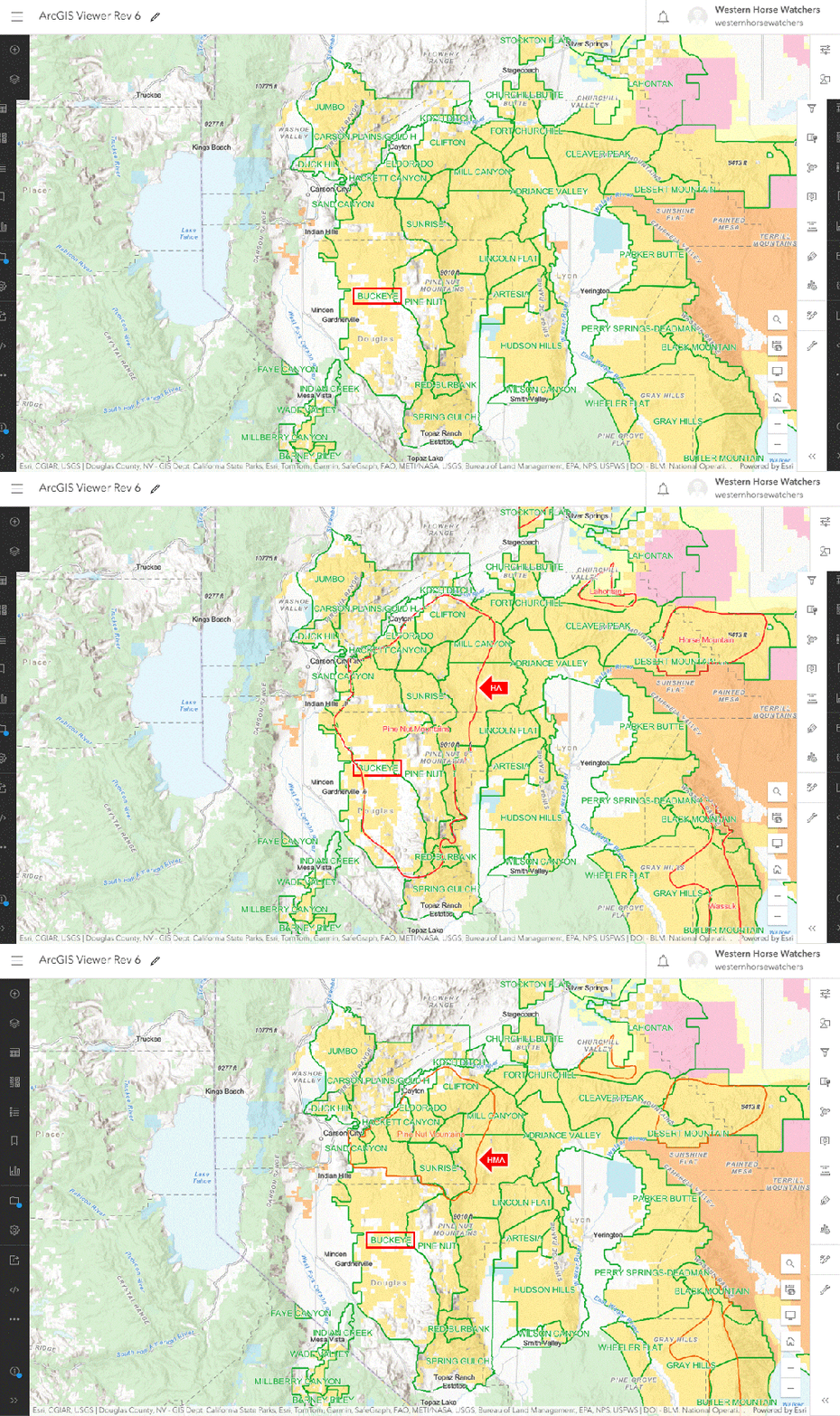
The allotment covers 81,960 public acres but there is only one pasture so it may operate as a general use area shared by two permittees, with cattle and sheep moving across the land as specified in the AMR.
The actual arrangement is unknown.
If free-roaming horses replaced cattle, the other permittee would still be entitled to graze sheep.
The advocates may never make such a request as they have been working for years to cement their relationship with the bureaucrats and ranchers.
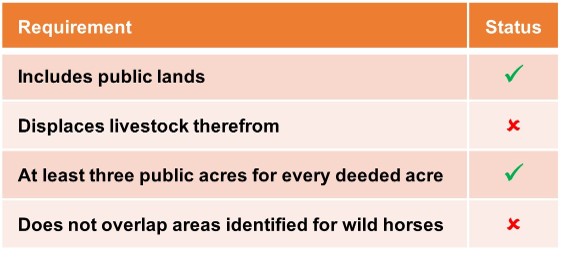
Thus, the land ratio is very good. Up to 81,960 public acres can be accessed through the acquisition of 944 deeded acres.
Unfortunately, the allotment overlaps the Pine Nut Mountains HA, an area that could be returned to the horses not by spending millions of dollars on a base property but by purging the bureaucracy of ranchers and ranching sympathizers and overturning the planning process that zeroed it out.
A refuge should increase territory for wild horses while decreasing lands occupied by livestock.
In summary, the allotment satisfies two of four requirements for a refuge:
If the project moves ahead and the cattlemen are howling, along with their cheerleaders, it might be worthy of your support.
The Authorization Use Report shows their portion is still permitted for cattle with a 5.5 month grazing season.
Western Horse Watchers does not know if the advocates have asked the BLM to change the livestock type to horses and the grazing season to 12 months, turning the area into a refuge for up to 122 equines.
The advocates tell us that wild horses face competition from livestock, unfair resource allocations and shrinking habitats but their solution—mass sterilization—aligns with and can only aggravate the problem.
The ranchers couldn’t have asked for more feckless opponents.
The Decision Record authorizes the Proposed Action, discussed in Section B of the Categorical Exclusion, clearing the way for bait-trap removal of six wild horses that have strayed from the Pokegema HMA onto school property.
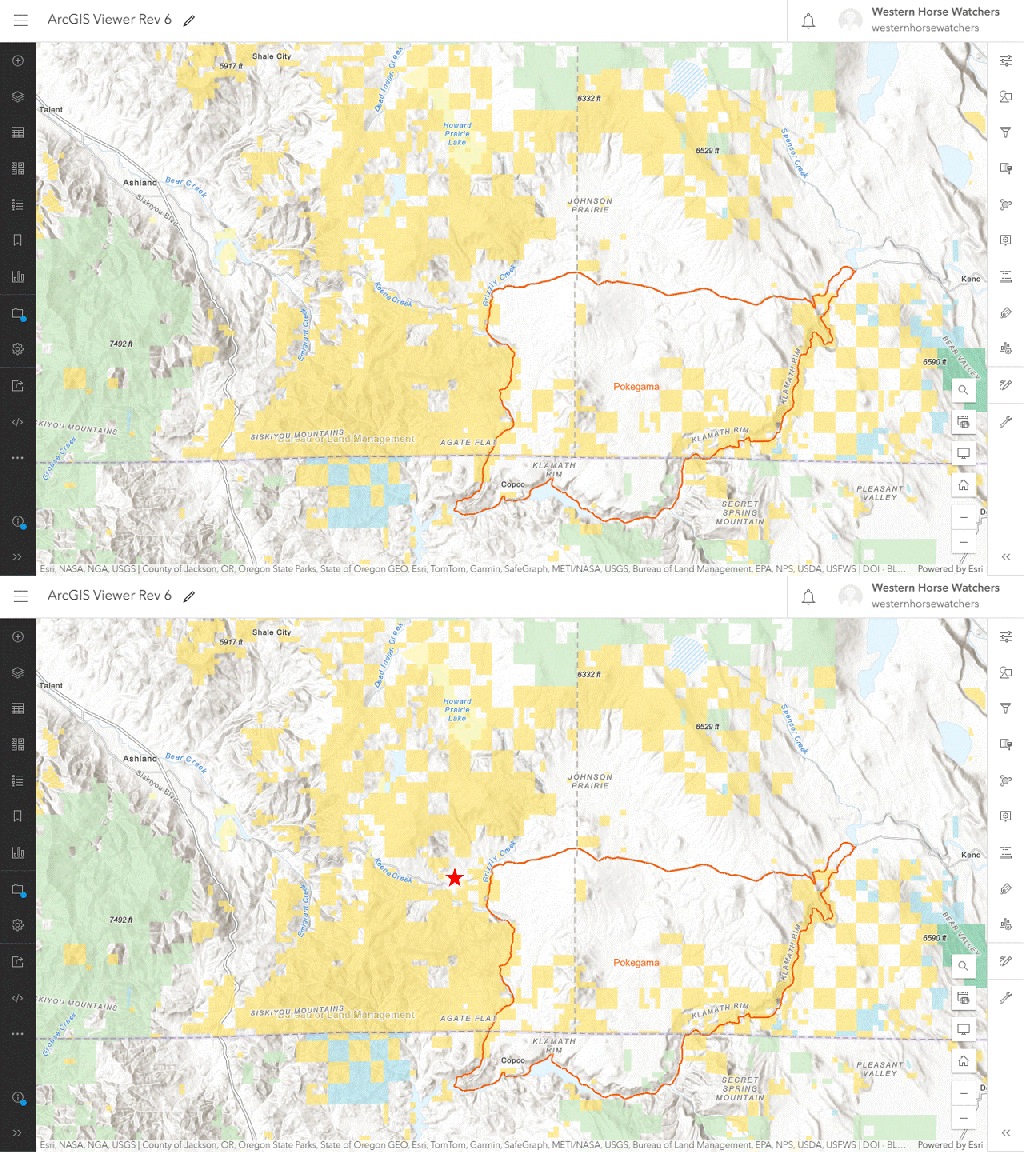
A map of the project area was not provided but the incident would probably take place near Highway 66 on the west side of the HMA based on the school address.
The news release did not indicate if Oregon was a fence-out state and if the barrier around the school meets the requirements of a legal fence.
Funding for the operation would come from ______________________.
Bidders paid $1,051,726 for 14,116 AUMs, or $74.50 per AUM according to today’s news release, suggesting that the American people are not receiving a fair price for grazing on term permits, which is currently set at $1.35 per AUM.
The news release did not indicate if the animals were confined to the area by fencing or if the advocates had offered to sterilize the mares and jennies with PZP.
BLM land adjacent to the facility is subject to permitted grazing.
Funding for the roundup will come from __________________________.
The proposal would withdraw approximately 5,000 public acres from settlement, sale, location and entry under the general land laws, subject to existing rights, and reserve the area for military purposes.
The BLM news release does not include a map or link to a NEPA project but a notice in the Federal Register gives the townships, ranges and sections which can be found in the PLSS layer of the ArcGIS Viewer.
Most of the project area is in the Coyote Lake HMA, or, if you prefer, the Coyote Lake Allotment, with a small portion in 15-Mile Community.
The Air Force would place two transmitters in Christmas Valley according to an article by Oregon Public Broadcasting. The facility on BLM land, about 150 miles to the southeast, would contain two receivers.
The project area covers 16 sections, for a total of 10,240 acres, so the withdrawn lands would be somewhere inside the blue box in the following map.
The House passed a continuing resolution that would fund the government through November 21 but it failed in the Senate.
Republicans need at least eight Democrat votes in that chamber to get it across the finish line according to a report by The Hill.
Any amendments would send it back to the House, which is not in session.
Another option is a partial government shutdown.
As of today, a FY26 schedule has not been posted to the BLM gather page.
The advocates will not receive any new funding for their PZP sterilization programs until FY26 appropriations bills have been signed into law and maybe then, given the desire to cut federal spending, not at all.
The agency published a signed decision on August 7 for temporary water hauls in the Stone Cabin and Willow Creek allotments, which contain the HMA.
A DNA worksheet was also copied to the project folder.
The decision document says on page three that water is the most effective tool for distributing cattle on arid lands and that the animals are unlikely to venture more than two miles from a water source, linking permitted grazing to riparian deterioration.
In response to a comment from the Nevada Department of Animal Agriculture, the BLM indicated that it may consider removal of wild horses if conditions persist. Refer to item 1 in Exhibit 3.
At the southwest corner of the Virginia Range with Jeff Martinez. Check out the darting injury at 2:09. The advocates are trying to convince the bureaucrats and ranchers that they can be as ruthless as the helicopter pilots and wranglers.
Stakeholders said it created regulatory uncertainty, reduced access to public lands and undermined the multiple-use mandate established by Congress according to the news release.
A 60-day comment period began with publication of a notice in the Federal Register.
Wild horses fall under “historical values” in the definition of multiple use in FLPMA.
When will the advocates explain how mass sterilization, the inevitable result of humane population reduction, stops competition from livestock, fixes unfair resource allocations and restores lost habitat?






 Western Horse Watchers Association