Introducing the Peterson Farm Brothers Youtube Channel. Here you have a real-life boots-on-the-ground farming and ranching operation in flyover country. Family owned.
You can be successful without the help of government.

Western Horse Watchers Association
Exposing the Hypocrisy, Lies and Incompetence of the Wild Horse Advocates
Around the ranch
Introducing the Peterson Farm Brothers Youtube Channel. Here you have a real-life boots-on-the-ground farming and ranching operation in flyover country. Family owned.
You can be successful without the help of government.
More than two dozen horses found dead on a two acre ranch in Wicomico County, according to a report published 03/17/18 in Delmarva Now.
A woman interviewed for the story said “…it is not unusual for a horse owner, especially so many of them, to have horses die….” Maybe that’s consistent with her show-horse experience.
But it’s not inevitable.
Which of these things might be a factor in the case?
Looks like the horses only had access to part of the property, so if you chose the last three you’re probably not too far off the mark.
Refer to this article in Equus magazine by Dr. Jennifer Williams, president of Bluebonnet Equine Humane Society.
Key points:
Item 5, Nursing, probably should include a remark about colostrum, the first milk a mom makes for her foal. Essential for the baby, as it contains antibodies needed to fight infection. If the foal does not get up and nurse within the first hour or two, you may have to get involved.
Conventional wisdom says wean the baby at four months. A better time frame is seven to eight months, as the foal’s digestive system is not sufficiently developed to sustain him on solid food alone until then.
Here’s a list of things to do after the foal is born.
Avoid the temptation. Let the mom care for the baby and teach it how to be a horse.
An exception would be the rescue of foals born in feedlots while their moms await shipment to slaughter.
Your new mustang probably doesn’t know what a carrot is. Nor an apple. Never heard of crimped oats, rice bran or any of the other grains.
So first time you give him these treats he might just walk away. May even pee on them.
If that happens try again in a few days. Eventually he’ll decide he likes them, even waits at the gate while you’re mixing them up in the barn. (Especially if you have a consistent pattern in your chores around the ranch: It’s dusk, my corral has been cleaned, my water buckets are full, I know what that human is doing in there.)
Also remember that he doesn’t know what worm paste is, never had a syringe shoved in his mouth…at least by you. So use this opportunity to teach him to take the medicine in his grain. Smear some paste on a few pieces of carrot, same for the apples. If you feed cookies, put a dab on them too. One third of a tube per horse (this is usually less than the recommended dosage). Repeat tomorrow.
Look at his poop next few days to gauge effectiveness. Follow the manufacturer’s recommendations for intervals between treatments.

To calm the horse.
Signs that you have a lousy relationship with your horse:
You’ve thrown in with the wrong crowd. Shake the dust from your boots and move on.
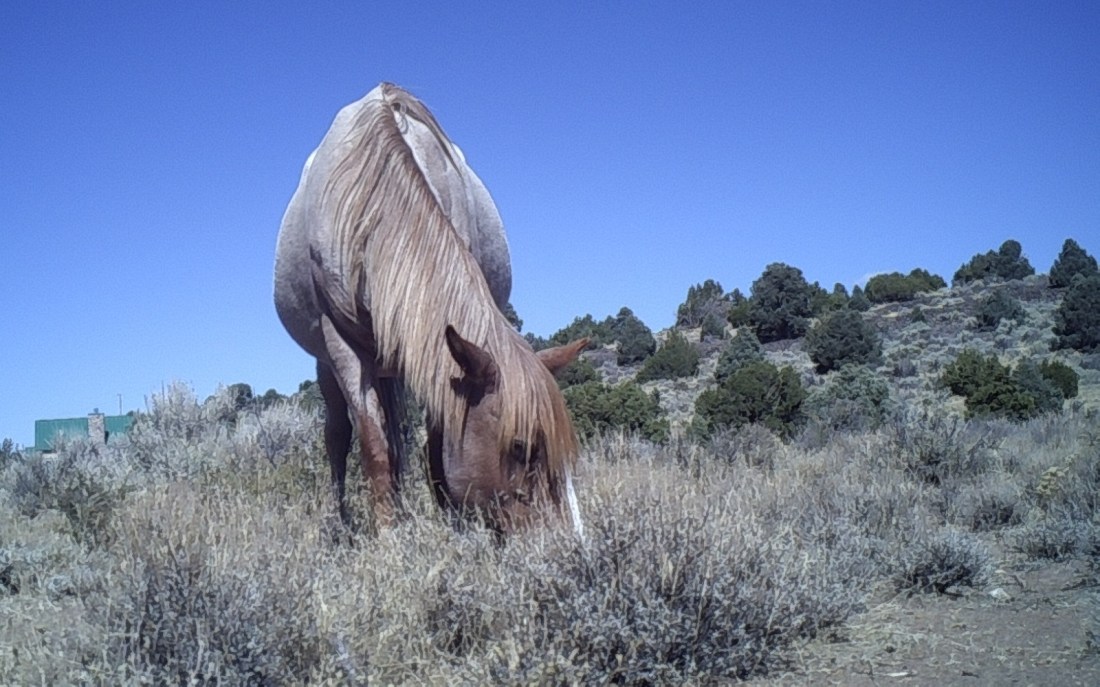
Two base colors…red and black. Red is recessive, black is dominant. You should see roughly three black-based horses for every red-based horse.
Common modifiers:
Red-based combinations:
Black-based combinations:
More at Mustangs 4 Us.
Color of a BLM horse can be found in his signalment key.

Another example of repairs to underground PVC pipe. The leak was at a 2″ 45 degree elbow above the one you see in the photo. Only the soil held the pieces together.
As shown in the photo, you can join any two pieces of pipe with three elbows.

They may not hold water but they’ll carry hay.
Your horses are not in stalls, right?
How to connect a rope to a halter.
For leading and riding.
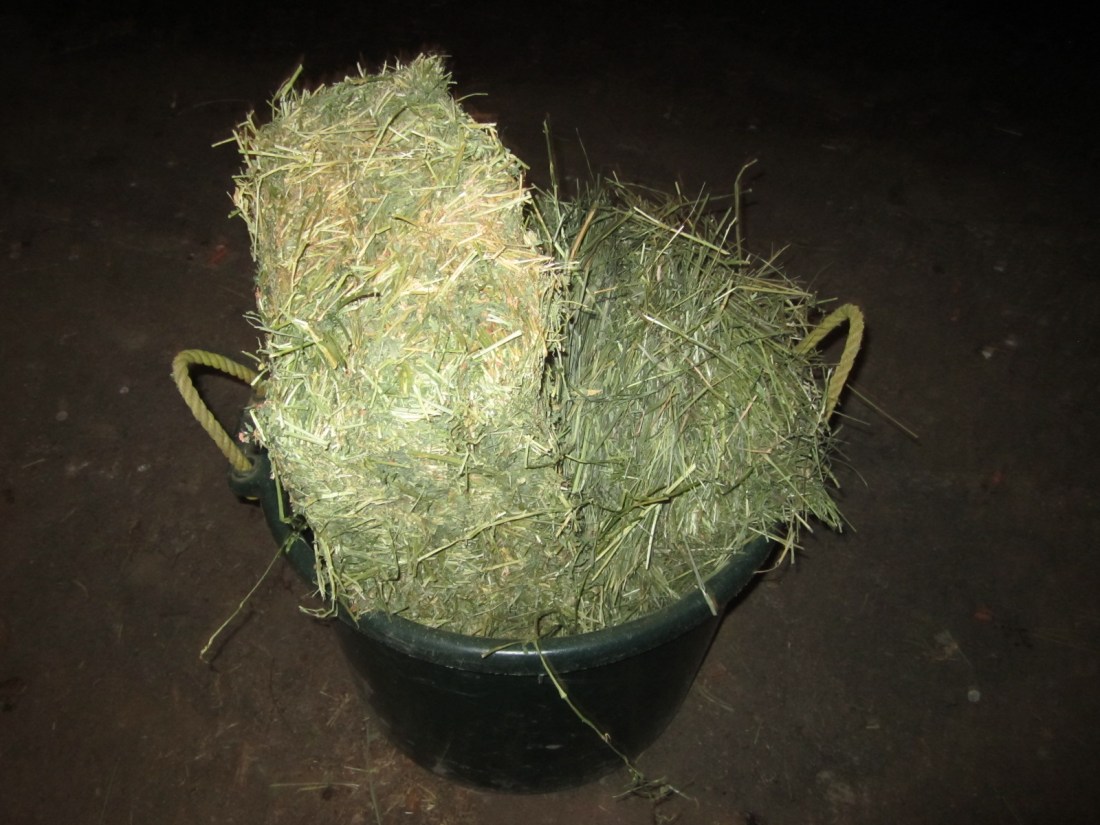
You can fit 20 bales of hay into your truck if it has an eight foot bed. Start with four bales in V-formation.

Next, lay six bales in the valley, all with the same orientation.
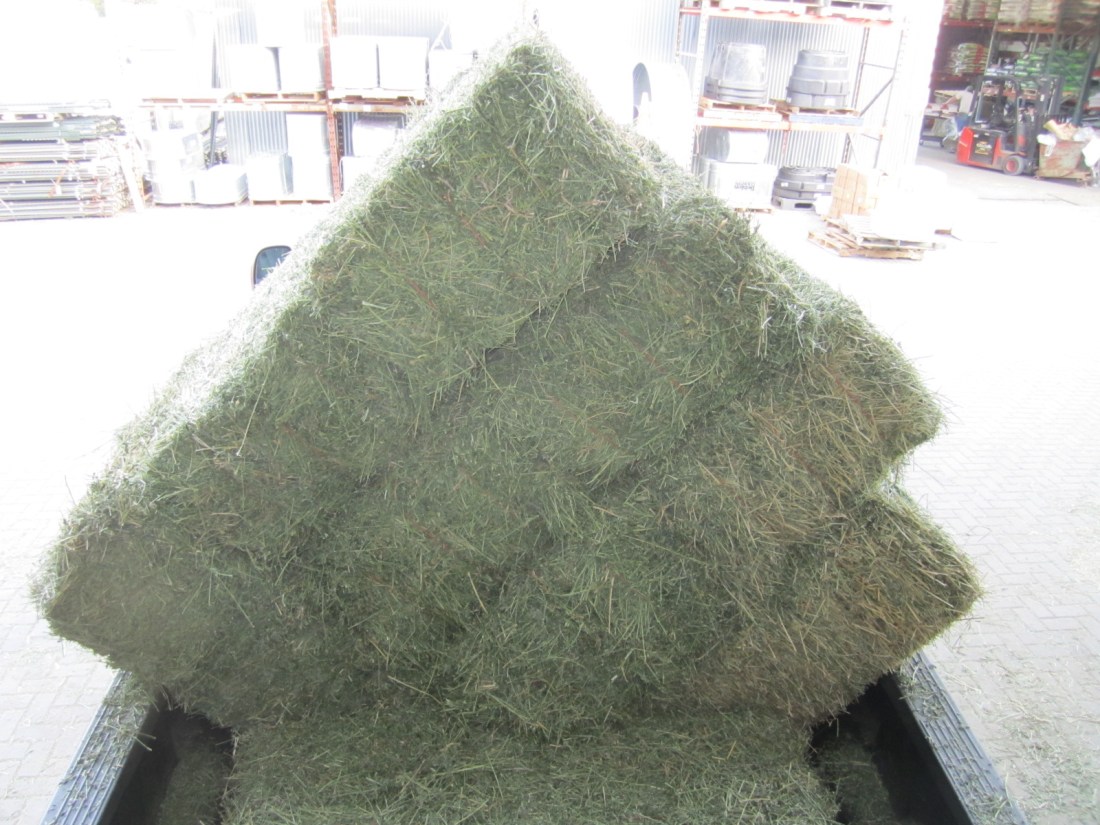
Repeat the process in the rear half of the bed.
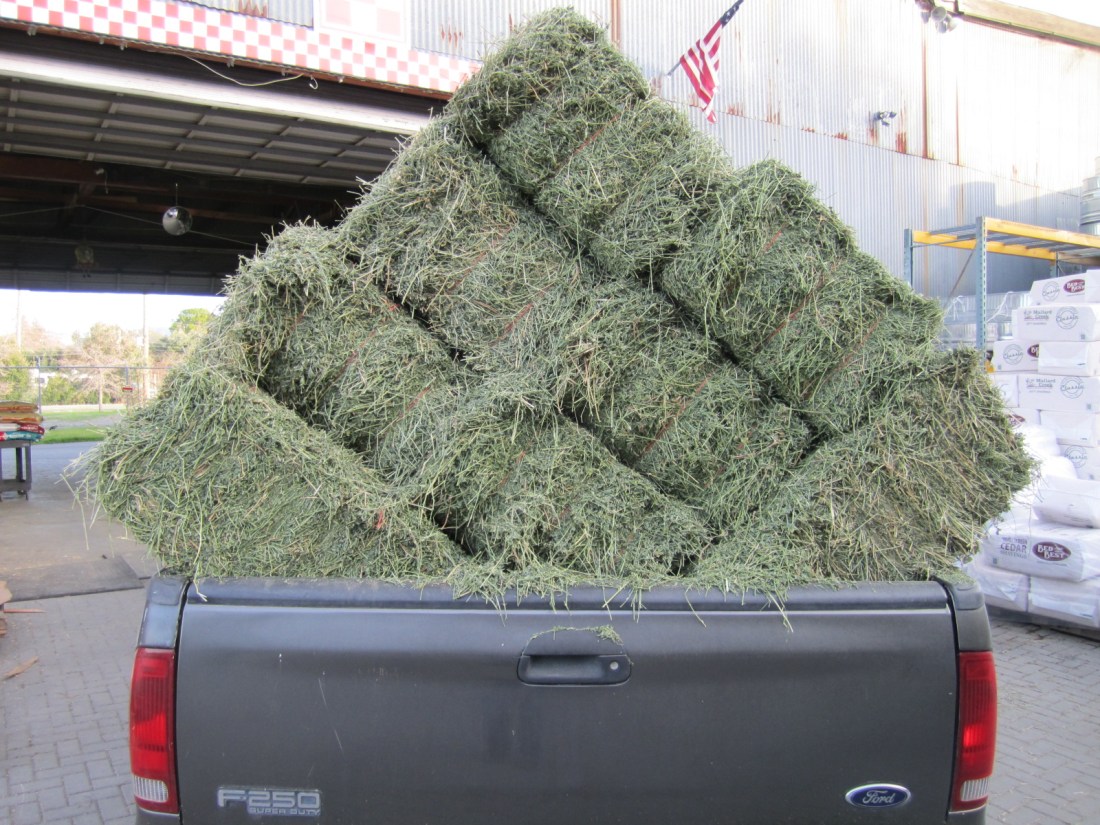
The finished stack will resemble a cube.

It doesn’t obstruct your side-view mirrors and if you’re not going too far, ropes and straps won’t be needed. The feed store offers a price break at 20 bales so this is really great!
If your ranch has trees, you’ll probably want to keep a chainsaw around, along with fuel, cutting oil and a spare chain. Some day a tree will come down, due to age, weather or disease, and it won’t be the one at the far end of the pasture where nobody goes.
That’s your driveway and gate under there.

A case like this should be handled by professionals. It’s too much work and for an individual and too dangerous. You’d need a boom truck, bucket truck, chipper and variety of saws.
Don’t worry though, there will be cases where you can do the work:
Incidents like the one above can cost over $5000 in cleanup and repairs, and you can’t put them off due to their location. Another reason why you want to have some cash in a savings account.
If you have the right equipment however, expenses like that can be minimized.


Originally installed as a tie point for grooming and hoof cleaning, this post is now used for scratching and rubbing. It’s a 4 x 6 treated timber 8 foot long, cemented about 30 inches into the ground.
The metal loop at the top is known as a ‘shoulder nut ring bolt.’ The eye (above the ring) has been polished by these guys.

Tie points should be high enough and lead ropes short enough so the horse can’t step on the rope or get his leg over it. If you’ll be around while he’s tied, then maybe you can give him a little more slack. See if you can get him to stand quietly without tieing while you clean his feet.
If circumstances are such that you want to be able to untie him quickly, try the bank robber’s knot:
If water gets to your horses by way of PVC pipe, you’ll want to keep some tools and parts on hand for leak repairs, such as
Get parts for the various line sizes at your ranch (3/4″, 1″, etc). Keep these items in a dry place and away from sunlight.

Before you glue anything, make sure the parts are clean and dry. Remove rough edges from where the pipe was cut.
If the leak is underground in a straight run of pipe, you won’t be able to replace the faulty section directly. Instead, reroute the line with some elbows, to create a flexible loop that reconnects to the old pipe at the points where you first cut into it.

You can also install a tee and riser to provide a branch connection for future use.
If your system uses copper tubing, you’ll want to keep the same assortment of fittings and valves, along with a cutter, propane torch, solder, and flux. Copper tends to be more durable than PVC so you probably won’t be making many repairs. But pipe fitting and soldering take a little more skill compared to PVC.
Don’t forget to order a spare bulb for your UV unit. It should be replaced annually.
If you have galvanized pipe panels with butterfly clamps, make sure the bolt head faces the area where your horses are. If that’s not feasible, cut off the threaded end and grind smooth so your horses won’t get hurt.

You can get them at Barn Light Electric Company.
Prices have come down and lead times have shortened.
Use them to accent your barn, illuminate a hose station, or light the way to your tack room.
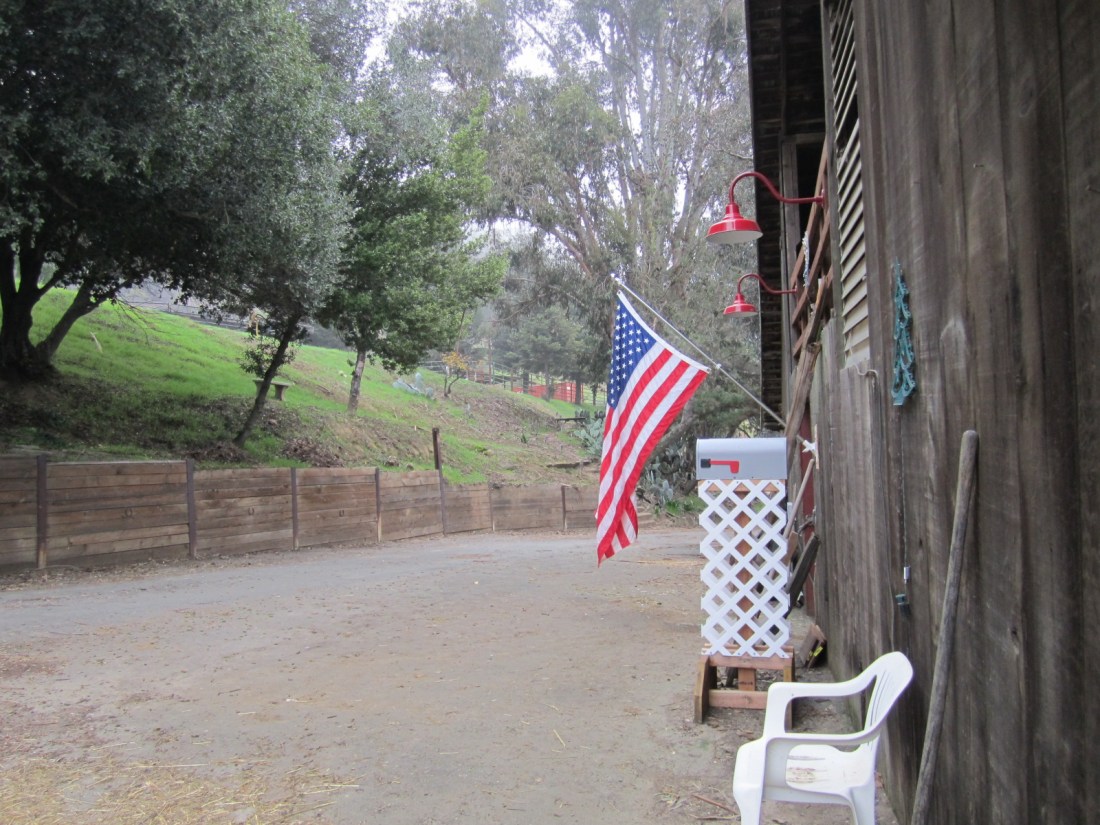

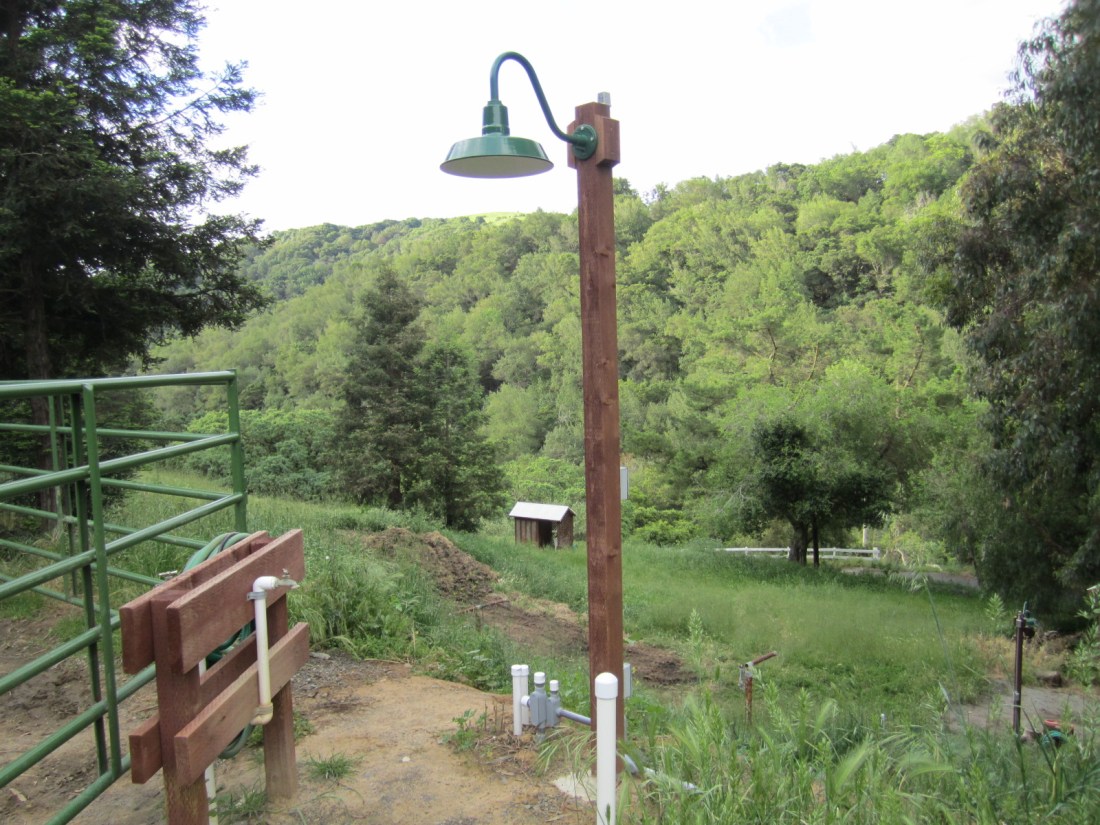
Don’t.
It’s a great way to corrupt your relationship, leads to bribery.
Do you have to bring cookies to catch him in pasture? To put on a halter? Might as well place a sticker on your forehead that says KICK ME I’M LOWER.
Watch the video on the Oatman burros, especially the action from 2:22 to 2:38 where the burro is a bit too aggressive. Do you identify with that woman? Who’s moving whose feet?
You want your horse to see you as his leader not a walking talking vending machine.
You want him to come to you respectfully and pay attention, not frisk you with his nose.
Don’t set an expectation of food when it’s time to work.
If you want to give him carrots, cookies and apples, put them in his grain bucket.

Your water system should have a back-up power source, such as a generator. If the pump in your well can’t run, you only have what’s in your pressure tank(s). And the power will probably go out when you’re just a few psi above the low setpoint of the pressure switch.
Ideally, the generator would be large enough to serve everything at your ranch, which means 15 to 20 kW in size. A smaller unit, say 10 kW, might require some load shedding before startup.
You’ll have to install a transfer switch to prevent back-feeding the power company. It can be manual or automatic.
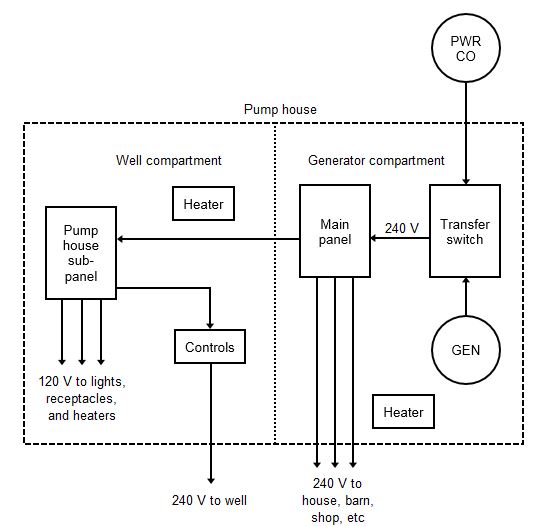
If your generator can carry the full load of your ranch, the transfer switch can be automatic, along with startup of the generator.
A manual switch lets you reduce load before starting the generator. The sequence might look something like this (power already out):
At this point lights should come back on, the refrigerator should run, and your pressure tanks should refill when the low setpoint is reached.
When power is restored (numbers appear on face of electric meter), the sequence might be:
Load has now been transferred back to the power company. If your generator has a fuel tank, top it off so you’ll be ready for the next outage. Keep several five-gallon containers of fuel on hand and store in a safe location.
One way to keep electric demand low (and get by with a smaller generator) is to have ‘fired’ appliances, such as your water heater, furnace, cooktop and clothes dryer. Fuel can be natural gas (if available at your location) or propane. A stove that burns wood or pellets is another option.
A ‘poor man’s version’ would be to install the transfer switch at the panel that feeds the pump and connect a portable generator there. Allow 2 kW for a 1 HP pump, 4 kW for 2 HP pump, etc. It won’t power anything else but at least your horses will have water. The UV unit in your treatment system will be inactive, and the softener will not regenerate if it has electric controls.
Always make sure the exhaust from the generator is routed to a safe location. Never run it inside an occupied space such as a house or barn.
You can buy a trickle charger for the battery in your generator to make sure it’s ready to go when you need it.
Two basic types:
Here’s an example of each, side by side. Bow on the left, swing on the right.

A six foot bow gate with one-hand latch gives you easy access when you’re entering the corral with halters or fly masks in the other hand. Also gives you quick access to the poop pile when dumping the wheel barrow. Place the gate so the latch is on the outside of the corral.
The latch has a slider and keeper. To open the gate, flip the keeper up (on the right in the following photo) and pull the slider to the open position. The gate will swing freely in either direction.

If you are new to horses or are in the process of gentling some mustangs, always open the gate inward. Pull the slider open, push the gate in a few inches, then move the slider back to the closed position. If a horse approaches the gate as you enter and pushes, it will swing back and hit the bow, stopping it from flying open, knocking you to the ground, and setting your horses free. (This is one way your horse tells you he thinks you’re lower, that he doesn’t have to listen to you. It’s not a problem of smacking him and showing him who’s boss, it’s a problem of relationship. Yes, you may have to turn up the pressure for a while until he comes to you respectfully, the same way he would to a higher horse in his band.)
Unlike bow gates, swing gates are usually not furnished in a frame. You’ll have to cement 6 x 6 posts to hang them. Once they’re in place, you can bring in fill material with your tractor to create a dry space in the corral. Twelve feet wide should work. Orient the hinge post so the dead weight of the gate will not bend it (lines of grain parallel to gate in closed position).

You’ll also have to supply a latch for the gate. It can be mounted on the 6 x 6 post opposite the hinges. In the following example, you can reach through the gate to lift the inside keeper and push the gate open. If a horse pushes back or the wind blows it toward you, the outside keeper will stop it from flying open. It’s a great safety feature.

The latch will also allow the gate to open outward (not recommended unless you have halters on your horses and are taking them out to pasture or going on a ride). Some gates are furnished with chains for added security.
Avoid gates with chains only, no latches. They require two hands to secure properly.
Here’s another view of the two gates. Note the absence of 90 degree interior corners.

If you will be leaving your ranch for a few hours or retiring for the evening, check your gates to make sure they’re properly latched. And don’t think your horse won’t notice if they aren’t. If he doesn’t hear the ‘clink’ of the keeper dropping into position when the gate closes, he’ll probably walk over to investigate. If it’s the outside keeper, pasture is just one push away!
Opening and closing gates is not complicated. But on a ranch you’re doing that many times a day so it’s easy to mess up, especially when you’ve got a hundred other things on your mind.
 Western Horse Watchers Association